Category: Trading Psychology

  • How to Stop Revenge Trading Before It Blows Your Gold Account

    How to Stop Revenge Trading Before It Blows Your Gold Account

    It’s 2 a.m. The house is asleep. The only light in the room is the blue glow off the screen, and there’s a red number sitting in your trade that has no business being there. Your finger is already on the button. One more. Bigger this time. Win it all back, and go to bed like nothing happened.

    I know that finger. I know that click. I blew accounts doing exactly this — not because I couldn’t read a chart, but because after every loss I’d size up to get it back, right now, tonight. And it worked. Until the account was gone.

    So before you press it, hear me out. Losing a trade is weather. It rains. No setup is right every time, and one red trade doesn’t mean you’re broken or stupid or finished. You’re not. What’s happening is quieter than that, and worse. You’re stuck in a loop: loss feeds fear, fear feeds the revenge click, the click punches a hole in the account, and the smaller account makes the next loss hurt more. Round and round. Faster each time.

    Here’s the part that should give you a little hope. The market handed you one of those four. You built the other three. Which means you can un-build them — not with a better signal, but with a way out. This is how to stop revenge trading before it drains what you’ve got left.

    Why You Keep Blowing Your Gold Account: The Loss to Fear to Revenge to Blow-up Loop

    Let me show you the loop. Once you see it you can’t unsee it.

    Loss. Fear. Revenge. Blow-up. Then loss again, and around it goes.

    Look close at those four links. Only one of them — the loss — actually comes from the market. Gold moved against you. You were wrong. That’s it. That’s weather. It was always going to rain sometimes.

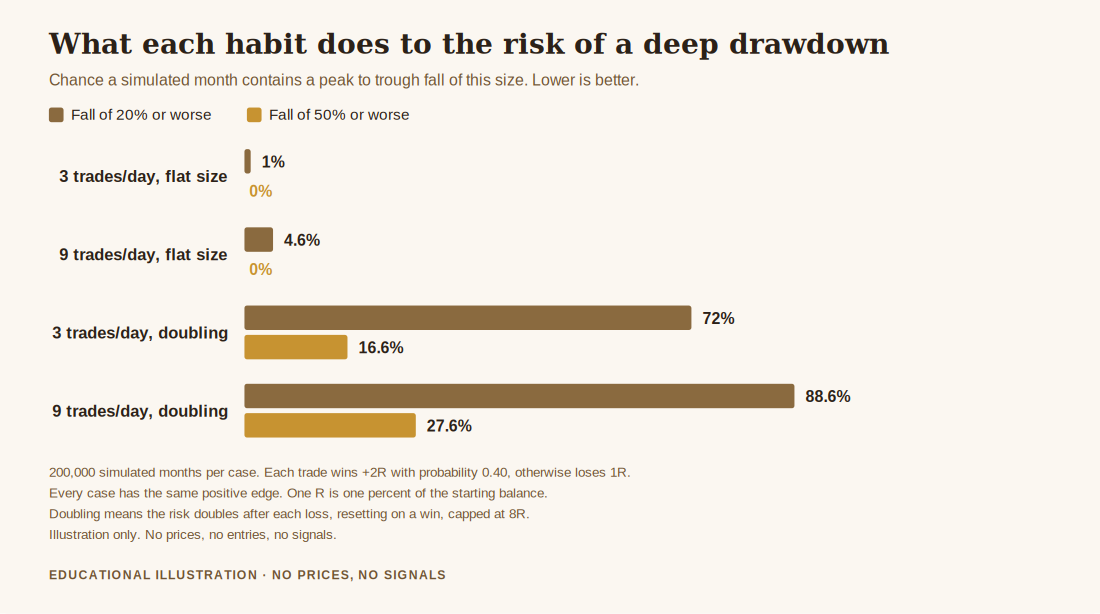
    The other three, I built those. You build those. The fear that grabs your chest and puts a shake in your finger. The revenge that leans in and whispers size up, one clean trade fixes everything, get it back before anyone knows. The blow-up that follows the click the way night follows dusk. None of that is the chart. All of it is us. That’s the hard news and the good news in one breath: three of the four links are yours, so three of the four are yours to cut.

    And here’s what nobody warns you about at 2 a.m. The loop runs faster every lap. Each blow-up leaves you a little less room. Less room, and the fear bites harder. Harder fear makes the revenge more reckless — less to lose, more to prove. Tighter and quicker, tighter and quicker.

    So the account doesn’t die in one loud bang. I used to think it would. It doesn’t. It bleeds. You size up to win it back. You lose. You size up to win back the win-back. Down and down, drip by drip, until the tank reads zero and you’re sitting there wondering where it all went. Quiet. Slow. Almost polite about it.

    I know that loop from the inside. I lived in it a while. More than once, if I’m honest. And here’s what took me too long to get: this was never a signal problem. You don’t need a better read on gold. You have a survival problem. That one, you can fix.

    The Good News Hiding in the Loop

    The loop looks like it owns you. It doesn’t.

    Look at the four links again. Loss. Fear. Revenge. Blow-up. Only one comes from the market — the loss. That’s weather. It shows up whether you deserve it or not, and beating yourself up over it is like yelling at the rain.

    The other three are yours. Fear. Revenge. The blow-up. You built them with your own hands, every single time. So you can take them apart. Read that again, because it took me a lot of dead accounts to feel it and not just nod at it: three of the four links are inside your reach. You don’t need to read a chart better. You don’t need a sharper signal. You need to stop feeding the thing.

    That was my turn. For years I tried to be right. Size up, win it back, prove the chart wrong. I bled out doing it. Then one day I quit chasing right and started guarding what I had left. The day I stopped trying to win the argument was the day the bleeding stopped.

    Nothing about my analysis changed. My survival did. Survive first. Then grow. There’s no other order that works.

    How to Stop Revenge Trading: 5 Rules You Can Set Tonight

    You won’t stop revenge trading at 2 a.m. by wanting it less. I tried that for years. Red on the screen, one loss chewing at me, the room dark and everyone asleep — I’d swear I’d be smarter this time, then click anyway. The wanting never held. Wanting has no hands. The version of me who promised to behave was never the one holding the mouse.

    What holds is a decision you make tonight. Calm. Sober. Before a single dollar is on the line. So let’s make it now, while your hands are steady and nothing hurts yet. Five rules. Each one cuts a single link in the chain that drains an account.

    Rule 1 — Decide your worst-case loss before you enter. Set the most you’re willing to lose while you’re still calm, not while you’re starving to be right. Fear can’t do math. As an educational example: some traders cap it at 1% of the account per trade. On a $1,000 account, that’s $10. I know how small that sounds. That smallness is the whole point — it’s what carries you through the losing streaks that used to finish me. This starves the fear before it’s even born.

    Rule 2 — Stop by the plan, not by hope. Place your stop before you enter, at the price that proves the idea wrong — not at the price that finally hurts too much to hold. Hope is not a stop level. A stop is the seatbelt you buckle before you pull out of the driveway, not the one you reach for mid-crash.

    Rule 3 — Size backward from what you can survive. Your lot size is an output, not a feeling. Take the fixed risk from Rule 1, divide it by the distance to your stop times the value per point. Wider stop means smaller size. Never bigger risk. You don’t stretch the risk to keep the size you wanted — you shrink the size. The math protects you on the nights you won’t protect yourself.

    Rule 4 — One loss never buys a bigger trade. This is the kill-switch. It cuts revenge off at the wrist. Take the small loss. Close the laptop if you have to. Nobody’s making you win it back tonight. Nobody’s making you trade at all.

    Rule 5 — After a bad day, rest. Don’t chase. Two losses. Three in a row. At that point the problem isn’t the chart. It’s the person reading the chart. Standing aside is a trade too, and some days it’s the best one you’ll make.

    Read them and they’re easy. Setting them tonight, while it’s quiet — that’s the whole trick. Because at 2 a.m. it won’t be easy, and by then it’s too late to decide. Cut one link, and the loop can’t sprint away from you.

    Educational examples only. The 1% / $1,000 / $10 figures illustrate the method — they are not promises. Forex and gold carry high risk, and this is not financial advice. Only ever risk money you can afford to lose.

    The 20-Second Check Before Every Click

    Rules are only worth the moment you actually use them. So before I let myself click, I run five questions. Out loud, sometimes. 2 a.m., alone, screen glowing blue. One “no” and there’s no trade. Not a smaller trade. No trade.

    1. Do I know the exact amount I’m risking right now, and does it match the max loss I set before I opened the chart? If I’m guessing, I’m already lying to myself.
    2. Is my stop where my plan says it goes — placed before I click, at the price that proves me wrong, not the price that just hurts too much to hold?
    3. Did I size this backward from that stop, or did I pick a number because it felt right? Feelings pick the number that kills you.
    4. Is this a trade I actually want, or am I only here to win back the one I just lost? This is the one that burned me. Every account I bled out died on a “yes” I forced through this question. Revenge always shows up wearing a good setup — this is where you catch it at the door. If the honest answer is revenge, close the laptop.
    5. Am I calm enough that I’d take this exact trade tomorrow morning, coffee in hand, nothing to prove?

    Five yeses, maybe you’ve got a trade. Four yeses and a no, you’ve got a mistake waiting to happen. The check takes twenty seconds. The loss it stops can take months to earn back.

    I wish I could tell you the list is enough. It isn’t. Rules on paper don’t hold your hand when it hurts. A person does.

    Survive First, Then Grow

    Here’s the whole thing in one breath. The market only ever hands you one thing: a loss. That’s the weather. It was always going to rain sometimes, and no chart reads the sky right every time.

    The rest, you built. The fear that grips your wrist after. The revenge that whispers “size up and get it back now.” The zero at the bottom of the account. I built that last one myself — brick by brick, click by click, alone at 2 a.m. with the screen glowing blue.

    And that’s the good news, even when it doesn’t feel like it. Three of the four links in that chain are yours. What you built, you can take apart. You can’t fire the storm. You can fasten your own seatbelt.

    I know because I lived inside that loop for years. The day I stopped bleeding wasn’t the day I finally read the chart right. It was the night I sat there, finger over the button, and for once didn’t press it. I took the small loss. I closed the laptop. Nothing exploded. I was still there in the morning. Same charts. Same losses. Different man on the keys. The account stopped draining the moment I stopped feeding it.

    You don’t need a new indicator to make that turn. You need a decision — the boring, quiet kind you make while you’re still calm. Survive first. Grow later. Grow is a problem you only get to have if you’re still here to have it. You can make that turn tonight.

    Forex and gold carry high risk. This is not financial advice. Only risk money you can afford to lose.

    Get the Survival Sheet + Follow the Real Trades

    I made one thing for the version of you sitting there at 2 a.m., finger hovering, screen bleeding red. It’s called The Gold Trader’s Survival Sheet. One page. The 5 rules, the sizing formula, and the 20-second check. Nothing more.

    It’s free. Print it and tape it next to your screen, in the exact spot your eyes land before you click. Not for tidy afternoons. For 2 a.m. Alone. Red on the screen, finger on the button. That’s when a piece of paper earns its keep — the answer’s already there, it won’t need Wi-Fi, and it won’t need me. It’ll just be there.

    Grab it here.

    And if you want company on the harder nights, follow the Gold Empire channel on Telegram. I post real XAU/USD trades — the ones that work, and the ones that don’t. You’ll watch me take a loss and take it small, in public, because that’s the whole point. No cleaned-up highlight reel. No countdown clock. No “spots left.” Nothing runs out.

    I’m not selling you a shortcut. I’m just leaving the light on. Rules on paper don’t hold your hand when it hurts. People do. So come sit with people who’ve stood where you’re standing — the ones trying to survive first and grow later, and still here to talk about it.

    FAQ: Revenge Trading and Staying in the Game

    What is revenge trading?
    It’s trading to get even. Not with the market — with yourself. You take a loss, it stings, and the next trade isn’t a setup. It’s a grudge. Bigger size, no plan, just that hot need to get it back right now. I know it because I’ve done it. The tell is simple: if you couldn’t calmly take this same trade tomorrow morning, it’s not a trade. It’s the wound.

    Why do I keep blowing my account?
    Probably not your signals. Mine were fine while I was torching accounts one after another. No read is right every time — losing trades are weather. Accounts don’t die from one bad call. They bleed. You size up to recover, lose, size up to recover the recovery. Bigger. Faster. Angrier. Until there’s nothing left. Cut the size-up habit and the bleeding stops. It’s a survival problem, not a signal problem.

    How much should I risk per trade?
    That’s your call, not mine — nothing here is financial advice. One thing I do: decide the max loss before I click, while I’m still calm. As an example only, some traders cap it near 1% per trade. On $1,000 that’s $10. Sounds too small to matter. That tiny number is exactly what keeps you alive through a losing streak. Pick a fixed percent while you’re calm, then size back from your stop.

    Is it okay to sit out a trade?
    Yes. Sitting out is a trade. Often the best one that day. Two or three losses in a row, and the problem isn’t the chart — it’s the person reading it. You don’t have to win it back today. Close the laptop. The market opens tomorrow.

    Forex and gold carry high risk. This isn’t financial advice. Only ever risk money you can afford to lose.


    About the author. Matthew (@Matthew_TraderGold) runs the Gold Empire channel on Telegram, where he posts real XAU/USD trades in public — the wins and the losses alike. He’s traded gold for years, and blew accounts of his own early on, sizing up to win losses back until there was nothing left. His authority comes from the scars and the transparency, not from a certificate or a screenshot of profits. He writes about one thing: surviving first, so you’re still here to grow.

  • Why You Keep Blowing Your Trading Account (and the Quiet Loop That Causes It)

    The coffee went cold an hour ago. The account’s open, the balance smaller than last week again, and here’s the part that eats at you: you can’t point to the trade that did it. No blow-up, no margin call at 3 a.m., no single stupid click to blame. Just… less. If you’ve caught yourself asking why do I keep blowing my trading account when you don’t take dumb trades and you read a chart fine, you already know the exact confusion I mean. It’s quieter than panic — it’s watching your own money leak out and not being able to name the hole.

    I lived there longer than I want to admit. My entries were clean, my setups the same ones that had worked before, and still the number shrank week over week — like a tire with a nail in it you can’t find. So let me say the thing nobody said to me for two years: it’s almost never your signals.

    I bled out with signals that were better than fine. When the account bleeds, the instinct is to assume there’s a gap in your analysis, so I studied more, stacked confluence on confluence, waited for the fourth confirmation instead of the third. The account kept leaking. I was solving an analysis problem, and the problem was never analysis. A blown account is usually a survival problem instead. Analysis is whether you can read the market; survival is whether you’re still in the chair, capital intact, long enough for a good read to pay you. I’ve called the move, watched it play out exactly like I said, and still ended the month down — because between the good read and the closed trade, the loop got me. I was the leak.

    (This is educational, not financial advice. Nothing here is a promise of any result, and trading gold carries real risk of loss.)

    Losing trades aren’t the disease — no approach wins every time. The disease is what you do around them, and it hides in one link that’s yours. By the end you’ll have a name for the loop, the four places it hides, and one question you can answer tonight. But first, the leak.

    The Quiet Loop: How an Account Bleeds Instead of Crashes

    Accounts rarely blow up. They bleed out — the way a tire goes flat overnight: no bang, no smoke, just a little less air every morning until one day the whole thing sits on the rim.

    Here’s the loop. It starts with a normal loss — a fine trade that just didn’t work. On a $5,000 account, a clean 1% loss is $50, the cost of doing business. But then something shifts in your chest that has nothing to do with the $50. You don’t feel broke — you feel behind, and a quiet voice says: I want that back. Now. So the next trade you size up: instead of $50 you risk $90, because a bigger position gets you back to even faster. You’re not trading the chart anymore. You’re trading the last loss — and it feels efficient.

    Then the recovery trade loses too, so the next one has to be bigger still. The account is smaller, the bets are larger, and the gap between them closes like a pair of scissors. And here’s the cruelest version: sometimes the recovery trade wins, your brain files the wrong lesson — sizing up to get it back works — and now you’re carrying a habit that only ever had to fail once. Each lap runs faster than the last, not because your reads got worse but because the loop feeds on itself.

    Your account is the tire, the revenge sizing is the nail — and that’s why the morning-after confusion is so honest. There’s no single killer trade. You made twenty ordinary ones, each a little worse than the last, and none felt like recklessness. They felt like fixing things. Step back far enough to watch the whole loop turn, and you can finally ask: which lap am I on, and what put me here?

    The Four Places the Leak Hides (and Which One Is Yours)

    The leak is a specific link that gives out under pressure. I’ve had it in all four of these. Read each asking: is this me, right now?

    One: Risk creep after a win. A win doesn’t just add money — it adds heat, and the next entry gets a little bigger without you deciding anything. You’re not reckless. You’re warm. Your rule was $50; then two good ones land in a morning, the third feels obvious, and you nudge it to $150, then $200. Then gold turns and one red trade gives back three green ones. Your size walked up the stairs while your stop stayed in the basement.

    Two: Moving the stop to “give it room.” Price comes toward your stop and something says, the setup’s still valid, I placed it too tight. So you drag it down. It feels like conviction. But you didn’t give it room; you gave it your account. The $100 you buckled in cold becomes $340 and climbing, and you’re not managing a trade anymore — you’re negotiating with it. A stop you keep moving isn’t a stop; it’s a wish with a price tag.

    Three: Sizing by feeling instead of by math. Two traders, same $5,000, same trade. One sizes backward from his stop and risks $50. The other “felt strong about this one” and put on three times the size. Same chart, same loss — one shrugs, the other loses $150 and now he’s angry, and the anger books the next mistake. The trades that felt most certain took the most from me. Confidence is not a position-sizing input, even when it feels like one.

    Four: Trading a losing streak instead of resting. Three losses in a row and the loop tightens. You don’t step back — you lean in. The screen isn’t a market anymore, it’s a scoreboard, and something refuses to close the laptop while you’re down. Three losses at your planned $100 is $300 — annoying, survivable, back tomorrow whole. But trade through the streak, angry and sizing up to get flat by bedtime, and the same three become a thousand, because the person reading the chart isn’t reading it — he’s arguing with it. Standing aside is a trade too, and on those days it’s the only good one left.

    None of these means your analysis is bad. They’re the places discipline gives out under emotion, which is why a “better setup” never fixes them. So which one is yours? Not the one that sounds noblest — the one that made your stomach drop as you read it. It’s a link, and it’s got a name now.

    If you felt one most — the anger after a loss, the click you knew you’d regret before your finger came down — that’s the fast version of the drain, and it has its own fix: How to Stop Revenge Trading.

    Do This Tonight: The One-Page Account Audit

    Do this before you place another trade — tonight, while nothing’s on the line and your chest isn’t tight. Not at 2 a.m. with a red number staring back. It only works when you’re honest, and you can’t be honest when you’re bleeding.

    Pull up your last 10 trades and look at them cold, the way you’d look at somebody else’s account. Don’t grade whether they won or lost; money lies. A trade can go green and still be a bad trade you got paid for, which is the most dangerous kind. You’re grading the decision, not the result. For each, ask four questions. Yes or no. No maybes.

    1. Was the risk fixed before I entered? Did I know the exact dollar amount I was willing to lose before I clicked — or figure out the damage after? On a $5,000 account, 1% is $50; on $10,000, $100. If you can’t remember the number, that’s a No.

    2. Was the stop placed by plan, or by hope? Did the stop go where the chart said the idea was wrong — or where it stopped hurting to look? Did I ever slide it wider so I “wouldn’t get stopped out”? That slide is the tell. A stop you keep moving is hope wearing a stop’s name tag.

    3. Was the size math, or was it mood? Did the lot size come from the fixed risk and the stop distance — cold arithmetic — or from how I felt? If a feeling picked the number, it’s a No.

    4. Was it a real setup, or a recovery? Did I take this because my criteria were met — a trade I’d have taken cold, on a fresh account — or because the last one lost and I needed this one to fix it? Recovery trades show up dressed as good setups. But you always know.

    Now look down the columns, not across the rows. Count where the Nos cluster. Question 3, size is your leak. Question 4, revenge dressed as opportunity. Question 2, your stops are negotiable and the market knows it. One column will be heavier than the rest — that’s the link draining you while the chart takes the blame. Write it down: “My leak is ______.” Keep it where tomorrow’s you can see it before the next trade.

    This won’t make the next trade a winner. What it does is turn a vague, sinking “why does this keep happening” into one specific thing you watch for before the next click. Not a cure — a mirror, and a light on. Because you can’t fix a leak you can’t find.

    Survive First, Then Grow — Why This Order Is the Whole Game

    The market never blew up my account. Not once. Every account I lost, I lost with my own hands. It handed me one clean, bounded loss — the size I agreed to when I clicked buy — and then I did the rest: sized up to win it back, moved the stop, opened a second account because I needed the number green by morning. The loss came from the market. The bleed came from me. And that’s the best news you’ll get all year, because the market can’t reach through the screen and drag your stop lower or size your next position. Those are your keys.

    Here’s the one the whole thing hangs on: you cannot get good at trading gold if you’re not still trading gold. Every edge you’ll ever develop lives on the far side of one condition — you’re still in the chair when it arrives. A blown account learns nothing; it just starts over, smaller, angrier, further behind. The traders who make it aren’t the ones with the sharpest signals. They’re the ones still here.

    So the order isn’t a slogan — it’s the mechanics. Keep your risk small enough that no single night can end you, then grow on the timeline the market gives you and not the one your fear demands. Survive first. Then grow. I’ve never found another version that holds.

    Get the Survival Sheet + Watch Real Trades on Telegram

    If the loop sounds like your account — the slow leak, the trade after the trade, the size creeping up on a Tuesday night — I made one small thing for this moment: The Gold Trader’s Survival Sheet. One page, free: https://goldempire.eo.page/survival-sheet.

    It’s not a strategy and it’s not signals — it’s the short list of questions you run before your finger hits the button, because rules you keep in your head don’t hold when the account is red and your chest is tight. It won’t make you win. It keeps the loss small enough that you’re here next week.

    And if you want to see what surviving actually looks like — not screenshots, not a highlight reel — I post my real XAU/USD trades in the open on Telegram: t.me/GoldEmpire. The good months and the ugly ones. You’ll watch me take a loss and not chase it.

    No countdown, no “only for the next hour.” I’m just leaving the light on — in case tonight’s the night you trade the next candle instead of the last one.

    FAQ + About the Author

    Why do I keep losing money trading when I know what I’m doing?

    Because knowing what you’re doing and doing it are two different men in the same body — one calm, one at 2 a.m. after a loss with his finger already on the mouse. Your account doesn’t die on the trades you got wrong; it dies on what you do after them. Read your last twenty trades — not the entries, the reasons. That’s usually where the money went.

    Do most traders blow their account?

    A lot do, and more than once. I did. There’s no clever way around it, so I’m telling you only so you stop treating your drawdown like a failure and stop assuming you’re the exception. The ones who last aren’t the ones who never blow up — they’re the ones who blow up small, once, and build the rule before it happens twice.

    Is it my strategy or my psychology?

    Nine times out of ten it’s not the strategy — and I mean that as good news, because a psychology problem needs a decision you can make tonight, not study you don’t have time for. Here’s how you know: your strategy behaves the same at 9 a.m. with a clear head as it does at 2 a.m. down three trades. You don’t. If the same setup makes you risk $50 on Monday and $300 on Thursday, you’re the variable.

    About the author

    I’m Matthew. I run Gold Empire on Telegram, where I post my real XAU/USD trades in the open — the green months and the red ones. I don’t hide the red.

    I’m not writing from the far side of some finish line. Early on I blew accounts of my own doing exactly the thing I warn you about now: sizing up after a loss, night after night, until there was nothing left to size. Whatever I know, I learned paying for it. I don’t have certificates to wave at you, and I won’t show you a profit screenshot and call it proof. What I have are the scars and the habit of showing my work while it’s still uncertain. Survive first, then grow.

    Nothing here is financial advice or a promise about outcomes. No method wins every time; trading gold carries real risk of loss, and even following a good rule you will still have losing trades. Decide what you can afford to lose before you risk it, and if you need it, talk to a licensed professional about your situation.