

Nobody picks a broker by reading its income statement. You pick one because the spread looked tight, somebody you trust uses it, or the withdrawal went through quickly for a friend. Then you spend years handing it money without ever asking the question underneath all of it: how do forex brokers make profit, and which of your own habits is the profitable one. This is not a conspiracy article. It is a cost article, and the costs are knowable.
The language in my inbox tells me most people feel the answer without seeing it. One reader wrote: “I think my spread is too big. It just closed the two other order.” Another: “I think that’s due to my brokers spread or may be something that I may have been missing here.” A third, resigned: “No profit because of the spread, but no losses either.” And one who had done the comparison and stopped there: “I don’t want to change the broker because I have a good broker with a very small spread.” Roughly 48 messages in my inbox touch spread and execution costs, which is a keyword count rather than a survey. Every one of them is circling the same thing without naming it.
How do forex brokers make profit: the four lines, in order of size
A retail broker has four main ways of earning from your account, and they are not equally visible. Two of them you can see on a statement if you look. Two of them you almost never see at all.
The spread. You buy at one price and sell at another, and the gap belongs to the house. On a raw or ECN account this gap is close to what the broker itself pays, and you are charged a separate commission instead. On a standard account the commission disappears and the gap widens. Neither is free. The difference between the two account types is where the fee is written, not whether there is one.
Financing, which you may know as swap. Hold a leveraged position overnight and you are charged for the money you did not put up. This is the quietest of the four, because it accrues while you are asleep and appears as a small line that most people never reconcile.
The dealing desk result. If your broker takes the other side of your trade rather than passing it to the market, then your loss is literally its revenue. This is the uncomfortable one, and it is also completely legal and completely disclosed when it is done properly. I have written separately about what A book and B book mean in forex and how to tell which one you are on, so I will not repeat the mechanics here.
Everything around the edges. Inactivity fees, conversion charges when your account currency differs from the instrument, deposit and withdrawal handling, and partner payments for introducing you. Individually small, collectively not.
What the spread actually costs you in a year
Here is the arithmetic, and I am going to show my assumptions so you can change them to match your own account rather than mine.
Assume a position of 100 ounces of gold. Assume twenty round turns a month, which is a trade opened and closed roughly every working day, so 240 round turns a year. Now vary one thing only: how much extra spread you are paying per ounce, above the tightest pricing available to you.
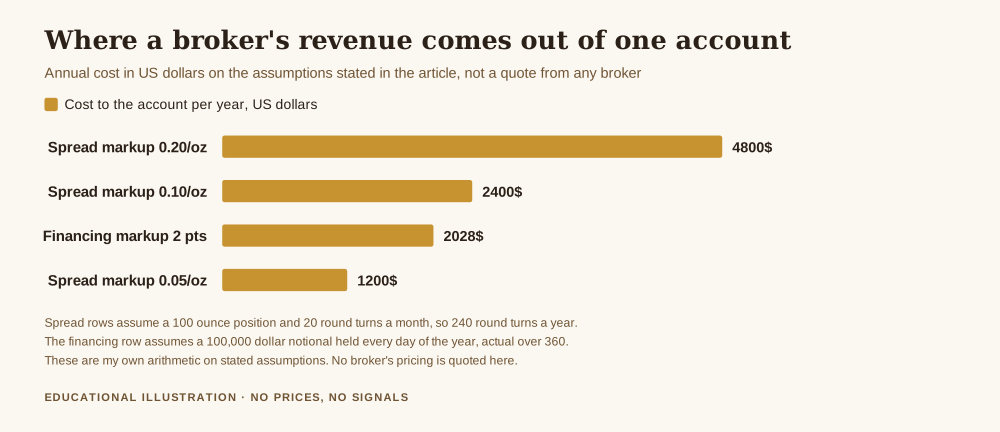
An extra 0.05 per ounce costs 5 dollars a round turn, 100 dollars a month, 1,200 dollars a year. An extra 0.10 costs 2,400 dollars a year. An extra 0.20, which is not an unusual gap between a tight account and a wide one, costs 4,800 dollars a year on exactly the same trading.
Read that last figure next to your account size rather than next to zero. If you are trading a 10,000 dollar account, a 0.20 per ounce gap on that activity level is 48 per cent of your capital a year in costs alone, before a single losing trade. The trades are not what killed that account. The rate card did.
This is also why I am wary of the comparison most people actually run, which is spread alone. A tight raw spread with a commission can easily cost more than a wider all in spread, or less, depending entirely on your size and frequency. The only honest comparison is total cost per round turn at your size. I have set out how to run that comparison properly in raw spread account versus standard account.
The financing line, and the rate it is built on
Overnight financing is the part almost nobody checks, and it is arithmetic you can do yourself from a published number.
The Federal Reserve publishes the effective federal funds rate daily in release H.15. In the release dated 16 October 2026, the effective rate for 15 October 2026 was 3.88 per cent. That is roughly what dollars cost in the wholesale market. It is the floor under what it should cost you to borrow them.
Take a 100,000 dollar notional position, held overnight, on an actual over 360 day count. At 3.88 per cent that is 10.78 dollars for one night, or 323.33 dollars if you hold it for thirty days. That is the benchmark component, the part that would exist even if your broker earned nothing at all on it.
Now add a markup of two percentage points, which is modest by retail standards. Those same thirty days cost 166.67 dollars more. Held continuously for a year, the markup alone is 2,027.78 dollars. Nothing about your trading changed. You simply held positions overnight instead of closing them, and a second cost line switched on while you slept.
Two practical consequences. First, swap is a reason to know whether your method genuinely needs multi day holds, because if it does not, that cost is voluntary. Second, a swap free account is not a gift, and the charge usually returns in another form. The mechanics are in what swap means in gold trading.
What the regulator concluded, and the numbers it published
In March 2018 the European Securities and Markets Authority agreed EU wide restrictions on contracts for difference sold to retail clients. The published decision is worth reading in full, because a regulator describing an industry’s economics is more candid than the industry ever is about itself.
The headline finding is this, in ESMA’s own words: analyses by national regulators across different EU jurisdictions showed that “74-89% of retail accounts typically lose money on their investments, with average losses per client ranging from €1,600 to €29,000”. That is not a figure from a critic. It is the supervisory data that prompted the rules.
The measures ESMA then imposed tell you which parts of the model it considered the problem. Leverage on opening a position was capped at 20:1 for gold, alongside non major currency pairs and major indices, with 30:1 reserved for major currency pairs and tighter limits further down the risk ladder. A margin close out rule was applied per account. Negative balance protection was made mandatory per account, so a client cannot end up owing more than they deposited. Incentives from CFD providers were prohibited outright. And a standardised firm specific risk warning was required.
Look at what that list actually targets. Leverage, because volume written at high leverage produces spread revenue and ends accounts quickly. Incentives, because deposit bonuses are an acquisition cost paid to encourage exactly the behaviour that generates the other three revenue lines. The regulator was not banning brokers. It was removing the parts of the revenue model that worked best when the client did worst.
One caveat I owe you. These rules are European and they apply to firms selling into the EU. If your broker is regulated elsewhere, none of it is automatically true for your account, and the leverage you are offered is often a quiet signal about which rulebook you are actually under.
Which of your habits pays them most
This is the part that is in your control, so it is the part worth most.
Every revenue line above is driven by something you choose. Spread revenue scales with how often you trade and how large you trade, not with whether you are right. Financing scales with how long you hold. Edge fees scale with how often you move money in and out and how long an account sits idle. And if you are on a dealing desk, the firm’s result scales with your losses, which scale with leverage and position size.
So the single habit that costs most is high frequency trading at size on a wide rate card. Not because frequency is wrong, but because it multiplies a fixed cost by a number you chose casually. A reader put the consequence plainly: “Yes, but the spread difference can’t take the position at the right time.” Once costs are large enough to change which trades are viable, they are no longer a detail at the edge of the method. They are part of the method.
The three checks I would actually run, in order:
One. Work out your total cost per round turn at your real size, including commission, and multiply by your real annual trade count. Put that number next to your account balance. Most people have never seen it written down, and it is usually larger than they expect.
Two. Pull three months of statements and total the swap line separately. If it is material, you have discovered a cost that has nothing to do with your analysis and everything to do with your holding period.
Three. Check which book you are on and what the firm discloses about order handling, then check the regulator’s own register rather than the firm’s website. A reader asked me the right question without knowing it: “Sir, is the spread or commission higher in this standard account, and which account is better?” The answer depends on arithmetic they can do and nobody had shown them how.
What this article is not saying
It is not saying brokers should not make money. They provide execution, custody, platforms and regulatory compliance, and all of that costs real money to run. A broker earning nothing from you is a broker that will not be there when you want your funds back.
It is not saying a dealing desk is fraud. Internalising flow is a standard, disclosed market practice with a genuine conflict attached, and the conflict is managed rather than eliminated.
And it is not telling you to switch. Moving to a tighter rate card at a firm you have not verified is a worse trade than paying slightly more somewhere solid. If you are weighing that decision, how to choose a broker for gold trading is the longer version, and the only non negotiable is that the firm is properly regulated and the withdrawals work.
Get the free Gold Empire survival sheet, a one-page guide to protecting your account from the slow costs described in this article. One email, no spam, unsubscribe anytime.
Frequently asked questions
How do forex brokers make profit if they say they charge no commission?
Through the spread, which is the gap between the buy and sell price, plus overnight financing, plus any dealing desk result. A zero commission account has not removed the fee, it has moved it into the quoted price where it is harder to total.
Is a raw spread account always cheaper?
No. A raw spread plus commission can cost more or less than a wider all in spread depending on your size and frequency. Compare total cost per round turn at your own size, because that is the only comparison that holds.
Does my broker want me to lose?
It depends on how your order is handled. If flow is passed to the market, the firm earns from your activity whether you win or lose. If it is internalised, your loss is its revenue, which is a disclosed conflict rather than a secret. Either way, trading volume at size is what the model runs on.
Why is my swap charge so large?
Because it combines a benchmark cost of money with the broker’s markup, and it accrues every night regardless of whether the position is working. With a benchmark near 3.88 per cent, a two point markup on a 100,000 dollar notional adds about 166.67 dollars over thirty days on top of the benchmark component.
Are deposit bonuses free money?
They are an acquisition cost, usually attached to volume conditions that make the bonus difficult to withdraw without trading heavily first. European regulators prohibited such incentives for retail CFD clients in 2018 precisely because of the behaviour they encourage.
What is the single number I should check this week?
Your total annual cost of trading, which is cost per round turn multiplied by your real trade count. If that number is a meaningful percentage of your account, fix it before you touch anything else in your method.
Where Gold Empire fits
Gold Empire is a free channel about surviving in this market long enough to get good at it. There is no account management here, no profit sharing, and nothing sold on a promise of returns. The free survival sheet is one page about protecting an account, and the piece everything else rests on is risk management in gold trading, because position size is the one input that moves every cost line in this article at once.
About the author. Matthew writes Gold Empire. He once spent a year comparing entry techniques while paying a rate card that cost more than every mistake he was trying to fix, which is a cheap lesson to read about and an expensive one to live through. He writes about surviving first because the traders still here in five years are not the ones who were right most often.
Sources and method. The finding that 74 to 89 per cent of retail accounts typically lose money, with average losses per client ranging from 1,600 to 29,000 euros, and the full list of measures including the 20:1 leverage limit covering gold, the per account margin close out, mandatory negative balance protection, the prohibition on incentives and the standardised risk warning, are all quoted from the European Securities and Markets Authority press release of 27 March 2018, linked above. The effective federal funds rate of 3.88 per cent for 15 October 2026 is from Federal Reserve release H.15 dated 16 October 2026, also linked. Both pages were checked live before publication. The annual spread costs of 1,200, 2,400 and 4,800 dollars, the overnight and thirty day financing figures of 10.78 and 323.33 dollars, and the markup figures of 166.67 dollars over thirty days and 2,027.78 dollars over a year, are my own arithmetic on the assumptions stated in the text, namely a 100 ounce position, 240 round turns a year, a 100,000 dollar notional and an actual over 360 day count. No broker’s pricing is quoted anywhere in this article. Reader quotations are real messages, anonymised and lightly edited, with broker names removed, and the count of roughly 48 is a keyword count of my inbox rather than a survey.
Disclaimer. This article is educational content about broker cost structures. It is not investment advice, not a recommendation of any firm, and not a claim about the pricing or conduct of any named company. Fee structures, leverage limits and regulatory protections differ by jurisdiction and change over time, so verify current terms with the firm and the regulator that applies to your own account. Nothing here is personal advice, and no entry, stop or target discussed should be treated as a signal. Decide your own risk, and never trade money you cannot afford to lose.
One step first
Where should we send the Gold Survival Sheet?
Leave your email and we will send the free one page checklist, then take you straight to the Telegram channel.
No cost and no obligation. Educational only, not financial advice, and nothing here promises a return. Unsubscribe any time in one click.
Leave a Reply