
Someone decides they are serious about gold, opens a platform, and then runs into the only question that stands between them and a live account. So how to get trading capital becomes the thing they search for, usually late at night, usually after a demo week that went well. The question gets asked as though it were a sourcing problem, a matter of finding the money. It is not. It is a pricing problem. Every source of capital arrives with a number attached, and that number is the return your account has to produce before you keep a single cent of your own work.
This belongs under survival rather than strategy, because the wrong answer here does not cost you a trade. It costs you the account and then keeps charging you after the account is gone.
In my inbox, roughly 208 messages mention trading with a small account. That is a count of a keyword in messages, not a survey, and it proves nothing about who is right. But the shape of them is consistent enough to be worth quoting. One reader wrote: “I currently have only $160. I just lost my job so I don’t have a lot of capital to invest.” Another: “I’m a student. I lost my $10,000 last month, and now my remaining capital is very small. I only have $360 left.” A third put the plan plainly: “Well if my account got blown I’ll try again and raise small capital to continue.” And a fourth set a target out loud: “I have a small account of savings, $2.5k usd. My goal is to grow it at least 40% towards the end of the year.”
That last one is the one I want to come back to, because it is the only message in the group that names a required return. Everyone else has a hurdle too. They just have not written it down.
How to get trading capital, the four sources people actually use
Strip away the marketing and there are four. Not forty. Four.
One, money you already have and can afford to lose. Savings that are genuinely spare, after rent, after the emergency fund, after the debts that charge you interest. This is the only source on the list with a hurdle of zero, and it is the only one that lets you trade badly for a while without the arithmetic turning on you. It is also, inconveniently, the slowest to accumulate.
Two, borrowed money. A credit card, a personal loan, a line of credit, a relative who will be polite about it until they are not. This is the source that looks like a shortcut and prices like a lender, which is exactly what it is.
Three, somebody else’s money, formally. A funded account programme, where a firm sets you a test and, if you pass, lets you trade their capital for a share of the result. There is a real cost here too, in fees and in rules, and I have written about what that arrangement actually prices elsewhere. The honest summary is that it is a purchase, not a gift.
Four, the account itself. Profits left in, position size raised only when the balance justifies it. This is the slowest and the only one that compounds in your favour rather than against you.
Notice what is not on the list. Money you need for something else is not capital, it is a deadline. And taking deposits from friends to trade on their behalf is not a source of capital either, for reasons I will come to.
The hurdle nobody writes down
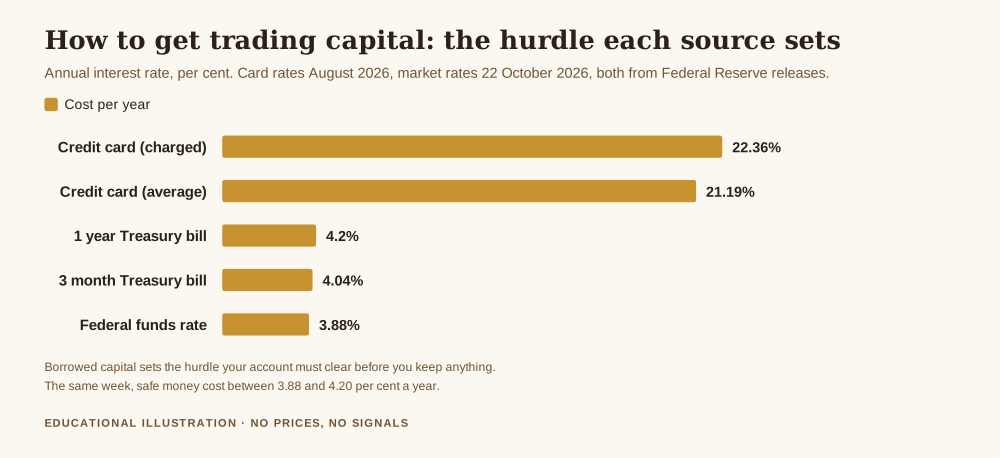
Here is where the second source stops being abstract. The Federal Reserve publishes what consumer credit actually costs in its G.19 consumer credit release. For August 2026, the average rate on credit card accounts that were charged interest was 22.36 per cent a year. Across all credit card accounts, including those that are paid off monthly and pay nothing, the average stated rate was 21.19 per cent.
Take the first figure, because if you are funding a trading account on a card you are, by definition, in the group being charged. Hold that balance for a year and the position has to return 22.36 per cent before you are level. Not before you are rich. Before you are level.
Split it across the months and the hurdle is about 1.86 per cent a month if you divide it evenly, or roughly 1.70 per cent a month once you account for the fact that interest compounds. Every month. In a market that owes you nothing in particular that month.
Leave it two years and the arithmetic stops being polite. At 22.36 per cent compounding, money borrowed today costs 49.72 per cent by the end of the second year. The debt has grown by half while you were learning.
The same hurdle, written in R
Percentages are easy to nod at and hard to feel. So convert it into the unit you actually trade in.
Say you risk 1 per cent of the account on a position, which is the conventional ceiling and already more than many survive. Call that one unit of risk, one R. To clear a 22.36 per cent annual cost, the account has to produce a net 22.36 R over the year. Net, meaning after the losing trades have been subtracted, not 22 winners in a row.
That is the real sentence. Funding a trading account with borrowed money at this rate means your first twenty two units of net profit belong to the lender. Everything you are actually trying to achieve starts at unit twenty three.
Set that beside the reader who wanted 40 per cent in a year on a 2,500 dollar account. If that account were funded on a card, the required return would not be 40 per cent. It would be 40 plus 22.36, and the margin for being wrong would be gone before the first trade.
None of that arithmetic says a 22 R year is impossible. It says it is the entry fee, and that you would be paying it for the privilege of taking risk with money that was never yours.
What safe money cost in the same week
The comparison that makes this concrete is sitting in another Federal Reserve release. In the H.15 selected interest rates published on 23 October 2026, with figures for 22 October, the effective federal funds rate was 3.88 per cent. Three month Treasury bills were 4.04 per cent and one year bills were 4.20 per cent.
So in the same week, money with essentially no credit risk cost somewhere between 3.88 and 4.20 per cent a year, while the card in your pocket charged 22.36. The gap is 18.32 percentage points.
That gap is not a quirk. It is the price of unsecured lending to someone the lender cannot assess. It is priced for a population, and the population it is priced for includes people who do not pay it back. When you put that money into a leveraged market, you are stacking one of the most expensive forms of borrowing on top of one of the most volatile uses of capital, and you are doing it voluntarily.
The source that is not capital at all
There is a fifth thing people try, and it deserves its own warning rather than a place on the list.
Once an account shows a good month, someone offers to send money for you to trade on their behalf. Or a stranger offers to trade yours. In my inbox this pattern shows up often enough that it has its own file, around 104 messages, and it almost never ends with the money coming back.
Two separate problems. The first is legal. Taking other people’s funds to trade is a regulated activity in most places, and doing it without the relevant permission is not a technicality, it is the kind of thing that ends with your accounts frozen. The second is human. A losing month on your own money is a bad week. A losing month on your cousin’s money is a different category of event, and it will change how you trade at exactly the moment you need to trade normally.
If someone approaches you offering to manage your account for a share of profits, treat the offer itself as the warning. The honest version of that service is regulated, documented, and does not arrive as a direct message. It is worth knowing how to read the screenshots such offers tend to arrive with, because the screenshots are usually the whole product.
Get the free Gold Empire survival sheet, a one-page guide to protecting your account through the kind of market this article describes, including the hurdle test before you fund anything. One email, no spam, unsubscribe anytime.
What this article does not say
It does not say that borrowing is always irrational. People borrow to buy tools that produce income, and sometimes that is sound. It says that a trading account is not a tool with a known yield, and that borrowing against an unknown yield at 22.36 per cent is a different proposition from borrowing against a known one.
It does not say that funded account programmes are a scam. It says they are a purchase with a price, and that the price should be compared against the alternative of waiting.
And it does not say that a small account is hopeless. It says that the floor a small balance imposes is a real constraint worth understanding on its own terms, which is a separate question from where the money came from. If your balance is small, the useful next step is understanding what a small balance actually changes, not finding a way to make it bigger by borrowing.
What I would actually do, in order
Work out the hurdle before the source. Write down the annual rate attached to the money, convert it to R at your risk per trade, and look at that number honestly for a minute.
Clear the expensive debt first, because paying off a balance charging 22.36 per cent is a guaranteed 22.36 per cent return, and nothing in a gold account is guaranteed.
Fund with money you can lose without changing anything about your life, even if that means waiting two more months. Then size positions so that the market behaving normally cannot end you, which is what risk management in gold trading is for. The question of how much money you actually need to start has a smaller answer than most people assume, and the gap between that answer and what people borrow is where most of the damage happens.
Frequently asked questions
How do I get trading capital if I have no savings?
Slowly, and from income rather than credit. The arithmetic above is the reason. A card at 22.36 per cent sets a hurdle of about 22 R a year before you keep anything, and an account funded that way has to be right under pressure rather than right at leisure.
Is it ever sensible to fund a trading account with a credit card?
I have not found a version of the sum that works. You are paying one of the most expensive rates available to retail borrowers in order to take risk in a market with no promised return. If the trading works, you could have waited and kept the 22.36 per cent. If it does not, you owe the money anyway.
What about a funded account programme instead?
It is a legitimate category and it has a price, in an evaluation fee and in rules that can end the arrangement. Price it like a purchase. The comparison worth running is the fee against what the same money would do if you simply added it to your own account and traded smaller.
How much of my savings should go into trading?
Only the part whose complete loss would not change your housing, your bills or your relationships. That is not a formula, it is a test, and it is the only one that holds when a position goes against you.
Can I trade a friend’s money to build capital faster?
In most jurisdictions managing other people’s money is a regulated activity requiring permission, and doing it without that is a serious problem rather than a shortcut. The practical objection arrives first, though: it changes how you trade, and not for the better.
Where did the numbers in this article come from?
The 22.36 and 21.19 per cent credit card rates are August 2026 figures from the Federal Reserve’s G.19 consumer credit release. The 3.88, 4.04 and 4.20 per cent market rates are for 22 October 2026 from the Federal Reserve’s H.15 release, published 23 October 2026. Both are linked above. The monthly equivalents, the 49.72 per cent two year figure, the 18.32 point gap and the conversion into R are my own arithmetic from those published rates, assuming the rate holds, no annual fee, no repayment of principal, and tax ignored.
What Gold Empire actually does
Gold Empire is free to follow. Daily gold analysis with the reasoning stated before the outcome, losing days included, on Telegram. There is a free survival sheet for anyone who wants the capital protection material in one place, and an optional Kit for people who want the full method. Nothing here promises a profit, and nothing here is a signal service.
About the author. Matthew writes Gold Empire. He spends most of his time on the unglamorous half of this business, the part that decides whether an account is still open in a year, and he would rather talk somebody out of a funding decision than watch them learn the rate from a statement. This article is educational and is not financial advice. Trading gold carries a high risk of losing money rapidly, and no entry, stop or target discussed should be treated as a signal. Interest rates, lending terms and the rules on managing other people’s money differ by country and change over time, so verify your own before acting. Decide your own risk, and never trade money you cannot afford to lose.
One step first
Where should we send the Gold Survival Sheet?
Leave your email and we will send the free one page checklist, then take you straight to the Telegram channel.
No cost and no obligation. Educational only, not financial advice, and nothing here promises a return. Unsubscribe any time in one click.
Leave a Reply