

The phrase usually turns up at a bad moment, in an email from a broker or a line on a platform that has gone a different colour. So what is margin maintenance requirement, in plain words, and why does it matter more than the margin you paid to open the trade? It is the minimum amount of your own money that has to stay in a leveraged position for the position to stay open. Fall below it and the decision about your trade stops being yours.
That last sentence is the whole reason this belongs on Gold Empire. Most people learn the opening number, the deposit that lets them in. Far fewer learn the second number, the floor that decides when they get pushed out, and the distance between those two numbers is where a surprising share of accounts quietly end.
About 54 messages in my inbox mention leverage or margin in some form. That is a count of a keyword, not a survey, but the voices are consistent. One reader wrote: “Because of margin level getting low, I have to add fund.” Another: “When the chart flips against you I literally got margin calls a number of times.” And one of the most honest lines I have received: “I keep margin call. Need to study proper risk management for now.” That is the right conclusion, and this article is the part of the study that has numbers in it.
What Is Margin Maintenance Requirement, in One Paragraph
When you trade with borrowed money or leverage, two thresholds govern the position. The initial margin is what you must put up to open it. The maintenance margin is the lower amount of equity you must keep in it while it stays open. As the market moves against you, your equity shrinks while the loan behind the position does not. When your equity falls below the maintenance requirement, the firm will ask you to add money, and if you do not, or cannot, it can close the position for you. The maintenance requirement is, in effect, the line where control changes hands.
The Two Published Numbers, and Where They Come From
These thresholds are not folklore. In the United States securities market they are written into rules, and both are public.
The opening number is set by the Federal Reserve’s Regulation T. Section 220.12(a) sets the required margin for a margin equity security at 50 percent of the current market value of the security, or the percentage set by the regulatory authority where the trade occurs, whichever is greater. You can read the text in the Code of Federal Regulations, Part 220.
The floor is set by FINRA Rule 4210. Paragraph (c)(1) sets the margin that must be maintained at 25 percent of the current market value of all margin securities held long in the account.
Fifty percent to get in, twenty five percent to stay in. A gold trader using a retail CFD account will not see these exact percentages, because that account runs on a different set of rules, and I will come to that. But these two published figures are the cleanest way to see the shape of the problem, because nobody has to take my word for them.
The Move That Breaches It, With the Assumptions Written Out
Here is the arithmetic, slowly, because the result is the part people do not expect.
The assumptions. A position worth 20,000 dollars is opened at the 50 percent initial margin, so 10,000 dollars is your own money and 10,000 dollars is borrowed. The maintenance requirement is 25 percent. There are no costs, no interest and no other positions in the account, which flatters the result.
Your equity is the market value of the position minus the 10,000 dollar loan. The maintenance requirement is breached when that equity falls to 25 percent of the market value. Solving that, the position breaches maintenance when its market value falls to 13,333.33 dollars. That is a fall of 33.33 percent from where you opened.
Now look at what that same fall did to your own money. Your equity started at 10,000 dollars. At the breach it is 13,333.33 minus 10,000, which is 3,333.33 dollars. A 33.33 percent fall in the market took 66.67 percent of your money. The loan stayed the same size while your stake absorbed the entire loss, which is exactly what leverage means, written as a sum.
The general formula, if you want to run your own numbers, is this. The adverse move that takes a position from its opening margin to its maintenance floor is one minus the result of dividing one minus the initial margin by one minus the maintenance margin.
Why the Thinner Margin Changes Everything
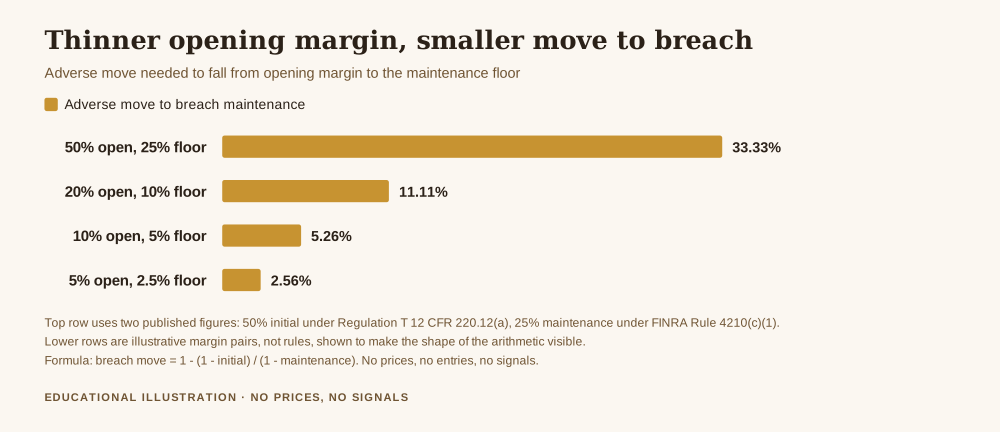
The top row of that chart uses the two published rules. The lower rows are illustrative pairs I chose to show the shape, not rules from any regulator or broker, and I want to be plain about that.
Open with 20 percent margin against a 10 percent floor, and the breaching move is 11.11 percent. Open with 10 percent against 5 percent, and it is 5.26 percent. Open with 5 percent against 2.5 percent, and it is 2.56 percent.
Read those numbers as distances. At the published securities levels, the market has to fall by a third before the floor is touched. At thin leverage, a move of a few percent is enough. And a few percent is not an exotic event in gold. It is the sort of distance the market can cover around a major release, or across a session when it is in a hurry. The more leverage you use, the less of the market’s ordinary movement you can survive before the floor arrives.
This is the quiet point most people miss when they choose leverage. They think of it as a setting that changes how much they can make. It is more accurately a setting that changes how far the market can go against them before someone else closes the trade.
How This Shows Up in a Gold Trading Account
If you trade XAUUSD through a retail CFD account, nobody will send you a message quoting FINRA Rule 4210. The same idea arrives in different clothing. Your platform shows a margin level, which is your equity divided by the margin your open positions use, written as a percentage. As the market moves against you that percentage falls, and two thresholds sit on the way down. The higher one is the margin call, a warning. The lower one is the stop out, where the broker starts closing positions.
That stop out is the retail version of the maintenance floor, and I have written about how it works, and why it fires later than people expect, in what does stop out level mean. The arithmetic above is the reason it deserves respect. Whatever the exact percentages in your account, the distance between your opening margin and that floor is the only room your position has, and leverage is what decides how big that room is.
There is a second way the floor moves, and it moves without the price moving at all. A broker can raise its margin requirements, and when it does, the floor rises towards your equity rather than your equity falling towards the floor. I covered that in why does my broker increase margin requirements, and it is worth reading alongside this, because it is the version that catches people who thought they had done everything right.
What I Would Actually Do About It
Find your own two numbers before you need them. Your account terms will state the margin requirement for gold and the margin call and stop out levels. Write them down somewhere you will see them, not in a document you read once when you opened the account.
Then run the formula above on your own position size. Work out, in percent, how far gold has to move against you before the floor arrives. If that distance is smaller than the moves you have watched gold make in a single session, the position is not sized for the market you are trading. It is sized for a calmer market than the one in front of you.
And treat a margin call as information, not an invitation. One reader put the pattern clearly: “I frequently hit margin calls, which forces me to cut losses often.” Adding money to a position that has reached the warning line is a decision to make the same bet larger at a worse moment. Sometimes that is defensible. Most of the time it is the first step of the sequence I wrote about in why you keep blowing your trading account.
What This Article Does Not Say
It does not say leverage is forbidden or that every leveraged trade will be closed out. It says the distance to the maintenance floor is set by how much leverage you use, and that the distance can be computed in advance.
It does not say your broker uses the Regulation T or FINRA percentages. Those rules govern securities margin in the United States, and they are used here because they are published and checkable. Your gold account has its own terms, and those are the numbers that matter for you.
It does not say anything about where gold is going, and nothing here is a reason to open or close any position.
Get the free Gold Empire survival sheet, a one-page guide to protecting your account through the kind of market this article describes, including where to find your own margin floor before the market finds it for you. One email, no spam, unsubscribe anytime.
Frequently Asked Questions
What is margin maintenance requirement in simple terms?
It is the minimum equity you must keep in a leveraged position for it to stay open. The initial margin is what you need to open the trade. The maintenance requirement is the lower floor you must not fall below afterwards. Fall below it and the firm can ask for more money or close the position.
What is the difference between initial margin and maintenance margin?
Initial margin is the entry ticket, maintenance margin is the floor. In United States securities, Regulation T sets the initial requirement at 50 percent of market value for margin equity securities, and FINRA Rule 4210 sets the maintenance requirement at 25 percent for securities held long.
How far can the market fall before I breach maintenance?
At 50 percent initial and 25 percent maintenance, a fall of 33.33 percent. The formula is one minus the result of dividing one minus the initial margin by one minus the maintenance margin. With thinner margins the distance shrinks fast, to 5.26 percent at 10 against 5, and 2.56 percent at 5 against 2.5.
Is a margin call the same as a stop out?
No. A margin call is a warning that your equity is near the floor. A stop out is the action the broker takes when it is breached, closing positions to protect the loan. In a retail gold account both appear as levels of your margin level percentage.
Can my maintenance requirement change while my trade is open?
Yes. A broker can raise its margin requirements, which lifts the floor towards your equity even if the price has not moved. That is why it is worth checking the terms periodically, not only when you open the account.
Where did the numbers in this article come from?
The 50 percent and 25 percent figures are quoted from Regulation T, 12 CFR 220.12(a), and FINRA Rule 4210(c)(1), both linked above. The 33.33, 66.67, 11.11, 5.26 and 2.56 percent figures are not quoted from anywhere. I computed them from those rules and from illustrative margin pairs, with every assumption written out, so you can repeat or reject them.
What Gold Empire Actually Does
Gold Empire is free to follow. Daily gold analysis with the reasoning written down before the trade, losing days included, and a free survival sheet for anyone who wants the capital protection material in one place. There is an optional Kit for people who want the full method. Nothing here promises a profit.
Protecting the account is the whole job, and risk management in gold trading is the pillar this sits under. What is leverage in gold trading explains the setting that decides how close the floor sits, and what does stop out level mean shows how the floor behaves in a retail account. If you are still choosing where to trade, how to open a gold trading account covers the terms worth reading before you deposit anything.
About the author. Matthew writes Gold Empire. He spends most of his time on the unglamorous half of this business, the part that decides whether an account is still open in a year, and he would rather know where the floor is before the market finds it. Nothing in this article is a recommendation to trade, and no entry, stop or target discussed should be treated as a signal.
Disclaimer: This article is general educational content about how margin requirements work. It is not financial advice, not legal advice and not a recommendation to buy, sell or use any product, venue, broker or firm. Regulation T and FINRA Rule 4210 govern securities margin in the United States and are quoted for illustration. Your own account’s terms apply to your own trading. Rules and terms change over time. Trading carries risk of loss. Only commit capital you can afford to lose.
One step first
Where should we send the Gold Survival Sheet?
Leave your email and we will send the free one page checklist, then take you straight to the Telegram channel.
No cost and no obligation. Educational only, not financial advice, and nothing here promises a return. Unsubscribe any time in one click.
Leave a Reply