

What does stop out level mean is a question most traders look up in the worst possible hour, somewhere between seeing a red number they do not recognise in the terminal and finding that a position they never closed is no longer there. By then the answer is academic. The stop out has already happened, and the account is smaller for it.
So here is the answer in one sentence, before anything else. The stop out level is the point at which your broker stops asking and starts closing, expressed as a percentage of the margin your open positions require. It is not a stop loss. You did not set it, you cannot move it, and it is not there to protect you.
The rest of this article is the arithmetic behind that sentence, computed from published rules with every assumption written down, because the part that surprises people is not the definition. It is how much of an account is already gone by the time the rule finally does something.
What does stop out level mean in the broker’s own arithmetic
Every MetaTrader account shows three numbers that matter here, and they are related by one formula.
Equity is your balance plus the profit or loss on everything currently open. Required margin, shown as “margin” in the terminal, is the deposit the broker holds against those open positions. Margin level is the first divided by the second, written as a percentage:
margin level = equity divided by required margin, times one hundred.
Open nothing and the margin level is undefined, because you are dividing by zero. Open a position and it starts somewhere high, often several hundred per cent or several thousand. As the trade goes against you, equity falls, required margin stays where it is, and the ratio grinds downwards.
Two thresholds sit on that falling line. The higher one is the margin call, which is a warning. The lower one is the stop out, which is an action. When margin level touches the stop out number, the platform closes positions for you, usually the largest loser first, until the ratio is back above the line. Nobody phones you. There is no confirmation dialog.
That is the whole mechanism. The interesting question is where the line sits.
Where the 50 per cent comes from
If your account is with a broker regulated in the European Union or the United Kingdom, the number is not a matter of taste. In the final product intervention measures on contracts for difference, published in the Official Journal on 1 June 2018 and applying from 1 August 2018, the European Securities and Markets Authority set a margin close out rule that standardises the percentage of margin, at 50 per cent of minimum required margin, at which providers must close out a retail client’s open positions. The same measures capped leverage for retail clients at 20:1 on gold, 30:1 on major currency pairs, 10:1 on other commodities and 2:1 on cryptocurrencies, and required negative balance protection on a per account basis.
Three things follow from that paragraph, and all three are worth holding on to.
First, the stop out is a floor on protection, not a ceiling. A broker may close you out earlier than 50 per cent, and many do. It may not leave you open for longer.
Second, the rule is per account, not per trade. Your margin level is computed across everything you have open at once. A profitable position can hold a losing one alive, and when the profitable one is closed, the ratio moves without the loser doing anything.
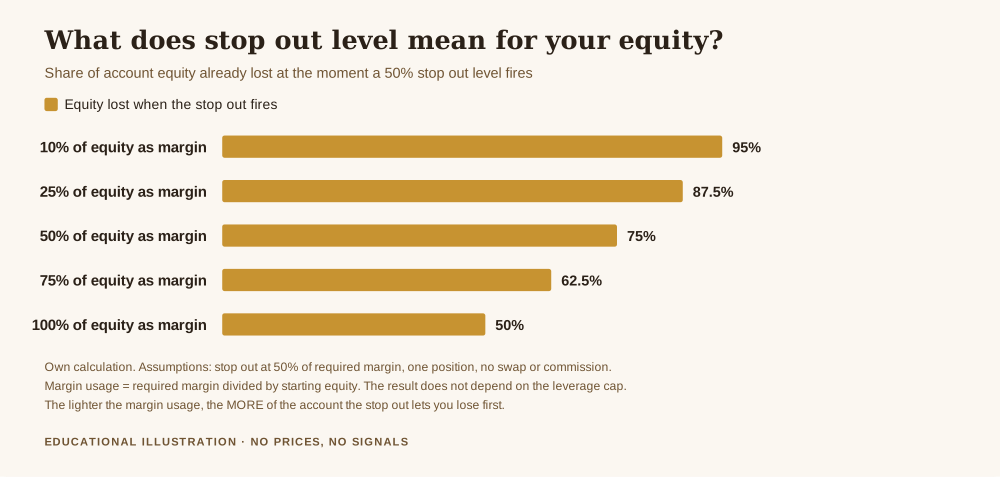
Third, and this is the one that gets people, a stop out at 50 per cent of required margin does not mean you lose half your account. It means something far less comfortable, and the arithmetic is below.
Why the stop out fires later than you think
Call the fraction of your equity committed as required margin your margin usage. If you have 2,000 in the account and your open position requires 500 of margin, your margin usage is 25 per cent.
Your margin level starts at one divided by that usage. At 25 per cent usage the margin level is 400 per cent. The stop out waits at 50 per cent. So the loss you are allowed to take before anything happens is your starting equity minus half of the required margin, and as a share of the account that works out as one minus half your margin usage.
Run that across the usual range and the result is the chart above:
At 100 per cent margin usage, where every unit of equity is committed, the stop out fires once 50 per cent of the account is gone. At 75 per cent usage it waits until 62.5 per cent is gone. At 50 per cent usage, 75 per cent. At 25 per cent usage, 87.5 per cent. At 10 per cent usage, which most traders would describe as conservative, the stop out does not act until 95 per cent of the account has been destroyed.
Read that last line again, because it inverts the intuition almost everyone brings to this. The more careful you are with position size, the more patient the stop out becomes. It is not watching your capital. It is watching the broker’s exposure, and a small position simply does not threaten the broker until almost everything you own has been eaten.
The assumptions behind those figures: one position, no swap or commission, no deposits or withdrawals during the trade, and a stop out at 50 per cent of required margin. Change the stop out level and the numbers shift a little. Change the conclusion and you will not, because the shape of the formula does not depend on the broker.
What the trigger move looks like
The same arithmetic answers a more practical question: how far does price have to travel against you before this happens? That depends on how much notional exposure the account carries, which is where the leverage cap finally matters.
Under the 20:1 gold cap, an account at 50 per cent margin usage is carrying ten times its equity in notional exposure, and the stop out arrives after a 7.5 per cent adverse move. At 25 per cent usage it takes a 17.5 per cent move. Those are large distances in gold, and that is the point of the cap.
Now take the same account to an offshore broker advertising 1:500. At 50 per cent margin usage it is carrying 250 times its equity, and the stop out arrives after an adverse move of 0.30 per cent. At 25 per cent usage, 0.70 per cent. Gold covers that kind of distance on an ordinary Tuesday, sometimes in the first minute of a data release.
The leverage number does not change the risk of any particular position. It changes how much position the account is permitted to hold, and therefore how little price has to move to end it. Our piece on what leverage actually is in gold trading works through that distinction properly, and how to calculate lot size for gold turns it into the number you actually type into the order ticket.
The margin call is not the stop out
These two get used interchangeably and they are different events.
The margin call is a notification level, often 100 per cent. When margin level touches it, the platform typically stops you opening new positions and flags the account. Nothing is closed. Many brokers do not call or email at all, and the regulatory measures above do not require them to.
The stop out is the enforcement level. It closes positions without asking.
Between the two there is a window, and what you do in it decides the outcome. There are exactly three actions available: add funds, close part of the position yourself, or accept the stop out. Hoping is not on the list, although it is the one most accounts choose.
Worth knowing, too, that the required margin in the denominator is not frozen. Brokers raise requirements around weekends and high impact events, and an increase moves the line towards you while price does nothing at all. We covered that mechanism separately in why your broker increases margin requirements, and the two articles describe the same wall from opposite sides.
What this changes about how you size a position
If the stop out will not save you, something else has to, and the only candidate is the size of the position and the stop you place yourself.
Four things follow from the arithmetic above, in the order they matter.
First, your own stop loss is the real protection. The broker’s stop out is the wall at the end of the corridor, not a handrail along it. A stop you placed at a level you chose, sized so that being wrong costs a small and survivable fraction of equity, is the mechanism that keeps the broker’s rule irrelevant. The full approach is in our risk management guide for gold trading.
Second, watch margin level as a live number, not just equity. Equity tells you how the trade is doing. Margin level tells you how close the enforcement is, and the two answer different questions.
Third, know your broker’s actual stop out percentage before you fund the account rather than after. It is in the contract specifications or the client agreement, it takes two minutes to find, and it varies: 50 per cent is the European floor, some brokers use 20 per cent, some close positions one at a time and some close everything at once. If you are still choosing, how to open a gold trading account lists the questions worth asking first.
Fourth, remember that the stop out does not fail gracefully. Positions close at whatever the market is doing at that moment, which in a fast market is not the price you would have chosen. This is also why what happens when a broker fails matters more than most people assume: the mechanics of a forced close and the mechanics of a broker in trouble meet in the same place, your equity.
Get the free Gold Empire survival sheet, a one-page guide to protecting your account through the kind of market this article describes. One email, no spam, unsubscribe anytime.
Frequently asked questions
What does stop out level mean on MT4 and MT5?
The same thing on both. It is the margin level percentage at which the terminal closes your positions automatically. You can see your broker’s figure in the contract specifications, and your live margin level in the trade tab of the terminal.
Can I change my stop out level?
No. It is set by the broker, inside the limits its regulator imposes. What you can change is your margin usage, which decides how far the account is from that level in the first place.
Does a stop out close all my positions?
It depends on the broker. The common behaviour is to close the largest losing position first, then check whether the margin level is back above the line, and continue if it is not. Some close everything in one pass.
Is a stop out the same as being liquidated?
Liquidation is the general word for a forced close. A stop out is the specific retail version of it, triggered by a margin level rule in your client agreement.
Can I lose more than my deposit when a stop out happens?
Under the European measures cited above, retail clients have negative balance protection on a per account basis, so losses are limited to the funds in the account. Outside that regime it depends entirely on the broker’s terms, which is one of the better reasons to read them.
Why did my position close when the margin level was still above the stop out?
Two common causes. The required margin was raised, which moves the ratio without price moving, or a profitable position elsewhere in the account was closed, which removed the equity that was holding the loser alive.
What Gold Empire actually does
Gold Empire is a free channel about surviving in gold rather than getting rich in it. There is no signal service, nothing is sold on the promise of a return, and the arithmetic here is published so you can check it rather than trust it. The free Gold Survival Sheet is one page on protecting an account in exactly the conditions described above, and it asks for an email address you can unsubscribe from at any time.
Follow for free, read the numbers, decide for yourself. If anything you read anywhere makes you feel you have to act this minute, that urgency is a reason to slow down, including when you read it here.
About the author
Matthew writes Gold Empire. He learned what a stop out level was from the receipt rather than the manual, on an account where the position was small, the margin usage looked responsible, and the rule let him lose almost all of it before doing anything. He has kept the margin level column visible ever since, and he still has no interest in telling anyone where price is going. More on the approach is on the about page.
This article is educational and is not financial advice. Trading gold carries a high risk of losing money rapidly, and no entry, stop or target discussed should be treated as a signal. The 50 per cent margin close out rule, the leverage caps including 20:1 on gold, and negative balance protection are quoted from the European Securities and Markets Authority’s final product intervention measures, published in the Official Journal on 1 June 2018 and applied from 1 August 2018, as linked above. Every percentage of equity and every trigger move in this article is computed from those published rules with the stated assumptions, excludes swap and commission, and assumes position size is unchanged. Your own broker’s terms govern your account and may differ. Decide your own risk, and never trade money you cannot afford to lose.
One step first
Where should we send the Gold Survival Sheet?
Leave your email and we will send the free one page checklist, then take you straight to the Telegram channel.
No cost and no obligation. Educational only, not financial advice, and nothing here promises a return. Unsubscribe any time in one click.
Leave a Reply