
Most people looking up how to calculate lot size for gold forex trades are hoping for a rule of thumb. Something like “use 0.01 lots per thousand dollars” that they can memorise and stop thinking about. I understand the appeal, and I am not going to give you one, because any rule of that shape is wrong the moment your stop distance changes, which is every trade.
The good news is that the real calculation is one line of arithmetic and takes about fifteen seconds once you have done it a few times. The part that takes longer is accepting what it implies, which is that your position size is not a decision you get to make. It is an output. Three other numbers decide it for you.
To be clear from the start: no entry, stop or target discussed should be treated as a signal.
The three inputs, and why size is not one of them
Every correct position size comes from exactly three things.
Your account balance. Simple enough, and the only one of the three that changes slowly.
The percentage you are willing to risk on this trade. A decision made once, in writing, while calm, not per trade and not by feel. I have written separately about how much to risk per trade, and the number matters far less than the fact that it stays fixed.
The distance to your stop. This comes from the chart, from wherever your idea is proven wrong. It is not a number you choose for convenience.
Multiply the first two and you have your risk in dollars. Divide that by the third and you have your size. Notice what is missing: how confident you feel, how good the setup looks, how much you would like to make. None of those appear anywhere in the calculation, and the moment one of them creeps in, you no longer have a risk rule, you have a mood.
How to calculate lot size for gold forex trades, in one line
You need one fact about the instrument. A standard lot of XAU/USD is 100 troy ounces, because gold is priced per troy ounce, a convention you can see in the LBMA precious metal price data. That single fact does all the work.
If one lot is 100 ounces, then a one dollar move in the gold price is 100 dollars of profit or loss per lot. So:
Lots = risk in dollars, divided by (stop distance in dollars per ounce, times 100).
Work an example all the way through. A 5,000 dollar account, risking 1 percent, which is 50 dollars. Your stop sits 5 dollars per ounce away. Then lots equals 50 divided by (5 times 100), which is 50 divided by 500, which is 0.10 lots.
That is the whole method. Now watch what happens when only the stop changes:
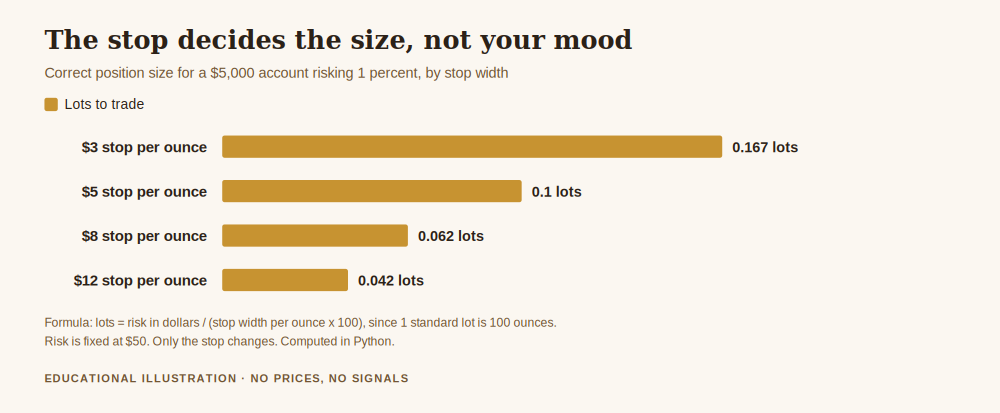
- A $3 stop gives 0.167 lots.
- A $5 stop gives 0.100 lots.
- An $8 stop gives 0.062 lots.
- A $12 stop gives 0.042 lots.
Same account, same risk percentage, same dollar amount at stake. Only the stop moved, and the correct size moved by a factor of four. This is the relationship that trips people up: size and stop distance are inversely proportional, so a wider stop is not more dangerous. A wider stop with unchanged size is more dangerous, and those are completely different statements.
Rounding, and the small error it introduces
The formula gives you numbers like 0.062 lots. Your platform will not accept that. Most allow steps of 0.01, so you have to round.
Always round down. Rounding up means risking more than you decided to, which defeats the purpose of the calculation.
Rounding down introduces a small, quantifiable shortfall. On a 5,000 dollar account with an 8 dollar stop, the exact answer is 0.062 lots, you trade 0.06, and your real risk becomes 48 dollars rather than 50. That is 4 percent below target. On a 10,000 dollar account with the same stop, 0.125 rounds to 0.12 and you risk 96 rather than 100, again 4 percent light.
Being 4 percent under your intended risk is harmless. Being 4 percent over, every trade, for a year, is not. That asymmetry is the entire reason the rule is round down rather than round to nearest.
One thing to watch on smaller accounts: rounding down can take you to the platform minimum, and below a certain balance the minimum itself becomes the binding constraint rather than your arithmetic. I worked through exactly where that line sits in how to trade gold with small account balances, and it is worth reading alongside this if your balance is under about a thousand dollars.
Four ways this calculation goes wrong
Using a fixed lot size regardless of stop. The most common error by a distance. Trading 0.10 lots every time means your risk swings with every stop distance, so a trade with a 12 dollar stop risks nearly two and a half times one with a 5 dollar stop. You think you have a consistent risk rule. You have a consistent lot size, which is not the same thing and is considerably worse.
Choosing the stop to justify the size. The reverse error, and subtler because it feels disciplined. You want a bigger position, so the stop moves closer to entry to make the arithmetic allow it. Now your stop is placed for accounting reasons rather than where your idea fails, and you will be taken out of trades that were working.
Confusing pips with dollars per ounce. Gold quoting conventions differ between brokers, and a “pip” on gold may be 0.01 or 0.10 or 1.00 depending on the platform. This is where most calculation errors of ten times or a hundred times come from. Working in dollars per ounce, as above, sidesteps the problem entirely. If you prefer to work in pips, confirm what one pip is worth on your account first, and I explain the convention in what a pip in gold trading actually is.
Forgetting that the account balance changes. One percent of your balance after a losing month is a smaller number than it was before. Recalculating from the current balance is what makes the rule self-correcting, shrinking your size automatically when things go badly. Using the balance you started the year with removes that protection at exactly the moment you need it.
Check the contract size before you trust the formula
Everything above assumes a standard lot is 100 troy ounces, which is the common convention. It is not a law, and it is the one input worth verifying rather than assuming.
Some brokers offer gold in different contract sizes, and a few quote it in a way where one lot is 10 ounces rather than 100. If yours does, every number in this article is out by a factor of ten, which is not a small error when it lands on your position size.
There is a two minute check that settles it, and it does not require reading any documentation. Open your platform, set up an order for exactly 1.00 lot without placing it, and look at the contract size or notional value the ticket displays. Divide that notional by the current gold price and you have your ounces per lot. If the answer is 100, use the formula as written. If it is 10, replace the 100 in the formula with 10.
Do the same check whenever you open an account somewhere new, and again if your broker changes its product specifications, which they occasionally do without much fanfare. It is the cheapest possible insurance against the single most expensive category of sizing mistake.
The same caution applies to any instrument you carry this method across to. The structure of the calculation never changes, risk divided by stop distance times units per lot, but that last term is specific to the contract in front of you.
Do it before you look at the chart
A practical suggestion that costs nothing.
Work out your risk in dollars at the start of the session, before you have an opinion about anything. Write it at the top of the page. Then, when a setup appears, the only number you need from the chart is the stop distance, and the size follows mechanically.
The reason this ordering matters is that it removes the opportunity to negotiate. If you calculate the risk amount after you have found a setup you like, the number has a way of drifting upward, and the drift never feels like a decision at the time. Calculating it while you have no position and no opinion is the cheapest discipline available in this whole business, and it is the same reasoning that sits underneath the risk management approach and position sizing for gold more broadly.
Frequently asked questions
What is the formula for lot size in gold trading?
Lots equals your risk in dollars divided by the stop distance in dollars per ounce multiplied by 100. The 100 comes from a standard XAU/USD lot being 100 troy ounces, so a one dollar move is 100 dollars per lot. Risking 50 dollars with a 5 dollar stop gives 0.10 lots.
How many lots should I trade with a $1,000 account?
There is no single answer, because it depends entirely on your stop distance. Risking 1 percent of 1,000 dollars is 10 dollars, which gives 0.033 lots on a 3 dollar stop but only 0.008 lots on a 12 dollar stop. Any advice that quotes a lot size without asking about your stop is guessing.
Should I round lot size up or down?
Down, always. Rounding up means exceeding the risk you decided on, while rounding down leaves you slightly under. On a 5,000 dollar account with an 8 dollar stop, rounding 0.062 to 0.06 puts your real risk at 48 dollars instead of 50, about 4 percent light, which is harmless in a way that being 4 percent heavy is not.
Does lot size change if I use more leverage?
No. Leverage determines the margin your broker holds while the position is open, not what you lose if the stop is hit. Your loss is size multiplied by stop distance, and leverage appears nowhere in that calculation. Higher leverage only permits larger positions, it does not make them appropriate.
Why is my risk different from what I calculated?
Usually one of three things: rounding, a pip convention that differs from what you assumed, or slippage. Stop orders become market orders when triggered, so in fast conditions you may be filled worse than your level, making the real loss larger than the arithmetic suggested. Treat the calculated figure as your intended risk rather than a guaranteed maximum.
Can I use a lot size calculator instead?
Yes, and most are fine, but check what it assumes about contract size and pip value before trusting it. A calculator built for currency pairs will give you a badly wrong answer on gold. Running one example by hand against the formula above takes a minute and tells you whether the tool is doing the right thing.
Where this leaves you, and what we do about it
The honest summary is that position size is arithmetic dressed up as a decision. Three inputs go in, one number comes out, and the only judgement involved is where the stop belongs. Once you work it in this order, the daily question stops being how much should I trade and becomes where is this idea proven wrong, which is a far better question to be asking.
Gold Empire is a free Telegram channel where we work through market context in public, including the days the read does not work out. There is no promise of profit, because there honestly cannot be one. What there is, is a group of people trying to stay in the game long enough for competence to start paying.
If this was useful, the free Gold Survival Sheet is the natural next step. It is a one page checklist that puts the size, the cost and the ceiling in front of you before you enter, and it is free to download with nothing to join.
About the author. Matthew writes the Gold Empire market notes. He spends most of his time on the unglamorous half of trading, position size, dealing costs and the arithmetic of recovery, on the view that surviving the first two years is what makes the rest of it possible.
Disclaimer: This article is general educational content about how leveraged markets work. It is not financial advice and it is not a recommendation to buy or sell anything. Trading leveraged products carries a high risk of losing money rapidly. No entry, stop or target discussed should be treated as a signal. Figures attributed to external sources are linked so you can check them, and figures I have calculated are shown with the assumptions they rest on so you can change them.
One step first
Where should we send the Gold Survival Sheet?
Leave your email and we will send the free one page checklist, then take you straight to the Telegram channel.
No cost and no obligation. Educational only, not financial advice, and nothing here promises a return. Unsubscribe any time in one click.
Leave a Reply