

Why does my broker increase margin requirements is a question that almost always arrives too late, usually in the same hour the increase happens, and usually from someone whose position has just been closed without price doing anything dramatic. The sequence feels like a betrayal. Nothing moved. No stop was hit. The trade simply stopped existing, and the account is smaller than it was an hour ago.
It is not a betrayal, and it is not a glitch. It is a rule working exactly as written. A margin requirement is not a fixed property of an instrument, it is a number the broker sets and is allowed to change, including on positions you already hold. When that number goes up, the amount of your equity reserved against your open trade goes up with it, and the distance between you and an automatic close out gets shorter. Price never has to move for that to happen.
This article does the arithmetic. Everything numerical below is computed from published rules with the assumptions written out, so you can redo it yourself in a couple of minutes and check whether I am right.
Why does my broker increase margin requirements, mechanically
Start with what a margin requirement is. When you open a gold position, you are not paying for the whole position. You post a fraction of its value and the broker carries the rest. That fraction is the margin requirement, and it is quoted either as a percentage of the position or as its reciprocal, the leverage. A 5 per cent requirement and a 20:1 leverage cap are the same sentence said two ways.
The European Securities and Markets Authority fixed that particular number for retail clients. In its product intervention measures agreed on 23 March 2018, ESMA set leverage limits that run from 30:1 down to 2:1 depending on what you are trading. Gold sits with non major currency pairs and major indices at 20:1, which is a 5 per cent margin requirement. Commodities other than gold are capped at 10:1, individual equities at 5:1, cryptocurrencies at 2:1.
Here is the part that answers the question. Those are floors on how much margin must be collected, not ceilings. A broker may always require more than the regulator demands, and brokers routinely do, for reasons that have nothing to do with you personally:
The first reason is volatility. A margin requirement is the broker’s estimate of how far price can run before it can close you out and still be made whole. When gold starts moving further per hour than it did last month, that estimate stops being adequate, so the requirement rises.
The second is the calendar. Scheduled events with large and uncertain outcomes, central bank decisions, inflation releases, employment data, concentrate risk into a known minute. Many brokers raise requirements ahead of those minutes and lower them afterwards.
The third is the weekend. Markets close, news does not, and a position held across the gap cannot be managed while it is closed. Higher weekend requirements are common and are usually published in advance.
The fourth is you. Tiered margin is widespread: the requirement rises with position size, so the same instrument can carry one requirement on a small position and a higher one on a large position. Grow the position and you can trigger the higher tier yourself.
The rule that turns a requirement into a close out
A requirement on its own does nothing. It becomes an event because of a second rule sitting next to it. The same ESMA measures standardised a margin close out rule at 50 per cent of minimum required margin. When your equity falls below half of the margin your open positions require, the provider is obliged to start closing them. The same package added negative balance protection on a per account basis, so retail losses are capped at the account, which is the one genuinely good piece of news in this article.
Read those two rules together and the mechanism is obvious. The close out trigger is defined as a fraction of the requirement. Raise the requirement and you raise the trigger. Your equity has not changed. The floor has come up to meet it.
I have written separately about what a blown trading account actually means, which works the same arithmetic in the direction people expect, where price moves and the account does not. This article is the other direction, where the account does not move and the rule does.
What doubling the requirement does to a trade you already hold
Let me put numbers on it. The assumptions, so you can disagree with them precisely: equity is whatever it is, call it E. Your position has some notional value N. The requirement is a fraction m of N, so the margin reserved is m times N. Margin usage is the share of your equity that reservation consumes. Close out is at 50 per cent of required margin, per the rule above. Price does not move at any point, and the position size never changes. Only m changes, from the 5 per cent retail floor for gold to 10 per cent, which is what happens if a broker halves your effective leverage from 20:1 to 10:1.
The question I am asking is: how far could price still move against this position before it is closed, before and after the change?
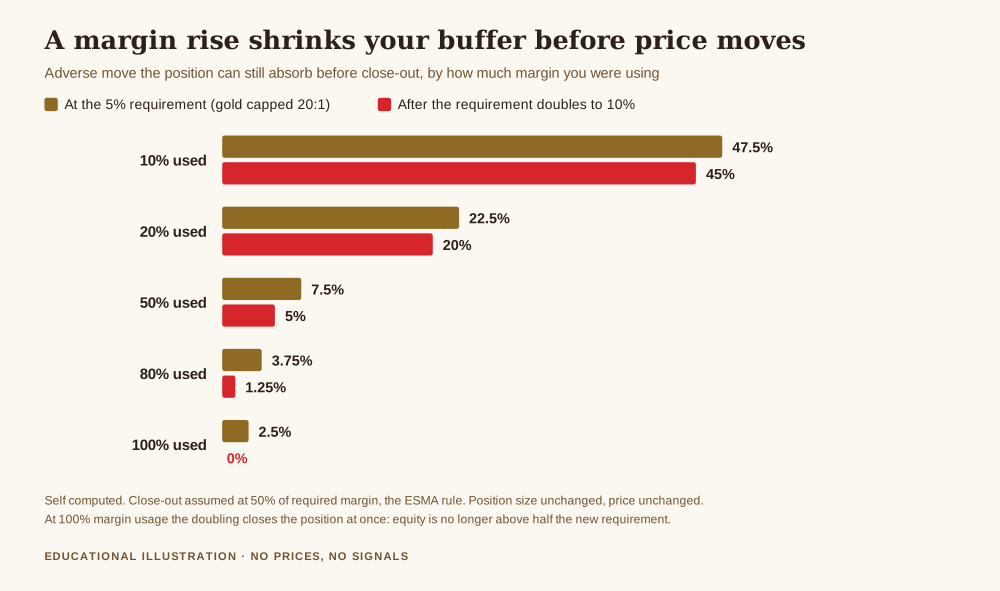
At 10 per cent margin usage, the buffer falls from 47.50 per cent to 45.00 per cent. That is a reduction of about 5 per cent of the buffer, and in practice you would never notice it.
At 20 per cent usage, 22.50 per cent becomes 20.00 per cent. Still comfortable.
At 50 per cent usage, 7.50 per cent becomes 5.00 per cent. You have lost a third of your room, and gold can cover 5 per cent in a session that nobody would describe as unusual.
At 80 per cent usage, 3.75 per cent becomes 1.25 per cent. Two thirds of the buffer is gone. This is the band where traders get hurt without understanding what hit them.
Notice the shape of that progression. The damage is not proportional to the size of the increase. It is governed by how much margin you were already using. The same change in the same instrument on the same day is a rounding error for one trader and an account ending event for another, and the only difference between them is a decision each made before the announcement.
The number that genuinely surprises people
Run the same arithmetic at 100 per cent margin usage, meaning you have committed every unit of equity as margin, and the result stops being a reduced buffer and becomes something else.
At a 5 per cent requirement with full usage, the notional is 20 times equity and the required margin equals equity exactly. Buffer before the change: 2.50 per cent. Now double the requirement. Required margin becomes twice equity. The close out trigger is half of that, which is exactly equity. Your equity is equity. You are at the trigger the moment the change takes effect.
The position closes immediately, with no price movement whatsoever. The free margin figure makes the same point in plainer terms: at 50 per cent usage, free margin goes from half your equity to zero. At 80 per cent usage it goes from a fifth of your equity to negative 0.6 of it. At full usage it goes to negative 1.0.
That is the whole lesson of this article in one line. Full margin usage is not an aggressive position, it is a position with no tolerance for the rules changing, and the rules are allowed to change.
Get the free Gold Empire survival sheet, a one-page guide to protecting your account through the kind of market this article describes. One email, no spam, unsubscribe anytime.
How much warning you actually get
This varies, and it is worth knowing where your broker sits before you need to know.
Scheduled increases, the weekend and calendar kind, are normally published days ahead, in a notices section of the client portal or by email. These are the easy ones, and they are easy only if you read the notices.
Unscheduled increases, the volatility kind, can arrive with very little notice, because the condition that justifies them is itself sudden. Client agreements for leveraged products generally reserve the right to change margin requirements with immediate effect in abnormal market conditions, which is the clause that makes the scenario above legal.
There is also a question worth asking that most people never do: does the new requirement apply to new positions only, or to everything open? Some brokers apply increases prospectively, which leaves your existing trade alone. Others apply them to the whole book. The arithmetic above only bites in the second case, and which case you are in is a factual question with an answer, available before you ever need it.
What the loss statistics suggest about who this reaches
One more figure, because it frames how common the vulnerable position is. In the same intervention, ESMA reported that analyses by national regulators across EU jurisdictions found that 74 to 89 per cent of retail accounts typically lose money, with average losses per client ranging from 1,600 to 29,000 euros. Those numbers are the reason the leverage caps exist at all.
They do not tell you that margin increases caused those losses. They tell you that the population being discussed here is mostly losing, which means mostly operating with less equity than they started with, which means mostly operating at higher margin usage than they intended. The group most exposed to a requirement change is not the reckless minority. It is the ordinary majority, several weeks into a drawdown.
What this article is not saying
It is not saying brokers raise requirements to close you out. The incentive runs the other way. A broker that force closes clients in volatile conditions generates complaints, and under negative balance protection it absorbs the tail risk itself. Raising requirements is how it avoids that, not how it causes it.
It is not saying every broker does this the same way. Policies differ, notice periods differ, and whether increases apply to open positions differs. That is exactly why the useful version of this question is not the general one but the specific one about your own account.
It is not telling you what margin usage to run. I have deliberately given ratios rather than a recommendation, because the right answer depends on your stop distance, your instrument and how much of your life is attached to the money. And it is not a view on gold. Nothing above says anything about direction.
What I would actually do about it
Four things, none of which require predicting anything.
First, find out your broker’s current margin requirement for gold, in writing, and whether it is tiered by position size. It is usually in a contract specifications table. This takes about four minutes.
Second, find out whether increases apply to open positions. Ask support and keep the answer. This is the single fact that decides whether any of the arithmetic above applies to you.
Third, watch margin usage as a live number, not equity. Equity tells you how the trade is going. Margin usage tells you how much room you have if the rules change, and the chart above says the two are not the same question. If you want the mechanics of sizing the position in the first place, the risk management guide and what leverage actually is in gold trading are the places to start.
Fourth, treat scheduled high impact events as requirement events as well as price events. If you already reduce size around them, you are also reducing the exposure described here, which is a second reason to do something you may already be doing. Trading gold through high impact news covers the price side of that decision.
Frequently asked questions
Why does my broker increase margin requirements without warning?
Usually because the increase is tied to market conditions rather than a date. Client agreements for leveraged products generally allow immediate changes in abnormal conditions. Scheduled increases around weekends and known events are normally published in advance.
Can a margin increase close my position even if price has not moved?
Yes, if you were using enough margin. With close out at 50 per cent of required margin, a doubling of the requirement closes a position held at 100 per cent margin usage immediately, because equity is no longer above half of the new requirement.
Is a margin increase the same as a margin call?
No. A margin call is a warning that equity is approaching the required level. A margin increase moves the required level itself. The increase can produce the call rather than the other way round.
Does the 20:1 cap mean my broker cannot ask for more than 5 per cent?
The opposite. The cap is a minimum standard of protection for retail clients, so the broker cannot offer more leverage than that. It can always require more margin than the floor, and often does.
Do margin increases apply to positions I already have open?
It depends on the broker, and this is the question worth asking before you need the answer. Some apply increases only to new positions, others to the entire book.
How do I know how much room I have left?
Compare your equity with your required margin. The close out level sits at half the requirement, so the loss you can still absorb is equity minus half of required margin, and the move that represents depends on your position size.
What Gold Empire actually does
Gold Empire is a free channel about surviving in gold rather than getting rich in it. There is no signal service here and nothing is sold on the promise of a return. The free Gold Survival Sheet is a single page on protecting an account through exactly the kind of week this article describes, and the only thing it asks for is an email address you can unsubscribe from. If you are still choosing where to hold the account, how to open a gold trading account covers the questions worth asking before you fund anything, and margin policy belongs on that list.
The model is deliberate. Follow along for free, read the arithmetic, and decide for yourself. If a piece of writing ever makes you feel you must act immediately, that is a reason to be suspicious of the writing, including mine.
About the author
Matthew writes Gold Empire. He once held a gold position through a weekend requirement increase he had been emailed about and had not read, and spent the following Monday constructing the arithmetic in this article from the wrong end of it. He now checks margin usage before he checks the chart. He has no interest in telling anyone where price is going. You can read more about the approach on the about page.
This article is educational and is not financial advice. Trading gold carries a high risk of losing money rapidly, and no entry, stop or target discussed should be treated as a signal. The leverage caps, the 50 per cent margin close out rule, the negative balance protection and the 74 to 89 per cent loss statistics are quoted from the European Securities and Markets Authority’s product intervention measures agreed on 23 March 2018, as cited above. All buffer figures are computed from those published rules with the assumptions stated, exclude swap and commission, and assume the position size and price are unchanged. Your own broker’s terms govern your account and may differ. Decide your own risk, and never trade money you cannot afford to lose.
One step first
Where should we send the Gold Survival Sheet?
Leave your email and we will send the free one page checklist, then take you straight to the Telegram channel.
No cost and no obligation. Educational only, not financial advice, and nothing here promises a return. Unsubscribe any time in one click.
Leave a Reply