
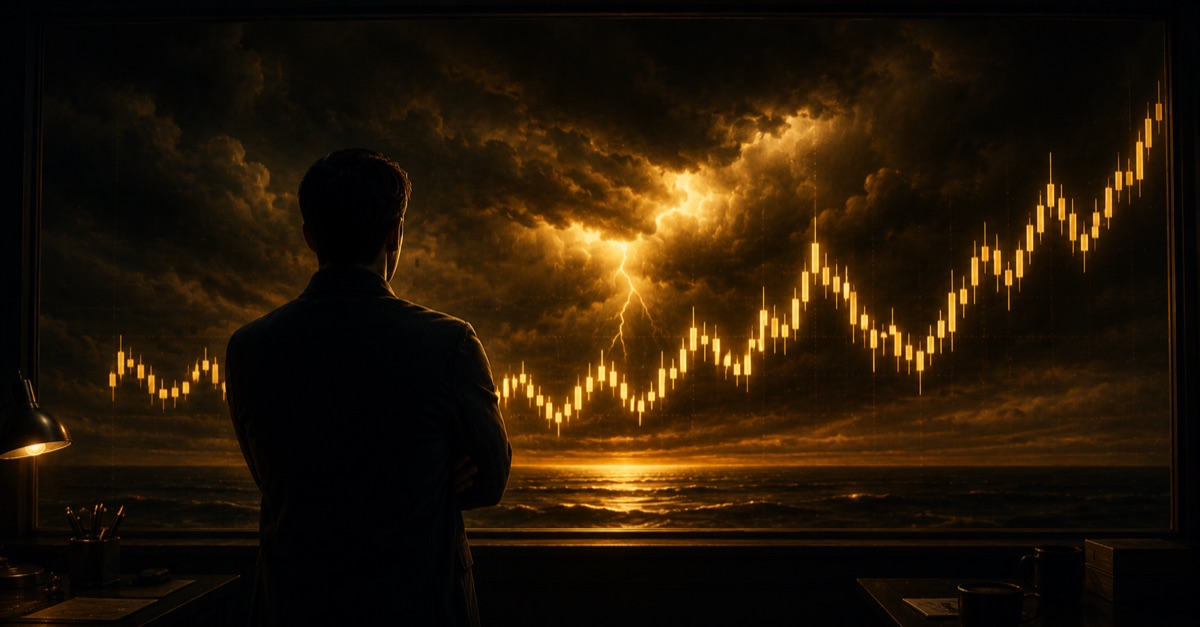
A few weeks back, gold moved more than 36 points in a single stretch. The headlines were about US–Iran tension, and you could feel the fear and the greed hit the market at the same time. Within minutes, some traders had made their week. Within the same minutes, others had erased a month of careful work. Same chart. Same candle. Two completely different outcomes.
I’ve watched this movie enough times to know how it usually ends for the person who tries to “catch the news.” So let me talk to you honestly, the way I’d talk to a friend who called me right before a rate decision, thumb hovering over the buy button.
This isn’t a guide to profiting from news. It’s a guide to surviving it. Because in this business, the trader who is still standing after the storm is the one who eventually wins. Before we go further, one thing needs to be said plainly: most retail traders lose money trading gold and CFDs. This is education, not financial advice, and nothing here is a signal or a promise.
Why News Turns Gold Into a Different Animal
On a normal day, gold has a personality you can read. It breathes. It respects levels. It gives you time to think.
During a high-impact news release, a central bank rate decision, a CPI print, a sudden geopolitical flare-up, that personality vanishes. Liquidity thins out because the big players pull their orders back to avoid getting run over. Spreads widen. Price gaps. The “smooth” market you were trading turns into a set of stairs with missing steps.
Here’s what most people don’t understand until it costs them: your stop loss is a request, not a guarantee. In a violent move, price can jump straight past your stop and fill you somewhere far worse. That’s slippage, and news events are where it lives. The 36-point spike I mentioned didn’t travel in a straight, orderly line, it whipsawed. It spiked up, ripped down, then reversed again, hunting stops on both sides before anyone knew which direction actually mattered.
So the first mental shift is this: news doesn’t just make gold move fast. It makes gold move unfairly. The rules you rely on, clean fills, predictable spreads, orderly candles, are temporarily suspended. If you walk in expecting the usual rules, you’ll get taught an expensive lesson.
Why “Predicting the Number” Is a Losing Game
Every news event tempts you with the same fantasy: If I just guess right, I’ll ride the spike and bank a fortune.
Let me take that fantasy apart.
Even if you somehow predicted the exact CPI figure or the exact wording of a central bank statement, you still would not know how the market will react to it. I’ve seen gold rip higher on “bad” news and collapse on “good” news, because price had already positioned for one outcome and the crowd unwound the other way. The number is only half the equation. The reaction, the psychology of thousands of traders repricing all at once, is the half you can’t model.
And here’s the part that stings: to profit from a news spike, you need to be right about the number, right about the direction of the reaction, right about the timing, and get a decent fill in a market that’s actively working against you. That’s four coin flips in a row, in conditions designed to punish you. Betting your capital on that isn’t trading. It’s gambling with extra steps.
The professionals I respect don’t win by predicting the news. They win by not needing to.
The Framework: Before, During, and After
Here’s the posture I actually use. It’s not glamorous. It won’t give you a story to brag about at dinner. But it has kept me in this game for years, and staying in the game is the whole point.
Before the news: decide in advance, then get smaller or step aside.
The most important decisions are made before the candle prints, when your mind is still calm. Know what’s on the economic calendar for the week, the rate decisions, the inflation prints, the scheduled speeches. Geopolitics you can’t schedule, but the recurring big-ticket events you absolutely can.
Once you know what’s coming, you have three honest choices, and none of them is “bet big”:
- Reduce your size dramatically, so that whatever happens, the outcome can’t hurt you badly.
- Stand aside entirely and let the event pass, cash is a position, and often the best one.
- Protect what you already hold, if you’re in a trade with open profit, consider whether you want to be exposed through the event at all.
When our channel saw that volatility spike building around the US–Iran situation, the message to members wasn’t “here’s how to play it.” It was: make risk management your top priority and protect the profits you’ve worked to earn. That’s not caution for its own sake. That’s how you make sure there’s a “next trade” at all.
During the news: keep your hands still and widen your expectations, not your risk.
The moment the number drops, your job is mostly to not act. The first move is frequently a trap, a stop-hunt designed to shake out both the longs and the shorts before the real move begins. Chasing that first candle is how accounts die.
If you must have exposure through the event, understand that everything is wider now: wider spreads, wider swings, wider ranges. The mistake most people make is widening their stop to survive the noise while keeping their position size the same, which quietly doubles or triples their real risk. If anything, it should work the other way. Widen your expectation of how far price can travel, and shrink your position so that width can’t hurt you. Your risk per trade should get smaller when volatility gets bigger, not larger.
After the news: let the dust settle before you trust the chart again.
There is no prize for being first. Once the spike has fired and reversed and fired again, the market eventually shows its hand. Spreads normalize. A real trend, if there is one, establishes itself. That’s when the chart becomes readable again, and that’s when a patient trader can actually think.
Waiting isn’t weakness. Waiting is a decision. The trader who sits on their hands for twenty minutes after a CPI release, and then acts on a market that has calmed down, is playing a completely different, far saner game than the one who tried to front-run the candle.
Protect Capital First, Everything Else Is Second
I want to strip this down to the one idea that matters most.
Your capital is the only thing that lets you keep playing. Lose it, and it doesn’t matter how good your analysis becomes next month, you’re out. That’s why capital protection comes before profit, before being right, before everything.
News events are the sharpest test of that principle because they offer the loudest temptation. The spike is thrilling. The story you tell yourself, “this is the one”, is intoxicating. And that’s exactly why discipline has to be louder than adrenaline.
I’ve come to believe something that took me years to accept: success in this game isn’t about how many indicators you stack on your chart, or how often you’re right, or how clever your prediction was. It’s about mental discipline and emotional resilience. It’s about being the person who can watch a 36-point spike, feel the pull, and still choose the boring, correct thing, smaller size, or no trade at all.
The market will always offer you another chance. The only way to guarantee you can take it is to still be here when it comes.
A Word to the Trader Tempted by the Spike
If you’re reading this with a news event coming up and a plan to “just try it once,” I understand the pull completely. I’ve felt it. But ask yourself an honest question: if this trade goes against you in the worst way the spread and slippage allow, can your account absorb it and keep going?
If the answer is no, you don’t have a trade. You have a wager. And the house, the volatility, the slippage, the whipsaw, is built to win that wager over time.
The long game rewards the patient and punishes the greedy. That’s not a motivational slogan. It’s just the math of survival compounding in your favor.
Get the free Gold Empire survival sheet, a one-page guide to protecting your account through the kind of market this article describes. One email, no spam, unsubscribe anytime.
Frequently Asked Questions
Should I close all my trades before a big news release?
That’s a personal risk decision, not a rule I can make for you. What I can say is that many disciplined traders reduce their exposure or step aside entirely around scheduled high-impact events, precisely because fills and spreads become unreliable. The question to ask yourself is whether you’re comfortable holding through conditions where your stop loss may not protect you the way it normally would. If the honest answer is no, that tells you something.
Can’t I just use a wider stop loss to survive the volatility?
A wider stop without a smaller position is a trap, it simply increases how much you can lose. If you widen your stop to accommodate news-level swings, your position size has to come down to keep your actual risk the same or lower. Volatility going up should mean your risk per trade goes down, not up. Most people do the opposite, and that’s why news events wreck them.
Isn’t standing aside just missing opportunity?
I used to think so. Now I see cash as a legitimate position and patience as an edge. You don’t get paid for the trades you avoid, but you also don’t lose on them, and in a game where survival is everything, avoiding a catastrophic loss is worth more than catching a lucky spike. There will always be another setup. There isn’t always another account.
About the Author, Matthew
I’m Matthew, and I trade and study gold (XAU/USD) the slow, unglamorous way, risk first, ego last. I’m not interested in selling anyone a dream about getting rich from a single candle. I’ve been around this market long enough to have made the painful mistakes myself, and most of what I teach is simply the discipline I wish someone had drilled into me earlier. Through Gold Empire, I share how I think about volatility, risk, and the long game, because I believe the traders who last are the ones who learn to protect their capital before they chase a profit. Trade calm. Trade small when it’s loud. Stay in the game.
Risk disclaimer: This article is for educational purposes only and does not constitute financial, investment, or trading advice. Trading gold, forex, and CFDs carries a substantial risk of loss, and most retail traders lose money. Any numbers or scenarios mentioned are generic illustrations, not recommendations, and are not entry, stop-loss, or take-profit advice. Past performance does not guarantee future results. You are solely responsible for your own decisions, consider your circumstances carefully and seek independent, licensed advice before risking capital you cannot afford to lose.
You reached the end. Nice work. 👏
Read the lesson through, then claim your 100 XP and climb a rank in the Survival School. Progress saves on this device, no sign-up, no email.
One step first
Where should we send the Gold Survival Sheet?
Leave your email and we will send the free one page checklist, then take you straight to the Telegram channel.
No cost and no obligation. Educational only, not financial advice, and nothing here promises a return. Unsubscribe any time in one click.
Related from Gold Empire
Leave a Reply