

Most people choose a broker on spread, platform and withdrawal speed, and never once ask what happens if your forex broker goes bust. It is an uncomfortable question because it has nothing to do with trading well. You can have a sound method, disciplined sizing and a year of patient work, and still lose the account to an event that happens in a legal filing rather than on a chart. The good news is that this is one of the few risks in this business you can inspect before you take it, using documents the regulators publish for free.
This article is about where your money actually sits, who stands behind it, and what the published compensation limits genuinely cover. I have used the regulators’ own numbers throughout, and I have shown my arithmetic so you can redo it.
What happens if your forex broker goes bust is a custody question, not a platform question
Three different failures get filed under the same worry, and they have almost nothing in common.
The first is an outage. The platform stops responding, you cannot close a position, and you sit there watching. That is painful and it is operational, but the firm still exists and your balance is still recorded. The second is the firm being unregulated in the first place, where there is no filing to read because nobody required one. The third, the one this article is about, is the firm ceasing to exist as a going concern while it is holding your money.
Only the third raises the question that matters: is the money you can see in your account balance actually yours in a legal sense, held apart from the firm’s own funds, or is it a number on a screen that represents a claim on a company that no longer has assets? Those are very different positions to be in, and the answer is not decided at the moment of failure. It was decided when you opened the account and chose which jurisdiction you were dealing with, which is worth thinking about before how to open a gold trading account becomes a form you click through.
Six firms out of seventy four, which is what the CFTC file actually shows
In the United States, firms that hold retail forex money must file monthly financial reports with the CFTC, and the regulator publishes a summary spreadsheet every month. Anyone can download it. I pulled the file for the month ended 31 July 2026 and counted.
Seventy four firms are listed. Of those, exactly six report any retail forex obligation at all. Their combined retail forex obligation is 471,577,840 US dollars. Across every firm in that same file, customer assets held in segregation total 382,273,801,362 US dollars, so the entire regulated retail forex pool is 0.123 per cent of the customer money sitting in that system.
Sit with that proportion for a moment. The retail forex corner of the regulated American market is a rounding error next to the futures business it shares a rulebook with. It is not that retail forex is small worldwide, it plainly is not. It is that most of the firms advertising to retail traders are not in this file, because they are not registered here. When someone tells you a broker is large, the honest follow up is: large where, and filed with whom.
A firm’s own capital is not a fund that pays you back
The same file reports each firm’s adjusted net capital, which is the regulatory measure of the firm’s own financial cushion. It is tempting to read that as protection money set aside for clients. It is not. It is the firm’s own resources, and comparing it with what the firm owes retail forex customers produces a spread wide enough to be worth seeing.
Set each firm’s adjusted net capital against its retail forex obligation for that month and the ratios run like this. GAIN Capital Group reports an obligation of 204,121,663 dollars against adjusted net capital of 82,904,419, which is 41 per cent. OANDA Corporation reports 132,445,959 against 33,191,483, which is 25 per cent. tastyfx reports 49,950,447 against 67,394,162, which is 135 per cent. Charles Schwab Futures and Forex reports 55,996,755 against 301,491,825, which is 538 per cent. Trading.com Markets reports 2,872,026 against 24,180,804, which is 842 per cent. Interactive Brokers reports 26,190,990 against adjusted net capital of 10,238,479,537, which is roughly 39,092 per cent.
From the lowest to the highest, that is a factor of about 1,560.
Now the important part, because this is exactly where a number like that gets misused. A low ratio is not evidence that a firm is unsafe, and I am not suggesting it is. The ratio mostly reflects what else the business does. A firm whose main activity is retail forex will naturally show a smaller multiple than a diversified broker for whom retail forex is a side line, and both can be perfectly compliant with the capital rules that apply to them. What the spread tells you is something more basic: adjusted net capital is not a client protection pot, and a firm being well capitalised in the regulatory sense is a statement about the firm, not a guarantee attached to your balance. If you want to judge a firm, judge the custody arrangement and the authorisation, which is a different exercise from the one in best broker for gold trading and sits alongside knowing what an ECN account actually changes about execution.
What a compensation scheme promises, and exactly where it stops
Compensation schemes are the part people half remember and badly overestimate. In the United Kingdom the Financial Services Compensation Scheme covers eligible investment claims up to 85,000 pounds per eligible person, per firm, for firms that failed after 1 April 2019. The FSCS states the condition plainly: the PRA or the FCA must have authorised the provider or adviser, as well as regulated the service and product it provided. It may protect you where a provider goes out of business and there is a shortfall in the money or assets it was holding for you, and it does not pay for investments that simply lost value.
Two words in there carry most of the weight. Per firm means the cap is not per account and not per currency. Eligible means the authorisation has to be real and has to cover what you were actually doing.
Separately, across the European Union, the measures agreed by ESMA for retail contracts for difference include negative balance protection on a per account basis, alongside leverage caps and a margin close out rule. Negative balance protection answers a different question from a compensation scheme. It limits what you can lose to the funds in the account while the firm is running. It says nothing about recovering those funds if the firm stops running.
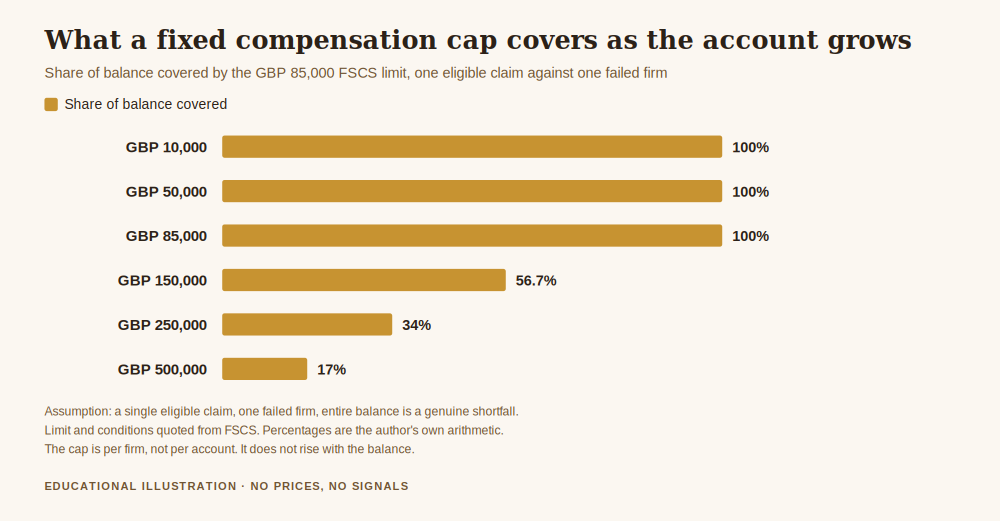
The arithmetic of a fixed cap is worth doing once, properly, because a cap does not scale with you. Assume a single eligible claim against one failed firm, and assume the whole balance is a genuine shortfall. At a balance of 10,000 pounds you are fully covered. At 50,000 pounds you are fully covered. At 85,000 pounds you are fully covered, right up to the line. At 150,000 pounds the cap covers 56.7 per cent and 65,000 pounds sits outside it. At 250,000 pounds it covers 34.0 per cent, leaving 165,000 pounds uncovered. At 500,000 pounds it covers 17.0 per cent, and 415,000 pounds is uncovered.
Which means the protection quietly stops being protection somewhere around the point where the account starts to matter to your life. Splitting changes the arithmetic, because the cap is per firm. The same 250,000 pounds held at one firm is 34.0 per cent covered, at two firms 68.0 per cent, and at three separately authorised firms it is fully covered. The catch is that splitting only works if the firms are genuinely separate authorised entities. Two brands owned by the same legal entity count once, and finding that out afterwards is an expensive way to learn it.
What this does and does not change
It does not mean any firm named here is in difficulty. Every one of them filed the report the rules require, and the figures are theirs. It does not rank brokers, and it is not a recommendation to use or avoid any of them.
The figures are also a snapshot. They describe one month, self reported by the firms, and they will be different next month. A monthly filing is evidence that a supervisory system exists and is producing public data, which is genuinely useful, rather than a live guarantee of solvency.
What it does change is the shape of the question. Custody and authorisation are decided when you open the account, they cost nothing to check, and they are invisible in every spread comparison you will ever read. That puts them in the same family as position sizing: unglamorous decisions made in advance that quietly determine whether an account survives an event nobody scheduled. It is the same logic as everything under risk management in gold trading, applied one level further out, to the firm rather than the trade.
Get the free Gold Empire survival sheet, a one-page guide to protecting your account through the kind of market this article describes. One email, no spam, unsubscribe anytime.
Frequently asked questions
How do I check whether my broker is actually regulated where it claims to be?
Go to the regulator’s own register rather than the broker’s website, and match the exact legal entity name, not the brand. A group can hold a licence through one subsidiary while your account is opened with a different one in another jurisdiction. The entity named on your client agreement is the one that matters, and it is the one you should be searching for.
Does negative balance protection mean my money is safe?
No, and this is the most common mix up. Negative balance protection limits your loss to the funds in the account while the firm is operating normally, which is a real protection against a gap moving against you. It is not a custody arrangement and it is not compensation. It does not help you recover funds from a firm that has failed.
Is a bigger broker automatically safer?
Size tells you about the business, not about your claim. As the figures above show, the relationship between a firm’s own capital and what it owes retail forex customers varies by a factor of over a thousand, and a firm can be large in one activity while its retail forex book is small. Authorisation, custody and the applicable compensation scheme are what determine your position, and none of those is a function of size.
Should I split my account across several brokers?
That is a decision about your own circumstances and I am not going to make it for you. What I can tell you is the arithmetic: a per firm cap means the covered share of a fixed total rises as you split it across separately authorised firms, from 34.0 per cent at one firm to full coverage at three, on a 250,000 pound balance. Against that, more firms means more account admin, more platforms and more places to get something wrong.
Where did the numbers in this article come from?
The firm level figures are from the CFTC’s published Financial Data for FCMs, the FCM webpage update for the month ended 31 July 2026, linked above. Counting the firms, totalling the retail forex obligation, dividing it by total customer assets in segregation, and calculating each capital to obligation ratio are all my own arithmetic on that file. The 85,000 pound limit and its conditions are quoted from the FSCS page linked above. The coverage percentages are simple division under one stated assumption: a single eligible claim against one failed firm where the entire balance is a genuine shortfall. No gold price appears anywhere in this article.
Where Gold Empire fits
Gold Empire is free to follow. Daily gold analysis with the reasoning written out, losing days included, plus an optional Kit for people who want the method in one place. There is no promise of profit here, because nobody honest can make one.
Checking who holds your money is the least exciting thing you will do this year and one of the few that cannot be undone later. It belongs next to risk management in gold trading, and if you want to know who is writing this, the about page covers it.
About the author
Matthew has spent a long time around gold, most of it learning things the slow way, and now writes them down so other people can learn them the fast way. He would rather spend an article on a filing cabinet than on a setup, because the filing cabinet is what decides whether the account is still there to trade. Nothing in this article is personal advice, and no entry, stop or target discussed should be treated as a signal.
This article is educational content about broker custody, regulatory capital reporting and compensation schemes. It is not investment advice, not a recommendation of any broker or jurisdiction, not an assessment of the financial condition of any named firm, and not a solicitation to trade. Firm level figures are taken from the monthly Financial Data for FCMs published by the CFTC for the month ended 31 July 2026 and are self reported by the firms concerned; they describe one month and will change. Compensation limits and conditions are quoted from the FSCS, and the retail CFD measures referenced are those agreed by ESMA. Eligibility, limits and protections differ by jurisdiction, by entity and by product, and they change over time, so check the current rules of the scheme that actually applies to your account and read your own client agreement rather than relying on a general description. Trading carries risk of loss.
One step first
Where should we send the Gold Survival Sheet?
Leave your email and we will send the free one page checklist, then take you straight to the Telegram channel.
No cost and no obligation. Educational only, not financial advice, and nothing here promises a return. Unsubscribe any time in one click.
Leave a Reply