
Almost nobody asks what is a bid ask spread before they start trading. The question arrives later, usually in a very specific moment: a position closed at a level you did not expect, or a trade that went your way and still came back flat. About 48 messages in my inbox mention the spread, counted by keyword rather than by any survey, and they almost all arrive in that same tone of mild betrayal. One person wrote: “I think my spread is too big, it just closed the two other orders.” Another put it more precisely: “I am talking about the stop loss being hit, because the spread is not fixed and it hit the stop with that spread.”
Neither of them had been cheated. Both had run into the single most ordinary feature of every market on earth, and nobody had explained it to them first. So let me do that, and then let me show you what it actually costs over a year, because that second part is where the survival argument lives.
What is a bid ask spread, in plain terms
At any moment there are two prices, not one. The bid is the price at which you can sell right now. The ask, sometimes called the offer, is the price at which you can buy right now. The ask is always the higher of the two, and the gap between them is the spread.
That single chart line you watch is a simplification. It is usually the bid, or sometimes the midpoint, and the price you actually transact at is on the other side of the gap. This is why a position shows a small loss the instant it opens. You bought at the ask and the platform is immediately marking you against the bid. Nothing has gone wrong. You are simply seeing the cost of entry, charged up front.
It also explains the stop loss complaint above. If your stop is a sell order, it is triggered off the bid. If you are short, your stop is a buy and it is triggered off the ask. In both cases the spread sits between the number on your chart and the number that actually fires. When the spread widens, which it does around news and at the daily rollover, that distance grows, and a stop that looked comfortable becomes a stop that is already touching.
Why the gap exists at all
The spread is not a fee someone invented to take money from retail traders. It is the price of immediacy.
Whoever sells to you at the ask is taking the other side of your trade and carrying the risk of holding that position until someone else wants it. They are willing to do that because they capture the gap. Remove the spread and nobody has any reason to stand ready to trade with you at any hour you choose, and the thing you would lose is not a few points, it is the ability to get filled at all.
This is also why spreads differ so much between instruments and between moments. Where there is enormous two way flow, the gap is thin, because many participants compete to capture it. Where flow is thin or uncertain, the gap widens, because the risk of being left holding the position is higher.
The scale of that flow is worth seeing. The Bank for International Settlements measures global foreign exchange activity every three years, and its April 2025 survey put turnover at 9.6 trillion US dollars a day, up 28 per cent from 7.5 trillion three years earlier. Spot trading alone ran at about 3 trillion a day, which is 31 per cent of the total. That depth is exactly why the headline instruments quote tight most of the time, and why the gap still opens when everyone steps back at once.
What the spread actually costs you
Here is where most explanations stop, and where the useful part begins. The right way to measure the spread is not in points, because points mean nothing on their own. Measure it as a share of the risk you are taking.
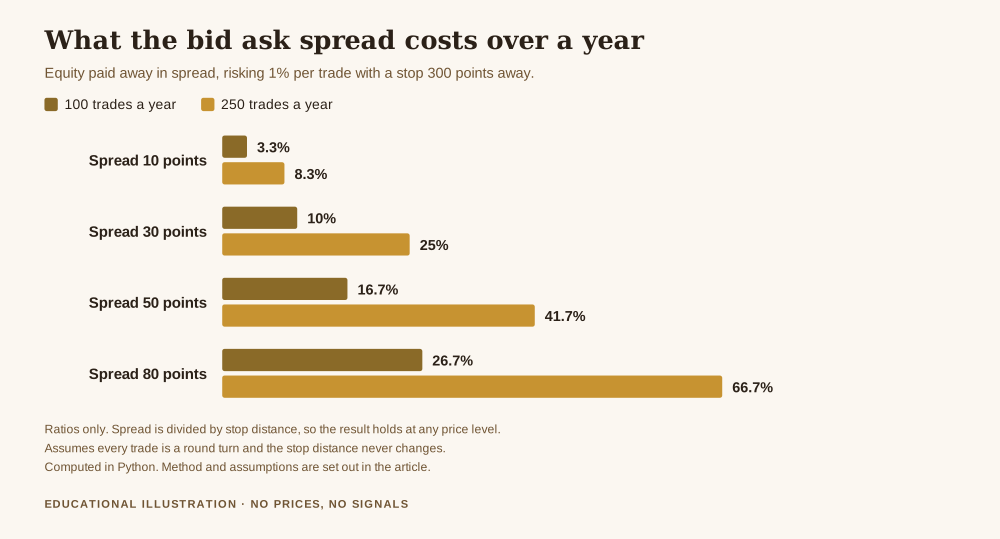
Take a simple, stated set of assumptions. You risk 1 per cent of the account per trade, and your stop sits 300 points from entry. Now divide the spread by that stop distance. Because it is a ratio, the answer holds at any price level, which is why there are no prices anywhere in this article.
A 10 point spread is 3.3 per cent of your risk budget. A 30 point spread is 10 per cent. A 50 point spread is 16.7 per cent. An 80 point spread, which is not unusual in fast conditions, is 26.7 per cent of everything you put at risk on that trade. More than a quarter of your risk is gone before the market has done anything at all.
Another way to feel it: divide the stop distance by the spread and you get the number of trades it takes for accumulated spread to equal one entire stop loss. At 30 points, that is 10 trades. Ten round turns and you have paid away a full losing trade, without having lost one.
Now extend it over a year. At 250 trades a year and a 30 point spread, the spread alone consumes 25 per cent of all the capital you risked. At 80 points it consumes 66.7 per cent. Those are not exotic numbers. That is an ordinary active trader paying away most of a year’s risk budget to the gap.
The part that quietly changes your odds
There is a subtler effect, and it is the one that makes a sound method look broken. The spread changes the win rate you need in order to break even.
Suppose you take trades with a one to one reward to risk, stop at 300 points, target at 300 points. Without costs you need to win half the time. Add a 30 point spread and your winner now travels 270 net points while your loser travels 330. Work through the algebra and your break even win rate becomes 55 per cent. With an 80 point spread it becomes 63.3 per cent.
Read that again, because it is the whole argument. A trader with a genuine 52 per cent edge is profitable on paper and losing money in practice, and nothing in their chart reading is at fault. The method was never the problem. The cost structure was. One reader described the experience without knowing the mechanism: “It took me out. No profit because of the spread, but no loss either.”
Where the benchmark price comes from
It is worth knowing that the two way quote you see is not the same thing as the official reference price for gold. The LBMA Gold Price is set twice each day in auctions operated and administered by ICE Benchmark Administration, commencing at 10:30 and 15:00 London time.
Those are two different mechanisms doing two different jobs. An auction gathers everyone at one moment to discover a single clearing price, which is why it is used for settlement and valuation. A continuous two way quote lets you trade at any second, and the spread is what you pay for that convenience. Understanding that distinction answers a question I get often, which is why a price published somewhere official does not match the one on a platform.
What to do about it
You cannot negotiate the spread away, so the practical response is to stop letting it be invisible.
Measure it as a ratio, not in points. The question is never whether a spread is big, it is what share of your stop distance it represents. The same spread is trivial on a wide stop and ruinous on a tight one, which is the real reason very short term trading is harder than it looks: the shorter the stop, the larger the spread looms in proportion.
Count your round turns. If you know your typical spread and your typical stop distance, you can work out in a minute what the gap costs you per year. Most people have never run that number, and it is usually the largest single cost in the account.
Watch when it widens. Around scheduled news and at the daily rollover, the gap opens, and orders resting inside that window can be triggered by the spread rather than by any real move. Knowing that is not a trading signal, it is simply knowing when the ground is uneven.
And compare costs honestly. One reader asked the right question: “Is the spread or the commission higher on this account, and which one is better?” The only way to answer it is to add both into a single per round turn figure and compare that, because an account advertising a tighter spread while charging a commission can easily be the more expensive of the two.
Get the free Gold Empire survival sheet, a one-page guide to protecting your account through the kind of market this article describes. One email, no spam, unsubscribe anytime.
Frequently asked questions
What is a bid ask spread in simple terms?
It is the gap between the two prices quoted at any moment. The bid is where you can sell, the ask is where you can buy, and the ask is always higher. You pay that gap on entry, which is why a new position shows a small loss immediately.
Why does my trade show a loss as soon as I open it?
Because you bought at the ask and the platform marks your position against the bid. The difference is the spread. Nothing has gone wrong and no money has been taken unfairly, you are seeing the cost of entry charged up front.
Can the spread trigger my stop loss?
Yes, and it is one of the most common surprises. A stop on a long position is executed against the bid, and a stop on a short against the ask, so the gap sits between the chart price and the level that actually fires. When the spread widens around news or rollover, a stop that looked safe can be reached without the market making the move you were watching for.
Is a zero spread account actually free?
No. Accounts advertising very tight or zero spreads usually charge a commission instead, so the cost has moved rather than disappeared. Add the spread and the commission into one figure per round turn and compare accounts on that single number.
How much does the spread really cost over a year?
More than most people estimate. On the assumptions used here, risking 1 per cent per trade with a stop 300 points away, a 30 point spread takes 10 per cent of your risk budget on every trade, and across 250 trades a year it consumes 25 per cent of everything you risked. Substitute your own spread, stop distance and trade count, the method is in the article.
Where this fits
Gold Empire is free to read and stays free. I spend most of my week reading messages from people somewhere in the middle of a hard stretch, and the spread is one of the handful of things that quietly decides how long an account survives. The free gold survival sheet is a one page summary of how to keep an account alive through the conditions that end most of them, and there is an optional kit for people who want the longer version. There is no profit promise attached to any of it, because anyone promising you one is telling you something they cannot know.
If this was useful, the natural next step is the pillar piece on risk management in gold trading, and two related pieces sit beside this one: raw spread accounts versus standard accounts, which compares the two cost structures directly, and how forex brokers make profit, which explains who is on the other side of that gap. If you are weighing execution models, what an ECN broker is covers the mechanics.
About the author
Matthew writes the Gold Empire blog and spends most of his week reading messages from people who are somewhere in the middle of a hard stretch. He is more interested in why accounts die than in why they win, on the grounds that the first question is answerable and the second mostly is not. The figures here are either from the published sources linked above or computed as ratios with their assumptions stated, so you can repeat them with your own numbers. You can read more about Gold Empire and Matthew here.
This article is educational and general in nature. It is not financial advice, and it does not account for your circumstances, your jurisdiction, or your risk tolerance. Nothing here is a recommendation to use or avoid any particular firm, and no entry, stop or target discussed should be treated as a signal. Trading leveraged products carries a substantial risk of loss.
One step first
Where should we send the Gold Survival Sheet?
Leave your email and we will send the free one page checklist, then take you straight to the Telegram channel.
No cost and no obligation. Educational only, not financial advice, and nothing here promises a return. Unsubscribe any time in one click.
Leave a Reply