
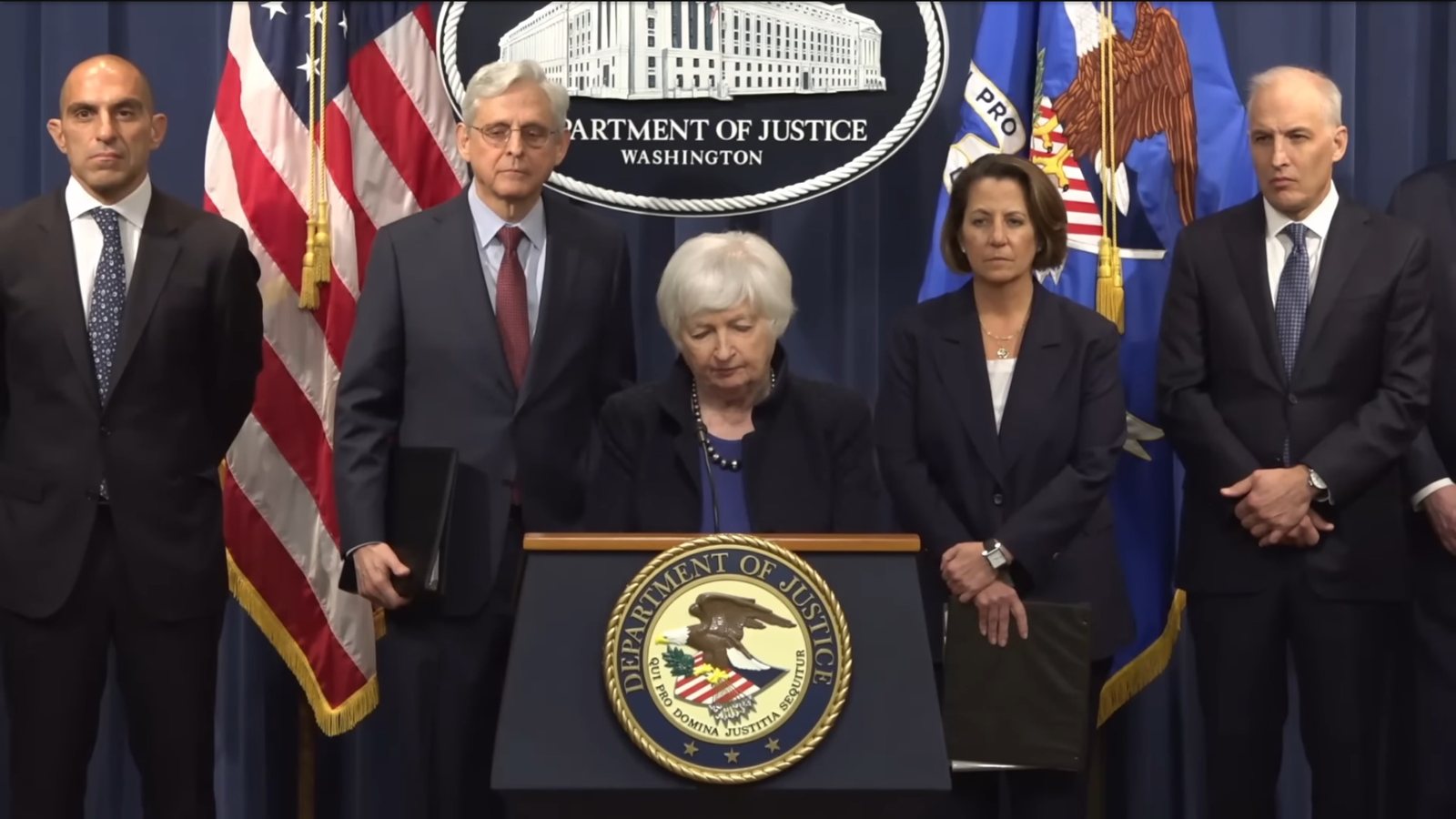
Photo: US Department of Justice, public domain, via Wikimedia Commons
Since the news broke on 29 October, one question has filled my inbox more than any chart question: is Binance safe to keep money on after a reported $6.3 billion theft? Some people asked it calmly. Others asked it at two in the morning, after watching their withdrawal button go grey. One reader put it simply: he did not want to get rich, he just wanted to be safe. That is the right instinct, and it deserves a careful answer rather than a loud one.
I am not going to tell you to leave Binance, or to stay. I run a small business around gold trading, and I judge any venue that holds my money like a supplier: what can go wrong, how big could it get, and what happens to me if it does? Here is that test for Binance, using only public numbers.
What happened in the $6.3 billion Binance hack
Binance disclosed a security breach on Thursday 29 October 2026. Early on Friday 30 October, Asia time, withdrawals were halted. The reported loss is about $6.3 billion, which has been described as the largest crypto theft on record. The FBI has attributed the attack to North Korea’s TraderTraitor group, the same group previously linked to the $1.5 billion theft from Bybit in 2025.
Withdrawals came back in phases on Sunday 1 November. The first window opened between 06:00 and 09:00 UTC and covered the major coins, including Bitcoin, Ether, BNB, Solana and XRP, plus the two big stablecoins, USDT and USDC. Other coins were described as “still undergoing repeated security audits”, with no timeline given, according to Business Today. One detail matters more than it looks: deposits were never suspended. Money could go in the whole time. For a while, only some of it could come out.
Binance says it will absorb the loss itself rather than pass it on to customers, and that about 95% of the stolen assets had been replenished by 1 November. The remaining 5% is mostly tokens outside the top 10. Investigators are looking at a possibly compromised engineer laptop, and Binance says it found no evidence that private keys were exposed. It also reports that withdrawal volumes are now declining and stabilising, as covered by Yahoo Finance.

Source: Reuters via Investing.com, Yahoo Finance and public reporting on Mt. Gox (2014), Coincheck (2018) and Bybit (2025).
Mt. Gox lost about $0.47 billion in 2014 and never recovered. Coincheck lost about $0.53 billion in 2018, and Bybit $1.5 billion in 2025. The scale has changed, and so have the attackers: organised, patient and state-linked.
Is Binance safe? What “safe” really means for an exchange
When people ask whether an exchange is safe, they usually mean: will I get my money back when I ask for it? That question hides four separate risks.
Custody: whose money is it, really?
When you hold coins or USDT on an exchange, you do not hold them like cash in your pocket. You hold a claim. The exchange keeps the assets in its own wallets and shows you a balance. Most days that difference does not matter. During a hack, it is the only thing that matters.
A reader asking about another platform this year said he had never withdrawn yet and wanted to know how reliable they were with withdrawals. That is the right question for any venue. A balance you have never withdrawn is a balance you have never tested.
Proof of reserves versus the size of the hole
Binance publishes proof of reserves, meant to show it holds customer assets one for one. That is useful, but it is a snapshot of the day it was checked. It says nothing about money leaving through the back door.
That is where the SAFU fund comes in. SAFU, set up in 2018, is Binance’s emergency insurance fund for users. It has typically been kept near $1 billion. Compare that with a $6.3 billion loss and you can see the problem: the hole was about 6.3 times the size of the safety net. Binance is covering the loss from its own resources, but that is a choice by a company with deep pockets, not a guarantee written into your account. A smaller exchange would likely not survive the same hit.
Regulation history
Safety is also about how a company has behaved in the past. In November 2023, Binance and its founder Changpeng Zhao pleaded guilty to US federal charges as part of a $4 billion resolution with the US Department of Justice. The photo at the top of this article is from that press conference. The case was about compliance failures, not lost customer funds, and Binance has since worked under closer oversight. Still, an honest answer to “is Binance safe” has to include it.
Withdrawal pauses
The last risk is the one people feel most sharply: the pause. From early on 30 October until the phased reopening on 1 November, many users could not get money out. For less common tokens, there was still no timeline. If your margin is stuck while the market moves, a pause is a risk event in its own right.
How markets reacted, and why gold did not act as a shield
You might expect gold to rise while crypto shakes. That is not what happened this time. Based on daily closes from Yahoo Finance, Bitcoin fell about 4.3% on 29 October, the day the breach was disclosed. Gold futures then fell about 3.3% on 30 October, one of the biggest daily drops of the past six months.
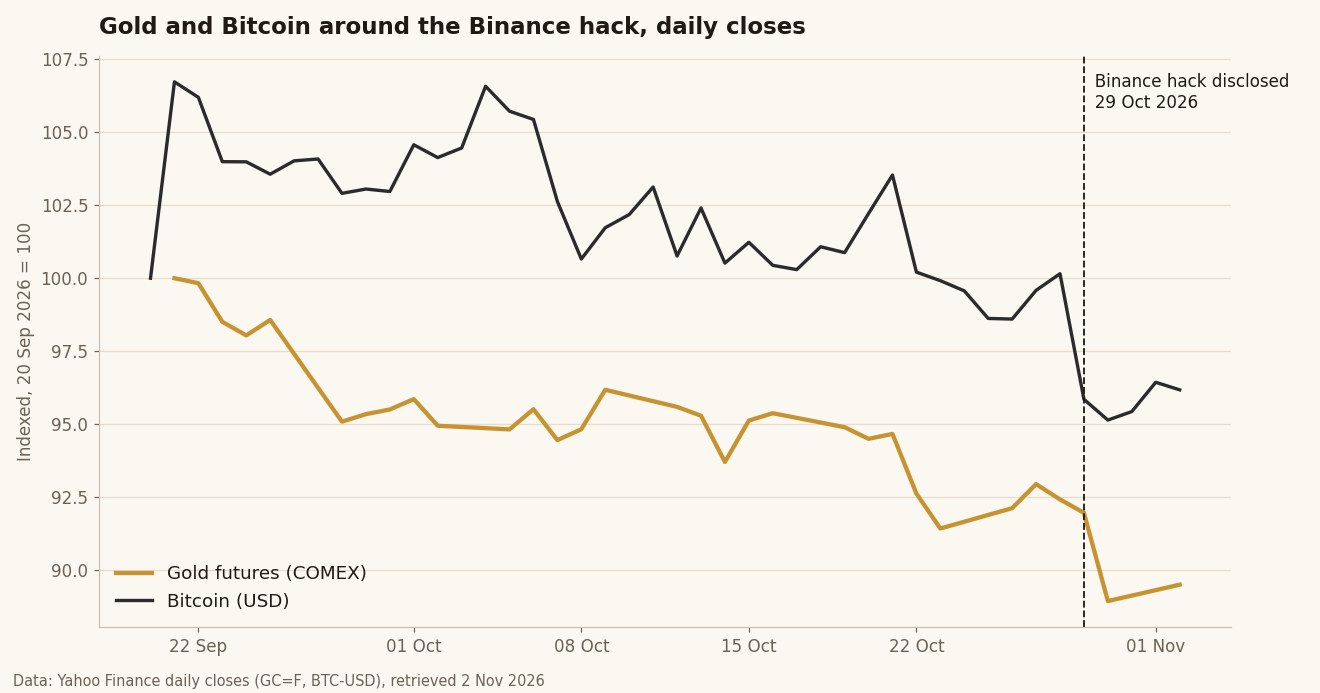
Source: Yahoo Finance daily closes, retrieved 2 November 2026. Chart by Gold Empire.
Gold, Bitcoin and stocks all fell together that week. Analysts have tied the broad sell-off mostly to worries about AI investment, sticky inflation and tighter liquidity, rather than to the hack alone. Gold is also down roughly a quarter from its January 2026 record. The lesson: market risk and venue risk do not take turns. They can arrive in the same week.
How often does gold move sharply? Over the last 126 trading days, May to November 2026, gold futures moved 2% or more in a day on 20 days (16%), and 1% or more on 55 days (44%). A paused withdrawal on a day like that is very different from one on a quiet day.
Owning gold versus holding a USDT gold contract
This is the part I most want gold traders to understand. In January 2026, Binance launched USDT-settled perpetual futures on gold and silver, as reported by DL News. The gold contract has reportedly been offered with up to 50x leverage, through an entity regulated in Abu Dhabi Global Market. Binance also lists a PAXG perpetual with up to 75x leverage, and a Tether Gold perpetual whose monthly volume hit a record $6.4 billion in March 2026.
None of these is owning gold. You hold a USDT-margined contract on an exchange, so you carry two risks stacked together: gold going against you, and the exchange being hacked or frozen. A bar in a vault does not become stuck because an engineer’s laptop was compromised. A contract can.
Leverage makes the stack heavier. The loss on your margin is roughly the adverse move multiplied by your leverage. A 2% move against you costs 10% of your margin at 5x, 20% at 10x, 40% at 20x, and 100% at 50x. At 75x, a move of just 1.33% is enough to wipe the margin out. That is before fees and funding, and gold moved 2% or more on about one day in six. Some channels leave this part out. I would rather you see it.
If you want the longer version of this comparison, I have written about gold CFDs versus physical gold and about the difference between gold and gold futures.
A practical checklist for a gold trader
There is no single right venue, but there are habits that stop one bad week from becoming a disaster.
Do not keep everything on one venue
No single exchange or broker should hold more than you could survive losing access to for a few weeks. You are not predicting a failure, just making sure your business keeps running if one comes. I wrote about the broker version of this in what happens if your forex broker goes bust, and the logic is the same for exchanges.
Withdraw what you do not trade
Money on a trading venue should be money you are using as margin. Profits and spare capital belong somewhere you control. Make small test withdrawals so you know the route works before you need it. If a withdrawal ever gets stuck, my article on why you can’t withdraw from a brokerage account covers the usual reasons and what to do.
Lock down your account, because scammers follow hacks
After every big hack, fake “withdrawal” and “verification” emails surge, asking you to click a link to “release” your funds. Use app-based two-factor authentication, not SMS. Turn on the anti-phishing code, which puts your personal word in every genuine email. Never log in from an email link. As one reader told me, the world is full of scammers, and they are busiest right after bad news.
Know exactly what you hold
Write down in one sentence what you own: metal, a fund share, a CFD, or a USDT contract on an exchange. If you cannot, you do not yet know your risks.
Size for the bad week, not the good one
Choose leverage as if the market and your venue could both go wrong in the same week. Low leverage will not stop a hack, but it buys time.
So, should you keep money on Binance?
Binance has shown it can absorb a loss far larger than its insurance fund and reopen withdrawals within days. Few exchanges could. It has also shown that a record theft can happen there, that withdrawals can pause, and its past includes a $4 billion guilty plea. Both are true.
No exchange is safe in an absolute sense. The better question is how much money you could live with having stuck, and for how long. Answer that, and the right amount to keep on Binance, or anywhere, becomes clear.
Where this fits in Gold Empire
Gold Empire is free to read. I run it as a business, and the part I care about most is helping people keep their accounts alive. The free gold survival sheet is a one-page checklist for weeks like this one. You can get it at the survival sheet page. If you want to follow along day to day, the free Gold Empire Telegram channel is where I share how I read gold each day. No profit promise comes with any of it, because nobody can honestly make one.
Get the free Gold Empire survival sheet, a one-page guide to protecting your account through the kind of market this article describes. One email, no spam, unsubscribe anytime.
Frequently asked questions
Is my money on Binance safe right now?
Binance says it is absorbing the $6.3 billion loss itself, that about 95% of the stolen assets were replenished by 1 November, and that withdrawals for major coins and USDT and USDC have resumed in phases. Whether that is safe enough depends on how much you hold there.
Does the SAFU fund protect all users?
SAFU is an emergency fund that has typically been kept near $1 billion. The 2026 loss was about 6.3 times that size, so SAFU alone could not have covered it. Binance is covering the gap itself, a company decision, not a legal guarantee.
Did Binance stop deposits during the hack?
No. Deposits were never suspended. Withdrawals were halted early on 30 October and resumed in phases from 1 November.
Is a gold perpetual on Binance the same as owning gold?
No. It is a USDT-margined contract held on the exchange. You carry the market risk of gold plus the exchange risk of hacks and paused withdrawals.
How do I spot a fake Binance email after the hack?
Turn on the anti-phishing code so every genuine email carries your personal word. Distrust any message about “releasing” funds and never log in through an email link.
About the author
Matthew writes the Gold Empire blog and runs it as a small business built around gold trading. He is more interested in why accounts fail than in why they win. The figures in this article come from the public sources linked above or are simple calculations with their assumptions stated, so you can check them yourself. You can read more about Gold Empire and Matthew here.
This article is educational and general in nature. It is not financial advice and not a recommendation to use or avoid any exchange or broker. Trading leveraged products carries a high risk of loss, and you can lose more than you expect.
One step first
Where should we send the Gold Survival Sheet?
Leave your email and we will send the free one page checklist, then take you straight to the Telegram channel.
No cost and no obligation. Educational only, not financial advice, and nothing here promises a return. Unsubscribe any time in one click.
Leave a Reply