
Almost everyone who asks me how to avoid losing money in forex trading is really asking a different question. They want to know which setup wins, which session is safest, which indicator finally makes the chart make sense. I understand the instinct. But the traders I have watched survive their first two years did not get there by finding a better signal. They got there by fixing a handful of things that can be measured with a calculator, before the market ever entered the picture.
So this article is not a strategy. It is arithmetic. I want to show you where retail money actually goes, why a loss costs more than it appears to, and which of the leaks are inside your control. Some of it is uncomfortable. All of it is checkable, and I have shown my working throughout so you can rerun the numbers yourself and disagree with my assumptions.
To be clear from the start: no entry, stop or target discussed should be treated as a signal.
The base rate almost nobody quotes you
Start with the number that frames everything else.
When European regulators reviewed retail trading in leveraged products, they did not rely on anecdote. National regulators across the member states analysed real client accounts, and the European Securities and Markets Authority published what they found: 74 to 89 percent of retail accounts typically lose money, with average losses per client ranging from 1,600 to 29,000 euros.
Read that range again, because the width of it matters more than the headline. It is not a single figure from a single broker. It is a band drawn across different countries, different firms and different market conditions, and the floor of that band is 74 percent. Even in the friendliest jurisdiction studied, roughly three accounts in four ended up down.
I do not quote this to frighten anyone away. I quote it because it changes what a sensible goal looks like. If the base rate is that harsh, then the first job is not to make money faster than everyone else. The first job is to not be in the losing group, and those are genuinely different objectives that pull you toward different behaviour.
How to avoid losing money in forex trading starts with the recovery math
Here is the piece of arithmetic I wish someone had put in front of me on day one.
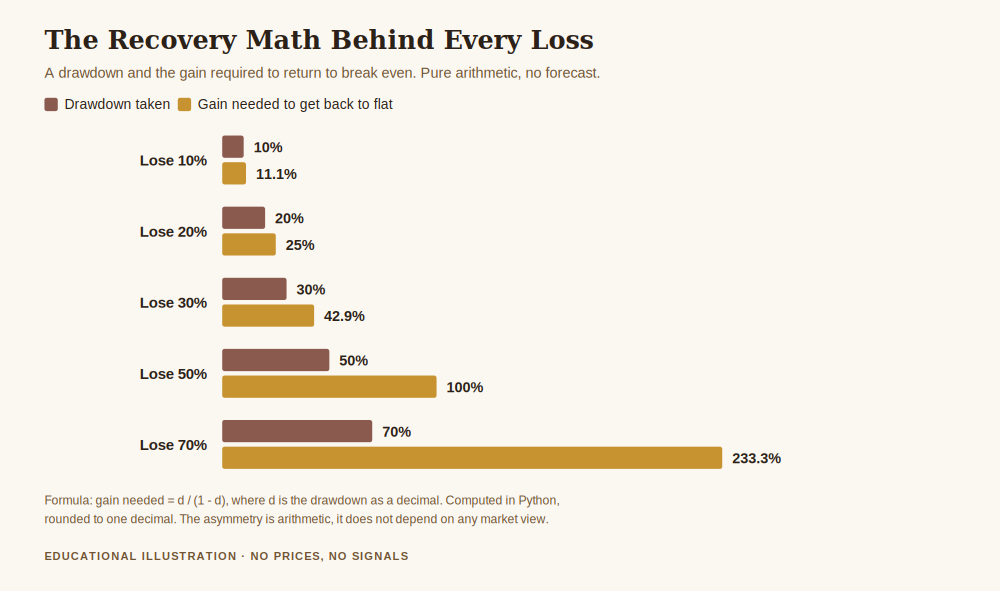
A loss and the gain that reverses it are not the same size. If you lose 20 percent of an account, you do not need 20 percent to get back to where you started, because you are now earning that percentage on a smaller balance. You need 25 percent. The formula is simple: the gain required equals d divided by (1 minus d), where d is the drawdown expressed as a decimal.
Run it across the range and the curve gets ugly quickly:
- Lose 10 percent, you need 11.1 percent to get back to flat.
- Lose 20 percent, you need 25 percent.
- Lose 30 percent, you need 42.9 percent.
- Lose 50 percent, you need 100 percent. You have to double what is left.
- Lose 70 percent, you need 233.3 percent.
I computed these in Python and rounded to one decimal place. There is no forecast in them and no assumption about gold, the dollar or anything else. It is the same arithmetic whether you trade metals, currencies or nothing at all.
What this tells you is that damage is not linear, so caution should not be linear either. The cost of a bad month is not the money, it is the months of competent trading you now have to spend undoing it. A trader down 50 percent is not halfway to recovery. They are facing a task most people never complete, which is why the account that reaches 50 percent down so rarely comes back.
The practical consequence is that the whole game is played in the shallow end of that table. Keeping your worst stretch inside 10 or 15 percent is not timidity. It is the thing that keeps recovery a routine matter rather than a heroic one. That is the reasoning behind the risk management guide that sits underneath everything else on this site, and it is why how much to risk per trade is the first number worth settling.
The leak you can measure before you place a trade
The second thing that quietly drains accounts is not a bad call. It is the cost of doing business, multiplied by how often you do it.
Every trade crosses the spread, which means you begin every position slightly behind. That is not a scandal, it is how dealing works, and I explain the mechanism in more detail in what the spread in gold trading actually costs you. What surprises people is the size of it once you multiply by frequency.
Let me do it with numbers you can change. Assume an account of 5,000 dollars, risking 1 percent per trade, which is 50 dollars. Assume a stop distance of 5 dollars in gold, which puts the position at 10 ounces. Assume a dealing spread of 30 cents. Those are my assumptions, not measurements, and your broker and your stop distance will move them.
On those numbers, the spread costs 3 dollars per round trip. That is 6 percent of the money you put at risk, gone before the market has done anything at all. Now multiply by frequency across a year:
- 1 trade a week, 52 a year: 156 dollars, or 3.1 percent of the account.
- 2 trades a week: 312 dollars, or 6.2 percent.
- 4 trades a week: 624 dollars, or 12.5 percent.
- 10 trades a week: 1,560 dollars, or 31.2 percent.
- 20 trades a week: 3,120 dollars, or 62.4 percent.
The trader taking twenty trades a week has to be right enough to overcome a headwind of more than 60 percent of their capital per year, purely in dealing costs. They usually describe their problem as a strategy problem. It is an arithmetic problem, and no strategy fixes it, because the cost is charged on activity rather than on accuracy.
This is the most encouraging finding in the whole article, because frequency is entirely yours to set. You do not need a better forecast to cut that number. You need fewer, more deliberate trades, and the saving is guaranteed rather than hoped for. It is also why who you trade through is a decision worth taking seriously rather than settling in five minutes.
The loss that is not a market loss at all
There is a category of losing money that has nothing to do with trading, and it is larger than most people imagine.
The FBI’s Internet Crime Complaint Center publishes an annual report of what the American public actually reports losing. In its 2024 Internet Crime Report, total reported losses came to 16.6 billion dollars across 859,532 complaints. The single largest crime type by loss was not ransomware, not romance fraud, not tech support scams. It was investment fraud, at 6,570,639,864 dollars.
Investment fraud alone accounted for close to 40 percent of every dollar reported lost to internet crime that year. And the shape of it is familiar to anyone who has spent time in trading communities: a mentor with screenshots, a managed account promising a monthly return, a signal group where the wins are posted and the losses are not, a platform where deposits work smoothly and withdrawals develop problems.
I raise it because someone asking how to avoid losing money in forex trading is often, statistically, one bad decision away from a loss that no amount of risk management touches. Position sizing does not protect you from handing your capital to someone who has no intention of giving it back. Two habits do most of the work: never send money to an individual, and treat any promised return as disqualifying rather than attractive. A real market cannot promise a number, so anyone who does is telling you they are not operating in one.
What actually moves the odds
Put the three sections together and you get a short list that does not require you to predict anything.
Keep the worst stretch shallow, because the recovery curve is unforgiving and the cost of a deep drawdown is measured in months rather than money. Trade less often than feels natural, because the cost of activity compounds against you whether you are right or wrong. Refuse anything that promises a return, because the largest single category of reported loss is not the market at all.
None of that is a strategy, and that is the point. It is the floor a strategy stands on. Traders who skip the floor spend their first years discovering these numbers the expensive way, one account at a time, usually concluding that they need a better system when what they needed was a smaller size and a slower week. I have written elsewhere about the loop that keeps repeating when the floor is missing, and it is remarkably consistent from trader to trader.
The uncomfortable part is that none of this is fast. The arithmetic rewards patience and punishes urgency, and urgency is exactly what most people bring to a new account. If you are opening one, how to open a gold trading account walks through the practical setup, but the numbers above matter more than any of those choices.
A quick word before the questions
If this is the kind of explanation you find useful, the Gold Empire Telegram channel is where I post market context through the week, in plain language and without pretending anyone knows what happens next. The free Gold Survival Sheet is a one page checklist built around exactly these numbers, so the arithmetic is in front of you before you size a position rather than after.
Get the free Gold Empire survival sheet, a one-page guide to protecting your account through the kind of market this article describes. One email, no spam, unsubscribe anytime.
Frequently asked questions
Is it actually possible to avoid losing money in forex trading?
Not entirely, and anyone telling you otherwise is selling something. Losses are a normal operating cost of the activity. What is realistic is avoiding the losses that are structural rather than market driven: oversized positions, excessive frequency, and outright fraud. Those three are where most of the damage lives, and all three are inside your control.
Why do most retail traders lose money?
Regulators looking at real accounts found 74 to 89 percent of retail accounts losing. The common threads are leverage used to take size the account cannot absorb, trading frequency that multiplies dealing costs, and a recovery curve that turns a moderate drawdown into a problem that outlasts the trader’s patience.
Does trading more often improve my chances?
It reliably increases your costs and it does not reliably increase your edge. On the assumptions above, moving from one trade a week to ten multiplies the annual spread bill from about 3 percent of the account to more than 31 percent. That is a headwind you have to beat before you profit at all.
How big a drawdown is too big?
There is no universal figure, but the arithmetic gets punishing fast beyond 20 percent, where you already need 25 percent to recover. Past 50 percent you need to double what is left. Most traders find that setting a ceiling in advance, while calm, is the only version of this decision they can actually keep.
How can I tell if a signal service or mentor is a scam?
The clearest tell is a promised return, because no honest participant in a market can promise one. After that: pressure to deposit quickly, payments to an individual rather than a regulated firm, withdrawals that develop friction, and a public record that shows wins but not losses. Investment fraud was the largest single category of reported internet crime loss in 2024, so the base rate justifies the suspicion.
Do I need a bigger account to be safe?
A bigger account does not change the percentages, it only changes the currency amounts. What a bigger account does buy is the ability to take a sensible percentage risk while still trading a position size the platform supports. The percentages in this article behave identically at any account size.
Where this leaves you, and what we do about it
The honest summary is that avoiding losses is mostly a bookkeeping discipline dressed up as a market skill. The recovery curve, the cost of frequency and the base rate of fraud are all knowable in advance, and none of them require an opinion about where gold goes next. Getting them right will not make you money on its own. Getting them wrong will reliably take money from you regardless of how good your analysis is.
Gold Empire is a free Telegram channel where we work through market context together, in public, including the days the read does not work out. There is no promise of profit here, because there cannot honestly be one. What there is, is a group of people trying to stay in the game long enough for competence to matter.
If this was useful, the free Gold Survival Sheet is the natural next step. It is a one page checklist covering the size, the cost and the ceiling before you enter, and it is free to download with nothing to join.
About the author. Matthew writes the Gold Empire market notes. He spends most of his time on the unglamorous half of trading, position size, dealing costs and the arithmetic of recovery, on the view that surviving the first two years is what makes the rest of it possible.
Disclaimer: This article is general educational content about how leveraged markets work. It is not financial advice and it is not a recommendation to buy or sell anything. Trading leveraged products carries a high risk of losing money rapidly. No entry, stop or target discussed should be treated as a signal. Figures attributed to external sources are linked so you can check them, and figures I have calculated are shown with the assumptions they rest on so you can change them.
One step first
Where should we send the Gold Survival Sheet?
Leave your email and we will send the free one page checklist, then take you straight to the Telegram channel.
No cost and no obligation. Educational only, not financial advice, and nothing here promises a return. Unsubscribe any time in one click.
Leave a Reply