
Ask how do forex funded accounts work and most answers describe the brochure: you pay a fee, you pass a test, you trade a large account, you keep most of the profit. That sequence is accurate and it is also the least important part. The part that decides what happens to you is the rule set attached to the account, because those rules do not simply tell you how to behave. They set a hard ceiling on how much you are allowed to risk per trade, and that ceiling is usually far tighter than the one people arrive with. A trader who would survive a bad month on their own money can fail an evaluation in a single afternoon, not because the method stopped working, but because the method was never sized for the rules.
About 172 messages in my inbox mention funded accounts, challenges, evaluations or payouts. That is a keyword count across my own inbox rather than a survey, so read it as a measure of how often this comes up, not as a statistic about traders in general. The messages have a pattern. People rarely ask how the profit split works. They ask what happens now that they are close to a limit.
How do forex funded accounts work, the sequence behind the brochure
Strip out the marketing and there are four steps.
You pay a fee for an evaluation. The fee buys access to an account with a target and a set of limits. In most programmes the account you trade during the evaluation is a simulated one, which matters more than it sounds and comes up again below.
You hit a profit target without breaking a limit. Typically there is a profit target, a daily loss limit, an overall maximum loss, and a minimum number of trading days. Some programmes run this in two stages with a lower target in the second.
You are given a funded account. Depending on the firm this is either live capital or, again, a simulated account whose results the firm chooses to mirror with its own money. The limits usually stay.
You request a payout and split the profit. The split is the headline number in every advertisement, commonly somewhere between half and most of the gain, paid on a schedule with conditions attached.
Notice where the risk sits at each step. Your money is at risk at step one, in the fee. From step two onwards your money is not in the market, which is the genuine appeal, and the thing people say most often in my inbox. One reader put it simply: “Sir for now I can’t afford a large account so let me instead get a prop firm account.” Another wrote: “I am doing a prop firm challenge at the moment so I don’t have to risk my own money.” That is a real benefit and I am not going to talk anyone out of it. But the fee is spent whether you pass or not, and the limits are what decide which of those two happens.
The rule set is the product
The firm is not selling you capital. It is selling you a conditional claim on capital, and the conditions are the product. Five of them do most of the damage.
The daily loss limit. A cap on how much you may lose in one trading day, usually measured from the balance or equity at the day’s start, commonly in the region of 5 per cent. Breach it and the account is gone, even if the overall account is up.
The overall maximum loss. A floor under the account, often around 10 per cent of the starting balance, sometimes trailing upward as the account grows. This is the one that ends evaluations quietly over weeks rather than loudly in an afternoon.
Consistency rules. Some programmes cap how much of your total profit may come from a single day or a single trade. A trader can hit the profit target and still be refused for hitting it too unevenly.
News and holding windows. Restrictions on holding through scheduled high impact releases, or over a weekend, vary by firm and are a common accidental breach.
One account per person, and how accounts may be linked. This one surprises people. A reader wrote: “my payout got declined because I had two accounts with the same prop firm, and they ended up blocking both of them.” Whatever the merits in that particular case, the general lesson stands. The agreement defines what counts as one trader, and copying the same decisions across accounts is often treated as one strategy rather than two.
None of this is hidden. It is written in the rules page you clicked past on the way to the payment page. The reason it still catches people is that the rules are easy to read and hard to translate into a position size, which is the next section.
What a 5 per cent daily limit does to your risk per trade
Here is the arithmetic that should happen before any fee is paid, and it is arithmetic rather than opinion.
If you risk a fixed percentage of the starting balance on each trade, then a run of straight losses walks you toward the limit in steps you can count in advance. Against a 5 per cent daily loss limit:
- at 1 per cent risk per trade, it takes 5 straight losses in one day to breach;
- at 1.5 per cent, it takes 4;
- at 2 per cent, it takes 3.
Against a 10 per cent overall maximum loss the same risk settings take 10, 7 and 5 net losing trades respectively. Now put a probability next to those counts. If your method loses 6 trades out of 10, then three straight losses is 0.6 multiplied by itself three times, which is 0.216, or 21.6 per cent of days on which you take three trades. A three loss day is not a disaster scenario. On those assumptions it turns up roughly every 4.6 trading days.
That is the whole problem in one line. At 2 per cent risk with three trades a day, the event that ends your evaluation is an ordinary Tuesday.
A positive expectancy method still fails a fair number of evaluations
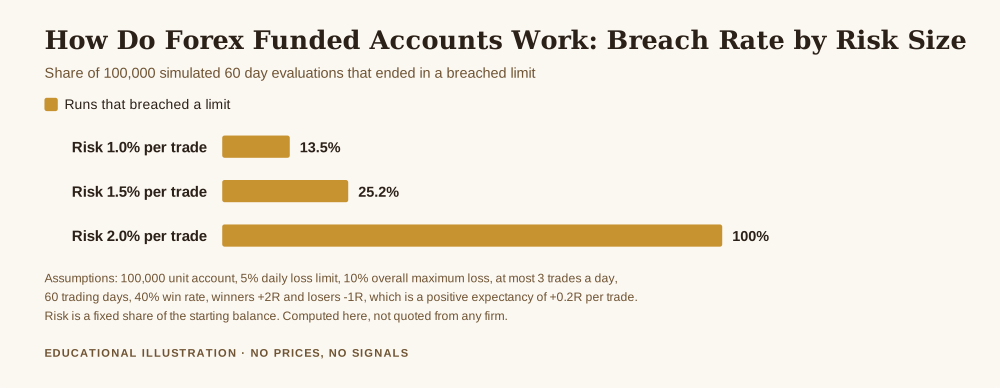
I ran this rather than guessed it, and the assumptions are all stated so you can rebuild it. Take a simulated account of 100,000 units, a daily loss limit of 5 per cent of the starting balance, an overall maximum loss of 10 per cent of the starting balance, at most three trades a day, and 60 trading days. Give the trader a 40 per cent win rate with winners of twice the risk and losers of one times the risk, which is a positive expectancy of 0.2 times risk per trade, so this is a trader who makes money over the long run. Risk is a fixed percentage of the starting balance. 100,000 runs at each setting.
- 1 per cent risk per trade: 86.5 per cent of runs got through 60 days without a breach. 13.5 per cent breached, every one of them on the overall maximum loss rather than the daily limit, with a median first breach on day 12.
- 1.5 per cent risk: 74.8 per cent survived, 25.2 per cent breached.
- 2 per cent risk: essentially none survived 60 days. The median first breach landed on day 3, and it was the daily limit every time.
Read the first line again, because it is the useful one. A trader with a genuinely profitable method, sized conservatively at 1 per cent, still lost the account in about one run in seven. Not through indiscipline. Through the ordinary clustering of losses that any random sequence produces. The 2 per cent line is not really a probability at all, it is the arithmetic above restated: three trades a day at 2 per cent cannot survive a 5 per cent daily limit, and a three loss day arrives within the first week.
The assumptions are mine and the real world is messier. Win rates drift, spreads widen, and nobody takes exactly three trades a day. Change any input and the output changes. What does not change is the shape: tightening the limit does not require you to be more disciplined, it requires you to be smaller, and most people arrive at an evaluation sized for their own account rather than for the rules.
One reader described exactly this adjustment: “I use your strategy to get a prop account, and because of the daily drawdown I can’t risk more than 1 per cent per position.” That is the correct response to the rules. Another described the other end of it: “I bought a 10k prop account but just have 250 dollars left to reach my max drawdown limit.” At that point the arithmetic has already decided; what is left is whether you stop.
You are not a brokerage customer, and that changes the questions
When you trade a funded account, the money you deposited was a fee, not a balance. Your claim on any profit comes from a contract with the firm, not from a client account at a broker. That is a different legal shape, and it changes which questions matter.
It is worth knowing what the regulated version of retail trading already looks like before judging the unregulated version. The United States Commodity Futures Trading Commission, in its customer advisory on things to know before trading forex, states plainly that two out of three forex customers lose money: over the year it describes, about one third of customers at registered over the counter forex dealers made a profit while two thirds lost. The same advisory makes a second point that applies with even more force to a programme that is not a broker at all: your deposits are not protected, and if a dealer disappears or goes bankrupt you may not get your money back. It also notes that in off exchange forex you are trading against the dealer, which controls the platform and the prices you see on your screen.
Translate that into questions for a funded account programme. Who is the counterparty on the trades, and is anything you do reaching a real market? If results are mirrored rather than live, what exactly are you being paid a share of? What happens to your pending payout if the firm stops trading tomorrow? Is the entity registered anywhere, and with whom? The CFTC’s own suggestion for the registered part of the industry is to check the register before depositing money, and the equivalent instinct serves you here: assume nothing about status from a website.
None of this makes these programmes fraudulent and I am not describing any particular firm. It makes them a commercial arrangement with a counterparty, which is a thing you can evaluate, rather than a job offer, which is how the advertising frames it.
What to do before you pay the fee
A short list, in the order I would actually do it.
Read the limits first and the profit split last. The split only matters in the branch where you pass. The limits decide which branch you are in.
Convert the daily limit into a maximum risk per trade, in writing. Decide how many losses in a row you will accept inside one day, divide the daily limit by that number, and that is your risk per trade. If the answer is uncomfortably small, that is information, not an obstacle to be argued with.
Check how the overall loss is measured. Static against the starting balance, or trailing against your peak equity? A trailing floor behaves very differently once you are in profit, and the difference is not a detail.
Find the consistency and news rules before your first trade, not after a good day.
Treat the fee as a cost you have already lost. It is the price of the attempt. If you need the fee back, you will size too large to get it back quickly, which is the mechanism that loses it.
And the one that has nothing to do with the firm: an evaluation does not fix a method. If your own account is not surviving, a funded account will apply a tighter version of the same test. One reader wrote: “I got funded. And I made a payout. But shortly after, I went into drawdown last week.” Passing is a filter, not a conclusion.
Get the free Gold Empire survival sheet, a one page guide to sizing your risk so a normal run of losses does not end your account, whether the account is yours or a funded one. One email, no spam, unsubscribe anytime.
Frequently asked questions
How do forex funded accounts work in one paragraph?
You pay a fee for an evaluation account that carries a profit target and a set of loss limits, usually a daily limit and an overall maximum loss. Pass without breaching a limit and the firm gives you a funded account, where you keep an agreed share of the profit and the limits generally continue to apply. The fee is spent whether you pass or not, and the limits, not the target, are what most attempts fail on.
Is a funded account real money?
Sometimes, and sometimes not. Many evaluations run on simulated accounts, and some funded stages do too, with the firm mirroring the results with its own capital. It is a fair question to ask directly before paying, because it determines what you are being paid a share of and what your claim is worth if the firm stops operating.
What risk per trade do the rules actually allow?
Divide the daily loss limit by the number of consecutive losses you are willing to take in a day. Against a 5 per cent daily limit, 1 per cent risk gives you five straight losses before a breach, 1.5 per cent gives four, and 2 per cent gives three. On a method that loses six trades in ten, three straight losses turns up on about 21.6 per cent of three trade days, so 2 per cent leaves almost no room.
Can a profitable trader fail an evaluation?
Yes, and routinely. In the simulation above, a method with positive expectancy of 0.2 times risk per trade still breached the 10 per cent maximum loss in 13.5 per cent of runs at 1 per cent risk, and in 25.2 per cent of runs at 1.5 per cent. Those figures come from the stated assumptions, not from any firm’s records, but the point survives any reasonable change to the inputs.
Are these programmes regulated?
Treat status as something to verify rather than assume, and remember what the regulated side already looks like: the CFTC advisory linked below says two out of three retail forex customers lose money, and that deposits are not protected if a dealer fails. A funded account programme is a contract with a counterparty, so the questions worth asking are who that counterparty is, what it is registered as, and what happens to your payout if it stops trading.
Is paying for an evaluation ever a reasonable decision?
It can be, if you are honest about what you are buying. You are buying attempts, at a fixed price, under rules tighter than your own. That is a sensible purchase for a trader whose method already survives and who cannot fund a larger account. It is an expensive way to find out whether a method works at all.
Where this leaves you
Gold Empire is free to follow and stays that way. The daily work on Telegram writes out the reasoning behind a level so you can judge it rather than copy it, there is a free survival sheet for anyone who wants the risk sizing material in one page, and there is an optional kit for people who want the longer version. Nothing here promises a return, because nobody can promise you one, and nothing here recommends any firm, programme or platform.
The foundation under this piece is risk management for gold trading. Beside it, the sizing question in its own right is in how much to risk per trade, the pattern this article is really about is in why you keep blowing your trading account, what to do after the limit has already been hit is in trading after a losing streak, the small account version of the same arithmetic is in how to trade gold with a small account, and if you decide to fund your own account instead, start with how to open a gold trading account.
Outside sources used here: the statement that two out of three forex customers lose money, with about one third of customers at registered over the counter forex dealers making a profit over the period described, the statement that customer deposits are not protected if a dealer disappears or goes bankrupt, the description of off exchange forex as trading against a dealer that controls the platform and the prices displayed, and the advice to verify registration before depositing money, are all from the United States Commodity Futures Trading Commission customer advisory Eight Things You Should Know Before Trading Forex. Every breach probability, consecutive loss count and percentage of days in this article is computed from the assumptions written out in the text, so you can reproduce all of it.
About the author. Matthew writes Gold Empire and spends most of his time on the unglamorous half of this job, which is making sure an account is still there next year. He reads the rules page before the profit split, on the theory that the split is marketing and the rules are the thing you are signing. The regulatory statements here are quoted from the CFTC advisory linked above, the simulation figures are computed from the assumptions stated in the text so you can repeat them with your own inputs, the reader comments are real messages shortened and stripped of anything identifying, the account sizes and limits are illustrative of a mechanic rather than the terms of any particular firm, this article is educational and is not investment, legal or tax advice, nothing in it recommends or warns against any specific firm, programme or platform, and no entry, stop or target discussed should be treated as a signal.
One step first
Where should we send the Gold Survival Sheet?
Leave your email and we will send the free one page checklist, then take you straight to the Telegram channel.
No cost and no obligation. Educational only, not financial advice, and nothing here promises a return. Unsubscribe any time in one click.
Leave a Reply