

A trading plan checklist is not a plan. The plan is the thinking you did when the market was closed and nothing was at stake. The checklist is the much smaller thing that survives contact with a live chart: the handful of lines you physically read before you are allowed to click. Most accounts are not lost because the plan was wrong. They are lost because the plan was not consulted, and the gap between having a plan and following one is wider, and more measurable, than almost anyone expects.
Why a trading plan checklist exists at all
Checklists did not come from trading. They come from places where competent, experienced, highly trained people were still making preventable mistakes under time pressure, and where somebody finally measured what happened when you forced the obvious steps to be spoken out loud.
The best documented example is surgical. A 19 item safety checklist was introduced across eight hospitals in eight cities, with outcomes collected from 3,733 patients before it and 3,955 after. The death rate fell from 1.5 per cent to 0.8 per cent, and inpatient complications fell from 11.0 per cent to 7.0 per cent. The study is Haynes and colleagues, New England Journal of Medicine, 2009, volume 360, issue 5, pages 491 to 499, DOI 10.1056/NEJMsa0810119, indexed at PMID 19144931.
Nobody involved was incompetent. They were busy, and the list caught the things busy people skip. That is precisely the trading situation, and it is worth being honest about the limits of the comparison: surgery is not trading, and no checklist has ever been shown to make anyone money. What the evidence supports is narrower and still useful. In complex, repeated, high stakes procedures, forcing the routine steps to be checked reduces the rate at which they get missed.
In trading, the steps that get missed are the ones that decide how much you lose when you are wrong.
The arithmetic that makes partial discipline useless
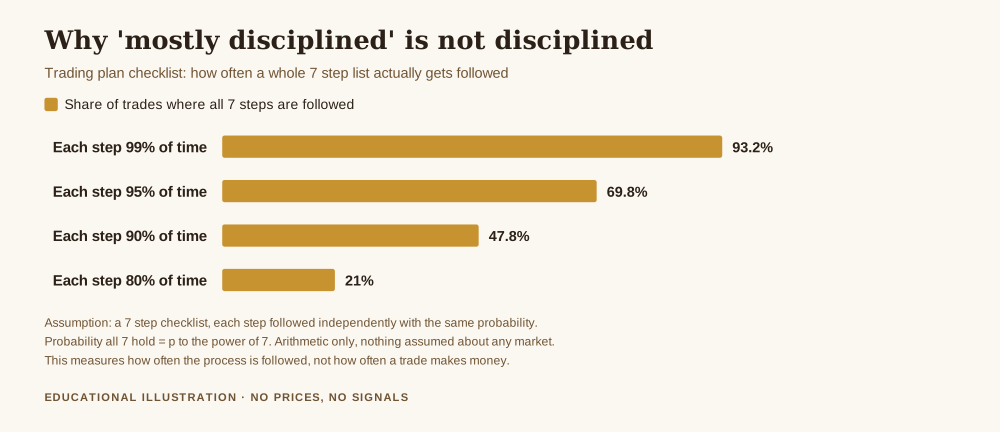
Here is the part that changes how people treat the list. Suppose your checklist has seven lines, and suppose you follow each individual line 90 per cent of the time. That sounds like a disciplined trader. Most people would be pleased with 90 per cent.
Now ask how often the entire list gets followed. If the lines are independent, it is 0.9 to the power of 7, which is 47.8 per cent. Fewer than half your trades fully follow your own process, while you are being 90 per cent disciplined on every single step.
Push the per step figure around and the picture gets clearer. At 95 per cent per line, all seven hold on 69.8 per cent of trades. At 99 per cent, 93.2 per cent. At 80 per cent, which still feels like trying, only 21.0 per cent of your trades follow the complete process. The assumption here is simply that the steps are independent and equally likely to be followed, and the arithmetic is nothing but repeated multiplication, with no claim about any market.
Two things follow, and they point in opposite directions from where most people go. First, a shorter list is a better list, because every line you add multiplies the failure rate. Second, the answer to a skipped step is not to try harder, it is to make that step impossible to skip.
One reader put the lived version of this well: “I have been torn in between trading small amounts without discipline and loosing money. I must say I have learnt the hard way.” Roughly 390 messages in my inbox mention discipline or trading rules. That is a keyword count in my own Telegram inbox and not a survey, but the shape of it is consistent, and almost none of those messages are about not knowing what to do.
The seven lines
Keep it to seven. If you need more, your plan is doing work the checklist should not be doing.
1. What is the reason for this trade, in one sentence? If you cannot write it before you enter, you do not have one. The reason matters more than most traders admit, which is the whole argument of why the reason behind a trade matters.
2. Where is the invalidation level? Not the target, the level at which the idea is wrong. This is decided before entry or it is decided emotionally after.
3. What is the position size, calculated and not estimated? The one line that does more than the other six combined, which is why it gets its own section below.
4. What is the total risk open right now, across every position? Three positions at 1 per cent each, all leaning the same way on gold, is one 3 per cent position wearing a disguise.
5. Is there a scheduled event before this idea resolves? A release you did not look up is a risk you did not choose.
6. Have I already hit today’s loss limit? The limit exists for the exact state of mind that wants to ignore it.
7. Would I take this trade if nobody ever saw the result? This catches the trades taken to prove something, which are the expensive ones.
Another reader described the discipline this list is trying to enforce: “I know I must accept today and trade as I started. Small and disciplined. If anything, after loss size should definitely decrease, not increase.” That instinct is correct, and it is exactly what line 3 and line 6 exist to protect.
Line 3 does most of the work
Position size is the one input that converts a wrong opinion into a survivable loss or a fatal one, and it is the easiest line to eyeball when you are in a hurry.
Take an account of 10,000 units with a plan that risks 1 per cent, which is 100 units, on a fixed invalidation distance. Get the size right and a loss costs 100, which is 1 per cent, and recovering it requires a 1.01 per cent gain on what is left. Size it at three times the plan and the same wrong opinion costs 300, needing 3.09 per cent back. At five times, 500, needing 5.26 per cent. At ten times, which is one misplaced decimal, the loss is 1,000, which is 10 per cent of the account, requiring 11.11 per cent to recover.
Note that the market did exactly the same thing in all four cases. The only variable was a number typed before entry. The recovery figures are plain arithmetic: to get back to the starting balance after losing x per cent, the remainder has to gain x divided by 100 minus x. That asymmetry is why survival comes before growth, and it is worked out in detail in how much to risk per trade.
If you take one line from this article and ignore the rest, take the habit of calculating size rather than estimating it. The full method is in risk management for gold trading.
What the odds look like without a process
It is worth knowing the environment the checklist is operating in. When European regulators examined contracts for difference across national markets, they found that between 74 and 89 per cent of retail accounts typically lose money, with average losses per client ranging from 1,600 to 29,000 euros. Those figures come from ESMA’s own analysis when it introduced leverage limits, a margin close out rule and negative balance protection for retail accounts in 2018.
That range is not a reason to quit, and it is not a prediction about you. It is a statement about what the default outcome looks like for people who do the obvious thing in the obvious way. A written process is one of the few things that separates a trader from that default, and a checklist is the cheapest version of a written process that exists.
Using it without turning it into a ritual
A checklist that gets recited without being read is worse than none, because it manufactures the feeling of diligence without the substance. Three things keep it honest.
Make it physical. On paper beside the screen, or a note you have to actively tick. A list you hold in your head is the one that gets skipped precisely when it matters, because the moments it is designed for are the moments your memory is least reliable.
Make it pre commitment, not commentary. Every line is answered before the order exists. A checklist completed after entry is a diary entry, and the place for those is a trading journal, which does a different and equally necessary job.
Review the misses, not the losses. Once a week, count the trades where the full list was followed and the trades where it was not. A losing trade that followed the process is the cost of doing business. A winning trade that skipped the process is the dangerous one, because it teaches you that skipping works.
As one reader listed their own version: “Risk management, emotional discipline, strategy evaluation, market understanding. My lessons.” The categories are right. The checklist is what turns categories into something you actually do at the moment of decision.
Get the free Gold Empire survival sheet, a one page guide to protecting your account through the kind of market this article describes. One email, no spam, unsubscribe anytime.
Frequently asked questions
What should a trading plan checklist contain?
The reason for the trade, the invalidation level, a calculated position size, total open risk across all positions, any scheduled event before the idea resolves, whether the daily loss limit is already reached, and whether you would take it unobserved. Seven lines, answered before the order exists.
How is a checklist different from a trading plan?
The plan is the full document: what you trade, when, how you size, what you do when it goes wrong. The checklist is the short extract you physically read at the moment of decision. Plans are written calmly and consulted rarely. Checklists are built to be consulted every time.
How long should the list be?
Short. If each line is followed 90 per cent of the time, a seven line list is fully followed on 47.8 per cent of trades, and every extra line multiplies the chance that something gets skipped. Length is a cost, not a sign of thoroughness.
Does a checklist improve results?
It improves consistency of process, which is not the same claim. No checklist has been shown to produce profit, and anyone promising that is selling something. What it does is reduce how often the steps that control your losses get skipped.
What do I do when I notice I skipped it?
Record the skip, not just the outcome. Count skipped trades weekly. If one line is skipped repeatedly, the line is badly worded or badly placed, and the fix is to redesign it rather than resolve to try harder.
Should the checklist include a profit target?
It can include where the idea would be complete, but a target is not a promise and should never be treated as one. No entry, stop or target discussed should be treated as a signal.
Where this leaves you
A trading plan checklist is a small, dull, physical object that exists for one reason: at the moment you are least able to think clearly, it does the thinking you already did. It will not improve your edge or tell you where the market is going. It narrows the gap between the trader you are when the market is closed and the trader you are when it is open, and for most accounts that gap is the whole problem.
Build seven lines. Keep them on paper. Count the skips weekly, and fix the line rather than blaming yourself.
The foundation under this article is risk management for gold trading. Beside it, the sizing arithmetic is in how much to risk per trade, the record that shows you whether the process is being followed is in how to write a trading journal, the failure this is built to prevent is in why you keep blowing your trading account, and the reasoning step behind line 1 is in why the reason behind a trade matters.
The retail account figures quoted above are published by the European Securities and Markets Authority in its statement on restricting contracts for difference for retail investors, which sets out both the loss ranges and the protections that followed. The surgical checklist study is cited in full above so it can be looked up directly by DOI.
About the author. Matthew writes Gold Empire for traders who would rather still have an account in a year than have a good week to talk about. The order here is always the same, survive first, then grow, because every technique in the world is worthless to someone who is no longer in the market. Everything published here is education and not financial advice, and no entry, stop or target discussed should be treated as a signal.
One step first
Where should we send the Gold Survival Sheet?
Leave your email and we will send the free one page checklist, then take you straight to the Telegram channel.
No cost and no obligation. Educational only, not financial advice, and nothing here promises a return. Unsubscribe any time in one click.
Leave a Reply