

Almost nobody types what is portfolio recovery scam call into a search box before the phone rings. The search happens afterwards, usually within an hour of a call that knew too much. About 104 messages in my inbox touch account management and being cheated, counted by keyword rather than by any survey, and a steady handful of them are some version of this exact moment. One person wrote: “I wanted to report this fake profile to you. I’ve reported it as a scam.” Another: “I just want to know if you are aware of this and would like to know your input if it’s a scam?” A third described the pitch itself: “After recovering his money then we share 50/50, I send you usdt direct.”
That last one is the whole article in a sentence. Somebody has offered to get a trader’s lost money back, and the price is a share, a fee, or a tax paid up front. What follows is who is actually on the line, how to tell the two possible callers apart in about ten minutes, and what the published figures say about who really recovers money and how.
What is portfolio recovery scam call traffic, and who is on the line?
The phrase is doing double duty, and the two meanings behind it need completely different responses. That is the first thing to sort out, because treating one like the other is how people either ignore a real obligation or hand money to a criminal.
The first meaning is a call that claims to be from a debt collection business. There are real collection firms with recovery in their names, and they buy portfolios of consumer debt and then contact people about them. A call like that may be genuine, may be an impersonator using a real firm’s name, and may be about a debt that is not yours at all.
The second meaning, and the one that empties trading accounts, is a call offering to recover money you already lost. Somebody rings, or messages, and says they can get back what a previous scam or a blown account took from you. They may claim to be law enforcement, a regulator, a lawyer, or a specialist recovery firm. This is the version I see in my inbox, and it is aimed squarely at people in the worst week of their trading life.
The first reading: how to test a collection call in ten minutes
If the call is genuinely about a debt, United States law gives you a test that costs nothing and does not require you to say a single word about your finances. Under the federal debt collection rule, a collector must give you validation information either in the initial communication or within five days of it. The notice has to identify the debt, and you then get a validation period that runs for thirty days after you receive it, during which you can dispute the debt in writing.
So the correct response to a collection call is not to confirm anything, not to pay anything, and not to argue. It is one sentence: send me the validation notice in writing. A real collector is required to work in that lane. An impersonator will not, because the entire scheme depends on getting a payment before you have anything on paper.
Notice what you did not do there. You did not confirm your identity, your account numbers, or the amount. You did not have to know whether the firm was real. The paperwork requirement does the sorting for you.
The second reading: the recovery pitch, and why it finds traders
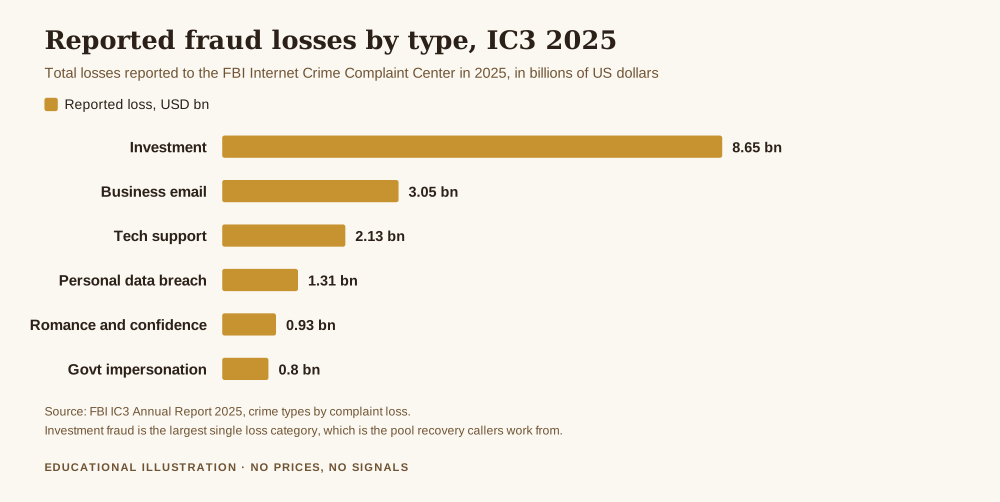
The money at stake here is not small, and it is concentrated in exactly the place you would expect. In its 2025 annual report, the FBI Internet Crime Complaint Center recorded 1,008,597 complaints and $20.877 billion in reported losses, a 26 per cent increase on the previous year. Investment fraud was the largest single loss category at $8,648,617,756 across 72,984 complaints. That works out at roughly $118,500 per complaint that reported a loss in that category, which is the arithmetic rather than a figure the report prints.
That is the pool. Every one of those complaints is a person who has already lost money and would very much like it back, and that is the list a recovery caller wants. The Federal Trade Commission is blunt about how the list gets built, describing how scammers trade in what they call a “sucker list” of people who have already paid a scammer, with names, addresses and amounts.
The gold angle is not hypothetical either. The same IC3 report counts roughly 725 gold courier scam complaints in 2025, with $311.8 million in losses, where criminals send couriers to collect cash and precious metals from victims of tech support and government impersonation schemes. That is about $430,000 per complaint. People who trade metal are on these lists.
What the callers actually say
The FBI published an update in July 2026 on criminals impersonating the IC3 itself. The finding that matters most is this one: “Almost all complainants indicated the scammers claimed to have recovered the victim’s lost funds or offered to assist in recovering funds.” The approach has become more convincing, not less. The same notice describes impersonators working through Facebook Messenger and Telegram, and separately describes AI generated video of a senior official promoting a spoofed complaint website that collects your details.
The FBI’s own position is unambiguous, and worth keeping where you can find it: “IC3 will never ask for payment to recover lost funds, nor will IC3 refer someone to a company requesting payment for recovering funds.” It also states that IC3 does not maintain a social media presence and does not recover funds through Facebook, Telegram or similar platforms.
The Commodity Futures Trading Commission describes the same structure in plainer language, calling recovery scams a form of advance fee fraud, “when you are asked to pay upfront for the chance of getting a much bigger sum of money later.” Its advisory lists the red flags directly: you are asked to pay before receiving any service, the person knows a lot about the money you lost, contact comes from someone you never approached, you are asked for bank details so the recovered funds can be deposited, and no phone numbers are provided or you are pushed onto Telegram or WhatsApp.
What real recovery looks like, and what it costs
Here is the part that makes the pitch collapse, because real recovery already exists, it works through your bank, and nobody charges you for it.
The IC3 runs a Recovery Asset Team which operates something called the Financial Fraud Kill Chain. In 2025 it handled 3,900 incidents covering $1,163,919,846 in attempted theft, and froze $679,013,183 of it. That is a 58 per cent success rate, and the report states the same figure. Dividing the frozen total by the incident count gives roughly $174,000 recovered per case, which is my arithmetic from the two published numbers rather than a figure the report prints.
Two things about that mechanism decide whether it helps you. The first is that it is free. The second is that it is fast or it is nothing. The report’s guidance is that if you discover a fraudulent transfer, time is of the essence, and you should immediately contact your financial institution to request a recall of the funds, then file a complaint at the official IC3 site regardless of the amount lost.
Which gives you the cleanest test in this whole subject. The real route is free and urgent. The pitch is paid and patient, because the caller needs time to collect the fee and go. Anyone asking you for money to start a recovery is, by that fact alone, not the route that works.
The arithmetic of a recovery fee
Run the numbers on the offer and it stops being tempting. Take the average investment fraud loss computed above, roughly $118,500. A recovery fee of 10 per cent on that is about $11,850. At 15 per cent it is about $17,775. Those are assumptions, not quoted rates, and I am stating them so you can redo the sum with whatever number you were quoted.
Now weigh that against what the fee buys. If the caller is a criminal, the fee is simply a second loss on top of the first, and the first loss does not come back. If the caller is a genuine asset recovery business, the CFTC’s warning still applies, which is that such companies can charge high fees to do little more than send a demand letter to the original fraudster and a boilerplate complaint to a regulator, both of which you can do yourself at no cost.
Either way the expected value of paying up front is poor, and the free route is sitting right there, unused, getting less effective every hour you wait.
A standing rule worth adopting
The rule I would set, and the reason I am writing this on a trading blog rather than a consumer advice site, is that the recovery call is a predictable event rather than a surprise. If you lose money in this market, assume your details reach a list, and assume somebody will eventually call about getting it back. Decide now what you will do, because the decision is much harder to make well in the moment, with somebody on the line who already knows the amount you lost.
The rule has three parts. Nobody who contacts you first gets money or account details from you, ever. Anything about a debt happens in writing or it does not happen. And anything about recovering a loss starts at your bank and the official reporting site on the same day, not with a caller’s fee.
That rule costs you nothing if the call turns out to be legitimate, because a legitimate caller can work in writing and a legitimate recovery route does not need your money. It is the same logic that governs position sizing: the defence has to hold on the bad day, and you do not get to choose when the bad day arrives.
Get the free Gold Empire survival sheet, a one page guide to protecting your account through the kind of market this article describes. One email, no spam, unsubscribe anytime.
Frequently asked questions
Is every call mentioning portfolio recovery a scam?
No, and that is exactly why the written test matters more than your instinct about the caller. Real collection businesses exist and some of them have recovery in the name. The federal rule requires validation information in the initial communication or within five days, so asking for it in writing sorts the real from the fake without you having to judge a voice.
How did they know how much I lost?
Either from a list of previous victims, which the FTC describes scammers buying and selling, or from the original scheme itself, since the same operation often runs both stages. Knowing the amount is not evidence that the caller is legitimate. The CFTC lists detailed knowledge of your loss as a warning sign rather than a reassurance.
Can anyone actually get my money back?
Sometimes, through the banking system, and only quickly. The IC3 Recovery Asset Team froze $679 million of $1.16 billion in attempted theft across 3,900 incidents in 2025, a 58 per cent rate. That route runs through your bank and a complaint filed at the official site, it costs nothing, and its effectiveness falls away as time passes.
What should I do in the first hour after a fraudulent transfer?
Contact your financial institution and ask for a recall of the funds, then file a complaint at www.ic3.gov with the full transaction details, whatever the amount. That is the published guidance. Do not wait to see whether the money comes back on its own, and do not wait for a caller to offer to handle it.
Someone claiming to be from a government agency called about my loss. Is that normal?
Not in that direction. The FBI states that the IC3 will never directly communicate with individuals by phone, email, social media, apps or public forums, and that it never asks for payment to recover lost funds. Treat an unsolicited approach from any agency about recovering money as an impersonation until you have verified it through a number you looked up yourself.
Where this fits
Gold Empire is free to read and stays free. I spend most of my week reading messages from people in the middle of a hard stretch, and the recovery call tends to arrive at the worst possible point in that stretch, when somebody is already down and would try almost anything. The free gold survival sheet is a one page summary of how to keep an account alive through the conditions that end most of them, and there is an optional kit for people who want the longer version. No profit promise is attached to any of it, because anyone promising you one is telling you something they cannot know.
If this was useful, the pillar piece on risk management in gold trading covers the defences that stop you joining the list in the first place. Beside this one sit how to report investment scams, which is the free route in more detail, and how to recover from trading losses, which is about the part no caller can do for you. If you want the pattern recognition, how to spot fake trading profit screenshots covers the proof these approaches lean on, and what an investor compensation scheme is explains the one genuine mechanism that sometimes returns money when a regulated firm fails.
Outside sources used here: the FBI IC3 Annual Report 2025 for the complaint, loss and Financial Fraud Kill Chain figures, the FBI public service announcement warning of scammers impersonating the IC3 for the impersonation tactics and the agency’s own statements, the CFTC advisory on not being re-victimized by recovery frauds for the advance fee structure and red flags, the FTC consumer article on refund and recovery scams for the list trade, and 12 CFR 1006.34 for the validation notice timing.
About the author
Matthew writes the Gold Empire blog and spends most of his week reading messages from people who are somewhere in the middle of a hard stretch. He is more interested in why accounts die than in why they win, on the grounds that the first question is answerable and the second mostly is not. The figures here are either quoted from the published sources linked above or computed from stated assumptions so you can repeat them with your own numbers, the reader quotations are real messages used with identifying details removed, and no entry, stop or target discussed should be treated as a signal. You can read more about Gold Empire and Matthew here.
This article is educational and general in nature. It is not financial advice, not legal advice, and it does not account for your circumstances or your jurisdiction. The rules described are United States federal rules and your local position may differ. Nothing here is a recommendation to use or avoid any particular firm or service, and no entry, stop or target discussed should be treated as a signal. Trading leveraged products carries a substantial risk of loss.
One step first
Where should we send the Gold Survival Sheet?
Leave your email and we will send the free one page checklist, then take you straight to the Telegram channel.
No cost and no obligation. Educational only, not financial advice, and nothing here promises a return. Unsubscribe any time in one click.
Leave a Reply