
Somebody opens a broker’s account comparison page, sees three columns, and asks the reasonable question: what is an ECN account, and is it the one a serious person picks? The page usually answers with a tighter spread, a commission per lot, and a phrase like direct market access or no dealing desk.
That answer describes a price list. It does not describe what the three letters mean, and the gap between those two things is where the money quietly goes. So this article does both. First what an ECN actually is in the only place the term has a legal definition, which will surprise most people. Then what an ECN account is in practice at a gold broker, which is a different thing entirely. Then the arithmetic that decides whether it is cheaper for you, which is the only part you can actually act on.
What Is an ECN Account: Start With What the Letters Mean
ECN stands for electronic communications network. The term is not marketing language in origin. It has a definition in United States securities regulation, and you can read it yourself in the definitions section of Regulation NMS at 17 CFR 242.600.
The definition says an electronic communications network is any electronic system that widely disseminates to third parties orders entered in it by an exchange market maker or an OTC market maker, and permits those orders to be executed against in whole or in part.
Read that once more, because every clause is load bearing. Orders are widely disseminated to third parties, so other participants can see them. Those orders come from market makers in a regulated quoting system. And other participants can execute against them directly.
Then the definition does something that almost nobody quoting the term mentions. It carves two things out. The first exclusion is a system that crosses orders at set times at a single price and does not let participants execute against each other outside those times. The second exclusion is the one that matters here: a system operated by, or on behalf of, an OTC or exchange market maker that executes customer orders primarily against the account of that market maker as principal, other than riskless principal.
In plain terms, the regulation explicitly says that a venue where your order is filled mainly by the operator taking the other side is not an electronic communications network. That is not my interpretation. It is the text of the carve out.
The Word Has a Home, and It Is Not Retail Gold
Here is the part that reframes the whole question. That definition lives in Regulation NMS, which governs the national market system for United States equities. It applies to shares quoted and traded on American exchanges. It is a term of art from stock market structure.
Spot gold is not an equity. XAUUSD is not listed on a national securities exchange. Neither is a currency pair, and neither is a contract for difference on any of them. So when a gold broker offers you an ECN account, it is not claiming a regulatory status under that rule, because that rule does not reach the product at all.
You can see how seriously the real thing is regulated by looking one section over. Under 17 CFR 242.301, an alternative trading system, the broader category ECNs belong to, has to register as a broker dealer and file a Form ATS with the Commission at least 20 days before it starts operating, plus an amendment at least 20 days before any material change to how it works. That is a filing regime with a paper trail, and it exists precisely because who matches your order matters.
None of that machinery applies to the label on a retail gold account. Which leads to the honest answer to the headline question: ECN account is a product name, not a regulated status. It might describe an excellent execution arrangement. It might describe a marked down spread with a commission bolted on. The three letters do not tell you which, and no amount of staring at the comparison table will.
So What Is an ECN Account in Practice?
Strip the label away and what a broker is usually offering is a pricing model, not a venue. Two models exist and every account type is one of them wearing a different name.
The all in spread model. One number quoted, wider than the underlying market, no separate charge. The broker’s revenue is inside the spread, so you never see it itemised. Usually called standard or classic.
The raw spread plus commission model. A much tighter quoted spread, plus an explicit commission per lot. The broker’s revenue is now on the invoice. Usually called ECN, raw, or zero.
The second one feels more honest and often is, in the narrow sense that you can see what you are paying. But visible is not the same as cheap, and this is the trap the label sets. People read the commission as the cost of the account, compare commissions across brokers, and pick the lowest. The commission is the smaller half of the bill and it is the half that does not change.
The Arithmetic That Actually Decides It
Let us put a number on it. Assume a standard gold contract of 100 troy ounces per lot. I will express the spread in dollars per ounce rather than pips, because every broker defines a gold pip differently and that ambiguity is where comparison errors breed. No gold price appears anywhere in what follows, and none is needed.
The cost of a round turn on one lot is the spread times 100 for the standard account, and the spread times 100 plus the commission for the raw account. Set them equal and you get the break even condition, which is pleasingly simple:
The standard account has to be quoting a spread wider by the commission divided by 100, measured in dollars per ounce.
So at a commission of 7.00 dollars round turn per lot, the standard account must be at least 0.07 dollars per ounce wider before the raw account is genuinely cheaper. At 10.00 dollars it needs to be 0.10 wider, at 14.00 dollars, 0.14 wider. That is the entire comparison, and you can run it in your head at the broker’s page instead of trusting the layout of the table.
Now the part that matters more, and that the comparison page will never show you.
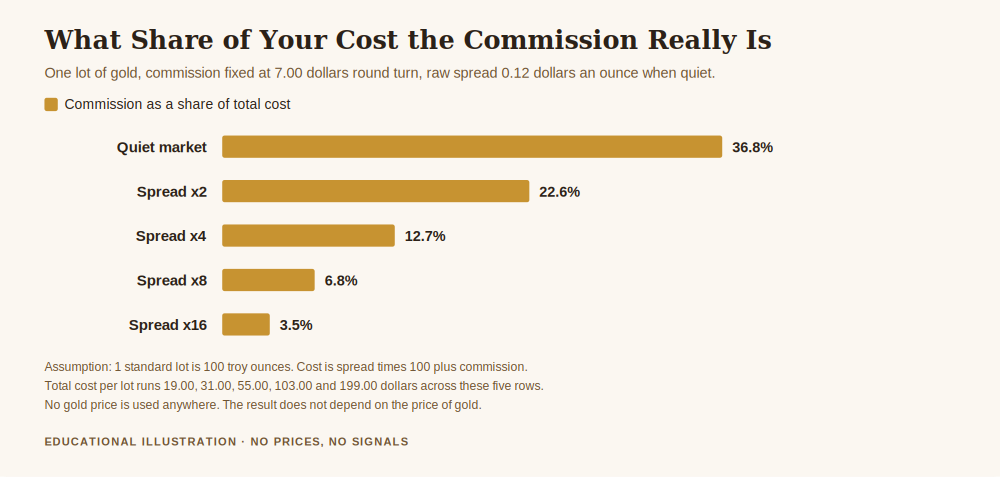
Hold the commission at 7.00 dollars and start the raw spread at 0.12 dollars an ounce in a quiet market. Total cost per lot is 19.00 dollars, and the commission is 36.8 percent of it. Now let the spread widen the way spreads do around a scheduled release or a thin hour. At twice as wide, total cost is 31.00 and the commission is 22.6 percent. At four times, 55.00 and 12.7 percent. At eight times, 103.00 and 6.8 percent. At sixteen times, 199.00 dollars and the commission is 3.5 percent of what you just paid.
The total bill went up 10.47 times. The commission did not move at all.
Which tells you something the account names actively obscure. The number printed on the comparison page, the fixed and knowable one, is the part that barely matters when it hurts. The variable one, the spread, is the part that does all the damage, and it is largest exactly when you most need to get in or out. Choosing an account by its commission is optimising the component that does not vary while ignoring the one that does.
Get the free Gold Empire survival sheet, a one page guide to protecting your account from the costs that only show up when the market is moving. One email, no spam, unsubscribe anytime.
What to Check Instead of the Label
If the three letters carry no guarantee, the useful move is to replace the label with questions that have verifiable answers. Five of them, in the order I would run them.
One of those questions is large enough to have its own article: who is legally the other side of your trade. What is an ECN broker takes that up from the firm side, using the CFTC rulebook for retail forex rather than the equity definition used above, and shows what ordinary cost does to an account before any of these checks are made.
Who regulates the entity you are actually contracting with? Not the group, not the brand on the website, the specific legal entity named in the client agreement. Then look it up on that regulator’s own public register, not on the broker’s page about its regulation.
What does the order execution policy document say? Regulated firms publish one. It describes how orders are handled and whether the firm may act as principal. That document is the answer to the question the account name is pretending to answer, and almost nobody reads it.
Is slippage symmetric? Ask whether price improvement is passed on as readily as adverse slippage. A firm that fills you worse when the market moves against you and never better when it moves for you has told you something about its model that no acronym will.
What is the total cost per lot, in one number? Spread times contract size plus commission, calculated by you, for the hour you actually trade. Two numbers cannot be compared across brokers. One can.
What does the spread do in the minutes that matter? Watch it yourself around a scheduled release on a demo or a small live account before you commit size. This is the only one of the five that takes patience rather than reading, and it is the one that tells you the most.
Notice that none of those five questions mentions ECN. That is the point. The label was never the variable, and treating it as one is how people end up paying more at the account that advertised paying less.
Frequently Asked Questions
What is an ECN account in forex or gold trading?
In practice it is a pricing model: a tighter raw spread plus an explicit commission per lot, as opposed to an all in wider spread with no separate charge. The term itself comes from United States equity market structure, where 17 CFR 242.600 defines an electronic communications network, and that definition does not apply to spot gold or currency pairs. So the name describes the price list, not a regulated status.
Is an ECN account better than a standard account?
Only if the standard account’s spread is wider than the raw spread by more than the commission divided by the contract size. With a 7.00 dollar round turn commission on a 100 ounce lot, that gap has to be at least 0.07 dollars an ounce. Below that, the standard account is cheaper. It is a calculation, not a tier.
Does an ECN account mean my orders go to the real market?
The name does not establish that. The regulatory definition of an electronic communications network specifically excludes a system that fills customer orders primarily against the operator’s own account as principal. Whether that applies to your provider is answered by its order execution policy and its regulator’s register, not by the account label.
Why does my ECN account still cost more on news?
Because the commission is fixed and the spread is not. In the illustration above, the commission holds at 7.00 dollars while total cost per lot runs from 19.00 to 199.00 as the spread widens, so the commission’s share of the bill falls from 36.8 percent to 3.5 percent. The account type does not change what happens to a spread in a fast market.
Is a lower commission the right thing to compare?
It is the easiest thing to compare and the least decisive. Compare one total cost per lot for the hour you actually trade instead, and check the spread’s behaviour around scheduled releases before you commit size.
Where did the numbers in this article come from?
The definition of an electronic communications network and its two exclusions are the text of 17 CFR 242.600, and the broker dealer registration and 20 day Form ATS filing requirements are 17 CFR 242.301, both linked above. Every cost figure is my own arithmetic under the assumptions stated in the text: 100 troy ounces per lot, a 7.00 dollar round turn commission, and a 0.12 dollar per ounce raw spread in a quiet market. Commission levels and spreads vary by firm and by hour, so run the calculation on your own numbers. No gold price appears anywhere in this article.
Where Gold Empire fits
Gold Empire is free to follow. Daily gold analysis with the reasoning written out, losing days included, plus an optional Kit for people who want the method in one place. There is no promise of profit here, because nobody honest can make one.
What an account costs you is a survival question before it is a preference, which is why this sits under risk management in gold trading. Raw spread account vs standard account takes the same comparison further into the two pricing models, what the spread is in gold trading covers the component that does all the moving, and how to choose a broker for gold trading puts the account type back in its place as one line among several. If you have not opened an account yet, how to open a gold trading account is the step before this one.
About the author
Matthew has spent a long time around gold, most of it learning things the slow way, and now writes them down so other people can learn them the fast way. He is more interested in the mechanics that quietly drain accounts than in the setups that fill timelines. Nothing in this article is personal advice, and no entry, stop or target discussed should be treated as a signal.
This article is educational content about account types, order handling terminology and trading costs. It is not investment advice, not a recommendation of any broker, account type or platform, and not a solicitation to trade. The definition of an electronic communications network and its exclusions are quoted from 17 CFR 242.600, and the alternative trading system requirements from 17 CFR 242.301. Those are United States securities rules summarised here rather than reproduced in full, they are amended from time to time, and they do not govern retail spot gold or foreign exchange in most jurisdictions; nothing here is legal advice and account naming conventions differ by firm and by country. No statement is made about the execution model of any particular broker, and readers should check the client agreement, the order execution policy and the relevant public register themselves. Every cost figure is my own arithmetic under the assumptions written out in the text, using illustrative commission and spread values rather than any firm’s actual pricing, and no gold price level is quoted. Trading gold carries a real risk of losing money, including more than you deposit in some account types. Nothing accounts for your personal circumstances, and no entry, stop or target discussed should be treated as a signal. If you are unsure, speak to someone properly qualified in your own jurisdiction before you risk anything.
One step first
Where should we send the Gold Survival Sheet?
Leave your email and we will send the free one page checklist, then take you straight to the Telegram channel.
No cost and no obligation. Educational only, not financial advice, and nothing here promises a return. Unsubscribe any time in one click.
Leave a Reply