
This question arrives in the Gold Empire group most weeks, and it usually arrives quietly, from someone who has just paid for something and has started to feel uneasy about it. The search they typed was are forex signal groups legit, and they were hoping for a simple yes or no. The honest answer is that the category contains both real operations and organised fraud, and the two are deliberately made to look identical from the outside. That is the whole problem, and it is solvable, but not by looking at screenshots.
So this article is not going to tell you that every signal group is a scam, which would be untrue and would also be a strange thing for us to say. It is going to show you what the fraud statistics actually look like, walk through two pieces of arithmetic that expose most fake track records in about a minute, and give you a checklist you can run before any money leaves your account. The maths is the important part, because it does not care how convincing the marketing is.
Are forex signal groups legit, or is the whole category a fraud?
Both things are true at once, which is what makes this hard. There are people who publish their reasoning openly, charge nothing or charge for education, and are upfront that they cannot promise outcomes. There are also criminal operations that use the same vocabulary, the same Telegram layout and the same chart screenshots, and whose actual business model is taking deposits and disappearing.
The difference is almost never visible in the marketing, because the fraudulent operation has a much bigger budget for marketing than the honest one does. What separates them is structural: where your money sits, what they claim, and what happens when you ask to take money out. We will get to all three.
What the fraud numbers actually say
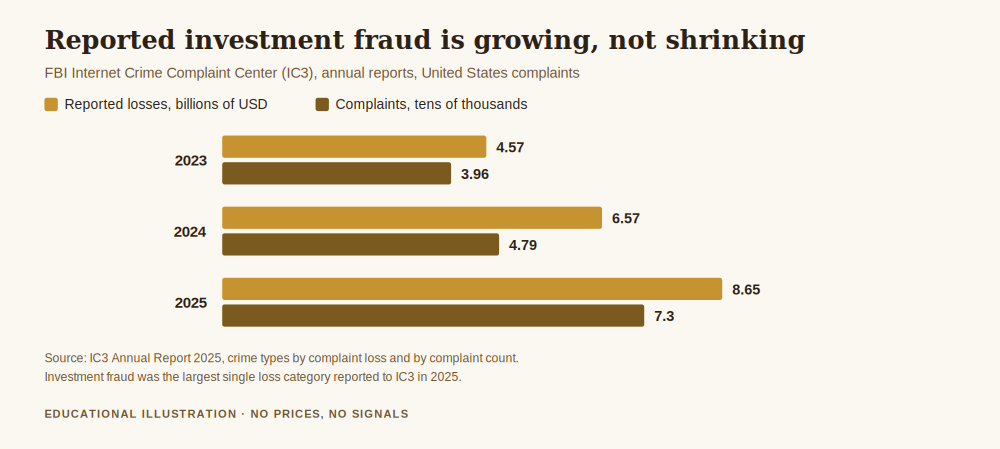
It helps to know the scale of what you are protecting yourself from, and for that there is a primary source rather than a guess. The FBI’s Internet Crime Complaint Center publishes an annual report of complaints filed by the public in the United States. The 2025 IC3 Annual Report records 72,984 investment fraud complaints, with reported losses of 8,648,617,756 US dollars.
Two things about that figure are worth sitting with. The first is that investment fraud was the single largest loss category of every crime type IC3 tracks that year, ahead of business email compromise and tech support scams. The second is the direction of travel. Reported investment losses were 4,570,275,683 dollars in 2023 and 6,570,639,864 in 2024, so the 2025 figure is an increase of about 89 per cent in two years. Complaint counts went from 39,570 to 72,984 over the same period, an increase of about 84 per cent. Dividing the 2025 loss total by the 2025 complaint count gives an average reported loss of roughly 118,500 dollars per complaint, which tells you these are not small sums from people with money to spare.
There is a second number in that report that changed how I talk about this. Through an operation that identifies victims of cryptocurrency investment fraud and contacts them, the FBI reported that 78 per cent of the victims it notified were unaware they were being scammed at the moment of contact. Not suspicious and ignoring it. Unaware. These were people who, if you had asked them that morning whether they had been defrauded, would have said no.
That is the part to take personally. The instinct most people rely on, the feeling that they would know, is precisely the thing the numbers say does not work. So the checks below are deliberately mechanical, because a procedure you run regardless of how you feel is worth more than a feeling.
One more trend is worth naming. The same report counts 4,356 investment fraud complaints with an artificial intelligence element, carrying 632,041,188 dollars in losses. The United States derivatives regulator has published its own advisory on criminals increasing their use of generative AI to commit fraud. In practice this means the voice on the call, the face in the video, the testimonials and the equity curve can all now be manufactured cheaply. Any check that relies on the content looking professional is already obsolete.
Why a perfect track record proves almost nothing
Here is the first piece of arithmetic, and it is the one I wish someone had shown me early. Suppose a promoter wants to produce a genuinely perfect ten-call record without any skill whatsoever.
They start with 1,024 people. They tell half of them gold goes up this week and the other half that it goes down. One of those groups was right, and there are 512 people in it. They drop the others and split the remaining group again, and again. After ten rounds of this, the arithmetic is simply 1,024 divided by two ten times over, which leaves exactly one person. That person has watched ten consecutive calls land correctly. From inside their own experience, the evidence is overwhelming.
Nothing was predicted. No skill was involved. The promoter simply discarded the people who saw the misses, and the survivor’s screenshots are completely authentic, which is why asking to see the wins never resolves anything. A pure coin flip lands ten in a row roughly once every 1,024 attempts, or about 0.098 per cent of the time, and a promoter with a large audience gets a great many attempts.
The defence is not to distrust screenshots. It is to ask a different question: show me the complete record, every call, in the order it was made, including the ones that lost. A real operation can produce that because it keeps it. A fake one cannot, and will explain why the request is unreasonable.
The arithmetic a signal seller hopes you never do
The second piece of arithmetic deals with the most common claim in this entire industry, the high win rate. Win rate on its own is close to meaningless, and here is why.
What matters is the size of the wins relative to the size of the losses. Traders measure this in R, where one R is the amount risked on a trade. If your risk on a trade is one R and the trade makes two and a half times that, it was a plus 2.5R result. Expressed that way, a strategy’s expectancy per trade is the win rate times the average win in R, minus the loss rate times the average loss in R.
Run that on a service advertising a 90 per cent win rate, where each win takes a small profit of 0.1R and each loss runs a full 1R. The expectancy is 0.9 times 0.1, minus 0.1 times 1, which comes to minus 0.01R per trade. Nine wins out of ten, and the account still bleeds. Now run it on a service that wins 45 per cent of the time but makes 2R on winners: 0.45 times 2, minus 0.55 times 1, gives plus 0.35R per trade on those assumptions.
The numbers above are arithmetic on assumed inputs, not results anyone achieved and not a prediction of what any method will do. That is exactly the point. The advertised win rate told you nothing in either direction, so a group that quotes a win rate and will not tell you the average size of its losses has not given you information at all. It has given you a number chosen because it sounds good.
Worth adding: the calculation above ignores costs. Spread, swap and slippage come out of every real result, which is why a method that looks marginally positive on paper often is not once it meets an actual broker.
Seven checks to run before any money moves
None of these require you to judge whether someone seems trustworthy. They are all things you can verify from the outside.
- Where does your money sit? This is the single biggest divider. A legitimate educational channel or signal service never holds your funds. Your money stays with a regulated broker in an account in your name. The moment someone asks you to deposit with them, send funds to a personal wallet, or use a specific unregulated platform they recommend, you are no longer looking at a signal service.
- Check the regulator’s register yourself. Not the licence number printed on their website, which costs nothing to invent. Go to the regulator’s own site, search the name, and confirm the entity and the permissions match. If the answer is confusing, that is your answer.
- Ask for the complete record. Every call, in sequence, including losses, with dates. Watch what happens when you ask. A defensive response to a reasonable request is information.
- Look for a guarantee. Any promise of a specific return, any claim of a risk free trade, any phrase like guaranteed profit, is disqualifying on its own. Nobody can promise market outcomes, so anyone who does is either lying or does not understand their own product.
- Test the withdrawal early, and small. If funds are with a broker, withdraw a small amount within the first weeks, before there is anything meaningful at stake. Frauds are built to accept deposits smoothly. Problems appear on the way out, often as a surprise tax or fee that must be paid first.
- Notice the pressure. Limited spots, prices rising tonight, a private group closing at midnight. Urgency exists to stop you completing the other six checks. That is its only function.
- Watch for the second approach. People who have lost money are frequently contacted again by someone offering to recover it for an upfront fee. This is the same operation or one that bought the list. There is no legitimate service that recovers defrauded funds for a fee paid in advance.
What an honest channel looks like, including this one
It would be convenient for us to end with a warning about everyone else, so let me be direct about where Gold Empire sits, because you should apply the same checks here.
Signals are part of what this channel offers. We also publish our results openly, including the bad stretches, and we do not promise profits, because no honest channel can. We never hold anyone’s money. We have no mechanism to and no interest in acquiring one. The free material is genuinely free and most people use the channel that way permanently, which is a completely normal way to use it.
What you should take from any group, including this one, is not a trade to copy. It is the reasoning behind it, so that eventually you do not need the group. A service whose model depends on you never becoming independent has an incentive that quietly works against you, and that is true even when the people running it are entirely sincere.
This is also why position size matters more than the source of an idea. If a single trade can hurt your account badly, then the quality of your signal provider becomes the most important thing in your life, which is a fragile way to operate. If your risk per trade is small and consistent, a bad call from anyone is survivable, and the question of whether to trust a group stops being existential. That is the actual defence, and it works against fraud, bad advice and your own mistakes equally well.
If you have already paid one
Stop sending money immediately, including any fee presented as the thing standing between you and your balance. Those fees are the fraud continuing, not the resolution of it.
Write down everything while it is fresh: names, handles, platform, dates, amounts, wallet addresses or account numbers, and screenshots of the conversations before they are deleted. If you are in the United States, file with IC3. Elsewhere, report to your national financial regulator and to the police. Your report may not recover your money, and it is fair to know that in advance. It does feed the data that identifies these operations, and that is the mechanism behind the notification work mentioned earlier.
Then, and this matters more than people expect, tell someone. Shame is what keeps victims quiet, and silence is precisely what allows the same operation to run the same script on the next person. Being defrauded by a professional criminal organisation is not a character flaw, and given the numbers above, it is not a rare one either.
Get the free Gold Empire survival sheet, a one-page guide to protecting your account from the kind of losses this article describes, including the position sizing that makes any single bad call survivable. One email, no spam, unsubscribe anytime.
Frequently asked questions
Are forex signal groups legit if they are free?
Free removes one risk, the subscription itself, and leaves the others in place. Free groups are often funded by broker referral arrangements, which means the group earns when you deposit or trade, whether or not you do well. That is not automatically dishonest, and plenty of channels disclose it openly. It is something you should know, and a group that hides it has told you something about how it operates.
What is the clearest single warning sign?
Being asked to send money to the group rather than to a regulated broker account in your own name. Almost every large loss follows from that one step, and it is the easiest thing on the list to check.
Does a verified track record on a third-party site settle it?
It helps, and it is better than screenshots, but verify what is actually being tracked. A verified account can still be a small demo account, a different account from the one being sold, or a real account run at risk levels nobody would survive. Look for the complete history with losses included, and check the dates line up with the claims.
Can I just follow signals without understanding them?
You can, and many people do. The cost is that you cannot tell a bad run from a broken method, because you have no way to evaluate the reasoning. When the losing stretch arrives, and it will, you will be making the most important decision of your trading life with no information. That is the real argument for learning the reasoning, quite apart from fraud.
Is the whole industry getting worse?
The reported numbers are rising, and the tools available to fraudsters have improved sharply, as the regulator’s advisory on generative AI sets out. The checks in this article are mostly structural, which is the reason they hold up: where your money sits and whether outcomes are guaranteed are facts that better video quality cannot change.
What Gold Empire actually does
Gold Empire is a free education channel for people trading gold, and the order is deliberate: survive first, then grow. We publish the mechanics of this market, the ways accounts get destroyed, and the habits that keep people around long enough to get good. The free gold survival sheet is the one page version of that, and it costs nothing.
Everything here is free to read. There is an optional kit for people who want the material organised into a working system, and following along without ever buying it is a completely normal way to use this channel. We share our own results openly, and signals are part of what the channel offers, but we do not promise profits, because no honest channel can. If you want the next steps in order, start with risk management in gold trading, then read how to get signals for forex trading for what a sensible relationship with any signal source looks like, and how to avoid losing money in forex trading for the mistakes that cost more than any subscription. If you are still choosing where to trade, how to pick a broker for gold trading covers what to look for.
About the author
Matthew writes the Gold Empire material. He spent his first years in this market learning the expensive way that the size of a position matters more than the direction of it, and most of what he publishes now is the article he wishes had existed then. He reads every message in the group and answers the ones about risk first. You can read more about the Gold Empire approach here.
This article is educational content, not financial advice. It does not account for your personal circumstances, your tax position, or your risk tolerance, and nothing in it is a recommendation to buy or sell any instrument. Trading leveraged products carries a high risk of losing money rapidly, and no entry, stop or target discussed should be treated as a signal. Consider speaking to a licensed professional in your jurisdiction before making decisions about your money.
One step first
Where should we send the Gold Survival Sheet?
Leave your email and we will send the free one page checklist, then take you straight to the Telegram channel.
No cost and no obligation. Educational only, not financial advice, and nothing here promises a return. Unsubscribe any time in one click.
Leave a Reply