
Sooner or later somebody in the group asks what is hedging in gold trading, and almost always they ask it while holding a position that is down. That timing is the whole story. The question arrives dressed as a technical one, but underneath it is a request for a way to not take the loss yet. I want to answer the technical part properly, and then I want to be straight with you about the other part, because the arithmetic is unkind and almost nobody runs it before they press the button.
Everything below is either quoted from a rulebook you can open yourself, or arithmetic I have shown in full with the assumptions written out. There are no gold prices in this article and nothing here is a recommendation.
What is hedging in gold trading, and what people usually mean by it
In the textbook sense, hedging means holding one position to offset the risk of another, where the two things are genuinely different. A refiner with metal in a vault sells futures against it. A mining company with production coming in nine months locks in a price today. In both cases there is a real exposure sitting outside the trading account, and the market position exists to cancel it.
That is not what the question usually means. What retail traders almost always mean is opening a sell of the same size, in the same instrument, in the same account, while the buy is still open. Long one lot, short one lot, both live. The floating loss stops moving. People call this a hedge. The more honest name, and the one used in most trading rooms, is a lock.
The distinction matters because the two things do different work. A refiner’s hedge cancels a risk that exists elsewhere. A lock cancels nothing. It freezes a number on a screen, and the position it freezes is one you already own the consequences of. You have not removed the loss. You have paid to stop looking at it.
The rule that says the position cannot exist
Here is the part that surprises people, and it is the cleanest evidence that this is not a normal trading technique.
If your account is with a US registered forex dealer, the lock is not allowed. It is not discouraged, not penalised, not a matter of platform settings. It is prohibited by rule. NFA Compliance Rule 2-43, section (b), reads in full:
Forex Dealer Members may not carry offsetting positions in a customer account but must offset them on a first-in, first-out basis. At the customer’s request, an FDM may offset same-size transactions even if there are older transactions of a different size but must offset the transaction against the oldest transaction of that size.
Read that slowly. Offsetting positions may not be carried. If you are long a lot and you sell a lot, the sell does not sit alongside the buy, it closes the buy, oldest first. The rule was adopted effective 15 May 2009 and has been amended four times since, most recently on 15 September 2022, so it is neither new nor an accident of drafting.
A regulator does not write a first in, first out requirement into a rulebook because the alternative is merely inelegant. It writes it because carrying both sides at once obscures what the customer actually owns, doubles the transaction costs the customer pays, and makes the account statement harder to read than the position it describes. The rule exists to stop the thing this article is about.
Plenty of brokers outside that jurisdiction do allow it, and their platforms have a button for it. The button existing is not evidence that the manoeuvre is sound. It is evidence about where the firm is registered, which is a different fact, and one worth checking for its own reasons before you check anything else.
What the lock actually costs, with the assumptions written out
Let me do the arithmetic, because this is the part that gets skipped.
I am going to assume one standard lot of gold is 100 troy ounces, which is the usual contract convention. I am going to assume a spread of 0.30 US dollars an ounce and a combined overnight financing cost across both legs of 0.02 dollars an ounce per session. Both of those are assumptions I have chosen to make the arithmetic concrete, not quotes from any broker, and I will show you further down what happens when you change them. I am also assuming each position pays the spread once across its lifetime, which is the standard way to count a round turn.
One position, opened and later closed, costs 0.30 times 100, which is 30.00 dollars a lot.
A lock is two positions. That is 60.00 dollars a lot before anything else happens. You have doubled your transaction cost, permanently, in exchange for freezing a number.
Then the financing starts. Both legs are open, so both accrue overnight, every session, for as long as the lock exists. At the assumed 0.02 dollars an ounce a session, that is 2.00 dollars a lot a day, and it does not stop because you have stopped thinking about the trade.
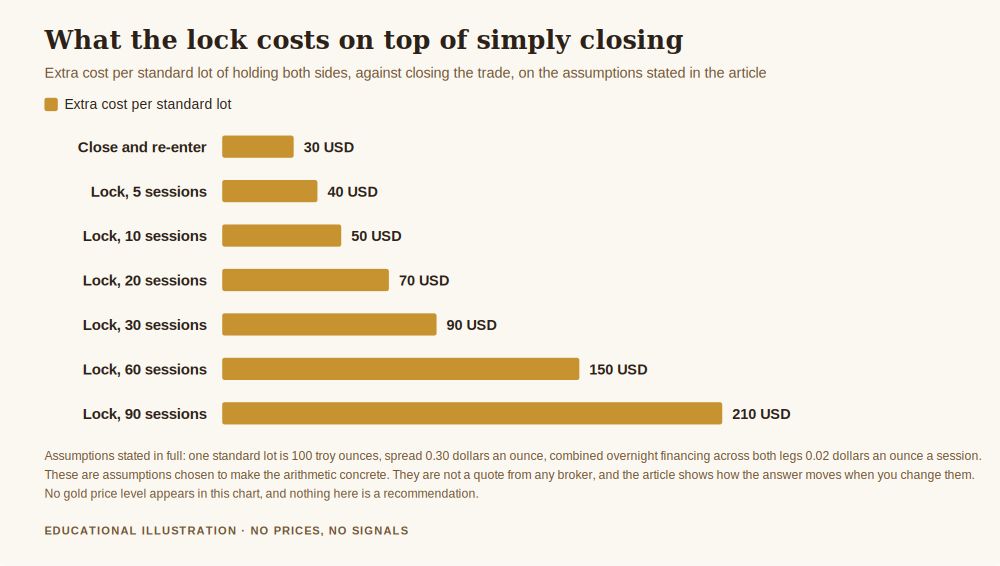
Adding the second spread to the accumulated financing gives the total extra cost of the lock, over and above simply having one position. Hold it five sessions and it is 40.00 dollars a lot. Ten sessions, 50.00. Twenty sessions, 70.00. Thirty sessions, 90.00. Sixty sessions, 150.00. Ninety sessions, 210.00 dollars a lot, which is seven times the cost of the single round turn you were trying to avoid paying.
Expressed per ounce, so it is comparable to a price move, the thirty session lock costs 0.900 dollars an ounce and the sixty session lock costs 1.500 dollars an ounce. That is the distance the market has to travel in your favour after you unwind, purely to get you back to where you would have been if you had closed the position on day one and done nothing else.
Now change the assumptions, because yours will be different. At a narrower 0.20 dollar spread and cheap 0.01 dollar financing, a thirty session lock costs 50.00 dollars a lot. At a wider 0.50 dollar spread and 0.04 dollar financing, the same thirty sessions cost 170.00 dollars a lot. Across that range the answer moves by a factor of more than three, and every single version of it is a cost you would not have paid by closing the trade. There is no combination of inputs where the lock is cheaper. That is not a coincidence, it is structural: you are paying to hold two positions where one would do, and the arithmetic cannot come out any other way.
The decision you did not avoid
Cost is the easy objection. The harder one is that the lock does not do the job people believe it does.
When you lock, the loss is frozen but it is not resolved. At some point you have to take one leg off, and the moment you do, you are directional again, with exactly the same question you had before: which way is this going. You have not answered it. You have deferred it, at a price, and you have deferred it to a version of yourself who has now been sitting with the position for weeks and is more invested in being right about it, not less.
Worse, the decision has become harder rather than easier. Before the lock there was one position and one question. After it there are two positions, two entry levels, two financing lines and a choice about which leg to remove first, and the two legs no longer move in step once you start removing one. People who lock frequently describe the same experience, which is that unwinding it well turns out to require better timing than the original trade did.
Against that, consider what closing actually costs. You crystallise the loss, which is the part that hurts, and you pay one more spread when you want to be in the market again. That is 30.00 dollars a lot on the assumptions above. The thirty session lock costs 90.00, which is three times as much, and at the end of it you still have to decide. The loss was going to be the loss either way. The only variable you controlled was how much you paid on top of it, and the lock is the expensive branch.
This is the same logic that runs through everything in risk management in gold trading. The costs that ruin accounts are rarely dramatic. They are small, repeated, and incurred while avoiding a decision. It is worth understanding what swap in gold trading is charging you before you double it, and worth knowing what the spread in gold trading takes on a single position before you commit to paying it twice.
What the position size question looks like underneath
There is one more thing worth saying, because it is the actual problem in most cases where this comes up.
Nobody wants to lock a position that is comfortably sized. The urge appears when the position is large enough that closing it would hurt in a way the trader is not prepared to accept. The lock is not a market judgement at that point. It is a response to sizing, arriving several days too late to help.
For scale, take the afternoon gold auction published by the London Bullion Market Association, in US dollars. Across the 14,690 day to day changes in that record, the middle of the distribution is a move of 0.511 per cent. That is what an ordinary day does. If an ordinary day in a normal market is producing a floating loss you feel you have to freeze rather than accept, the position was too big when it was opened, and no amount of clever position management afterwards fixes a sizing decision made in the past.
The rules in Europe point at the same conclusion from the other direction. The measures agreed by ESMA for retail contracts for difference set leverage at 20:1 for gold, require providers to close out retail positions at 50 per cent of minimum required margin, and provide negative balance protection on a per account basis. Notice what a margin close out rule implies. The regulator has assumed that at some point a retail position will need to be closed rather than managed, and has written the threshold into the rulebook rather than leaving it to the trader in the moment. There is a reason for that, and it is not a flattering one, but it is realistic, and a locked position sitting on both sides of the book does not exempt anyone from it.
Get the free Gold Empire survival sheet, a one-page guide to protecting your account through the kind of market this article describes. One email, no spam, unsubscribe anytime.
Frequently asked questions
Is hedging the same thing as a stop loss?
No, and they are close to opposites in what they commit you to. A stop is a decision made in advance about the point at which you are wrong, and it removes the position when that point arrives. A lock is a decision made in the middle of the trade to not decide, and it keeps both positions. One resolves the exposure, the other preserves it and charges you for the privilege.
My broker allows it, so why would it be a problem?
Whether a platform permits something and whether it serves you are separate questions. US registered forex dealers cannot carry offsetting positions at all under NFA Compliance Rule 2-43(b), quoted above, and the same manoeuvre is freely available elsewhere. That tells you about the regulatory perimeter your account sits inside, not about the merits of the trade. Both facts are worth knowing, and neither is a reason to use the button.
Are there situations where holding both sides genuinely makes sense?
Yes, when there is a real exposure outside the trading account that the market position offsets, which is the textbook case: a producer, a refiner, a jeweller with inventory, a business with a contracted delivery. In each of those the hedge cancels a risk that exists in the physical world. If both your positions are in the same account and there is no outside exposure, there is nothing being cancelled, and the description does not fit however it is labelled on the platform.
What if I lock and then the market moves a long way?
Then the two legs offset and your account equity barely changes, which sounds like the point until you notice that this is true in both directions. You have given up the recovery you were hoping for along with the loss you were avoiding. The frozen position captures nothing, and it accrues financing on both legs the entire time it is frozen.
Where do the numbers in this article come from?
The quoted rule text is from NFA Compliance Rule 2-43 on the National Futures Association’s own rulebook page, linked above. The leverage, margin close out and negative balance protection measures are from the ESMA announcement, also linked. The median daily move of 0.511 per cent is my own calculation across 14,690 day to day changes in the LBMA afternoon gold auction in US dollars, linked above. Every cost figure is my own arithmetic on two assumptions stated in the text, a spread of 0.30 dollars an ounce and combined financing of 0.02 dollars an ounce per session, with a sensitivity range shown. None of them is a quote from a broker, and no gold price level appears anywhere in this article.
Where Gold Empire fits
Gold Empire is free to follow. Daily gold analysis with the reasoning written out, the losing days included rather than quietly dropped, plus an optional Kit for people who want the method in one place. There is no promise of profit here, because nobody honest can make one.
If this article talked you out of one lock, it has more than paid for itself. The habit it belongs to is the boring one: decide the size before you enter, so that the moment where freezing the screen feels necessary never arrives. That sits with risk management in gold trading and with managing a gold trade after you enter, and if you want to know who is writing this, the about page covers it.
About the author
Matthew has spent a long time around gold, most of it learning things the slow way, and now writes them down so other people can learn them the fast way. He has a particular impatience with manoeuvres that feel like action while changing nothing, because those are the ones that quietly empty an account over a year. Nothing in this article is personal advice, and no entry, stop or target discussed should be treated as a signal.
This article is educational content about position management, trading costs and the rules that apply to retail forex accounts in different jurisdictions. It is not investment advice, not a recommendation of any broker, platform, jurisdiction or technique, and not a solicitation to trade. The rule text is quoted from NFA Compliance Rule 2-43 published by the National Futures Association, and the retail CFD measures referenced are those agreed by ESMA; rules differ by jurisdiction and by entity and they change over time, so check the rules that actually apply to your own account rather than relying on a general description. All cost figures are arithmetic on assumptions stated in the text and are not quotes from any firm. Trading carries risk of loss.
One step first
Where should we send the Gold Survival Sheet?
Leave your email and we will send the free one page checklist, then take you straight to the Telegram channel.
No cost and no obligation. Educational only, not financial advice, and nothing here promises a return. Unsubscribe any time in one click.
Leave a Reply