
Someone in the community sent me two broker adverts last week and asked which one to open with. Both used the same three letters in the headline. He wanted to know what is an ecn broker, whether it was better than what he had, and whether switching would stop the bleeding in his account.
I want to answer the first part properly, because the term has a real technical meaning and it is worth knowing. Then I want to show you the arithmetic on the second part, because I have watched a lot of people change broker looking for a fix and arrive at the new one with exactly the same problem.
What is an ecn broker, in the original sense
ECN stands for Electronic Communication Network. It came out of the equity markets, and it described something specific: a system that matched buy and sell orders from many participants directly against each other, displayed the resulting book, and charged a fee for the match rather than making money on the difference between the two prices.
The important word in that description is match. In a true ECN, the venue is not the other side of your trade. It is a place where your order meets somebody else’s. If you buy, another participant sold. The venue took a fee and went home flat, not caring at all which way the price went afterwards.
Set against that is the dealer model. You click buy, and the firm you clicked with sells to you. It is your counterparty. It now holds a position, and it either hedges that position somewhere else or it holds the risk itself. Its revenue is the difference between the price it showed you and the price it can get elsewhere, plus whatever your position does.
Those are genuinely different arrangements and it is reasonable to want to know which one you are in. The problem is what happened to the label on the way to the retail advertising department.
The label is not a regulated category, and here is the proof
This is the part almost nobody checks, and it took me one page of a regulator’s website to find.
The US Commodity Futures Trading Commission wrote the rulebook for off-exchange retail foreign exchange after Dodd-Frank. Its Foreign Currency Trading page sets out what that rulebook requires, and the relevant sentence is this: the regulations “require the registration of counterparties offering retail foreign currency contracts as either futures commission merchants (FCMs) or retail foreign exchange dealers (RFEDs), a new category of registrant.”
Read the word the regulator chose. Counterparties. Not venues, not networks, not matching engines. In the eyes of the rulebook governing retail forex in the United States, the firm offering you the contract is the other side of it, and the category it must register under is literally called a dealer.
There is no ECN category in that list. Not because ECNs are banned, but because what is being offered to a retail client is not a match on a venue, it is a contract with a firm.
Two more numbers from the same page, and they are worth having. The final rules were published on 10 September 2010 at 75 Fed. Reg. 55410, effective 18 October 2010. And the capital requirement is specific: FCMs and RFEDs “are required to maintain net capital of $20 million plus 5 percent of the amount, if any, by which liabilities to retail forex customers exceed $10 million.”
Twenty million dollars, before a single client deposits. That figure tells you more about the business you are dealing with than any three letter label. It exists because the regulator concluded the firm is carrying your risk and must be solvent enough to honour it.
What the label usually means in practice
None of this makes the word meaningless. When a retail broker advertises an ECN or raw spread account, it is normally signalling three real things, and they are worth understanding on their own terms rather than as a brand.
- A different pricing structure. Tighter quoted spread, plus an explicit commission per round turn, instead of a wider spread and no visible commission. This is a cost question, and it is the whole subject of a separate article, what is an ECN account, which takes the same three letters from the account side, works through the US equity market definition at 17 CFR 242.600, and does the spread against commission sum. This article is about the firm and who is on the other side. That one is about the account and what it costs you.
- Aggregated pricing. The quote is built from several liquidity providers rather than one internal desk. That usually does mean a tighter and more competitive price.
- An intention to hedge rather than warehouse. The firm is telling you it expects to pass your risk on rather than sit against it.
Every one of those is a genuine thing a broker might do. What none of them is, is a regulated guarantee. A firm can hedge one client’s flow and hold another’s, and switch which is which based on how the client is doing. That practice has a name in the industry and it is entirely legal and disclosed in the terms you agreed to. The label on the account does not decide it.
Now the arithmetic, which is why I am not excited about the label
Here is the calculation that changed how I think about this, and you can check every step.
Take an account with no edge at all. Not a bad trader, not an emotional one. A perfectly disciplined account whose trades are a fair coin flip: 200 trades in a year, each one either winning exactly one unit of risk or losing exactly one unit of risk, with equal probability. Then subtract a fixed cost per round turn, expressed in those same units.
This is exact binomial arithmetic, not a simulation, so there is no seed and no sampling error. The question is: what share of those accounts finish the year in profit?
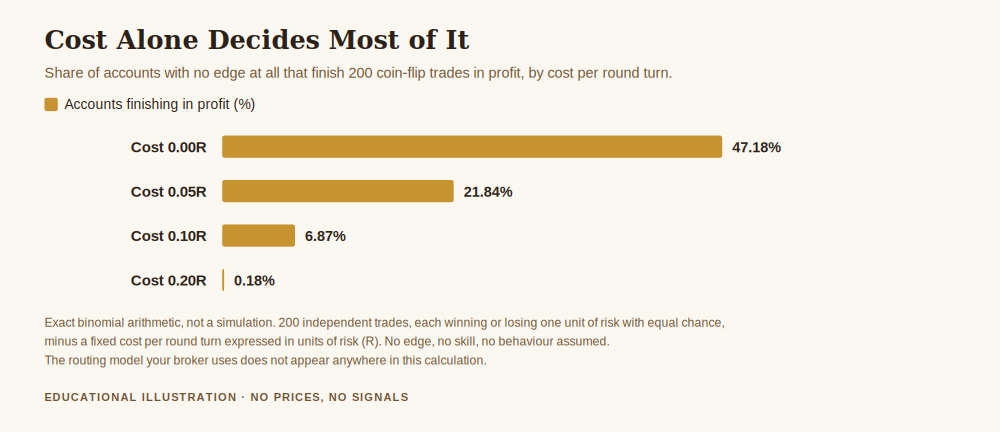
- At zero cost, 47.18 per cent finish in profit. Not fifty, because with an even number of trades a good many land exactly at break even.
- At 0.05R per round turn, it falls to 21.84 per cent.
- At 0.10R, it falls to 6.87 per cent.
- At 0.20R, it falls to 0.18 per cent. Roughly one account in five hundred and fifty.
Read those four numbers again, because they are the whole article. Nothing changed between them except the cost per trade. No psychology, no revenge trading, no bad entries, no leverage, no news event. Cost alone took a group of accounts from a near coin flip to a near certainty of loss.
And now hold that against what the European Securities and Markets Authority found when it looked at real accounts. In the announcement of its measures on binary options and CFDs, ESMA reported that national regulators’ analyses “shows that 74-89% of retail accounts typically lose money on their investments, with average losses per client ranging from €1,600 to €29,000.”
Between 74 and 89 per cent losing. My no-edge accounts at 0.05R cost lose 78.2 per cent of the time. At 0.10R they lose 93.1 per cent of the time. The regulator’s observed range sits almost exactly where friction alone would put it.
I want to be careful about what I am claiming. I am not saying costs are the only reason retail accounts lose, and I cannot prove that from this. Real traders are not coin flips, some have an edge and some have habits far worse than random. What I am saying is narrower and I think more useful: you do not need to assume anybody behaved badly to reproduce the regulator’s numbers. Ordinary friction, applied to an account with no advantage, gets you there on its own.
What this means for the question you actually asked
So, should you move to an ECN account? Here is how I would order it, and notice that the label comes last.
First, the break-even win rate. On a 1:1 payoff, cost 0.05R per round turn means you must win 52.5 per cent of the time to break even. At 0.10R it is 55.0 per cent. At 0.20R it is 60.0 per cent. Those are the hurdles your method has to clear before it produces anything at all. Work out yours before you compare any two accounts, because it tells you how much a cost saving is worth to you specifically.
Second, trade count. Every figure above scales with the number of round turns. Two hundred trades a year at 0.10R is a 20R drag. Cut to fifty trades and the same cost per trade is a 5R drag. For most people the largest available reduction in friction is not the account type, it is the number of times they click.
Third, solvency and regulation. The twenty million dollar figure above is the kind of thing worth checking. Is the firm registered, where, and what does that regime actually require of it. That question matters far more than routing when something goes wrong.
Fourth, and only fourth, the cost structure. Raw spread plus commission against an all-in wider spread. This is arithmetic you can do in ten minutes for your own trade count, and it is a real saving when it goes your way, and it is usually smaller than people expect.
The gentleman who wrote to me was trading roughly eight times a week. Moving accounts might have shaved a fraction of a unit of risk off each round turn. Halving his trade count would have done several times more, cost him nothing, and required no paperwork at all.
Get the free Gold Empire survival sheet, a one-page guide to protecting your account from the kind of slow friction this article describes, before it becomes the reason you quit. One email, no spam, unsubscribe anytime.
Frequently asked questions
So what is an ecn broker, in one sentence?
Strictly, a venue that matches your order against another participant’s and charges a fee for the match rather than earning the spread. In retail forex advertising it usually means an account with a tight raw spread, a separate commission and aggregated pricing from several liquidity providers. Those are two different statements and the marketing rarely separates them.
Is an ECN account safer than a dealing desk account?
Safety comes from regulation, segregation of client money and the firm’s capital, not from routing. The CFTC page above requires registered counterparties to hold net capital of $20 million plus 5 per cent of retail liabilities above $10 million, and that requirement applies to the firm regardless of what its account types are called. Check the registration and the regime. The label tells you about pricing, not about what happens if the firm fails.
Does an ECN account mean my broker cannot trade against me?
No, and I would treat any firm that claims otherwise with caution. Under the US rules the firm offering the contract is registered as a counterparty, which is what the word dealer means. Whether it hedges your particular flow in the market or holds it internally is an operational decision described in your terms, and it can differ between clients and change over time. The account label does not control it.
Will switching to a lower cost account fix a losing account?
It helps, and the numbers above show exactly how much it can help, but look at the direction of the effect. Going from 0.10R to 0.05R per round turn moves a no-edge account from a 6.87 per cent chance of a profitable year to 21.84 per cent. That is a real improvement and still a losing proposition, because cost reduction does not manufacture an edge. It makes an existing edge survive. If there is no edge to protect, a cheaper account only slows down the same outcome.
Where do the percentages in the chart come from?
They are my own exact binomial arithmetic, computed in Python and reproducible with a pocket calculator and patience. 200 independent trades, each winning or losing one unit of risk with probability one half, minus a fixed cost per round turn in the same units. An account finishes in profit when wins minus losses exceed total costs. No behaviour, skill, leverage or market condition is modelled, which is the entire point: these are the numbers before anything human happens.
What are the limits of that calculation?
Several, and I would rather state them than have you find them. Real trades are not 1:1 payoffs and not independent. Real costs vary with volatility, time of day and how the order fills. Real traders are not coin flips. And a 200 trade year is one choice of many. The calculation is not a model of you, it is a floor: it shows what cost does before anything else is added, and everything else is added on top of it.
Does Gold Empire recommend a particular broker?
There are broker articles on this site and some carry partner links, which are always disclosed on the page itself. Nothing here, including this article, is a recommendation to open any particular account, and the arithmetic above is deliberately the sort that no broker’s marketing department would commission.
What Gold Empire actually does
Gold Empire is a free resource for people trying to survive their first years in gold rather than get rich in them. The articles are free, the daily analysis on Telegram is free, and the Gold Survival Sheet is free. There is no profit promise anywhere on this site and there never will be, because the arithmetic in this article is precisely why nobody can make one honestly.
If cost is the thread you want to pull, raw spread account vs standard account does the full comparison with your own trade count, and what is the spread in gold trading covers the first cost every trade pays. The article underneath all of them is risk management in gold trading, and if you are choosing a firm rather than an account type, best broker for gold trading is the one to read.
About the author. Matthew writes Gold Empire. He changed broker three times early on looking for the thing that was wrong, and the thing that was wrong turned out to be how often he was clicking. Nothing in this article is financial advice or a recommendation to open any account, and no entry, stop or target discussed should be treated as a signal.
One step first
Where should we send the Gold Survival Sheet?
Leave your email and we will send the free one page checklist, then take you straight to the Telegram channel.
No cost and no obligation. Educational only, not financial advice, and nothing here promises a return. Unsubscribe any time in one click.
Leave a Reply