
Someone in the channel asked me a question that sounds simple and is not. He had found two products at his broker, one called a gold ETF and one called a gold fund, and he wanted to know which one to put his savings into. The question of gold etf vs gold fund which is better gets asked constantly, and almost every answer I have read online compares the wrong things: past performance, ticker popularity, which one the platform pushes on the front page.
None of that is the useful comparison. The useful comparison is structural, and it decides three things that will follow you for as long as you hold the position: what you actually own, what it costs you every year, and what rate your gains get taxed at. Two of those three are knowable in advance with certainty. Let me go through them.
Gold etf vs gold fund which is better starts with what you actually own
The first trap is that neither name tells you what is inside. “Gold fund” is not a legal category, and “gold ETF” describes how a thing trades, not what it holds.
Under those two labels you will find at least three genuinely different products. There are funds that hold physical bullion in a vault. There are funds that hold shares in gold mining companies. And there are funds that hold other funds, or that hold futures contracts rather than metal. A mining fund and a bullion fund can both be sold to you as “gold”, and they behave differently, because a mining company is a business with debt, costs, management and a share price that can fall while the metal rises.
So the first thing to do, before any comparison of fees, is to open the document and find out which of those three you are looking at. That distinction matters more than everything else in this article combined, and it is the one people skip because it takes ten minutes and the fee number takes ten seconds.
What “fund” means legally, and why the wrapper is not decoration
There is a real legal distinction underneath the marketing, and it is worth knowing because it changes what protections apply.
A conventional mutual fund is a registered product. The SEC’s own investor education material describes a mutual fund as an SEC-registered open-end investment company that pools money from many investors, whose portfolio is managed by an SEC-registered investment adviser, and whose investors buy and redeem shares from the fund itself at the next calculated net asset value on any business day.
Read what that gives you: registration, a regulated adviser, and redemption at net asset value once a day. It also tells you what it does not give you, which is the ability to sell at eleven in the morning at a price you can see. You get the day’s NAV, whatever that turns out to be.
A bullion-backed exchange traded product is often organised differently, commonly as a trust that holds metal, rather than as a registered investment company of that kind. It trades on an exchange all day like a share, so you can deal intraday at a visible price, and you are buying from another market participant rather than from the fund. That is a genuine convenience. It is also a different legal object with a different rulebook, and you should not assume the protections are identical because the marketing language is.
The practical instruction here is boring and I am going to give it anyway: find the prospectus, find the section that says how the thing is organised, and read that section. It is usually one page. It is the highest return ten minutes available to a person at this stage of the decision.
The tax difference that almost nobody checks first
Now the part that surprises people, and the reason I think this question deserves a whole article rather than a one line answer.
In the United States, long term capital gains for most assets are capped at a top rate of 20 per cent. But the IRS treats collectibles differently. Its guidance on capital gains states plainly that net capital gains from selling collectibles are taxed at a maximum 28 per cent rate.
And gold is a collectible for this purpose. IRS Publication 550 defines a collectibles gain or loss as gain or loss from the sale or trade of a work of art, rug, antique, metal (such as gold, silver, and platinum bullion), gem, stamp, coin, or alcoholic beverage held more than 1 year. The same passage adds the sentence that matters most here: collectibles gain includes gain from the sale of an interest in a partnership, S corporation, or trust due to unrealized appreciation of collectibles.
Hold those two together. If the product you own is a trust whose appreciation comes from bullion, the gain can be a collectibles gain, taxed at up to 28 per cent rather than up to 20 per cent. On 10,000 USD of gain that is the difference between keeping 8,000 USD and keeping 7,200 USD, or 800 USD, purely because of how the wrapper is built.
I want to be careful about how far I take that. Your own situation, your country, your account type and the specific structure of your fund all change the answer, and a fund held inside a tax sheltered retirement account is a different conversation entirely. I am not a tax adviser and this is not tax advice. What I am telling you is that the wrapper has a tax consequence, that the consequence is large enough to notice, and that it is the sort of thing worth asking a qualified person about before you buy rather than in April afterwards.
What the annual fee does while you are not looking
The third structural difference is the annual fee, and this is the one you can calculate exactly.
A fund charges a percentage of assets every year, whether the year was good or bad. Bullion exchange traded products tend to sit at the lower end, and actively managed funds and funds that hold other funds tend to sit higher, because the second layer of management gets paid too.
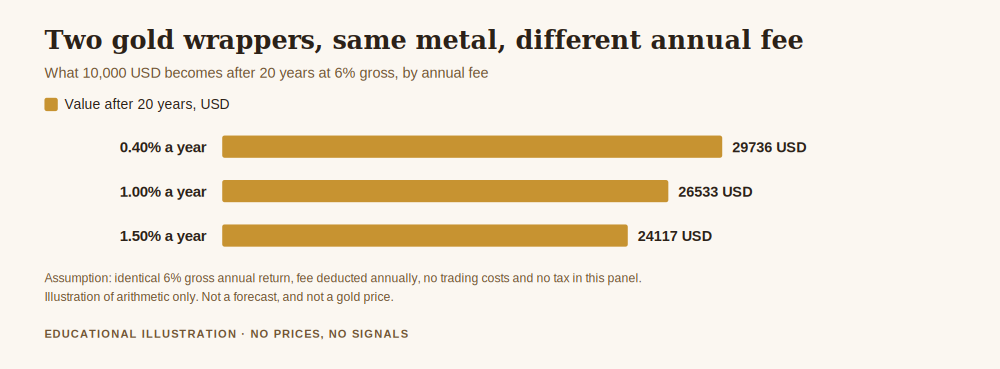
Take 10,000 USD, assume an identical 6 per cent gross annual return for both, and change nothing but the fee. After 20 years the 0.40 per cent product is worth 29,736 USD and the 1.00 per cent product is worth 26,533 USD. The gap is 3,203 USD, which is 10.8 per cent of the cheaper result. Push the fee to 1.50 per cent and the gap becomes 5,619 USD, or 18.9 per cent.
Those are assumptions, stated openly: same gross return, fee deducted annually, no trading costs, no tax in that particular calculation, and a 6 per cent figure chosen to make the arithmetic comparable rather than as any forecast of what gold will do. Nobody knows what gold will do. The fee, by contrast, is published in advance and is one of the very few numbers in this business you can know before you commit.
That is the reason I keep returning to costs in everything I write. You cannot control the return. You can control the fee and the tax treatment, and over twenty years those two do more visible damage than most of the things people worry about instead.
So which one is better
Neither, as a general answer, and I would be suspicious of anyone who gives you one without asking what you are trying to do.
What I can offer is the order to think in. Decide what exposure you want first, metal or mining companies, because that is the largest difference and it is not a cost question. Then check the annual fee, because it is knowable and it compounds. Then check the structure and its tax consequence, because an 8 percentage point difference in rate is not a detail. Then, last, consider whether intraday dealing actually matters to you, which for someone buying to hold for years it usually does not.
And if what you actually want is the metal itself rather than a claim on it, that is a third road with its own costs, covered in gold ETF vs physical gold returns. If you are weighing metal against the companies that dig it up, is it better to buy physical gold or gold stocks takes that comparison apart.
One thing this article is not about, and I want to say it clearly: none of this is a view on whether you should own gold at all, or when. It is about what happens to the money once you have decided. Whatever you hold it in, size it as part of a plan rather than as a reaction, which is the argument in risk management in gold trading.
Get the free Gold Empire survival sheet, a one page guide to protecting your account, including the costs worth checking before you commit money to anything. One email, no spam, unsubscribe anytime.
Frequently asked questions
Is a gold ETF always cheaper than a gold fund?
Usually but not reliably, and “usually” is not a good enough basis to skip checking. Bullion exchange traded products tend to sit at the low end of the fee range because they are doing something mechanical, holding metal, while an actively managed fund is paying people to make decisions and a fund that holds other funds is paying two layers. But fee ranges overlap, and a cheap wrapper around the wrong exposure is not a bargain. Look up the actual published figure for the actual product rather than reasoning from the category name.
Does the 28 per cent collectibles rate apply to every gold product?
No, and this is exactly why the structure matters. The rate attaches to collectibles gain, which the IRS defines to include gold bullion and to include gain from selling an interest in a trust due to unrealized appreciation of collectibles. A fund holding mining company shares is holding equities, not metal, so it is not the same case. Account type changes it again. The honest answer is that it depends on the specific product and on your situation, which is the whole argument for reading the prospectus and asking a qualified person in your country.
Where did the fee numbers in the chart come from?
They are my own arithmetic, not quoted from any provider. I took 10,000 USD, applied a 6 per cent gross annual return, deducted the fee annually, and compounded for 20 years at three fee levels. The 6 per cent is a comparison device, not a prediction, and the point survives whatever number you substitute: the gap between fee levels is a fixed share of the result and grows with time. Put your own product’s published fee into the same calculation and you will get a figure that means something for your case.
Can I just hold the metal instead?
You can, and plenty of people should consider it, but understand that you are swapping one set of costs for another rather than escaping costs. Physical metal brings a dealer spread when you buy and again when you sell, storage or insurance if you do not want it in a drawer, and the practical problem of verifying and selling it later. It removes the annual management fee and it removes counterparty questions. Which set of costs suits you depends on size, timeframe and how much practical hassle you are willing to absorb.
Does any of this tell me whether gold will go up?
Not even slightly, and I would be wary of any page that mixes the two questions. Everything here is about the container, not the contents. Choosing a cheaper wrapper does not make gold rise, and choosing the most expensive one does not make it fall. The reason to get the container right is that it is the part of the outcome you can actually determine in advance, which is rare enough to be worth the ten minutes.
What Gold Empire actually does
Gold Empire is a free Telegram channel and a free library of market notes about gold, written for people who want to survive their first few years in this market rather than get rich in them. Everything on the site is free and there is no profit promise anywhere on it, because nobody can make one honestly. The model is simple: follow along for free, and take the free survival sheet if it is useful to you.
About the author. Matthew writes the Gold Empire market notes and has spent most of his time in this market learning what not to do. He is not a licensed adviser and does not want to be one, and he paid a fee for years without once checking what it compounded to. His interest is in the part of this business nobody posts screenshots of: staying in the game long enough for a method to matter.
Disclaimer: This article is general educational content about the structure and cost of investment products. It is not financial advice, not tax advice, not a recommendation, and not a solicitation to buy or sell anything. All cost figures are illustrations computed from stated assumptions and are not quoted from any provider. Tax treatment depends on your individual circumstances and on the jurisdiction you are in, and it can change. Trading and investing carry a risk of losing money, and no entry, stop or target discussed should be treated as a signal. Consider your own circumstances and seek independent regulated advice if you need it.
One step first
Where should we send the Gold Survival Sheet?
Leave your email and we will send the free one page checklist, then take you straight to the Telegram channel.
No cost and no obligation. Educational only, not financial advice, and nothing here promises a return. Unsubscribe any time in one click.
Leave a Reply