

If you have ever wondered what is a book and b book in forex, you were really asking a simpler question: when I click buy, who is on the other side? Most traders never find out. The answer is not hidden exactly, it is just filed under a heading nobody reads, and it quietly decides whether your broker is paid for your activity or paid for your mistakes.
I want to be careful here, because this topic attracts two kinds of nonsense. One says every broker is a criminal running a rigged casino. The other says the whole thing is a conspiracy theory and you should stop worrying. Neither is true, and both are convenient for somebody. The honest version is duller: there are two ways a broker can handle your order, both are legal, both are used by serious firms, and they create different incentives. Knowing which one you are on is part of surviving.
Every figure in this article is either quoted from a regulator’s own document or worked out by me from assumptions I state as I go. There are no prices here and no forecasts.
What is a book and b book in forex, in plain terms
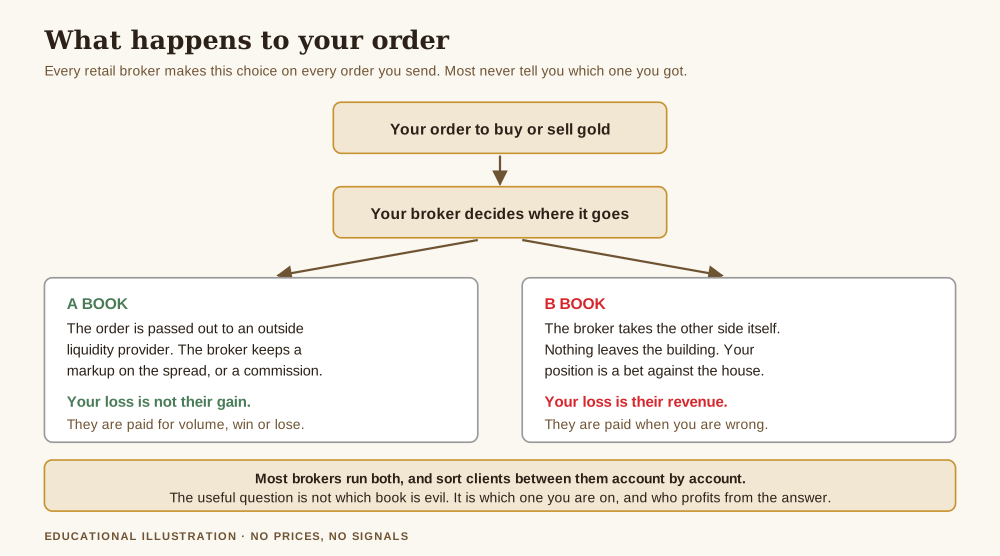
When your order reaches your broker, the firm has a choice. It can pass the risk out to somebody else, or it can keep it.
Passing it out is called putting you on the A book. The broker sends a matching order to a liquidity provider, usually a bank or a larger non bank market maker. Now the broker holds no market risk. If gold runs, the liquidity provider pays, and the liquidity provider has its own hedge. The broker earns the difference between the price it got and the price it gave you, or a separate commission, or both. It is paid for your volume. It does not care whether you were right.
Keeping it is called putting you on the B book. The broker does not send anything anywhere. It writes the other side of your trade itself. Your buy is its sell. Nothing leaves the building. If gold runs and you were long, the broker pays you out of its own pocket. If gold falls, your loss stays with the firm as revenue.
The terms come from old bookmaking language, where a bookmaker laid off some bets with other bookmakers and kept the rest. The vocabulary survived into retail trading because the structure is the same.
Here is the part people miss. Almost no broker is purely one or the other. Most run a hybrid, sorting clients between the two books, often automatically, often by a scoring system that watches how you trade. Consistently profitable accounts tend to get routed out to the A book, because the firm does not want to be the counterparty to someone who keeps winning. Accounts that lose tend to stay internalised. That sorting is not announced to you, and in most jurisdictions it does not have to be.
Why this is a conflict and not a scandal
A B book is not fraud. A firm taking the other side of a client trade is doing what a market maker has always done, and there is a genuine service in it. Internalising orders lets a broker offer tighter pricing on small trade sizes than it could get by sending every one of them out to a bank, because banks do not want a stream of tiny orders and will price accordingly. If you trade a fraction of a lot, somebody internalising that flow is the reason your cost is not absurd.
The problem is not the model. The problem is the incentive that sits inside the model when the client loses reliably. If my revenue is your loss, then every feature of the service that makes you lose faster is, in the short term, good for me. Higher leverage. A platform that makes it easy to add to a losing position. A marketing budget aimed at people who have never traded. None of that requires anyone to cheat. It only requires a firm to be slightly less diligent about things that happen to be profitable.
This is why the question is worth your attention even though the honest answer is “it depends”. You are not looking for a villain. You are looking at whether the business model of the firm holding your money is aligned with you lasting a long time, or not.
The number that makes the conflict concrete
Regulators have measured this, which saves us from guessing.
When the European Securities and Markets Authority introduced its restrictions on contracts for difference, it published what national regulators had found across the member states. Their analyses showed that 74 to 89 per cent of retail accounts typically lose money, with average losses per client ranging from 1,600 to 29,000 euros. That is ESMA’s own wording in its announcement of 27 March 2018.
Sit with that range for a second, then do the arithmetic on a dealing book.
Take 100 retail accounts. Assume the low end of ESMA’s own average loss figure, 1,600 euros, and apply it to each losing account. At the bottom of the range, 74 accounts lose, which is 118,400 euros. At the top of the range, 89 accounts lose, which is 142,400 euros. So a hundred ordinary retail accounts generate somewhere between 118,400 and 142,400 euros of client losses, using the regulator’s most conservative loss figure.
Those assumptions are deliberately crude and I want to name them: I have applied the lowest average loss in ESMA’s range to every losing account, I have ignored what the winning accounts get paid, and I have treated a published range as though it applies evenly to any one firm’s book. The real number for any particular broker will differ. The point is not precision. The point is the order of magnitude, and the direction it points in.
Now compare that with being paid for volume instead. Suppose an agency style broker earns a markup of six euros per round turn lot. That figure is illustrative, not any firm’s published rate. To earn what one single average losing client hands over, that broker needs 1,600 divided by 6, which is about 267 round turn lots of routed volume. One losing client equals roughly 267 lots of somebody else’s hard work.
That is the whole conflict in one line. It is much faster to be paid by a client who loses than by a client who trades.
What the regulator did about it
ESMA’s response is instructive, because it tells you which part of the structure it judged most dangerous. It did not ban the B book. It went after leverage.
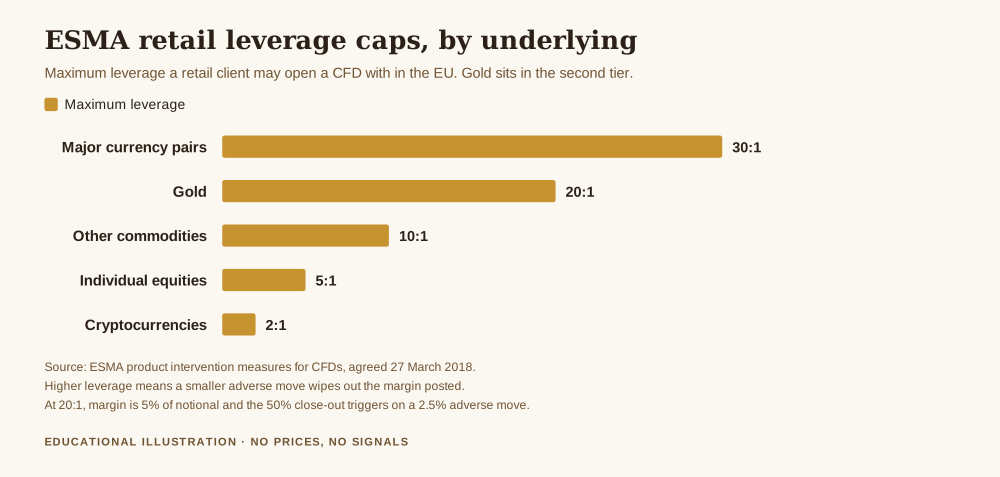
The caps, taken from ESMA’s own note on the agreed measures, run from 30:1 down to 2:1 according to the volatility of the underlying. Major currency pairs got 30:1. Gold sits in the second tier at 20:1, alongside non major currency pairs and major indices. Commodities other than gold got 10:1, individual equities 5:1, and cryptocurrencies 2:1.
Work out what 20:1 means and the logic becomes obvious. At 20:1 the margin you post is 100 divided by 20, which is 5 per cent of the notional value of the position. That means a 5 per cent adverse move in the underlying wipes out every cent of the margin backing it.
ESMA then added a margin close out rule at 50 per cent of the minimum initial required margin. Half of 5 per cent is 2.5 per cent. So on a fully leveraged gold position, a 2.5 per cent move against you is enough to trigger the close out. Not a crash. Not a black swan. A moderately busy afternoon.
The third measure was negative balance protection on a per account basis, which limits what you can lose to the funds in the account. Before that rule existed, a bad gap could leave a retail client owing the broker money. If you want the uncomfortable version of what happens when that protection is missing, read what happens if your forex broker goes bust.
Notice what the regulator concluded. The most effective lever was not forbidding brokers from taking the other side. It was reducing how fast a retail client can be destroyed. That is a judgement about where the real damage comes from, and it is worth copying into your own thinking.
How to tell which book you are on
You usually cannot, not with certainty, and I would be lying if I told you otherwise. But you can narrow it down.
Read what the firm calls itself in its legal documents, not its adverts. Terms like “dealing on own account” or “matched principal” in the licence disclosures tell you the firm is permitted to be your counterparty. “Agency only” or “straight through processing” points the other way. The marketing page is not evidence. The regulatory disclosure is.
Look at how it is paid. A raw spread account with a visible per lot commission is a structure that only makes sense if the firm is earning from volume. A zero commission account with a wider spread can be either. Neither proves anything on its own, but the first is at least consistent with an agency model. If the pricing model itself is unfamiliar, how the spread works in gold is the thing to understand first.
Check the regulator, not the website. Every serious jurisdiction publishes a register. The entity named in your account agreement should appear in it, under that exact name, with permissions that match what it is doing. A firm operating through an offshore entity while advertising a European licence is telling you something important.
Notice what changes when you do well. This one is anecdotal and I offer it as such. Traders who become consistent sometimes report that their execution changes character, with more frequent requotes or slower fills. That can be routing being switched. It can also be coincidence, or their own size growing. Treat it as a prompt to look harder, not as proof.
If you are choosing a firm from scratch rather than auditing one you already use, the practical checklist is in how to pick a broker for gold trading, and the account opening mechanics are in how to open a gold trading account.
What actually protects you
Here is the part I most want you to take away, and it will sound anticlimactic after all that.
Finding a pure A book broker would not save an account that is sized wrong. The ESMA figure, 74 to 89 per cent of retail accounts losing, was measured across the whole European market, including firms operating under some of the strictest rules in the world. Those clients had negative balance protection, capped leverage and a margin close out rule, and most of them still lost. Structure was not the binding constraint. Behaviour was.
A broker with a conflict of interest can only harm you through the gap you leave open. If you trade at a size where a 2.5 per cent move ends your position, you have handed the outcome to whoever is on the other side, and it stops mattering very much who that is. If you trade at a size where a 2.5 per cent move is an inconvenience, the conflict shrinks to a cost question, which is a question you can shop around on.
So the order of operations is: fix the sizing, then audit the counterparty. Not the reverse. The full version of that argument is in risk management for gold trading, which is the piece everything else here sits on top of.
Get the free Gold Empire survival sheet, a one page guide to sizing a position so that who is on the other side of it stops being the thing that decides your month. One email, no spam, unsubscribe anytime.
Frequently asked questions
Is the B book illegal?
No. Acting as principal against a client is a licensed activity in every major jurisdiction, and firms that do it hold permissions that say so. What is regulated is disclosure, capital adequacy, execution quality and the treatment of client money. A firm can run a B book and be entirely compliant. A firm can also run an A book and treat you badly on cost. The model is not the measure of honesty.
If my broker is on the other side, does it move the price to hit my stop?
On a regulated venue this is far less common than the internet suggests, and firms get caught when they do it, because execution data is auditable and regulators look at it. The more realistic risk is mundane: slightly worse fills, slightly wider spreads at busy moments, and a platform built to encourage activity. Those cost you steadily rather than dramatically. If your stop keeps getting hit, the likelier explanation is that it was placed where everybody else put theirs, which is a different problem with a different fix.
Does an ECN account guarantee I am on the A book?
No, and the label is used loosely. Some firms use it to mean genuine access to a pool of competing liquidity providers, and some use it to mean a pricing structure with a commission attached. The permissions in the regulatory register tell you more than the account name does. The distinction is worth reading properly in what an ECN broker actually is.
Should I move to a broker that advertises no dealing desk?
Only if the rest of it stacks up. A firm’s routing model is one input alongside its regulator, how client money is held, its cost structure and whether it has negative balance protection. Switching to a firm with a better sounding model but a weaker licence is a downgrade wearing the right word. And no change of broker fixes a position that is too large, which is the thing that ends most accounts.
Why does ESMA give a range of 74 to 89 per cent rather than one number?
Because the figure came from separate analyses by different national regulators, covering different markets and periods, so ESMA reported the span rather than inventing a false average. Under the same rules each provider must publish its own specific loss percentage, which is why you see a precise figure on individual broker websites. Firms that could not compute their own were required to show the 74 to 89 per cent range instead.
Where Gold Empire fits
Gold Empire is a free journal about surviving long enough in gold to get good at it. There is no signal service here, nothing is sold on a promise of returns, and I have no arrangement with any broker that depends on you opening an account. The free survival sheet is one page about position sizing, which is the lever that makes most of the other questions smaller. If you want the piece underneath all of it, read risk management for gold trading.
About the author. Matthew writes Gold Empire. He went looking for his own broker’s regulatory disclosure after a conversation with someone who insisted the whole industry was rigged, found a dull two line permission that answered the question in about forty seconds, and has recommended the exercise ever since. He is more interested in what survives a bad month than what wins a good one.
This article is educational and is not financial advice. Trading gold and leveraged products carries a substantial risk of loss and is not suitable for everyone. Nothing here is a recommendation to use or avoid any particular firm, and no entry, stop or target discussed should be treated as a signal. Figures quoted from ESMA are reproduced from its published documents; figures I have computed are labelled as such, with the assumptions stated. Do your own checks on any firm before you send it money.
One step first
Where should we send the Gold Survival Sheet?
Leave your email and we will send the free one page checklist, then take you straight to the Telegram channel.
No cost and no obligation. Educational only, not financial advice, and nothing here promises a return. Unsubscribe any time in one click.
Leave a Reply