
Some version of this question reaches me most weeks, and it is almost always asked by someone who has already opened an account and is now uneasy about it. So let me answer the practical half plainly. Is spot gold halal is not a question I can settle for you, because I am a trader and not a scholar, and anybody who tells you otherwise on a trading blog is selling something. What I can do is the part most people skip, which is to describe exactly what the contract on your screen does, what it settles, and what it charges you while you hold it. Scholars disagree about products, but they do not disagree about arithmetic. If you bring an accurate description of the instrument to someone qualified, you will get a far better answer than if you bring the word gold.
There is also a published standard on this, written by the body that writes accounting and Shari’ah standards for Islamic financial institutions, and it exists precisely because the question kept being asked without a common reference. Most people arguing about it online have never read it. It is worth knowing what it covers before you form a view.
What the word spot actually promises
In the professional bullion market, a spot trade is a contract to exchange metal for money at the current price, settling two business days later. Metal moves, money moves, and the trade is finished. That is the picture the word spot paints, and it is the picture most retail traders have in their heads when they open a gold position.
It is usually not what they have bought. The gold position in a retail trading account is, in the overwhelming majority of cases, a leveraged contract for difference or a rolling spot contract. It does not settle in two days. It does not settle at all. It is held open indefinitely, rolled forward every night, and closed one day for cash. No metal is ever allocated to you, no bar carries your name, and the broker is not obliged to deliver anything. What you own is a claim against your broker whose value tracks the gold price. That is a legitimate financial instrument, and it is also a completely different animal from the thing the word spot describes. Our piece on what spot gold actually means goes through the mechanics in more detail.
This distinction is not a technicality invented to complicate your life. It is the hinge the whole religious question turns on, because the two things scholars examine most closely are whether you took possession and whether you paid interest. A rolling leveraged contract is designed, by construction, to avoid the first and to require the second.
The standard that already exists, and who wrote it
In 2016 the Accounting and Auditing Organization for Islamic Financial Institutions, usually shortened to AAOIFI, issued Shari’ah Standard No. 57 on Gold and its Trading Controls, developed in collaboration with the World Gold Council. Before it existed there was no single agreed reference for gold as an investment in Islamic finance, which is one reason the same argument kept going in circles. The document runs to 31 pages and covers gold in its various forms, the parameters that apply to gold transactions, and the treatment of gold based financial products. The World Gold Council has published the launch material and the standard itself on its own site, so you can read the source rather than somebody’s summary of it.
Two things about that document deserve more attention than they usually get. First, its conclusion is permissive in principle. It does not say gold is forbidden. It sets out the conditions under which gold investment and gold based products are acceptable, which is a very different thing from a prohibition and a very different thing from a blanket approval. Second, the standard carries its own explicit notice that AAOIFI’s responsibility is limited to issuing the text of the standard, and that it is not liable for products claimed to comply with it. The collaboration with the World Gold Council was conceptual and technical input into the standard, and no commercial product was reviewed or approved through it.
That second point matters a great deal when you are reading broker marketing. A firm can truthfully say that a standard on gold exists and that it permits gold investment under conditions, while telling you nothing whatsoever about whether its own rolling contract meets those conditions. The standard is a yardstick, not a certificate, and nobody has handed out certificates.
Why is spot gold halal turns into two narrower questions
Once you stop asking about gold in general and start asking about the specific contract you hold, the question splits into two much more answerable parts.
The first is possession. Classical treatments of gold treat it as a monetary commodity, which brings in rules about exchange that do not apply to, say, wheat or shares. In broad terms, when gold is exchanged for currency, the exchange is expected to be completed without deferral on both sides. The practical question for you is therefore blunt. At any point in the life of your position, is any gold actually yours, whether allocated in a vault or delivered to you? For a rolling leveraged contract the honest answer is no, and the broker’s own contract specification will say so if you read it. For an allocated holding with a custodian, the answer may well be yes. Those are not the same product and they should not get the same answer.
The second is interest. A leveraged position is financed, because you have not paid for the full value of what you control. Somebody is funding the remainder, and that funding has a price, charged to you every night as a swap or rollover. Whether that charge is riba is exactly the sort of question a scholar is for. Whether it exists, and how large it is, is a question I can answer with a calculator, and most people have never run the numbers.
The financing, measured rather than described
One reader put the whole issue into two lines without meaning to. He wrote: “what is the margin rate, 1:500? what is the swap fees?” Those two questions belong together, because the second is the price of the first, and almost nobody looks at them side by side.
So here is the arithmetic, with every assumption stated so you can redo it with your own figures. Assume a notional position worth 100,000 US dollars. That is an assumption for the sake of the sum and not a gold price. Assume it is financed at 3.88 per cent a year, which is the federal funds effective rate reported in the Federal Reserve’s H.15 release of 15 October 2026, and use the 360 day convention the money market normally uses. The financing on that position is 10.78 US dollars a day, 323.33 over thirty days, and 3,880 over a year.
Now set that against what you actually put up. At 1:100 leverage the margin on a 100,000 notional is 1,000 US dollars, and the financing equals your entire deposit in 92.8 days. At 1:200 the margin is 500 and it takes 46.4 days. At 1:500, the setting that reader was asking about, the margin is 200 US dollars and the financing cost matches everything you posted in 18.6 days. Over a full year the financing on that position is 19.4 times the margin behind it.
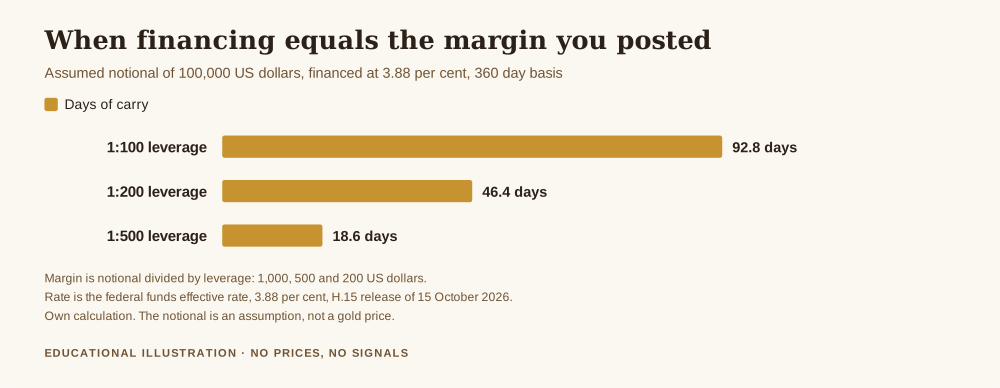
Read that chart as a description of the contract rather than as advice about leverage. The point is not that one setting is safer than another, though our piece on leverage in gold trading covers that ground. The point is that on a leveraged rolling position the borrowing is not a side detail attached to the trade. Over any meaningful holding period it is the dominant economic fact of the arrangement, and it is the single feature most likely to matter to the person you ask for a ruling.
What a swap free account changes, and what it does not
Readers ask me about this constantly. “please I want to know what leverage is the best to set please in forex trading”, wrote one. Another asked: “Do you focus on XAU/USD and then buy leveraged products? How much leverage do you use?” The follow up question is nearly always about swap free accounts, which are widely marketed as the answer to everything discussed above.
A swap free account, often sold as an Islamic account, simply does not apply the overnight financing line to your position. That is a real difference and not a trick. What it does not do is change what the contract is. The position still does not settle, still allocates no metal to you, and still represents leveraged exposure financed by someone. Removing the visible charge does not remove the borrowing, and brokers who waive it generally recover the cost somewhere else, through a wider spread, a fixed administration fee after a number of days, or limits on which instruments qualify. Our article on what swap free actually means walks through where the charge tends to reappear, and the piece on swap in gold trading explains how the overnight line is built in the first place.
The honest summary is that a swap free account addresses one of the two questions and leaves the other untouched. Whether that is sufficient is not my call to make.
What to check before you decide
If you want a real answer rather than a comfortable one, go and collect four facts about your own account. None of them requires a scholar, and all of them are things your broker must be able to tell you.
One, find the contract specification for the gold instrument you trade and read what it says about settlement and delivery. Two, establish whether any gold is ever allocated to you at any point, and get that in writing rather than from a support chat. Three, if your account is swap free, ask precisely what replaces the overnight charge, after how many days, and in what form. Four, work out your own version of the arithmetic above using your actual leverage and your broker’s actual financing rate.
Then take those four facts to someone qualified to rule on them. A scholar handed a precise description of a rolling leveraged cash settled contract will give you a far more useful answer than one handed the words gold trading. And if the exercise makes you uncomfortable, that discomfort is information too. There are gold exposures that settle, allocate and deliver, and they are not hard to find.
Get the free Gold Empire survival sheet, a one-page guide to protecting your account through the kind of market this article describes. One email, no spam, unsubscribe anytime.
Frequently asked questions
Is spot gold halal according to AAOIFI?
The standard does not answer the question in that form. AAOIFI Shari’ah Standard No. 57 sets out conditions for gold and gold based products rather than ruling on any particular broker’s contract, and the document itself states that AAOIFI is not liable for products claimed to comply with it. Whether your specific instrument meets those conditions is a question for a qualified scholar, working from your contract specification.
Does a swap free account make gold trading permissible?
It removes the overnight financing charge, which addresses one of the two issues usually raised. It does not change settlement, delivery or the leveraged structure of the contract, and the cost is often recovered through other charges. Treat it as one fact about your account rather than as a ruling.
What is the difference between spot gold and physical gold here?
Settlement. A physical or allocated holding ends with metal that belongs to you. A retail rolling spot or contract for difference position is cash settled and allocates no metal at any point, which is precisely the feature that makes the religious question non obvious.
How much does the financing actually cost?
On an assumed notional of 100,000 US dollars financed at 3.88 per cent on a 360 day basis, it is 10.78 US dollars a day and 3,880 a year. Against margin of 200 US dollars at 1:500 leverage, a year of financing is 19.4 times the deposit. Run the same sum with your own leverage and your broker’s own rate.
Can I rely on a broker advertising an Islamic account?
You can rely on it to describe a product feature, which is the absence of the overnight swap line. It is not a scholarly endorsement, and no product was approved through the AAOIFI and World Gold Council collaboration. Read the terms and ask what replaces the charge.
So what should I do?
Collect the four facts listed above about your own account, then ask someone qualified. This article is here to make sure the description you bring them is accurate, not to replace them.
Where Gold Empire fits
Gold Empire is a free journal about surviving as a gold trader for long enough to get good, written for people who would rather read the contract than the advertisement. Nothing here is sold on a promise of returns and there is no signal service. The free survival sheet is one page about protecting an account through conditions like the ones described above. The piece underneath everything else is risk management in gold trading.
About the author. Matthew writes Gold Empire. He spent a long time treating the overnight line on his statement as a rounding error, then added up a year of it and discovered it was the largest single number on the page. He has read contract specifications before opening accounts ever since.
Sources and method. The existence, number, scope and disclaimer of AAOIFI Shari’ah Standard No. 57 on Gold and its Trading Controls, developed in collaboration with the World Gold Council, are taken from the standard and the launch material published on gold.org, both linked above. The financing rate of 3.88 per cent is the federal funds effective rate from Federal Reserve release H.15 dated 15 October 2026, also linked above. The daily, monthly and annual carry figures, the margin figures and the day counts are my own arithmetic on an assumed notional of 100,000 US dollars using a 360 day convention, all stated in the text so you can repeat it with your own numbers. Reader quotations are real messages from my inbox, anonymised and lightly edited, and are illustrative rather than a survey.
Disclaimer. This article is educational content about contract structure and financing costs. It is not investment advice, not a recommendation, and it is not a religious ruling of any kind. Nothing here is personal advice, and no entry, stop or target discussed should be treated as a signal. No absolute gold price appears anywhere in this article. Questions of religious permissibility should be taken to a qualified scholar together with your broker’s contract specification. Decide your own risk, and never trade money you cannot afford to lose.
One step first
Where should we send the Gold Survival Sheet?
Leave your email and we will send the free one page checklist, then take you straight to the Telegram channel.
No cost and no obligation. Educational only, not financial advice, and nothing here promises a return. Unsubscribe any time in one click.
Leave a Reply