

What does it mean when your account is frozen, in the only sense that matters at the moment it happens to you: the money is still listed on the screen, the platform will not let you touch it, and the person you reach on support is reading from a script that explains nothing. That last part is the bit people take personally. I want to show you why it is often not evasion at all, and why in a whole class of cases the firm is legally forbidden from telling you anything.
This is a survival topic rather than a trading one. An account you cannot access is an account you cannot manage, and I would rather you understood the machinery before you meet it than afterwards. Everything below comes from published rules you can open yourself, and I have linked them.
What does it mean when your account is frozen, and which kind you have
The word covers at least five different situations, and they have almost nothing in common except the symptom. Sorting out which one you are in is the whole job, because the right response differs completely.
A verification hold. Your identity documents have expired, the address no longer matches, or a review flagged a mismatch. The most common and least alarming kind. It ends when the paperwork clears.
A payment hold. The card, bank or processor is the thing that stopped, not the broker. A chargeback or a rejected deposit can lock the account while it is resolved.
A compliance hold. Something about the account’s activity triggered an internal review under anti money laundering rules. This is the one with the strange silence around it, and it is the main subject of this article.
An external order. A court, a tax authority or a regulator has directed the firm to restrain the account. The firm has no discretion here.
A dormancy or platform lock. Inactivity rules, a failed login sequence, or a terms breach. Usually the easiest to clear and the easiest to confirm, because the firm will say so plainly.
Here is the useful test. If the firm tells you specifically what is wrong and what you must send, you are in the first, second or fifth group, and it is administrative. If the firm will not say anything beyond a general formula about a review, the probability shifts sharply toward the third or fourth, and nothing you say on a chat window will change the timetable.
The silence is written into the rule
This is the part almost nobody knows, and it reframes the whole experience. In the United States, a broker dealer that suspects a transaction may involve illegal activity has to file a Suspicious Activity Report, a SAR, with the Financial Crimes Enforcement Network. The rule is 31 CFR 1023.320, and you can read every word of it.
It applies to transactions involving at least 5,000 dollars where the firm “knows, suspects, or has reason to suspect” one of several things, including that the transaction “has no business or apparent lawful purpose or is not the sort in which the particular customer would normally be expected to engage”.
Read that last clause again, because it is broader than people assume. It does not require wrongdoing. It requires only that the activity be unusual for you and that the firm has no reasonable explanation for it after looking. A sudden deposit far larger than your pattern, a withdrawal to a destination you have never used, a flurry of transfers after a quiet year. None of that is illegal. All of it can be unusual.
Then comes paragraph (e), the one that explains the script you were read. It says that a SAR, “and any information that would reveal the existence of a SAR, are confidential” and that “no broker-dealer, and no director, officer, employee, or agent of any broker-dealer, shall disclose a SAR or any information that would reveal the existence of a SAR”.
The support agent is not stonewalling you. They are prohibited from telling you, and the prohibition reaches “any information that would reveal the existence” of the report, which is why you get a vague formula rather than a specific reason. A firm that explained itself clearly in that situation would be breaking the law. Once you know this, the silence stops being an insult and becomes a signal about which category you are in.
How long this can legitimately take
Vagueness about the reason does not mean vagueness about the clock. The deadlines are published, and they are longer than most people guess.
On filing, the same rule gives the firm 30 calendar days from initial detection to file the report, and if no suspect has been identified it may take another 30, to a maximum of 60 calendar days. That is just the paperwork deadline. It is not a promise about your access.
For the hold itself, the clearest published ladder sits in FINRA Rule 2165, which lets a firm place a temporary hold on disbursements where it reasonably believes financial exploitation is occurring. The rule is narrow, covering what it calls Specified Adults, but it is the place where a regulator has actually written down how long a hold may run.
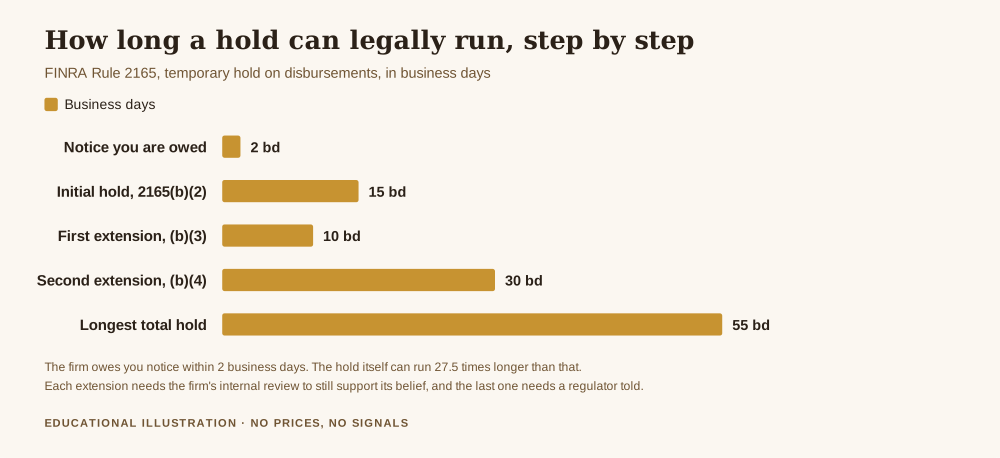
The firm must notify you within two business days. The initial hold expires no later than 15 business days. It can be extended by 10 more, and then by a further 30 if the firm has reported its belief to a regulator or court. Add those and the maximum is 55 business days.
Two business days of notice, 55 business days of hold. The hold can run 27.5 times longer than the window in which someone has to tell you it exists.
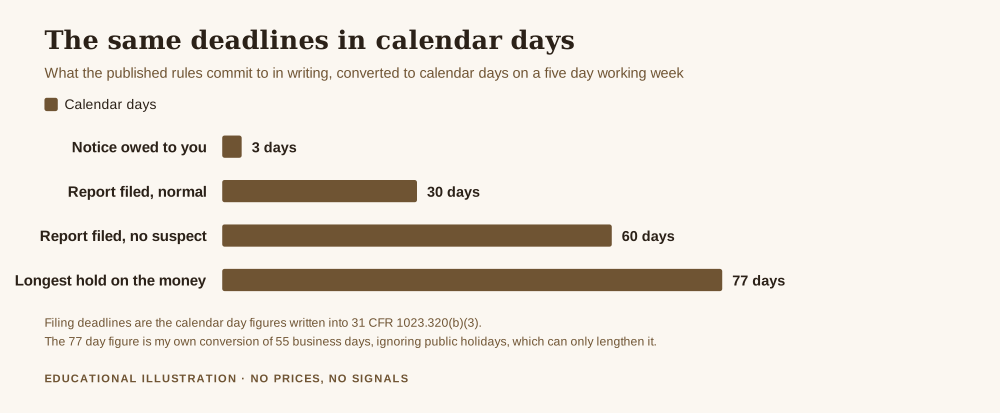
Converting 55 business days on a five day working week gives 11 weeks, which is 77 calendar days, a little over a fifth of a year. That conversion is mine and it ignores public holidays, which can only make the real figure longer.
One more number worth holding onto. The rule requires the firm to keep a copy of the report and its supporting documentation for five years. That is 1,826 days, about 23.7 times the longest hold. The file outlives the freeze by a wide margin, and you will never see it.
I want to be careful here, because precision matters more than drama. These particular rules are United States rules, and FINRA 2165 covers a specific category of customer. If your account sits with an offshore entity, and a great many retail gold accounts do, neither of these timetables binds anybody. What you get instead is whatever the client agreement says, which is usually much less. That is an argument for reading the agreement before you deposit, which is also the argument I made in what happens if your forex broker goes bust.
What actually helps, and what makes it worse
Given all that, the useful behaviour is narrower than people want it to be.
Send the documents once, completely, and in the format asked for. If it is a verification hold, this ends it. If it is not, you have cost yourself nothing and removed the one variable you control.
Put every request in writing. Email or the in platform ticket, not a phone call. You are building a record with timestamps, which is what any later complaint will stand on.
Ask for the one thing they can answer. Not why, which they may be forbidden to tell you, but what is required from you and when the review is scheduled to conclude. A firm that will not give you either, in writing, after a reasonable period, is a different problem from a firm working through a process.
Do not open a second account to move money around the freeze. If the hold is a compliance hold, this is close to the worst available move. Transactions “designed, whether through structuring or other means, to evade any requirements” are named in the rule as a reporting trigger in their own right. You would be manufacturing the suspicion that justifies the thing you are trying to escape.
Escalate on the clock, not on the feeling. When a reasonable published period has passed with no written timetable, go to the regulator the firm is actually licensed by. The process for that, and the detail of which regulator applies to which entity, is in how do I complain about a broker.
The part you can decide before any of this happens
The reason this topic belongs on a survival channel rather than a technical one is that every meaningful decision about a frozen account is made long before it freezes.
Which entity you signed with determines whose rules apply. Whether your name on the account matches your name on the bank account determines how fast a verification hold clears. Whether your trading capital is also your living expenses determines whether 77 days is an annoyance or a catastrophe. None of those can be fixed during the freeze, and all of them are free to fix now.
That is the same principle as position sizing. You are not trying to predict the bad event. You are arranging things so the bad event, when it arrives, is survivable without heroics. A frozen account is simply a drawdown you cannot trade out of, which is why the risk management that keeps a buffer outside the account is the only thing that reliably helps. And if you are still choosing where to open, the checks in how to open a gold trading account are worth more at that stage than at any point afterwards.
Get the free Gold Empire survival sheet, a one-page guide to protecting your account through the kind of market this article describes. One email, no spam, unsubscribe anytime.
Frequently asked questions
What does it mean when your account is frozen, in one sentence?
It means the firm has blocked some or all activity on the account, for one of about five quite different reasons, and the reason you are given tells you a lot about which one applies.
Why will my broker not tell me why?
If the hold relates to a suspicious activity report, 31 CFR 1023.320(e) forbids the firm from disclosing the report or any information that would reveal its existence. In that case the vagueness is required rather than chosen.
How long can a broker legally freeze my account?
It depends entirely on which rules govern your account. Under FINRA Rule 2165 the maximum is 15 plus 10 plus 30, so 55 business days, which is about 77 calendar days. Where that rule does not apply, and for most offshore entities it does not, your client agreement is the only timetable.
Does a frozen account mean I am suspected of a crime?
No, and this is the most common misreading. The reporting standard includes activity that is simply not the sort the customer would normally be expected to engage in, with no reasonable explanation found. Unusual is not unlawful.
Should I threaten legal action to speed it up?
It rarely moves a compliance review, which runs to its own timetable, and it can end the commercial relationship. A written request for the required documents and an expected conclusion date does more work.
Can I lose the money permanently?
A hold is not a forfeiture, and most holds end with the funds released. The serious risk is not usually the hold itself but the firm behind it, which is why the entity and its regulator matter more than the platform.
What if my broker is offshore?
Then the rules cited here are useful as a picture of how the process works in a regulated market, not as rights you can claim. Check the client agreement for the firm’s stated review and withdrawal timetables, and treat the absence of any as information in itself.
Where Gold Empire fits
Gold Empire is free to follow. Daily gold analysis on Telegram, with the reasoning written out so you can judge it rather than copy it, and a free survival sheet that exists to make you decide your limits before the market or your broker asks you about them. There is nothing here sold on a promise of returns, and no signal service. Survive first, then grow.
About the author. Matthew writes Gold Empire. He has sat through a verification hold that lasted a fortnight, spent the first three days of it convinced he had been singled out, and learned afterwards that the delay had a dull procedural explanation nobody was allowed to give him. He writes the dull explanations down now so other people lose fewer days to the guessing.
Sources and method. The reporting threshold, the suspicion standard, the 30 and 60 calendar day filing deadlines, the five year retention requirement and the confidentiality prohibition are all quoted from 31 CFR 1023.320, linked above. The two business day notice requirement and the 15, 10 and 30 business day hold ladder are from FINRA Rule 2165, linked above. The 55 business day total, the conversion to 11 weeks and 77 calendar days, the 27.5 times ratio and the 1,826 day retention figure are my own arithmetic on those published numbers, on a five day working week ignoring public holidays.
Disclaimer. This article is educational content about account restrictions and the rules that govern them. It is not legal advice, not financial advice, and not a statement about any particular firm or account. Nothing here is personal advice, and no entry, stop or target discussed should be treated as a signal. The rules cited are United States rules current at the time of writing and may not apply to your account, your firm or your jurisdiction, and rules change. Read your own client agreement and take professional advice on your own situation. No gold price appears anywhere in this article. Never trade money you cannot afford to lose.
One step first
Where should we send the Gold Survival Sheet?
Leave your email and we will send the free one page checklist, then take you straight to the Telegram channel.
No cost and no obligation. Educational only, not financial advice, and nothing here promises a return. Unsubscribe any time in one click.
Leave a Reply