
Somebody asked me last week to settle an argument he was having with himself. He had been offered a swap free account, and the offer sounded like a small miracle: hold positions as long as you like, no overnight charges, nothing quietly ticking away against you at midnight. He wanted to know what does swap free mean in practice, and whether he should move his account across.
The short version is that swap free means the broker does not apply the overnight financing charge. The longer and more useful version is that the cost does not vanish, because it never belonged to the broker in the first place. It changes shape. And whether the new shape is cheaper than the old one depends on one number that nobody asks about, which is how many days you hold a position.
I want to do that arithmetic in the open, because it is not difficult and it gives you a decision rule instead of a feeling.
What does swap free mean, in plain terms
When you hold a leveraged position past the daily rollover point, a normal account applies a swap, sometimes called an overnight financing charge or a rollover. It appears on your statement as a small debit, occasionally as a small credit, once per day, and three times on one day of the week to cover the weekend.
A swap free account, often marketed as an Islamic account because the arrangement was created to avoid interest for observant Muslim traders, simply does not apply that line. Your position sits there overnight and no financing debit appears.
That is the whole of the mechanical answer. What it is not is a claim that holding a leveraged position overnight has become costless, because that is not a thing a broker has the power to arrange.
Where the swap number actually comes from
This is the part that reframes everything, and it is why I wanted to write this article rather than a list of account features.
When you open a leveraged position you are controlling a quantity of an asset with a fraction of its value. The rest is financed. Financing has a price, and that price is set by short term interest rates in the wider economy, not by your broker’s marketing department. This is the same mechanism I went through in what leverage in gold trading actually is, seen from the cost side rather than the size side.
You can look up the anchor rate yourself, today, for free. The Federal Reserve publishes it in the H.15 Selected Interest Rates release every business day at 4:15pm. In the release dated 28 August 2026, the effective federal funds rate was 3.63 percent per annum, and had been 3.63 percent on each of the five preceding business days shown. The same table gives the bank prime loan rate at 6.75 percent and the one year Treasury constant maturity at 4.04 percent.
Gold has its own layer on top of that. Reference prices and forward pricing for the physical market are published by the London Bullion Market Association, and the relationship between a spot price and a forward price is, in essence, the cost of carrying metal across time. Your swap line is a retail expression of that same idea.
So the swap is not an invented fee. It is a real financing cost, anchored to a published rate, with a broker margin added on top. Hold that thought, because it tells you exactly what has to happen when a broker agrees to stop charging it.
The arithmetic of what you are actually being charged
Let me put numbers on it. Every figure below is my own arithmetic, and here are the assumptions in full so you can change them and rerun the sums yourself.
Take a position with a notional value of 10,000 units of account currency. Take the financing rate as the published anchor of 3.63 percent plus a broker margin of 2.00 percentage points, giving 5.63 percent per annum. Use a 365 day year. Then the daily financing cost is 10,000 multiplied by 5.63 percent, divided by 365, which is 1.542 units per day.
That is the number the swap free account removes. Now, what does it charge instead?
In practice, brokers offering swap free accounts replace the financing line with something else, and the common forms are a flat administration fee per position per day after a grace period, a wider spread on that account type, or a higher commission. The specific numbers vary by broker and I am not going to pretend to know yours. So let us take a clearly labelled assumption and see what the shape of the answer is: a grace period of three days, after which a flat administration fee of 3.00 units per day applies to the same position.
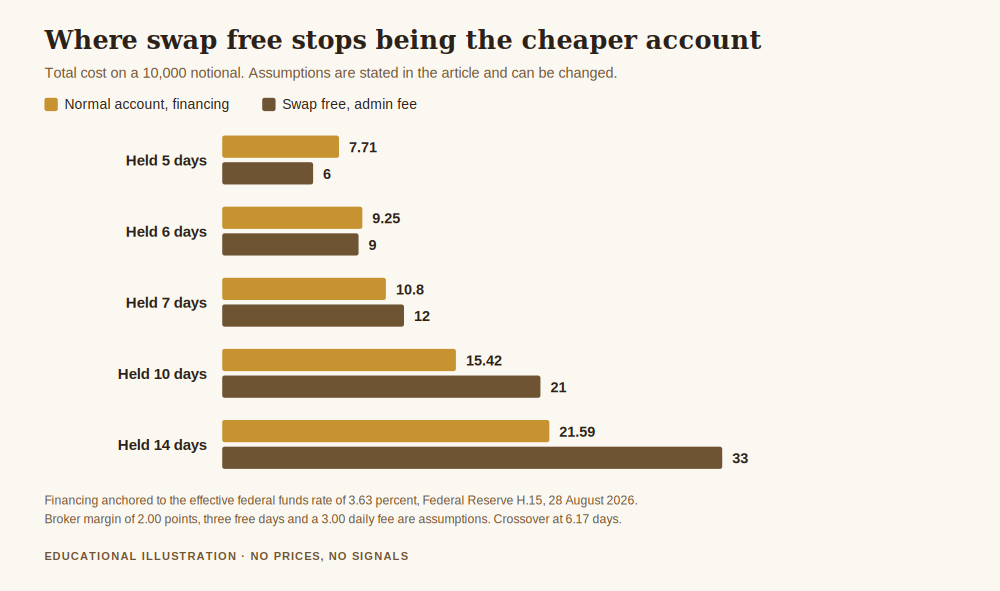
Here is what falls out.
- Hold for 1 day: normal account 1.54, swap free 0.00. Swap free is cheaper.
- Hold for 3 days: normal 4.63, swap free 0.00. Swap free is cheaper.
- Hold for 6 days: normal 9.25, swap free 9.00. Almost identical.
- Hold for 7 days: normal 10.80, swap free 12.00. The normal account is now cheaper.
- Hold for 30 days: normal 46.27, swap free 81.00.
- Hold for 90 days: normal 138.82, swap free 261.00.
- Hold for 365 days: normal 563.00, swap free 1,086.00.
The crossover point comes from setting the two totals equal. The daily swap multiplied by the number of days equals the administration fee multiplied by the number of days beyond the grace period. That solves to 3.00 times 3, divided by 3.00 minus 1.542, which is 6.17 days.
Under these assumptions, then: hold for less than about six days and the swap free account genuinely costs you less. Hold for longer and it costs you more, and the gap widens every single day after that, because the daily administration fee is about 1.94 times the daily financing charge it replaced.
Why the answer depends on you, not on the account
Notice what the arithmetic did not say. It did not say swap free accounts are a trick, and it did not say they are a bargain. It said the account type is the wrong thing to be arguing about.
The variable that decides the outcome is your holding period, which is a property of your method, not of the broker’s product sheet. If you close everything the same day and hold nothing over the weekend, the swap line is nearly irrelevant to you either way and you are choosing between two versions of almost nothing. If you routinely hold positions for weeks, the choice is worth real money and, on these assumptions, points the opposite way to the marketing.
There is a second thing worth noticing. A swap is not always a debit. Depending on the direction of your position and the rates involved, it can be a small credit. A swap free account removes that too. You are not removing a cost, you are removing a line that could go either way and replacing it with a fee that only goes one way.
And there is a third, which is the one that quietly does the most damage. If the replacement is not an explicit administration fee but a wider spread, then the cost has moved from a line you can read on your statement into a number you never see itemised at all. That is a worse position to be in, not a better one, even if the total happens to be similar. A cost you can count is a cost you can manage. I made the same argument about account types in raw spread against standard accounts, and it applies here without modification.
Get the free Gold Empire survival sheet, a one-page guide to protecting your account through the kind of slow, quiet costs this article describes. One email, no spam, unsubscribe anytime.
The four questions to ask before you open one
If you are considering a swap free account, these four questions get you the whole picture, and any broker worth using will answer all of them in writing.
Is there a grace period, and how long is it? This single number moves the crossover point more than anything else. A longer grace period pushes the crossover further out and makes the account better for medium holds.
What exactly replaces the swap, and in what unit? A fee per position per day, per lot per day, or a spread adjustment are three quite different things. Get it stated in the same unit you can measure, and do not accept a description that avoids naming one.
Is the spread or commission different on this account type? Compare the account against the normal account at the same broker on the same instrument, at the same time of day. If the spread is wider, that difference is part of the price and belongs in your arithmetic.
What is my actual median holding period? This one is not a question for the broker. It is a question for your own trade record, and if you cannot answer it, that is the first thing to fix, because without it you cannot evaluate any of the above. Your holding period is the input that decides the answer.
Frequently asked questions
What does swap free mean, in one sentence?
It means the broker does not apply the overnight financing charge to positions held past rollover, and instead recovers that cost in another form, usually a flat administration fee after a grace period, a wider spread, or a higher commission.
Is a swap free account actually free?
No, and no account is. The underlying financing cost is anchored to real short term interest rates, which the Federal Reserve publishes daily and which no broker controls. What changes is the form and the visibility of the charge, not its existence.
So is swap free cheaper or more expensive?
It depends entirely on how long you hold. On the assumptions in this article, a grace period of three days and an administration fee of 3.00 per day against a daily financing cost of 1.542, the crossover is at 6.17 days. Shorter holds favour swap free, longer holds favour the normal account, and the gap grows with every additional day.
Do I need to be Muslim to open one?
The account type exists to serve traders who must avoid interest for religious reasons, and that is its purpose. Availability and eligibility rules vary by broker and by jurisdiction, so that is a question for the broker and, if the religious question matters to you, for someone qualified to answer it. This article is about the arithmetic, not about the ruling.
Can the broker change the fee later?
Read the terms. Fee schedules on this account type are typically variable at the broker’s discretion, which means your crossover point can move without your method changing at all. Recheck it periodically rather than assuming today’s arithmetic is permanent.
Where did the figures in this article come from?
The effective federal funds rate of 3.63 percent, the bank prime loan rate of 6.75 percent and the one year Treasury constant maturity of 4.04 percent are read directly from the Federal Reserve’s H.15 Selected Interest Rates release dated 28 August 2026, linked above, and the precious metals reference pricing is published by the LBMA, also linked. Everything else, the 2.00 point broker margin, the 10,000 notional, the 365 day year, the three day grace period, the 3.00 daily administration fee, the 1.542 daily financing cost, the whole table and the 6.17 day crossover, is my own arithmetic on assumptions stated in the text. No gold price appears anywhere in this article, because none is needed: every figure is a rate, a ratio or a count.
Where Gold Empire fits
Gold Empire is a free place to learn how gold actually behaves and how accounts actually die, written for people who would rather survive the first two years than have a spectacular first month. Everything on the site is free to read. If you are new here, start here is the guided way in. There is a free survival sheet if you want the one page version, and an optional kit for people who want the whole framework in order. Nothing here promises you a return, because nobody honest can.
Costs are a survival topic rather than a technical one, which is why they sit under risk management in gold trading. If you want the mechanism this article assumes you already know, what swap in gold trading is covers the charge itself, and what the spread in gold trading is covers the place a removed fee most often reappears. When you are comparing account types across firms, the broker comparison is the practical companion to this one.
About the author
Matthew has spent a long time around gold, most of it learning things the slow way, and now writes them down so other people can learn them the fast way. He is more interested in the mechanics that quietly drain accounts than in the setups that fill timelines. Nothing in this article is personal advice, and no entry, stop or target discussed should be treated as a signal.
This article is educational content about how overnight financing charges work and about the arithmetic of comparing account types. It is not investment advice, not religious or legal advice, not a recommendation of any broker, platform or account type, and not a solicitation to trade. Fee structures, grace periods and eligibility rules differ by broker and by jurisdiction and change without notice, so verify the current terms with the firm in writing before deciding anything. The interest rate figures are read from the Federal Reserve H.15 release dated 28 August 2026 and the precious metals reference pricing is published by the LBMA. The broker margin, the administration fee, the grace period and the notional are assumptions of mine chosen to illustrate the method, not observations of any firm’s actual pricing, and every derived figure is my own arithmetic on those stated assumptions. Trading gold carries a real risk of losing money, including more than you deposit in some account types. No gold price level is quoted anywhere here. Nothing accounts for your personal circumstances, and no entry, stop or target discussed should be treated as a signal. If you are unsure, speak to someone properly qualified in your own jurisdiction before you risk anything.
One step first
Where should we send the Gold Survival Sheet?
Leave your email and we will send the free one page checklist, then take you straight to the Telegram channel.
No cost and no obligation. Educational only, not financial advice, and nothing here promises a return. Unsubscribe any time in one click.
Leave a Reply