
A trader wrote in last week genuinely annoyed. He had placed a buy limit below the market, watched gold turn and run away from it, and wanted to know what happens if a limit order is not filled, and whether he had done something wrong in the platform. He had not. The order did exactly what it was built to do.
The mechanical answer takes one paragraph. The useful answer takes rather longer, because underneath the question is a different one that almost nobody asks out loud: an order that did not fill feels like a loss, and people start behaving as though it was one. That behaviour costs far more than the missed trade ever would have made.
So I am going to do three things. Explain precisely what the platform does with an unfilled order, measure how often a limit at various distances actually gets reached using ten years of the published gold benchmark, and then deal with the part that actually drains accounts, which is what people do in the fifteen minutes after they realise the order is not going to fill.
What Happens If a Limit Order Is Not Filled, Precisely
Nothing happens. That is the whole mechanical answer, and it is worth sitting with because “nothing” is a genuinely unusual outcome in this business.
A limit order is an instruction with a condition attached: buy, but only at this price or better. If the price never reaches your level, the condition is never met, the order never becomes a trade, and you never had a position. Concretely:
- No money changes hands. You paid no spread and no commission, because nothing was transacted.
- No margin is taken. Most venues do not reserve margin for a resting limit order that has not been triggered.
- The order sits in the book until one of three things happens: it fills, you cancel it, or it expires according to whatever duration you attached to it.
That last point is the one that catches people. If you set the order as day only, it is gone at the end of the session and you may not notice. If you set it as good till cancelled, it is still sitting there next week, still live, still capable of filling on a day when the reasoning behind it has completely expired. Neither is wrong. Not knowing which one you chose is wrong.
Why the Price Reached Your Level and the Order Still Did Not Fill
There is a more irritating version of this, where the price clearly touched your number on the chart and yet nothing happened. That has real causes, and none of them is the platform cheating you.
Touching is not the same as filling. A limit order needs somebody on the other side willing to transact at your price. If the market prints your level briefly on very thin volume, there may not be enough of that other side to reach your particular order.
You were behind other people in the queue. Resting orders are generally worked in the order they arrived. If a lot of size is sitting at the same round number and only some of it trades, the orders at the back get nothing. The number was hit. Your order was not.
The chart is showing you a different price. A buy fills at the ask, and most charts are drawn from the bid. The gap between them is the spread, so on a wide spread the chart can dip a little below your level while the ask, which is the price your order actually needs, never quite gets there.
The market gapped over it. Over a weekend or through a data release, price can move from above your level to below it without transacting in between. On the far side of a gap the market is often already past where you wanted in, which is usually a mercy rather than a miss.
The Odds, Measured on Ten Years of Gold
Rather than guess at how often this happens, I measured it. I took the daily gold benchmark price published by the LBMA, used the last ten years of it, which is 2,423 daily moves ending on 2 September 2026, and counted how often a buy limit placed a given distance below the price was actually reached.
Two things to know before reading the numbers. First, the daily standard deviation of gold over that period is 1.0121 percent, so a one percent move is roughly a one sigma day and not the rare event people imagine. Second, and I want to be straight about this, I am working from one closing price per day. An intraday dip that touched your level and recovered before the close is not counted. So every figure below is a floor, and the real chance of getting filled is somewhat higher than what I am about to show.
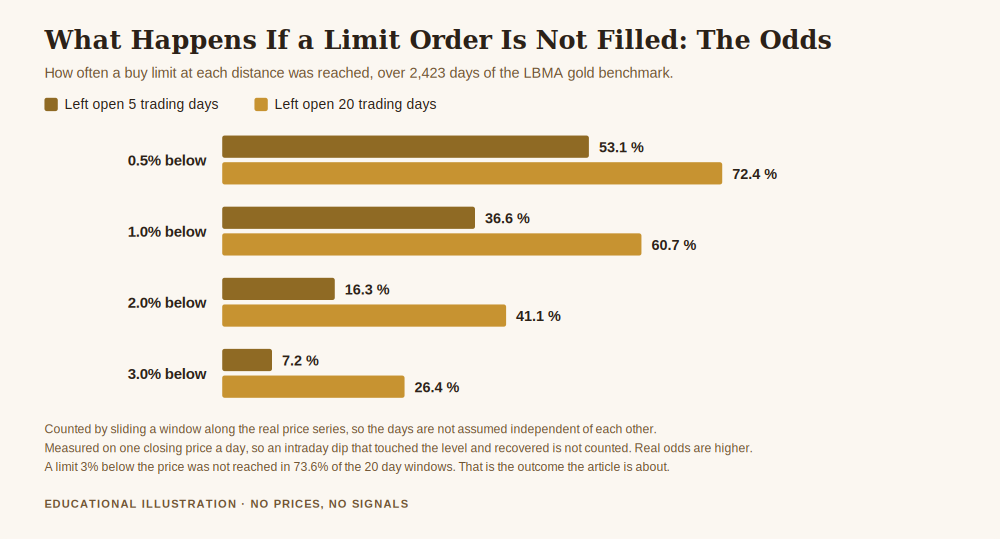
Give an order a single day and the odds are poor at any useful distance. A limit half a percent below was reached on 22.6 percent of days. One percent below, 10.4 percent. Two percent below, 3.0 percent. Three percent below, 0.7 percent, which is about one day in every hundred and fifty.
Leave it there for twenty trading days, roughly a calendar month, and the picture changes considerably. Half a percent below is reached 72.4 percent of the time. One percent below, 60.7 percent. Two percent, 41.1 percent. Three percent, 26.4 percent.
Read the last figure the other way round, because that is the honest way to read it. A limit three percent below the market went unfilled in 73.6 percent of the twenty day windows. If you place patient orders at attractive prices, roughly three quarters of them will simply expire without ever becoming a trade. That is not the system failing. That is the system working as designed, and it is the price of insisting on a good entry.
The Trade Nobody Counts as a Win
Here is where this stops being a mechanics article.
Ask a trader how last month went and he will tell you about the trades that filled. The ones that did not are invisible, filed under nearly, and if they are remembered at all it is with a small sting of regret. That accounting is wrong, and it is wrong in a direction that costs money.
An unfilled buy limit means the market never came down to where you thought it represented value. It kept going up, or it went sideways above you, or it fell straight through on a gap and kept falling. In the first two cases you missed a move you had correctly identified but incorrectly priced. In the third case, and this is the one people forget entirely, the order not filling on the way down is the only reason you were not long into a decline.
You cannot know in advance which of those three you are in. What you can know is the accounting: an unfilled order costs exactly nothing. No spread, no commission, no financing, no exposure. In a business where almost every action costs something, this is one of the few genuinely free outcomes available, and traders routinely treat it as a defeat.
The discipline worth building is small and slightly odd: when an order expires unfilled, write it down as a completed decision that produced a zero. Not a miss. The plan said this price or nothing, and you got nothing, which is precisely what the plan promised on the days it did not work.
Get the free Gold Empire survival sheet, a one page guide to protecting your account from the decisions that follow a trade you did not get into. One email, no spam, unsubscribe anytime.
Where the Real Cost Actually Shows Up
The unfilled order is free. What happens next is not, and in my experience it follows the same three steps almost every time.
Step one, the order gets moved. Price approaches, stalls, starts to turn away, and the limit drifts up to meet it. The level was chosen calmly with a reason. It is now being chosen anxiously, by a person watching a screen, for no reason except that the market is leaving. What made the level worth trading was the level. Moving it keeps the trade and discards the reason.
Step two, the limit becomes a market order. Patience runs out, the trader buys at whatever is showing, and now holds a position at a price he had already judged to be worse than the one he wanted. He has also paid the spread he was trying to avoid.
Step three, the position is oversized. Having missed the good entry, the trade has to work harder to be worth the wait, so the size goes up. The worst entry of the sequence is now being carried in the largest size of the sequence. This is a recognisable way to have a bad month, and it started with an order that cost nothing.
Notice that none of those three steps is a market event. They are all decisions, all made under mild frustration, and all avoidable by deciding in advance what happens when the order does not fill. The market did not take that money. The fifteen minutes after the market walked away took it.
What to Do With an Order That Is Still Sitting There
Three habits, all boring, all cheap.
Give every order an expiry when you place it. Not because time is meaningful to the market, but because your reasoning has a shelf life. If the level was worth buying because of something you saw on a Tuesday, an order still resting three weeks later is being justified by a chart that no longer exists. Set the duration at the moment you set the price, while you are still calm.
Decide the not filled branch before you place the order. One line is enough. If it does not fill by Friday, cancel and re-examine. If it does not fill and price breaks the level upward, stand down and do not chase. Written in advance this takes ten seconds. Decided live, it takes whatever the market charges you.
Review the unfilled orders, not just the trades. Once a month, look at what did not fill and what happened afterwards. If your patient orders keep missing by a hair and then running, you are pricing your entries slightly too greedily, and half a percent of patience is costing you the whole trade. If they keep filling right before a sharp fall, the opposite is true. Neither of those lessons is visible in a record that only contains executed trades, which is what most people’s records contain.
The short version of what happens if a limit order is not filled: nothing happens, and nothing is a perfectly good outcome. It is the only free outcome this business offers. The account damage comes from refusing to accept it.
Frequently Asked Questions
What happens if a limit order is not filled by the end of the day?
It depends entirely on the duration you set. A day order is cancelled automatically when the session closes. A good till cancelled order stays live and can fill days or weeks later, on reasoning you may no longer hold. Check which one your platform uses by default, because the default is rarely the one you would have picked.
Do I get charged anything for an order that never fills?
No. There is no trade, so there is no spread, no commission and no overnight financing. Most venues do not reserve margin against an untriggered limit either. It is one of the few genuinely free outcomes available to a trader.
The price touched my level on the chart, so why no fill?
Most likely one of three things. There was not enough volume at that price to reach your place in the queue, or your order was behind others at the same level, or the chart is drawn from the bid while your buy needs the ask, which sits a spread higher. Gaps do it too, where price moves across your level without ever trading there.
Should I move my limit closer when the market starts to run?
That is a decision to make before you place the order, not while you are watching it. Moving a level for no reason other than the market leaving keeps the trade and throws away the reasoning that made it worth taking. If it is genuinely worth buying at the new price, that should be a fresh decision with its own justification.
How often should I expect a limit order to fill?
On this measurement, a buy limit one percent below the market was reached 10.4 percent of the time within one day and 60.7 percent within twenty trading days. At three percent below, 0.7 percent within a day and 26.4 percent within twenty. Further away means a better price and a lower chance, and that trade off is the whole decision.
Where did the numbers in this article come from?
The price series is the daily LBMA gold benchmark, linked above, and I used the last ten years of it, being 2,423 daily moves ending 2 September 2026. The 1.0121 percent daily standard deviation and every fill percentage are my own arithmetic on that series, counted by sliding a window along the real data rather than assuming the days are independent. The stated limitation is that one closing price a day cannot see an intraday touch that recovered, so all fill figures are floors rather than exact odds. No gold price level appears anywhere in this article.
Where Gold Empire fits
Gold Empire is free to follow. Daily gold analysis with the reasoning written out, losing days included, plus an optional Kit for people who want the method in one place. There is no promise of profit here, because nobody honest can make one.
What you do after a plan fails to trigger is a survival question, which is why this sits under risk management in gold trading. Buy stop and buy limit explained covers the order types themselves and which direction each one waits in, what an OCO order is in gold trading deals with pairing orders so one cancels the other, and where to place a stop loss on XAUUSD is the other half of deciding a level before the market is in front of you.
About the author
Matthew has spent a long time around gold, most of it learning things the slow way, and now writes them down so other people can learn them the fast way. He is more interested in the mechanics that quietly drain accounts than in the setups that fill timelines. Nothing in this article is personal advice, and no entry, stop or target discussed should be treated as a signal.
This article is educational content about order types, order duration and execution mechanics. It is not investment advice, not a recommendation of any broker, platform or order strategy, and not a solicitation to trade. The price series used is the daily gold benchmark published by the LBMA. Every statistic is my own arithmetic on that series under the assumptions written out in the text, including the stated limitation that a single daily closing price cannot detect an intraday touch, which makes all fill percentages floors rather than precise probabilities. Historical frequencies describe what has already happened and are not a forecast of what any future order will do. Order handling, queue priority, default durations and margin treatment differ between venues, so check your own platform’s documentation and client agreement rather than assuming the behaviour described here. No specific price level, entry, stop or target is recommended anywhere in this article, and no gold price is quoted. Trading gold carries a real risk of losing money, including more than you deposit in some account types. Nothing accounts for your personal circumstances, and no entry, stop or target discussed should be treated as a signal. If you are unsure, speak to someone properly qualified in your own jurisdiction before you risk anything.
One step first
Where should we send the Gold Survival Sheet?
Leave your email and we will send the free one page checklist, then take you straight to the Telegram channel.
No cost and no obligation. Educational only, not financial advice, and nothing here promises a return. Unsubscribe any time in one click.
Leave a Reply