
Here is buy stop and buy limit explained the way I wish someone had explained it to me, which is not with two definitions and a diagram, but with the question that actually matters: what does each one do to you when the market is moving fast and you are not watching. The definitions take a paragraph. The consequences take a decade to learn by accident, and they are the reason two traders with the same view of gold can end a week with completely different results.
Both orders exist to get you into a position at a price you have chosen in advance rather than a price you panic into. That is where the similarity ends. One of them buys strength above the market. The other buys weakness below it. From the same idea, on the same chart, they produce different entries, different fill rates, and different failure modes.
What Each Order Actually Instructs Your Broker to Do
Strip away the jargon and each order is a sentence you are handing to a machine.
The buy stop
A buy stop sits above the current market. It says: if price reaches this level, buy me in at the market. The word stop is doing something specific here. It does not mean protection. It means the order does nothing until price touches the trigger, and once it does, the order converts into a market order and takes whatever is available.
People use it to buy a breakout, or to enter only if the move confirms itself. The logic is reasonable. You are refusing to buy until the market proves something.
The buy limit
A buy limit sits below the current market. It says: if price falls to this level, buy me in, and do not pay more than this. The word limit is also doing something specific. It caps your price. The order will fill at your level or better, never worse, and if the market never comes down to you it simply does not fill at all.
People use it to buy a pullback, or to enter only at a price they consider good value. That logic is also reasonable. You are refusing to chase.
So far this is a textbook. The textbook is where most explanations stop, and it is exactly where the useful part begins.
Buy Stop and Buy Limit Explained by the Data, Not the Definition
I wanted to know how differently these two orders behave in practice on gold, so I measured it rather than argued about it.
The test uses the published LBMA gold benchmark over the ten years from 2016 to 2025, which is 2,506 fixings. On each day I imagined placing both orders at the same distance from that day’s fixing, a buy stop 0.5% above and a buy limit 0.5% below, and then looked forward five fixings to see which levels the market actually reached. That gives 2,501 cases.
Two assumptions need stating plainly, because they shape the answer. First, the only price I can observe is the daily fixing, so an order counts as reached only when a later fixing prints at or beyond its level. Real intraday touches are invisible to this test, which means every figure below understates how often both orders would have triggered. Second, 0.5% is roughly one median daily move, since the median absolute change between fixings across this period was 0.48%. It is a normal distance, not a stretch.
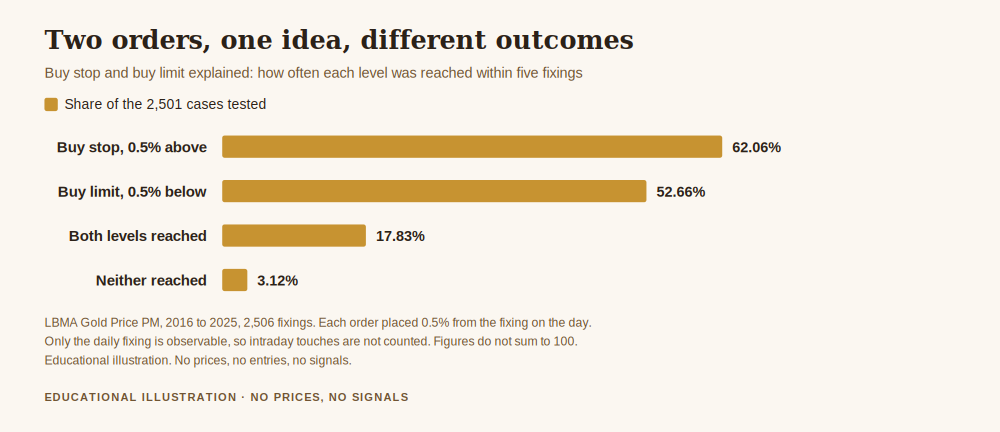
The buy stop above the market was reached in 62.06% of cases. The buy limit below the market was reached in 52.66%. Both levels were reached in 17.83% of cases, and neither was reached in only 3.12%.
Read those last two lines again, because they carry the whole article.
In nearly one case in five, the market went and touched both of them inside a working week. The same idea, expressed with two different order types, would have put you in the market twice at prices a full one percent apart, in opposite directions from where you started. Neither order was wrong. They were answering different questions.
And in only 3.12% of cases did the market sit still enough to leave both untouched. Placing a resting order on gold and assuming nothing will happen is not a neutral act. Something happens almost every time.
The Part of a Buy Stop Nobody Prices In
A buy stop converts to a market order when triggered. That sentence contains a cost, and it is worth measuring rather than accepting on faith.
In the same test, when the buy stop was reached, I recorded how far beyond the trigger the first observable price actually printed. The median was 0.47% past the trigger. The 90th percentile was 1.39% past it. The worst case in ten years was 4.74% past it.
Put that in proportion. You placed the order 0.5% away from the market. On a typical fill, the first price you could actually see was another 0.47% beyond your own trigger, which is very nearly the same distance again. In 46.71% of filled cases, the first observable print was at least 0.5% past the trigger.
Now, the honest caveat, because this figure is easy to abuse. A daily fixing series is a coarse instrument. In a liquid market with an intraday feed, most buy stops fill far closer to the trigger than these figures suggest, and the number above is not a slippage estimate for your broker. What the figure genuinely establishes is the shape of the risk: the market that triggers a buy stop is, by construction, a market that was already moving in that direction, and the distance it travels once it starts is not something your order controls. Your trigger sets where the decision fires. It does not set where you get filled.
That distinction is the entire practical difference between the two orders, and it is why sizing has to be done from the fill, not from the trigger. If you size a position on the assumption of entering at your trigger, and the market hands you an entry meaningfully beyond it, your stop distance has shrunk and your real risk per trade has grown, silently, at the exact moment the market was most active. This is the same arithmetic problem that risk management in gold trading deals with from the other end.
The Part of a Buy Limit Nobody Prices In
The buy limit has the opposite profile, and it is not the safer order. It is a differently dangerous one.
Its price is guaranteed. You will not pay more than your level. What is not guaranteed is anything else. In the test above the limit went unreached in 47.34% of cases, and an unfilled order is not a neutral outcome. It is a trade you decided to take and then did not take, which means your record no longer reflects your thinking, and the trades that got away are exactly the ones you will misremember later.
There is a subtler problem underneath. Consider what has to happen for a buy limit to fill. The market has to come down to you. Sometimes that is an ordinary pullback in a market that then continues. Sometimes it is the first leg of a move that is not going to stop where you hoped. Your limit order cannot tell the difference, and it fills identically in both cases. The buy limit gets its best price precisely when the market is going against the idea, which is a real cost that never shows up as slippage on any statement.
So the choice is not between a risky order and a safe one. It is between an order that guarantees participation while surrendering control of price, and an order that guarantees price while surrendering control of participation. There is no third option that guarantees both, and any explanation suggesting otherwise is selling something.
Why Scheduled Events Change the Answer
Resting orders behave differently around known events, and gold has an unusually predictable calendar of them.
The Federal Open Market Committee publishes its meeting dates a year in advance. According to the Federal Reserve’s own calendar, there are eight scheduled FOMC meetings in 2026, of which three remain at the time of writing: 15 to 16 September, 27 to 28 October, and 8 to 9 December. Those dates are not a forecast. They are published fact, and they are free.
The reason this matters for order types is mechanical rather than mystical. A resting buy stop left across a scheduled announcement is an instruction to buy into whatever the release produces, at whatever price exists a moment later, with no human in the loop. A resting buy limit across the same event is an instruction to buy if the market falls to your level, including in the case where the release is the reason it fell. Both of those may be exactly what you intend. The failure is intending neither and finding out afterwards which one you left switched on.
The cheapest habit in this whole article is checking the calendar before leaving an order unattended. It costs one minute. For the wider point about leverage and how quickly a fast market compounds a sizing error, the CFTC’s advisory on retail foreign currency trading is worth ten minutes of anyone’s time, particularly the section on how quickly leveraged positions move against small accounts.
What This Argument Is Not
I want to close off the two ways this gets misread.
It is not an argument that buy limits are better than buy stops, or the reverse. The data above says they are different, not that one wins. A trader whose method depends on confirmation needs the stop and should accept the fill risk that comes with it. A trader whose method depends on price levels needs the limit and should accept the participation risk that comes with it. Choosing the order type that does not match the method is where the damage happens.
It is also not a claim about your broker’s execution. Everything above is computed from a public daily benchmark, not from any account, and your fills are a matter for your own statement and your own contract specification. What I have measured is what the underlying market did. What you receive is that, plus your broker’s execution, plus your own timing, and only the first of those three is something I can show you honestly.
Four Things to Check Before You Place Either One
None of this requires new software. It requires four answers you can find today.
Which question you are answering. Are you refusing to buy until the market confirms, or refusing to buy above a price you consider fair? Those are different questions with different correct orders, and most order type mistakes are actually unanswered question mistakes.
Where your risk is measured from. If you size from the trigger rather than the fill, a fast market quietly increases your risk per trade. Size from a realistic fill, or check your position after it opens rather than assuming.
What happens if it does not fill. Write down in advance what you do when a buy limit is left behind by the market. Deciding this in the moment is how a missed trade becomes a chased one, which is covered in missed entries are not losses.
What is on the calendar. Before leaving anything resting overnight or over a weekend, check whether a scheduled release sits inside that window. If one does, that is a decision to make deliberately, not a detail to discover later.
Get the free Gold Empire survival sheet, a one page guide to sizing a gold position from the fill you actually receive rather than the price you hoped for. One email, no spam, unsubscribe anytime.
Frequently asked questions
In one line, what is the difference between a buy stop and a buy limit?
A buy stop sits above the market and buys strength at whatever price is available once triggered. A buy limit sits below the market and buys weakness at your price or better, or not at all. The buy stop trades price certainty for participation certainty. The buy limit does the reverse.
Which one is safer?
Neither, and the question hides the real trade off. The buy stop can fill worse than you planned, which is a price risk. The buy limit can fail to fill, or fill precisely because the market is heading lower, which is a participation risk and a selection risk. Safety comes from matching the order to your method and from sizing correctly, not from the order type itself.
Where do the fill rate figures come from?
From the LBMA gold benchmark over 2016 to 2025, 2,506 fixings, giving 2,501 test cases. On each day both orders were placed 0.5% from that day’s fixing and the next five fixings were checked. The buy stop level was reached in 62.06% of cases, the buy limit in 52.66%, both in 17.83%, neither in 3.12%. The source is linked above so you can rebuild it yourself.
Why does the article say the figures understate reality?
Because a daily benchmark shows one price per day. A level touched intraday and left behind before the fixing is invisible to the test. Every fill rate above is therefore a floor, not a ceiling, and the real proportion of orders triggered would be higher on any intraday feed.
Does a buy stop guarantee I get in at my trigger price?
No, and this is the most common misunderstanding of the order. The trigger price is where the order activates. The fill price is whatever the market offers at that moment, which in a fast market can be meaningfully different. If your risk calculation assumes the two are the same, your actual risk per trade is larger than you think.
What about a buy stop limit, which combines the two?
It triggers like a stop and then fills like a limit, so it will not pay worse than your cap. That solves the price problem by reintroducing the participation problem, since a fast market can trigger it and run past the cap, leaving you with no position in the exact scenario you built the order for. It is a legitimate tool and it is not a way around the trade off, because there is no way around the trade off.
Should I use resting orders at all if I cannot watch the market?
Resting orders are usually better than watching badly, because they commit you to a decision made calmly. The condition is that you know what each one will do without you, including across scheduled events, and that you have sized the position for a realistic fill rather than an optimistic one.
Where This Leaves You
The two orders are not competitors and there is no correct answer to hold on to. There is a question underneath them, which is whether you want the market to prove something before you commit, or whether you want a price you have decided is worth paying. Answer that first and the order type stops being a choice at all. It becomes the obvious consequence of what you already decided.
What the data adds is a sense of proportion. On gold, over ten years, the market reached one level or the other in almost every window tested, and reached both in nearly one case in five. Resting orders are not passive. They are decisions you have already made and handed to a machine to execute while you are asleep, and the only way to make that comfortable is to know exactly what you handed over.
Where Gold Empire Fits
Gold Empire is a free Telegram channel where I post gold analysis with the reasoning stated before the move rather than after it, losing days included. There is nothing to buy in order to follow along, and an optional Kit if you want more structure later. I publish no profit claims and I do not rank brokers for payment.
The free survival sheet is the one page version of the sizing discipline described here. If you want the neighbouring mechanics, what is the spread in gold trading covers what you pay on entry, and where to place a stop loss on XAUUSD covers the order on the other side of the position.
About the author. Matthew writes Gold Empire. He is interested in the unglamorous half of this business, cost, size, frequency and the arithmetic of staying solvent, on the view that most accounts are lost to ordinary errors repeated patiently rather than to any single dramatic trade.
Disclaimer: This article is general educational content about how two order types behave. It is not financial advice, not a recommendation of any broker, product or method, and not a suggestion to place any particular order. Trading gold, CFDs and leveraged products carries a high risk of losing money rapidly. No entry, stop or target discussed should be treated as a signal. The 0.5% order distance and the five fixing horizon are stated assumptions used as a worked example, not settings to copy. All fill rate and distance figures are computed from the published LBMA daily gold benchmark over 2016 to 2025, describe the behaviour of that public benchmark and not the execution of any broker or account, and the source is linked so you can verify them. The FOMC meeting dates are taken from the Federal Reserve’s published calendar, which is linked. No gold price is quoted anywhere in this article and no real trading results are represented.
One step first
Where should we send the Gold Survival Sheet?
Leave your email and we will send the free one page checklist, then take you straight to the Telegram channel.
No cost and no obligation. Educational only, not financial advice, and nothing here promises a return. Unsubscribe any time in one click.
Leave a Reply