

Somebody asks how to transfer funds from one forex broker to another and they are usually picturing something that does not exist. They are picturing the thing banks do, or the thing stockbrokers do, where you sign a form and your holdings appear somewhere else a few days later, untouched. In retail foreign exchange and gold there is no such pipe. The honest answer to the question is that you do not transfer anything. You close, you withdraw, you wait, and you deposit again somewhere else, and every one of those four steps costs you something.
That sounds like a technicality. It is not. The gap between what people think they are asking for and what actually happens is where the damage lives, and most of the damage is not the money. It is the forced timing.
How to Transfer Funds From One Forex Broker to Another: the Short Version
There are four steps and no shortcuts.
You close every open position at the old broker. You request a withdrawal, usually back to the funding method you originally deposited from. You wait for it to clear, which is the step nobody budgets for. Then you deposit into the new account and rebuild whatever you were holding, at whatever price the market is at by then.
Notice what is missing. There is no step where your positions move. There is no step where your cost basis follows you. There is no step where an outside party guarantees the handover or gives you a timeline you can hold anyone to. You are relying entirely on the old broker to return your own money at a speed of its choosing, which is a very different relationship from the one people imagine they are in.
The System That Does Exist, and Why It Does Not Cover You
The picture in people’s heads is real, it just belongs to a different market. In United States securities there is a formal transfer system called ACATS, and it is governed by FINRA Rule 11870. The rule is worth reading precisely because of the contrast.
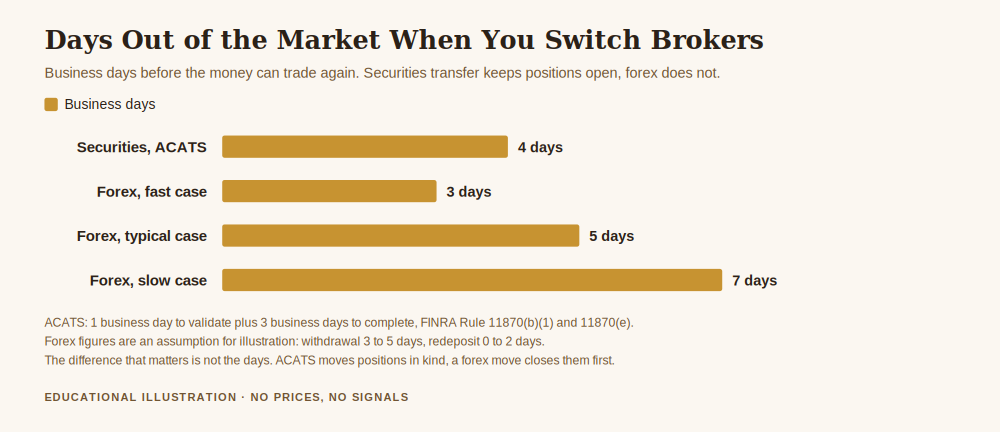
Under 11870(b)(1), once a transfer instruction is submitted, the firm currently holding the account must, “within one business day,” either validate the instruction or take exception to it. Under 11870(e), “within three business days following the validation of a transfer instruction, the carrying member must complete the transfer of the customer’s security account assets to the receiving member.” Four business days, with named obligations on both firms, and a clearing infrastructure sitting in the middle enforcing them.
Read the object of that sentence again: “security account assets.” Positions. The whole point of ACATS is that your holdings move in kind. You do not sell your shares to change broker. You do not realise a gain because you got tired of a platform’s spreads.
Retail spot forex and gold contracts for difference are not securities accounts and are not inside that system. In the United States they sit under a different regulator entirely, with their own rulebook. 17 CFR 5.9, the rule that sets minimum security deposits for retail forex transactions, requires firms to collect at least “2% of the notional value of the retail forex transaction for major currency pairs and 5% of the notional value of the retail forex transaction for all other currency pairs.” Different rulebook, different regulator, different world. Nothing in it creates a transfer facility, because there is nothing standardised to transfer. Your position at a CFD broker is a bilateral contract with that specific firm. It has no existence outside the relationship, so it cannot be handed to a stranger.
Outside the United States the details change and the conclusion does not. There is no cross broker transfer rail for retail forex anywhere I am aware of. If somebody offers you one, that is a thing to examine very carefully rather than a convenience to accept.
What the Round Trip Actually Costs
Let me put numbers on it, with the assumptions stated so you can disagree with them.
Assume a 5,000 USD account risking 1% per trade, so one unit of risk is 50 USD. Assume a gold spread of 25 cents per ounce and a standard contract of 100 ounces. Closing a position pays the spread once. Reopening it at the new broker pays it again.
At 0.05 lots that round trip is 2.50 USD, which is 0.05 of one risk unit. At 0.10 lots it is 5.00 USD, or 0.10 units. At 0.20 lots it is 10.00 USD, or 0.20 units. In other words, the direct cost of the move is a fifth of a single trade’s risk at most. That is nothing. If the trading cost of switching were the whole story, you would switch the moment you were unhappy and never think about it again.
The cost that matters does not appear in that arithmetic. It is the three to seven business days when your money is in transit and you have no position, no ability to take one, and no control over the timing. The market does not pause. If you are flat for a week because your withdrawal is sitting in a compliance queue, you did not pay 5 USD, you paid whatever the week was worth, and you cannot know that number in advance in either direction.
Then there is the forced realisation. Every open position gets closed on a date chosen by your administrative situation rather than by your reasoning. Winners and losers alike, crystallised because you wanted to change platform. In jurisdictions where realised gains are taxable events, you have just created a tax event for a reason that has nothing to do with the market. That is not an argument against switching. It is an argument against switching while you are holding something you would not otherwise close.
The Order of Operations That Reduces the Damage
Most of what goes wrong here is sequencing, and sequencing is free to fix.
Open and fully verify the new account before you touch the old one. Complete identity verification, deposit a small amount, confirm the platform works and the instrument you trade is actually available on your account type. People close everything first, then discover the new broker wants a document they cannot produce quickly, and spend two weeks holding cash in a bank account instead of a trading account. Verification is free and reversible. Do it first.
Withdraw a small amount from the old broker before you withdraw all of it. This is the single most useful thing in this article and it has nothing to do with transfers. A small test withdrawal tells you whether the exit works, at a stage where the answer still costs you nothing. If a firm returns 100 USD promptly and without a story, that is real information. If a small withdrawal produces delays, new document requests, a sudden bonus clawback clause or an account manager who wants to talk you out of it, you have learned something enormous while almost all of your money is still recoverable and your attention is not yet exhausted.
Most people asking how to move brokers are already uneasy about the one they are with. That unease is worth testing directly and cheaply rather than by betting the whole balance on a single large withdrawal request.
Withdraw to the method you deposited from. Anti money laundering rules at most regulated firms push funds back down the path they came in, often proportionally across several methods if you funded several ways. Expecting a card deposit to come back as a bank wire to a different name is how withdrawals get stuck. This is also why funding an account tidily in the first place pays off later, which is the argument made in the best way to fund a brokerage account.
Close positions on your own schedule, not in one click. If you are carrying several positions, closing them all simultaneously at whatever hour you happened to make the decision is the worst version of this. Spread it out. Close them at moments you would have been willing to close them anyway.
Export your records before the account closes. Trade history, statements, deposit and withdrawal confirmations. Access to a closed account is not guaranteed and support for a former client is not a priority. You will want these for tax purposes and for your own review long after the platform login stops working.
Leave the old account empty, then close it deliberately. Dormant balances attract inactivity fees at many firms, which quietly eat a small balance over a year or two until there is nothing left to argue about.
Get the free Gold Empire survival sheet, a one page guide to protecting your account in the situations where your money is somebody else’s to release. One email, no spam, unsubscribe anytime.
Frequently Asked Questions
Can I move an open position from one forex broker to another? No. The position is a contract with that specific firm, not a holding in a registry, so there is nothing to deliver to a third party. This is the practical difference between a CFD account and a securities account, and it is why ACATS has an equivalent for shares and no equivalent here.
How long does the whole move take? The honest answer is that it depends on the firm you are leaving, which is exactly the problem. The withdrawal is the variable step and it is controlled by the party with the least incentive to hurry. How long a forex withdrawal takes goes through what drives that timing.
Should I keep the old account open as a backup? Keeping a verified, empty, fee free account open is reasonable and occasionally useful. Keeping a funded one open because you have not decided is how people end up with money spread across three firms they no longer trust. Decide, then move all of it.
The new broker offered to cover my transfer costs. Is that a good sign? Treat it as a marketing cost, not a favour, and read what accepting it obliges you to do. Deposit bonuses and cost rebates frequently come with volume conditions that restrict withdrawals until you have traded a certain amount. An incentive that makes your money harder to remove is the opposite of what you were trying to achieve by switching.
My broker will not let me withdraw. Is there a transfer route around that? No, and looking for one is a distraction from what has happened. If a regulated firm is refusing a legitimate withdrawal, the route is the firm’s formal complaints procedure and then the regulator or ombudsman that licenses that specific legal entity, named in your client agreement. Recovery services that approach you offering to retrieve the funds for an upfront fee are, in the ordinary case, a second loss aimed at people who have just taken a first one.
Where Gold Empire fits
Gold Empire is free to follow. Daily gold analysis with the reasoning written out, losing days included, plus an optional Kit for people who want the method in one place. There is no promise of profit here, because nobody honest can make one.
Whether you can get your money out is a survival question before it is a preference question, which is why this sits under risk management in gold trading. How long a forex withdrawal takes covers the step that decides the timeline, the best way to fund a brokerage account covers the deposit side that determines how the exit will work, and how to choose a broker for gold trading is the decision you are making if you have got this far. If you have not opened the new account yet, how to open a gold trading account is the step to do first.
About the author
Matthew has spent a long time around gold, most of it learning things the slow way, and now writes them down so other people can learn them the fast way. He is more interested in the mechanics that quietly drain accounts than in the setups that fill timelines. Nothing in this article is personal advice, and no entry, stop or target discussed should be treated as a signal.
This article is educational content about account administration, transfer mechanics and withdrawal procedures. It is not investment advice, not legal or tax advice, not a recommendation of any broker, and not a solicitation to trade. The transfer timings and obligations described are quoted from FINRA Rule 11870, which governs United States securities accounts and does not apply to retail forex or contracts for difference; the retail forex security deposit minimums are quoted from 17 CFR 5.9. Both are United States rules, summarised here rather than reproduced in full, and amended from time to time. Rules, withdrawal procedures and investor protections differ substantially by jurisdiction and by firm, and you should read your own client agreement and check your own regulator. General guidance on transferring a brokerage account is published by the SEC at investor.gov. Every cost figure here is my own arithmetic under the assumptions written out in the text, using illustrative spread values rather than any firm’s actual pricing, and no gold price level is quoted anywhere in this article. Trading gold carries a real risk of losing money, including more than you deposit in some account types. Nothing accounts for your personal circumstances, and no entry, stop or target discussed should be treated as a signal. If you are unsure, speak to someone properly qualified in your own jurisdiction before you risk anything.
One step first
Where should we send the Gold Survival Sheet?
Leave your email and we will send the free one page checklist, then take you straight to the Telegram channel.
No cost and no obligation. Educational only, not financial advice, and nothing here promises a return. Unsubscribe any time in one click.
Leave a Reply