

The best way to fund a brokerage account is the method you can reverse, in an amount you can afford to lose entirely, into a firm you checked before the money left your bank. That sentence contains no product recommendation and it is the whole article in one line. Everything below is the reasoning, because most people funding an account for the first time are thinking about speed and fees, and the two things that actually decide the outcome are reversibility and who is on the other end.
This is the least glamorous moment in trading and the one with the highest concentration of permanent damage. Once money arrives in a trading account it is exposed to two separate risks that have nothing to do with each other. The first is the market, which is the risk you signed up for. The second is the possibility that the account is not what you think it is, and that risk is not managed by a stop loss. It is managed before the transfer, or not at all.
Why the Best Way to Fund a Brokerage Account Is a Question About Reversibility
Payment methods are not interchangeable. They differ in one property that matters more than fees, speed or convenience: whether a third party can claw the money back for you if the other side turns out to be dishonest or simply refuses to pay.
A card payment sits at one end. Card networks run chargeback procedures, and the money moves through an intermediary who has a relationship with you and an interest in your complaint. A bank transfer sits in the middle. It is traceable, it is slow, and recovering it depends on the receiving bank cooperating, which they may or may not do. Cryptocurrency sits at the far end. A confirmed transfer is final by design. There is no administrator, no dispute window and nobody to appeal to. That is a feature of the technology, not a flaw, but it means the decision is made entirely before you press send.
Ranking by reversibility inverts the usual ranking. The method that clears fastest and cheapest is usually the one that offers you the least protection, and the friction of a slower method is doing something for you even when it feels like an obstacle.
The Numbers Behind the Warning
This is where the argument stops being a matter of temperament. The FBI’s Internet Crime Complaint Center publishes an annual report with reported losses broken out by crime type, and the investment category has a shape that is hard to look away from.
In the 2024 IC3 Annual Report, reported losses to investment fraud were $6,570,639,864, from 47,919 complaints. The year before, the same category recorded $4,570,275,683 from 39,570 complaints, and the year before that $3,311,742,206 from 30,529 complaints. Working from those published figures, reported investment fraud losses grew 43.8 percent in a single year, and 98.4 percent across two years, which is to say the number very nearly doubled while most people were not watching. Investment was the largest single loss category in the 2024 report, ahead of business email compromise at $2,770,151,146.
Divide the 2024 loss total by the 2024 complaint count and you get roughly $137,120 of reported loss per investment complaint. I computed that myself and the assumption matters: it divides the full reported loss by every investment complaint, including the ones that reported no loss at all, so it is not the typical victim’s experience and it is not a median. It is a rough scale marker, and the scale is a life changing amount of money per report.
The same report puts total reported losses across all crime types at $16.6 billion from 859,532 complaints in 2024, a 33 percent increase on the previous year, with an average reported loss of $19,372 per complaint. These are reported figures from one country’s reporting channel, so they undercount rather than overcount. Nobody files a complaint about the money they did not lose.
The Fee You Pay Twice
Now the boring arithmetic, which is the part I actually care about, because it applies on every single deposit rather than only in the bad case.
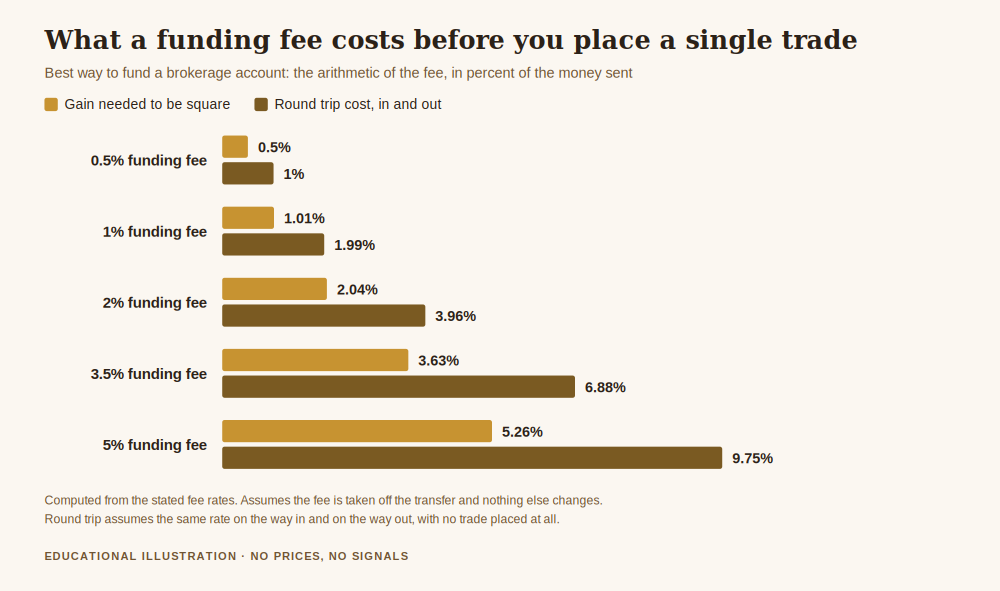
Suppose a funding method takes a percentage fee off the top. Call it f. The money that lands in the account is what remains after the fee, so to get back to the amount you originally sent, the account has to gain 1/(1 minus f) minus 1. That is slightly more than the fee itself, and the gap widens as the fee grows.
A 1 percent funding fee needs a 1.01 percent gain to be square. A 2 percent fee needs 2.04 percent. A 3.5 percent fee needs 3.63 percent, and a 5 percent fee needs 5.26 percent. The assumption is simple and stated: the fee is taken off the deposit and nothing else changes.
Now put the withdrawal on the other end, because money that goes in eventually comes out. If the same percentage applies both ways and you never place a single trade, a 1 percent method costs 1.99 percent of the money round trip, a 2 percent method costs 3.96 percent, and a 3.5 percent method costs 6.88 percent. Six point eight eight percent, for doing nothing at all. That is a real cost with no market risk attached to it, and it is invisible because it happens at two moments separated by months.
The practical consequence is that funding an account repeatedly in small pieces with a percentage fee method is expensive in a way that compounds against you, while a flat fee method rewards the opposite behaviour. Neither is universally right. The point is that this is arithmetic you can do in thirty seconds with your own broker’s published schedule, and almost nobody does it.
Check the Firm Before You Check the Fee
Fees are a second order question. The first order question is whether the entity receiving the money is regulated somewhere real, under the name it is trading under, for the activity it is actually performing.
Three checks cost about ten minutes between them. Look up the firm on the register of the regulator it claims, and read the entry rather than the badge on the website, because badges are images and images are easy to make. Confirm the legal entity name on the payment instruction matches the entity on the register, since a mismatch between the regulated name and the name your bank will see is a genuine warning rather than an administrative quirk. Check how old the domain is, which the CFTC suggests doing through ICANN’s public lookup in its own advisory on trading platforms making outsized claims.
If any of those three come back ambiguous, the correct amount to transfer is zero. Not a small test amount. Zero. A test deposit tells you a payment rail works, which was never the thing in doubt.
The Third Party Rule
There is one rule with no exceptions, and it is the rule most often broken by people who are being defrauded without knowing it: the money must travel from an account in your own name directly to the firm, and it must come back the same way.
Not through a helpful intermediary. Not through an account manager’s personal wallet. Not through someone in a group chat who offers a better rate. Not through a friend of a friend who will convert the currency for you. The CFTC’s advisory on money mules explains the other half of this, which is that people who move money on behalf of strangers can be committing a criminal offence, sometimes while believing they are doing a favour or working a legitimate remote job.
A legitimate broker wants a clean audit trail as badly as you do, because their own licence depends on it. When someone offers to work around the payment process, the workaround is the product being sold. The related CFTC advisory on relationship investment scams describes the pattern in which trust is built over weeks before any request for money appears, and the request, when it comes, always involves an unusual payment route.
Test the Exit Before You Trust the Entrance
Here is the check that would have saved more accounts than any other, and it takes a fortnight of patience.
Fund the account with an amount you would shrug at. Trade nothing, or trade the smallest size available. Then withdraw a portion, back to the same account it came from, and watch what happens. Not whether it arrives, but how it arrives: whether the process is documented, whether the timeline matches what was published, whether anybody contacts you to talk you out of it.
That last one is the real signal. Pressure applied at the moment of withdrawal is the single clearest tell there is, and it costs nothing to test for. A firm that processes a small withdrawal without commentary has told you something no marketing page can tell you. If you want the mechanics of what a normal timeline actually looks like, how long a forex withdrawal takes covers the stages and where the delays legitimately come from.
Fund In Steps, Not In One Move
The last piece is size, which is the same question as position sizing wearing different clothes.
The amount in the account sets the maximum possible loss from anything, market or otherwise. A larger balance does not make you safer. It makes the worst case larger. Funding in stages, with a working account balance and the rest left in your bank, caps the damage from every failure mode at once, including the ones nobody predicted, and it costs you nothing except the inconvenience of a second transfer later.
The counterargument is percentage funding fees, which punish multiple transfers. That is a genuine tension and it resolves in favour of a flat fee method if you plan to fund in stages, which is another reason the fee schedule and the funding plan need to be decided together rather than one after the other.
Get the free Gold Empire survival sheet, a one page guide to the account habits that decide whether a bad month is survivable, including the funding and withdrawal checks this article argues for. One email, no spam, unsubscribe anytime.
Frequently asked questions
What is the best way to fund a brokerage account for a first deposit?
The method that is reversible, in the smallest amount the firm will accept, after you have checked the firm on its regulator’s register. The first deposit is a test of the relationship rather than the start of a trading career, and treating it that way costs you a couple of weeks and nothing else.
Is a card deposit better than a bank transfer?
They protect you differently rather than one being better. Card payments carry chargeback procedures that give you a route to dispute, while bank transfers are traceable but slower to recover. The gap between both of them and an irreversible transfer is much larger than the gap between them.
Why do brokers charge to fund an account at all?
Payment processing genuinely costs them money, and some pass it through. What matters is whether it is a flat amount or a percentage, because a percentage on both ends of a round trip costs 3.96 percent of the money at a 2 percent rate even if you never place a trade.
Should I fund the account in one transfer or several?
Several, unless the fee structure makes that expensive. The balance in the account is the maximum you can lose to any cause at all, so keeping most of the capital in your bank caps every failure mode at once.
Someone offered to deposit on my behalf at a better rate. Is that normal?
No. Money should move from an account in your name straight to the firm and back the same way. Moving funds for other people can amount to acting as a money mule, which the CFTC warns can be a criminal offence even when the person believes they are helping.
Where Gold Empire Fits
Gold Empire is free to follow. Daily gold analysis with the reasoning attached, losing days included, plus an optional Kit for people who want the method written down. Nothing here promises a profit and nothing here ever will.
Survival first, as always. This article is the money movement half of a question whose other half is capital allocation, and risk management in gold trading is where the two meet. If you have not opened the account yet, how to open a gold trading account covers what happens before the first transfer and the best broker for gold trading covers the questions worth asking while you still have the leverage of being a prospect. Once the money is in, how much to risk per trade decides how long it survives contact with the market.
About the author. Matthew writes Gold Empire. He is interested in the unglamorous half of this business, cost, size, frequency and the arithmetic of staying solvent, on the view that most accounts are lost to ordinary errors repeated patiently rather than to one dramatic mistake.
Disclaimer: This article is general educational content about payment mechanics, fee arithmetic and fraud avoidance. It is not financial advice, not legal advice, not tax advice, and not a recommendation of any broker, payment provider, platform or account type. Trading gold, CFDs and leveraged products carries a high risk of losing money rapidly. No entry, stop or target discussed should be treated as a signal. Fraud figures are quoted directly from the FBI Internet Crime Complaint Center’s 2024 IC3 Annual Report and are reported losses from complaints filed with that one channel, which means they undercount total fraud rather than overcount it. The figure of roughly $137,120 per investment complaint, the growth rates of 43.8 percent and 98.4 percent, and all fee break even and round trip percentages were computed by me from the published figures and from stated fee rates; the fee calculations assume a percentage taken off the transfer with nothing else changing, ignore currency conversion, intermediary bank charges, spread, commission, financing and slippage, and the fee rates used are illustrative examples rather than any particular firm’s published schedule. Payment reversibility depends on your jurisdiction, your bank, your card issuer and the specific scheme rules that apply to you, none of which this article can know. Consumer protection procedures referenced are described from the published CFTC money mules advisory and CFTC relationship investment scam advisory. No gold price level is quoted anywhere in this article and no trading results are represented. Verify your own broker’s terms and your own regulator’s register before moving any money.
One step first
Where should we send the Gold Survival Sheet?
Leave your email and we will send the free one page checklist, then take you straight to the Telegram channel.
No cost and no obligation. Educational only, not financial advice, and nothing here promises a return. Unsubscribe any time in one click.
Leave a Reply