

How long does a forex withdrawal take is one of those questions that gets answered badly on purpose. Support desks say three to five business days because it is true often enough to be safe. Forum threads say it took them two hours, or eleven days, and both are telling the truth about their own case. Neither answer helps you, because a withdrawal is not one process with one duration. It is three separate waits stacked end to end, and only the middle one runs on published rules that anyone can check.
So I went and checked them. The middle wait, the part where money actually moves between banks, is governed by operating hours the Federal Reserve publishes openly. I took those hours, ran them against every calendar day of this year, and found something I did not expect to be quite so stark: the single biggest thing you control about the length of your wait is not your broker, not your payment method, and not your verification status. It is which day of the week you press the button.
How Long Does a Forex Withdrawal Take: The Three Clocks
Before the arithmetic, the anatomy. Money leaving a trading account passes through three custodians, and each one has its own clock running at its own speed for its own reasons.
Clock one is the broker’s internal review. Somebody, or some system, checks that the request came from you, that the destination matches a verified method already on file, and that nothing about the pattern trips an anti money laundering flag. This clock has no published schedule anywhere in the industry. It is a business process, it varies by firm, by time of day, by whether a human needs to look, and it is the one leg where a firm’s operational quality shows up plainly.
Clock two is the payment rail. Once the broker releases the payment, it has to travel on an actual settlement system, and settlement systems keep hours. This is the leg people assume is instantaneous because sending a message feels instantaneous. It is not, and its hours are a matter of public record.
Clock three is your receiving bank. Funds arriving at your bank still have to be posted to your account, which is a separate internal process from the settlement that delivered them. Same shape as clock one, opaque, and dependent on the institution.
Two of those three clocks are private business processes you cannot inspect. One of them is published. Guess which one everybody argues about and which one nobody measures.
Clock Two, and Why It Is the Only One You Can Actually Check
In the United States, high value payments between banks run over the Fedwire Funds Service, which the Federal Reserve describes as a real time gross settlement system where transfers become immediate, final and irrevocable once processed. Excellent. Now read the hours, which sit in the same document.
The Fedwire business day opens at 9:00 p.m. eastern time on the preceding calendar day and closes at 7:00 p.m. eastern time, Monday through Friday, excluding designated holidays. There is a further cutoff at 6:45 p.m. eastern time for transfers made for the benefit of a third party, which is what a payment to a broker’s customer is.
Read that again with your own withdrawal in mind. If your broker finishes its review at 8:00 p.m. eastern on a Friday, there is no rail running. Not a slow rail, not a queue, no rail at all. The system reopens at 9:00 p.m. eastern on Sunday for Monday’s business day. Nothing was lost, nobody was negligent, and your money sat still for roughly two and a half days because of a published schedule that has nothing to do with your account.
The cheaper alternative rail behaves differently and, in one respect, worse. The automated clearing house is described by the Federal Reserve as a nationwide network through which institutions send each other batches of electronic transfers. The operative word is batches. ACH does not move your payment when your payment is ready, it moves it when the batch goes, which is why an ACH transfer that could physically complete in seconds routinely takes days.
And then there is the part that makes the whole conversation honest. Since 20 July 2023 the United States has had the FedNow Service, which the Federal Reserve describes as maintaining uninterrupted 24x7x365 processing, with a 24 hour business day every day of the week including weekends and holidays, settling funds in near real time. Instant settlement, at any hour, any day, has existed for years now.
Which means that when a withdrawal takes days, the delay is not a law of physics. It is a choice of rail, made by institutions, for reasons of cost and risk and habit. That is not an accusation, those are often good reasons. But it does change the question you should be asking from “why is this slow” to “which rail is this firm using, and why”.
The Day of the Week Costs More Than Anything Else You Control
Here is where it stops being anatomy and starts being arithmetic. I took the Fedwire calendar, Monday to Friday minus the eleven Federal Reserve holidays, and asked a single question for every one of the 365 days of 2026: if the broker releases the payment after today’s cutoff, how many calendar days pass before a rail exists to carry it?
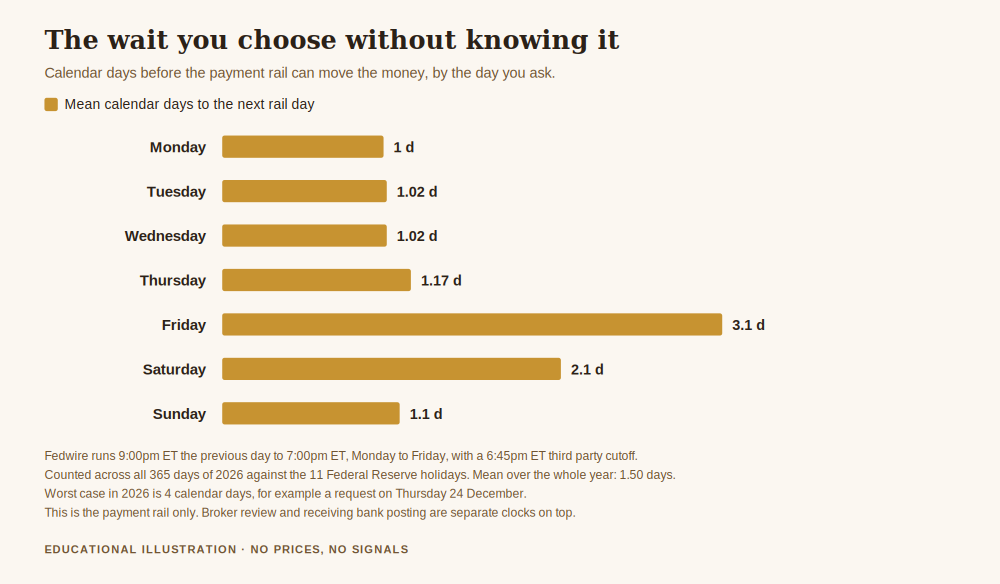
Monday through Thursday all sit at roughly one day, between 1.00 and 1.17. Friday sits at 3.10. Saturday at 2.10, Sunday at 1.10. Across the whole year the mean is 1.50 calendar days.
The gap between Friday and Tuesday is 2.08 calendar days. Two days of waiting, bought with nothing, obtained by nothing, caused entirely by which square of the calendar the request landed in. No verification tier, no premium account, no support ticket changes that number, because it is not about you.
Holidays stack on top. The worst case in 2026 is four calendar days, and it occurs five separate times: a request on Thursday 24 December does not meet a rail until Monday 28 December, and the same four day gap opens around Juneteenth, Independence Day, Labor Day and Columbus Day. If your withdrawal habit is “I do the admin on Friday afternoon”, you have quietly signed up for the slowest version of this available, every single week, forever.
The fix costs nothing and takes no negotiation. Submit early in the week, and early in the day. That is the entire intervention.
What the Wait Actually Costs, and Why That Matters Less Than You Think
There is a tidier argument I could make here, and it happens to be wrong, so let me make it and then knock it down honestly.
The argument goes: money parked at a broker is money not earning the risk free rate, therefore delays cost you. True. Let us price it. Using the Federal Reserve H.15 three month Treasury constant maturity, which stood at 3.87 percent per year on 17 August 2026, on an actual over 365 basis with no compounding, five days of float on 10,000 units of account currency costs about 5.30. On 100,000 it costs about 53. Thirty days on 10,000 costs about 31.81.
That is the honest size of it, and it is small. Five days of waiting on a five figure balance costs less than lunch. Anyone telling you that withdrawal speed matters because of lost interest is selling something.
So why care at all? Because the delay is not valuable information about money. It is valuable information about the firm. A withdrawal is the only test in this entire business where you find out, with certainty and at a time of your choosing, whether the balance on your screen is a number or an asset. Everything else on the platform is a promise. The withdrawal is the settlement of that promise, and it is the one experiment you can run cheaply, early, and repeatedly.
Which is the actual advice buried in all of this arithmetic: make a small withdrawal deliberately, soon after you fund an account, before the balance is large enough for the answer to hurt. Not because you need the money. Because you need the answer, and the answer costs about five units of currency to obtain.
When the Wait Stops Being Plumbing
Everything above describes a slow but functioning system. Now the other case, and it is worth being precise rather than dramatic about it, because the two look identical from the outside for the first several days.
The FBI’s Internet Crime Complaint Center publishes an annual count of what people report losing. In its 2025 Annual Report, IC3 logged 1,008,597 complaints and 20.877 billion dollars in reported losses, an average of 20,699 dollars per complaint across every category of internet crime it tracks.
Investment fraud was the largest single loss category of the year: 72,984 complaints, 8,648,617,756 dollars. Divide those and the average investment fraud complaint runs to roughly 118,500 dollars, about 5.7 times the average across all crime types. This category does not take small amounts from many people. It takes life changing amounts from fewer people.
The IC3 report also describes the mechanism, and this is the part that belongs in an article about withdrawals. In the pattern it documents, victims who try to take their money out are told they must first pay taxes and fees, as a final extraction before the operators disappear with everything. The report notes victims are then targeted again by people offering to recover the lost funds.
So here is the line, and it is bright, and it has no exceptions worth entertaining:
A legitimate firm never requires you to send money in order to receive money. Withdrawal fees are deducted from the amount leaving. They are not collected in advance as a separate deposit, ever, by anyone, for any reason, under any name.
Tax, clearance fee, insurance, verification bond, liquidity charge, anti money laundering deposit. The label changes and the request does not. If a withdrawal is blocked until you fund something, you are not experiencing a delay. You are being shown the end of the script.
Distinguishing this from ordinary slowness turns out to be simple, once you stop measuring the wrong variable. The length of the wait tells you almost nothing, because as the chart above shows, four calendar days can be entirely normal. The direction of the money tells you everything. Money owed to you should only ever move toward you.
If It Has Already Gone Wrong, the Clock Is the Only Lever Left
IC3 runs a Recovery Asset Team that asks receiving banks to freeze funds before they move on. In 2025 it ran 3,574 domestic freeze actions and froze 507,042,623 dollars, plus 326 international actions freezing 171,970,560 dollars. That is 679,013,183 dollars in total.
Set that against the 20.877 billion dollars of reported losses for the year and it comes to 3.25 percent.
Sit with that number for a second, because it reframes the whole subject. A dedicated federal recovery process, working with the banks, staffed and funded, recovers a low single digit percentage of what gets reported. Not because the process is bad, its own success rate on the incidents it reaches in time is far higher, but because most cases never reach it while the money is still catchable. The report’s own guidance is blunt about it: if you discover a fraudulent transfer, time is of the essence, contact your financial institution immediately and request a recall, and file at ic3.gov regardless of the amount.
Recovery is not a plan. Not sending the money is the plan. The 3.25 percent is what the backup plan is actually worth.
What This Does Not Say
It does not say that a slow withdrawal means fraud. The overwhelming majority of delays are exactly what the first half of this article describes, a calendar and a batch window, and treating every wait as a crisis will cost you nothing but sleep and your own credibility with a support desk that is probably doing its job.
It does not name a broker, rate one, or suggest that fast withdrawals prove a firm is sound. Speed is a service level, not a solvency test. A firm can pay quickly for years and still be badly run.
It does not model your broker’s internal review or your bank’s posting, because neither publishes hours. The chart above is the rail only, which is precisely why it is the only leg I was willing to put a number on.
And the payment hours cited are those of the United States system. If your broker, your bank, or your correspondent chain sits in another jurisdiction, the shape of the argument holds and the specific hours do not.
Get the free Gold Empire survival sheet, a one page guide to the account habits that decide whether a bad month is survivable, including the small test withdrawal this article argues for. One email, no spam, unsubscribe anytime.
Frequently Asked Questions
So how long does a forex withdrawal take, in one sentence?
Broker review, plus a payment rail that averaged 1.50 calendar days across 2026 and reaches 3.10 on a Friday, plus your bank’s posting time. The middle figure is the only one anybody publishes, and it is usually the smallest of the three.
Why is my withdrawal slower than my deposit was?
Deposits are usually taken by card or instant transfer, which are built for speed because the money is arriving. Withdrawals frequently go by wire or by batch clearing, and they also pass through a review step that deposits do not have. Different direction, different rail, different checks.
Does asking support to hurry it up help?
Only on clock one. Nobody at a brokerage can make a settlement system run outside its published hours. If the delay is the weekend, escalation changes nothing except your blood pressure.
Is a withdrawal fee itself a warning sign?
No. A fee deducted from the amount you are withdrawing is ordinary commercial practice. A fee you are asked to deposit before the withdrawal will be released is the pattern the IC3 report describes, and it is categorically different.
How small should a first test withdrawal be?
Small enough that losing it teaches you something cheaply, and large enough that the firm processes it as a real payment rather than waiving the checks. The point is the process, not the sum.
Where did the day of the week figures come from?
I computed them from the Fedwire operating hours published by the Federal Reserve, applied to all 365 days of 2026 against the eleven Federal Reserve holidays. The full assumptions are in the disclaimer below.
Where Gold Empire Fits
Gold Empire is a free publication about the unglamorous half of trading gold: cost, size, frequency, and the account mechanics that decide whether anyone is still here in a year. There is nothing to buy. The free survival sheet is the one page version of the habits that keep an account intact, and the reading list is open to everyone.
If this was useful, how to open a gold trading account covers the other end of the same pipe, the deposit side and the verification that makes withdrawals smoother later. Choosing a broker for gold trading is where the due diligence belongs, before the money goes in rather than after. The difference between a real and a demo account is worth reading beside this one, because a demo account never has to answer the question this article is about. And risk management for gold trading remains the piece everything else here is built on.
About the author. Matthew writes Gold Empire. He is interested in the unglamorous half of this business, cost, size, frequency and the arithmetic of staying solvent, on the view that most accounts are lost to ordinary errors repeated patiently rather than to any single dramatic trade.
Disclaimer: This article is general educational content about payment mechanics and account safety. It is not financial advice, not a recommendation of any broker, payment method or product, and not a suggestion to open or close any position. Trading leveraged products carries a high risk of losing money rapidly. No entry, stop or target discussed should be treated as a signal. The settlement hours and the batch clearing description are quoted from the Fedwire Funds Service, FedACH and FedNow Service pages published by the Federal Reserve Board. The weekday waiting figures were computed by me from those published Fedwire hours applied to all 365 calendar days of 2026, against the eleven Federal Reserve observed holidays for that year, and they model the interbank rail only, excluding any broker’s internal review and any receiving bank’s posting time. The cost of float figures use the Federal Reserve H.15 three month Treasury constant maturity of 3.87 percent as published for 17 August 2026, on an actual over 365 basis with no compounding, no fees and no tax. The fraud and recovery figures are as published in the FBI IC3 2025 Annual Report, with per complaint averages computed by me by dividing published totals by published counts; IC3 records only what is reported to it, so those figures are a floor rather than a census. These are United States payment systems and United States crime reporting, and your jurisdiction may differ. No gold price level is quoted anywhere in this article and no trading results are represented.
One step first
Where should we send the Gold Survival Sheet?
Leave your email and we will send the free one page checklist, then take you straight to the Telegram channel.
No cost and no obligation. Educational only, not financial advice, and nothing here promises a return. Unsubscribe any time in one click.
Leave a Reply