

You check the spread. You check the execution speed. You read three reviews and watch somebody’s withdrawal video. What almost nobody checks, until the week it matters, is the thing standing behind all of it: what is an investor compensation scheme, does the firm holding your money belong to one, and what would it actually pay you if that firm failed tomorrow.
The worry is already in my inbox, it just arrives in a different language. One reader wrote: “I haven’t withdrawn with it as yet, that is why I am asking you how reliable are they with withdrawals? The reviews on trustpilot are very disappointing.” Another: “I hope this doesn’t offend you, I’m only asking for my own reassurance and trust.” A third, after being burned: “I few months ago, I joined to some similar guidance, but to be honest I feel cheated, so I want to be more careful.” Roughly 261 messages in my inbox touch trust in the firm or the channel holding the money, which is a keyword count rather than a survey. Almost none of them use the words compensation scheme, and every one of them is asking about it.
So let us answer the question with published figures rather than reassurance, because the numbers are specific, they are public, and most of them are smaller than people assume.
What is an investor compensation scheme, in plain terms
An investor compensation scheme is a legally required fund that pays clients a limited amount when a regulated investment firm fails and cannot return the money or assets it was holding for them. It is the investment equivalent of deposit insurance at a bank, with two important differences that I will come to.
Note the three conditions hidden in that sentence, because every one of them is a place where a claim dies.
First, the firm has to be regulated and a member. An offshore entity outside any scheme has nothing standing behind it, however professional the platform looks.
Second, the firm has to have failed. The scheme covers insolvency and the inability to return client assets. It does not cover a trade that went against you, and that is the single most common misunderstanding about it.
Third, the money has to be covered business. This is the trap, and it is the part that catches gold and currency traders specifically.
The numbers, and where they come from
Europe set the floor in law. Under Directive 97/9/EC on investor compensation schemes, Article 4 requires member states to ensure schemes provide cover of “not less than ECU 20 000 for each investor”. That unit became the euro, so the floor across the European Union is 20,000 euros per investor per firm. Individual countries may go higher. None may go lower.
There is a second clause in the same article that almost nobody quotes, and it costs real money. A scheme may limit cover to a percentage of the claim, provided that percentage is at least 90 per cent while the amount payable is under 20,000 euros. So a scheme operating at that floor, facing a claim of 15,000 euros, may pay 13,500 euros. That is my arithmetic on the directive’s own wording, and it means you can be well under the headline cap and still be 1,500 euros short.
The United Kingdom runs a separate and more generous scheme. The Financial Services Compensation Scheme states its investment limits as up to 85,000 pounds per eligible person per firm for failures after 1 April 2019, up to 50,000 pounds for failures between January 2010 and March 2019, and for failures before 2010, 100 per cent of the first 30,000 pounds and 90 per cent of the next tranche. The date of the failure sets the limit, not the date you opened the account.
The United States works differently again, and this is where gold and currency traders need to pay attention. The Securities Investor Protection Corporation publishes its limits and its exclusions: protection is capped at 500,000 dollars, which includes a 250,000 dollar limit for cash. Then comes the sentence that matters here. SIPC does not protect “commodity futures contracts (unless held in a special portfolio margining account), or foreign exchange trades”. It also states that cash held in connection with a commodities trade is not protected.
Read that twice if you trade gold through a US entity. The largest compensation figure in this article is also the one least likely to apply to you.
What the cap covers once your account grows
A cap is a flat number, and an account is not. The protection you have is therefore a percentage that shrinks every time you fund the account, and most people never notice the crossover.
Here is that arithmetic at the European floor of 20,000 euros, which is my own calculation and needs no assumptions beyond the cap itself.
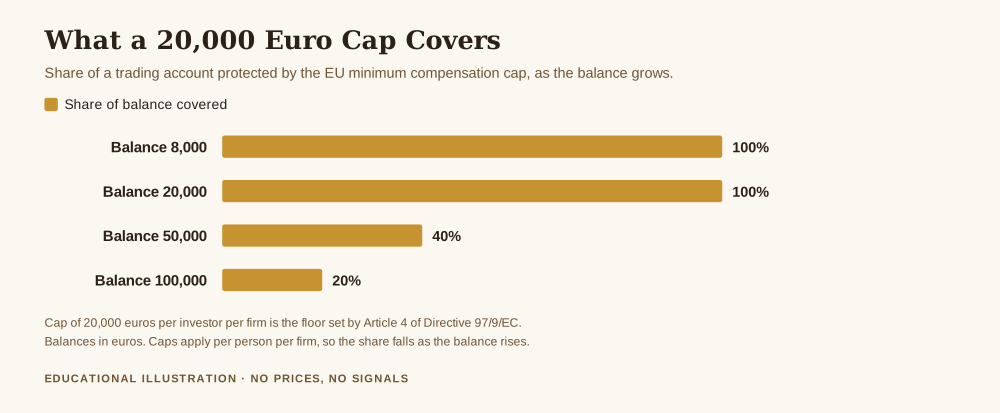
At 8,000 euros you are fully covered. At 20,000 you are exactly at the line. At 50,000 the cap covers 40 per cent of your balance. At 100,000 it covers 20 per cent. The United Kingdom figures behave the same way at a different level: 85,000 pounds is full cover at 85,000 pounds and 42.5 per cent of a 200,000 pound account.
So there is a balance at which your protection quietly stops being meaningful, and you can work out when you will reach it. A trader starting at 5,000 euros and adding 1,000 euros a month crosses the 20,000 euro floor in the sixteenth month. That is my arithmetic, and the point of it is that this is a date on a calendar rather than a surprise.
What you do about it is a separate decision and I am not going to make it for you. The options are the obvious ones: hold less at the broker and more at a bank, or spread the balance across more than one regulated firm, since the caps are per person per firm. Both have costs. Knowing the crossover exists is the part that is free.
What it does not cover, which is most things
The reason I wanted the real figures in front of us is that the scheme is narrower than the comfort people take from it.
It does not cover losing trades. If you lose money because gold moved against your position, no scheme anywhere pays you. That is not a loophole, it is the entire design.
It does not cover unregulated firms, and it does not cover an unregulated offshore subsidiary of a regulated group. The entity named on your account agreement is the entity that matters, and it is frequently not the one in the marketing.
It does not cover the person who offered to trade your account for a share of the profits. Several readers have described exactly that arrangement to me and it sits outside every scheme in this article, which is a large part of why I keep writing about it in how to report investment scams.
And for gold and currency traders specifically, it may not cover your product even at a fully regulated firm, as the SIPC exclusion shows. Segregation of client money is a separate protection from compensation, and the two are often confused. Segregation is meant to keep your money out of the firm’s own pot. Compensation is what pays out when segregation has failed or there is a shortfall. I have written about where the money sits and what happens to it in what happens if your forex broker goes bust, and this article is the companion to it: that one is about custody, this one is about the fund of last resort.
Get the free Gold Empire survival sheet, a one-page guide to protecting your account through the kind of market this article describes. One email, no spam, unsubscribe anytime.
The ten minute check, done properly
This is not a research project. It is four questions and a register lookup.
One, which legal entity holds my account? Open the client agreement, not the website. Find the company name, the country of incorporation and the licence number.
Two, is that entity on the regulator’s own register? Search the regulator’s site directly rather than trusting a licence number printed in a footer. A number on a page costs nothing to type.
Three, which scheme does that entity belong to, and what is the cap? The regulator’s register usually says. If no scheme is named anywhere, that is your answer.
Four, is my product covered business under that scheme? This is the question that separates gold and currency traders from equity investors, and it is the one almost nobody asks.
If the answers come back thin, that information is not a reason to panic. It is a reason to size the balance you keep there accordingly, which is the same discipline as risk management in gold trading applied one level up. You already limit what a single trade can cost you. The money sitting at the firm is a position too, and the cap tells you how large a position it is safe to hold there.
Frequently asked questions
What is an investor compensation scheme, in one sentence?
A legally required fund that pays clients of a failed regulated investment firm a capped amount when the firm cannot return the money or assets it was holding for them.
How much does it pay?
It depends on the jurisdiction. The European Union floor under Directive 97/9/EC is 20,000 euros per investor, and schemes at that floor may pay as little as 90 per cent of a claim below that figure. The United Kingdom scheme pays up to 85,000 pounds per eligible person per firm for failures after 1 April 2019. The United States scheme is capped at 500,000 dollars including 250,000 dollars of cash, but excludes foreign exchange trades.
Does it cover my losing trades?
No. It covers the failure of the firm, not the performance of your positions. No compensation scheme anywhere pays for a trade that went against you.
Are forex and gold CFD accounts covered?
It depends on the scheme and the product. The United States scheme explicitly excludes foreign exchange trades and most commodity futures. European schemes cover investment business done by an authorised firm, so the answer turns on the entity and its licence. Check the entity on the client agreement rather than the brand on the website.
What if my broker is offshore?
Then there is most likely no scheme at all, and the question becomes how much balance you are willing to hold at a firm with nothing standing behind it. That is a sizing decision, and it should be made deliberately rather than by default.
Is this the same as segregated client money?
No, and the difference matters. Segregation keeps client funds separate from the firm’s own money while the firm is operating. Compensation is what pays when the firm fails and there is a shortfall anyway. A firm can segregate properly and still leave a gap.
Where Gold Empire fits
Gold Empire is a free channel about surviving in this market long enough to get good at it. There is no account management here, no profit sharing, and nothing sold on a promise of returns. The free survival sheet is one page about protecting an account, and the piece everything else rests on is risk management in gold trading, because the size of what you expose is the one decision that sits underneath every other protection in this article.
About the author. Matthew writes Gold Empire. He has spent more evenings than he would like reading client agreements from firms that turned out to be two different companies wearing the same logo, which is how he learned to read the entity name before the spread table. He writes about surviving first because the traders still here in five years are not the ones who were right most often.
Sources and method. The minimum cover of not less than 20,000 units per investor, and the rule that a scheme limiting cover to a percentage of a claim must cover at least 90 per cent while the amount payable is under that figure, are quoted from Article 4 of Directive 97/9/EC of the European Parliament and of the Council on investor-compensation schemes, linked above and read in full on EUR-Lex before publication. The limits of 85,000 pounds for failures after 1 April 2019, 50,000 pounds for failures between 1 January 2010 and 31 March 2019, and 100 per cent of the first 30,000 pounds for earlier failures, are quoted from the Financial Services Compensation Scheme’s own investments page, also linked. The 500,000 dollar limit including a 250,000 dollar cash limit, the exclusion of foreign exchange trades and of commodity futures outside a special portfolio margining account, and the exclusion of cash held in connection with a commodities trade, are quoted from the Securities Investor Protection Corporation’s own page on what it protects, also linked. All three pages were requested and confirmed live before publication. The covered shares of 100, 40 and 20 per cent at balances of 8,000, 50,000 and 100,000 euros, the 42.5 per cent at a 200,000 pound balance, the 13,500 euro payout on a 15,000 euro claim at the 90 per cent floor, and the sixteen month crossover for a trader starting at 5,000 euros and adding 1,000 euros a month, are my own arithmetic on those published caps. Reader quotations are real messages, anonymised and lightly edited, and the count of roughly 261 is a keyword count of my inbox rather than a survey.
Disclaimer. This article is educational content about regulatory protection structures. It is not investment advice, not a recommendation of any firm or jurisdiction, and not a claim about the solvency or conduct of any named company. Compensation limits, eligibility rules and product coverage differ by jurisdiction and change over time, so verify the current position with the scheme and the regulator that apply to your own account before relying on anything here. Nothing in this article is personal advice, and no entry, stop or target discussed should be treated as a signal. Decide your own risk, and never trade money you cannot afford to lose.
One step first
Where should we send the Gold Survival Sheet?
Leave your email and we will send the free one page checklist, then take you straight to the Telegram channel.
No cost and no obligation. Educational only, not financial advice, and nothing here promises a return. Unsubscribe any time in one click.
Leave a Reply