

Ask a room full of gold traders what is a dealing desk broker and you will get two kinds of answer. One half will tell you it is the firm that hunts their stops. The other half will shrug, because nobody ever told them there was a choice to make. Both answers skip the part that matters, which is a plain question of plumbing: when you click buy on XAU/USD, does your order leave the building, or does it stop at a desk inside the firm that quoted you the price?
That is the whole of it. Everything else, the forum arguments, the screenshots of a stop filled one tick deep, the conviction that somebody is watching your account personally, follows from whether the answer is yes or no. This article answers the question properly, with the rules that actually bind a retail broker in Europe and the arithmetic of what leverage does to your margin, and it does it without naming a single firm or quoting a single gold price.
What is a dealing desk broker, in plain words
A dealing desk broker is a firm that takes the other side of your trade itself. You buy, it sells to you. It is your counterparty, not your agent. The desk inside the firm decides whether to hold that exposure on its own book, offset it against another client who wants the opposite side, or hedge it in the wider market. The industry word for this is market making, and the older retail word for it is B book.
The alternative is a broker that passes your order out to a liquidity provider and earns a commission or a markup for doing so. It does not hold the opposite side of your position. Its revenue comes from volume rather than from the profit and loss on your trade. That is the no dealing desk model, usually sold under the labels straight through processing or electronic communication network.
The distinction is real and worth understanding, but it is not the morality play the forums make of it. A dealing desk is not by itself a scam, and a no dealing desk route is not by itself a guarantee of better execution. Market making is a licensed activity that exists in every market, including the ones institutions use. What changes between the two models is where the firm’s revenue comes from, and therefore which of its incentives you need to watch.
The three models you will actually meet
In practice retail firms sit somewhere along a spectrum rather than in two clean boxes, and most of them run more than one model at once.
The first is the pure dealing desk. The firm quotes you a price, fills you from its own book, and manages the resulting exposure however it chooses. Its spread is its own decision. It makes money on the spread, and on the net profit and loss of the client book it decides not to hedge.
The second is the pure agency route. Your order is sent to an outside venue, you pay a commission plus whatever the market spread happens to be, and the firm has no position in the outcome. Spreads vary through the day because the market’s spread varies through the day.
The third, and by far the most common, is a hybrid. The firm sorts its clients. Flow it judges unlikely to be profitable stays internal, on the dealing desk. Flow it judges likely to be profitable gets passed out to the market. Most large retail brokers do this, and it is why the same firm can honestly describe itself as both. You are not on one model or the other because of the firm’s name. You are on one model or the other because of which bucket your account sits in, and that is a decision made inside the firm, about you, that you are rarely told about.
What the inbox says, and why it is always about the spread
I keep the messages people send me. About 48 of them mention spread or slippage directly, which is a count of keyword matches in my inbox rather than a survey of anything, but the pattern in them is consistent enough to be worth repeating. People almost never ask about the broker’s business model. They ask about one number, over and over.
One reader wrote: “Do we all have the same spread?” That single question is the whole topic in six words, and the answer on a dealing desk is that you have no way of knowing.
Another wrote: “I think my spread is too big. It just closed the two other order.” A third: “The spread and things that have happened this morning are very scary.” A fourth was more careful about it: “I think that’s due to my brokers spread, or maybe something that I may have been missing here.” A fifth described the mechanism exactly without naming it: “spread is not fixed and it hit my stop with that spread.” And a sixth: “Yes, but the spread difference can’t take the position at the right time.”
Read those again and notice what none of them is. None is a complaint about being cheated. They are all people trying to work out whether the number they are being shown is the market’s number or the firm’s number. That is the correct question, and it is the question the dealing desk model exists to make unanswerable from the outside.
What the rules force every retail broker to do
This is where the conversation usually dissolves into speculation, so let us anchor it in something published. In 2018 the European Securities and Markets Authority agreed a set of measures on contracts for difference sold to retail clients, and those measures bind the firm regardless of which model it runs. They are worth knowing because they set the outer boundary of what can happen to your account.
The ESMA measures cap the leverage a retail client can open with, and the cap depends on what you are trading. Major currency pairs are limited to 30:1. Gold sits in the next band down, at 20:1, alongside non major currency pairs and major equity indices. Other commodities are 10:1, individual equities 5:1, and cryptocurrencies 2:1.
Two more rules matter more than the leverage cap and get discussed far less. The first is the margin close out rule, which standardises the point at which a provider must start closing a retail client’s open positions. That point is 50 per cent of the minimum required margin, applied per account. The second is negative balance protection, also per account, which puts a guaranteed limit on what a retail client can lose. You cannot end the day owing the firm more than you put in.
There is a third requirement that tells you something about the whole business. Firms must show a standardised risk warning that includes the percentage of their own retail accounts that lose money. ESMA noted that national regulator analyses found 74 to 89 per cent of retail accounts typically lose money. That figure is not about dealing desks specifically. It is the base rate for the activity, and it is published by the regulator rather than inferred by me.
The margin arithmetic nobody puts in the brochure
Here is the part you can work out for yourself, and should. The numbers below are my own arithmetic on the ESMA caps. There is no gold price anywhere in them, because none is needed: every figure is a percentage of your own position.
At the retail cap for gold of 20:1, the required margin is 5 per cent of the notional value of the position. If the only money in the account is that required margin, then the close out rule bites when you have lost half of it, which is 2.5 per cent of notional. Not 20 per cent. Not 50. Two and a half.
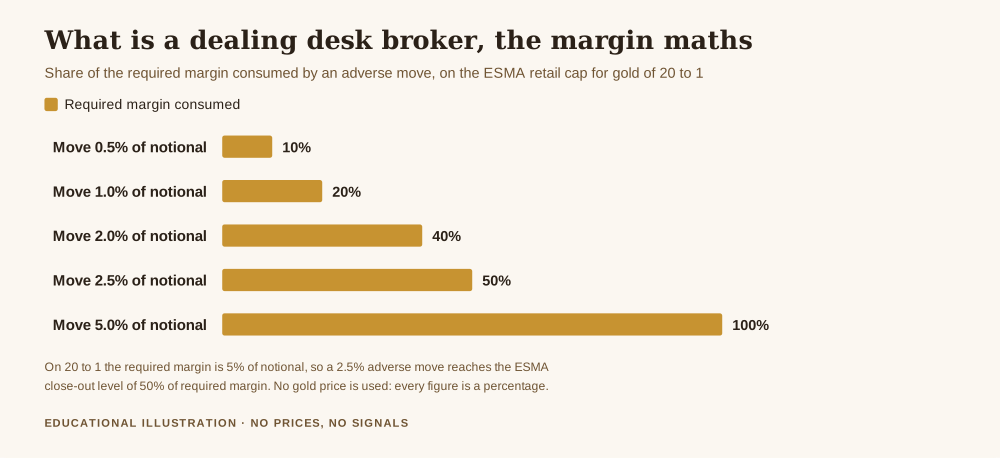
Walk down the chart. An adverse move worth 0.5 per cent of notional consumes 10 per cent of your required margin. One per cent consumes 20 per cent. Two per cent consumes 40. At 2.5 per cent you are at the close out threshold, and at 5 per cent you have consumed the entire required margin. Gold moves more than 2.5 per cent in a session often enough that this is not a thought experiment.
Now apply the same arithmetic to cost, which is where the dealing desk question comes back. Suppose the round turn cost of a trade, spread plus commission, is quoted as a fraction of notional. At 2 basis points a trade, one trade a day for twenty trading days costs 0.4 per cent of notional in a month. That sounds trivial. Against the margin you actually posted at 20:1, it is 8 per cent. At 5 basis points it is 20 per cent of posted margin. At 10 basis points, 40 per cent. At 20 basis points, 80 per cent of the margin you posted, gone in a month, before a single trade has been right or wrong.
That is the real answer to why everybody argues about the spread. Leverage does not just multiply your exposure to price. It multiplies your exposure to the cost of trading, by exactly the same factor. On a dealing desk, where the spread is the firm’s own decision rather than the market’s, that multiplier is pointed at a number the firm controls.
How to find out which model you are actually on
You cannot read this off the marketing page, and asking support usually produces the word hybrid. There are four checks that give you real information.
Read the regulatory disclosure rather than the website copy. The entity you have actually contracted with is named in the client agreement, and it may not be the brand on the login screen. Its licence tells you what it is permitted to do, and whether it is permitted to deal on its own account.
Watch the spread behaviour across the day rather than the headline number. A pass through route inherits the market’s spread, so it widens at the rollover, around scheduled releases, and in thin hours, because the underlying market does. A spread that stays suspiciously flat through a volatile hour is a decision somebody made, not a market observation.
Note the fee structure. Commission plus a raw spread is the pricing of an agency route. A single all in spread with no commission is the pricing of a firm earning from the spread itself. Neither is dishonest. They are just different revenue models, and the model tells you where the firm’s attention goes.
Check the risk warning on the firm’s own site. The percentage of its retail accounts losing money is a number the firm must publish about itself, and it is one of the few figures in this industry that is both standardised and specific to the firm you are considering.
If you want the longer treatment of the same question from the revenue side, the companion piece on what A book and B book mean in forex covers how the sorting works, and what an ECN broker is covers the other end of the spectrum. When you are comparing firms rather than models, the practical checklist lives in choosing a broker for gold trading.
What this article does not say
It does not say a dealing desk broker is cheating you. Market making is a licensed activity, the firm is allowed to be your counterparty, and the vast majority of what traders attribute to malice is explained by leverage, spread at the wrong moment, and position size chosen before the cost was counted.
It does not say a no dealing desk route will improve your results. It changes who profits from your spread. It does not change the arithmetic in the chart above, which is the thing that actually decides whether your account survives.
And it does not tell you which firm to use. I have deliberately named none. The checks are the deliverable here, not a recommendation.
Get the free Gold Empire survival sheet, a one-page guide to protecting your account through the kind of market this article describes. One email, no spam, unsubscribe anytime.
Frequently asked questions
What is a dealing desk broker in one sentence?
A firm that takes the opposite side of your trade on its own book instead of passing the order out to the market, so it is your counterparty rather than your agent.
Is a dealing desk broker trading against me?
It is holding the other side of your position, which is not the same as targeting you. Whether it keeps that exposure or hedges it is a risk decision the firm makes across its whole client book, not a decision about your account in particular.
How do I know if my broker uses a dealing desk?
Read the client agreement to find the entity and its permissions, watch whether the spread moves with the market through volatile hours, and look at whether you pay a commission plus a raw spread or a single all in spread. Most large firms run a hybrid, so the honest answer is often both.
Does a dealing desk mean wider spreads?
Not necessarily. It means the spread is set by the firm rather than inherited from the market, so it can be tighter as easily as wider. The point is that it is a decision rather than an observation, which is why the cost arithmetic matters so much.
What protection do I have either way?
Under the ESMA measures a retail client gets leverage capped at 20:1 on gold, a margin close out once equity falls to 50 per cent of required margin, and negative balance protection so losses cannot exceed the account. Those apply regardless of the execution model.
Why does leverage make the spread matter so much more?
Because it multiplies both. At 20:1 your posted margin is 5 per cent of notional, so a cost worth 10 basis points of notional per round turn, traded once a day for a month, is 40 per cent of the margin you posted. The same multiplier that magnifies the move magnifies the bill.
Where Gold Empire fits
Gold Empire is a free blog about surviving the first few years of gold trading, written for people who would rather understand the plumbing than be sold a shortcut. There is no signal service here and nothing is sold on a promise of returns. The free survival sheet is a single page on protecting an account, and the piece underneath everything else is risk management in gold trading, which is where the arithmetic in this article turns into a position size you can actually use.
About the author. Matthew writes Gold Empire. He spent long enough on the wrong side of a margin close out to stop believing that the firm was the problem, and long enough reading client agreements afterwards to know which parts of them are worth reading. He would rather you understood the cost of a trade than the opinion behind it.
This article is educational and is not financial advice. Trading gold and other leveraged products carries a high risk of losing money rapidly, and no entry, stop or target discussed should be treated as a signal. The leverage caps of 30:1 for major currency pairs, 20:1 for gold and non major currency pairs, 10:1 for other commodities, 5:1 for individual equities and 2:1 for cryptocurrencies, the margin close out level of 50 per cent of minimum required margin, negative balance protection, and the finding that 74 to 89 per cent of retail accounts typically lose money, are all from the ESMA announcement linked above, which was retrieved and read before publication. The margin figures of 5 per cent of notional at 20:1, the 2.5 per cent adverse move that reaches the close out level, the full table of moves against margin consumed, and the monthly cost figures of 8, 20, 40 and 80 per cent of posted margin at 2, 5, 10 and 20 basis points per round turn, are my own arithmetic on those caps and are reproducible from the assumptions stated in the text. The count of about 48 inbox messages mentioning spread or slippage is a keyword count in my own inbox, not a survey, and the quoted messages are real, anonymised, and lightly edited to remove identifying detail. No gold price is quoted anywhere in this article, and no broker is named. Decide your own risk, and never trade money you cannot afford to lose.
One step first
Where should we send the Gold Survival Sheet?
Leave your email and we will send the free one page checklist, then take you straight to the Telegram channel.
No cost and no obligation. Educational only, not financial advice, and nothing here promises a return. Unsubscribe any time in one click.
Leave a Reply