

Two words turn up in every broker’s paperwork, they sound like they belong to the same family, and they do almost opposite things to your account. So what is markup and margin, in the only terms that matter when you are the one paying? One is a cost that leaves and never comes back. The other is a deposit that sits there and returns to you when the position closes. Confusing them is how people end up watching the wrong number.
I want to be exact about this rather than clever, because the confusion has a direction. People worry about margin, which they get back, and ignore markup, which they do not. The arithmetic below is mine, the assumptions are written out, and the one external rule comes from a regulator.
What Is Markup and Margin, Side by Side
Markup is what your broker adds to the dealing spread it receives. Somewhere upstream there is a raw price with a narrow gap between bid and offer. Your broker takes that gap, widens it, and quotes you the wider one. The difference is the markup, and it is revenue for the firm.
Margin is collateral. When you open a leveraged position you are not paying for it, you are putting up a fraction of its value as a good faith deposit while the position is open. Close the position and the deposit is released back to your free balance.
The three differences worth memorising. Markup is an expense and margin is a deposit. Markup is gone the instant you trade and margin comes back when you close. Markup scales with how often you trade and margin scales with how much you hold.
That last one is why the two feel similar and behave differently. A trader who holds one position for a month pays markup once and ties up margin for a month. A trader who opens and closes forty times in that month ties up margin briefly and pays markup forty times. Same instrument, same account, completely different bills.
Markup, the Toll That Never Comes Back
Here are the assumptions, so you can argue with them. A standard lot of XAUUSD is 100 troy ounces, so a 1.00 move in the quoted price is 100 per lot. Say the raw dealing spread is 0.12 and your broker marks it up by 0.20, making the quoted spread 0.32. A round turn means opening and closing once, so you pay the spread once. Position size 0.10 lot, which is 10 ounces. Activity, four round turns a day across twenty trading days.
At that size each round turn costs 3.20 in total spread, of which 2.00 is the markup. Over a month of eighty round turns that is 256 in spread, 160 of it markup. Over a year it is 3,072 in spread, 1,920 of it markup.
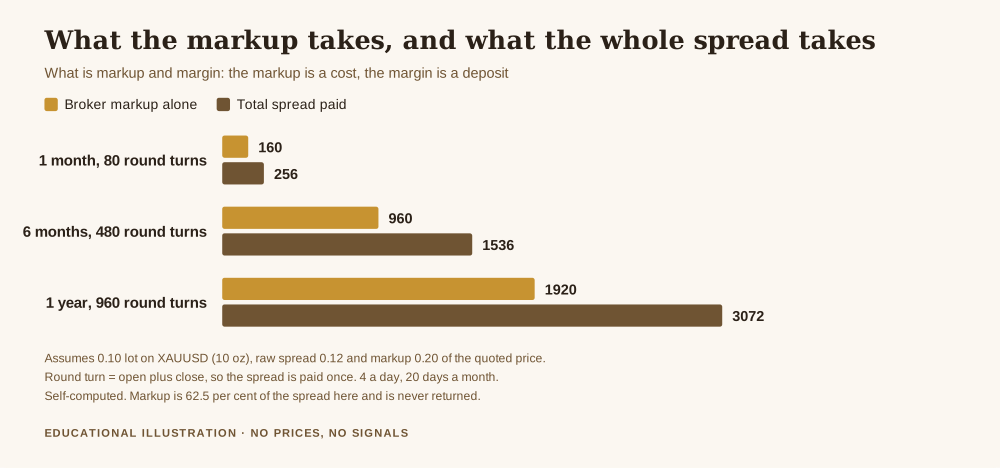
On a 5,000 account, that markup alone is 38.4 per cent of the account in a year. Not the spread, the markup portion of it. The part that exists because the price you were shown was not the price the broker was shown.
Two honest caveats. Those are illustrative spread values, not a quote from any firm, and real markups vary enormously between brokers and account types. And a trader doing four round turns a day is an active trader, so halve the activity and you halve the bill. The shape of the finding survives either adjustment: markup is charged per transaction, so it is the one cost that grows purely because you were busy.
Margin, the Deposit, and the Rule That Decides When You Are Out
Now the other word, and here the arithmetic can be done entirely in percentages, which is useful because it means no gold price is needed and the conclusion holds at any price level.
Under the product intervention measures the European Securities and Markets Authority announced in 2018, retail leverage on gold is capped at 20 to 1, and providers must close out a retail client’s positions when margin falls to 50 per cent of the minimum required margin. Negative balance protection applies per account.
Run those two rules together. At 20 to 1 you post 5 per cent of the position’s value as margin. The close-out rule fires when your equity on that position has fallen to half of what you posted, which is 2.5 per cent of the position’s value. So the adverse move that gets you closed out is 2.5 per cent, not 5 per cent, and certainly not 100 per cent.
That is the number people do not have in their heads. A fully margined position at the maximum retail leverage for gold does not need a crash. It needs the instrument to move two and a half per cent against you.
Note also what the close-out rule is. It is a protection, not a punishment. It exists to stop an account running past zero, and the negative balance protection sits behind it for the cases where a gap moves faster than any close-out can. Both are on your side. They are simply not a substitute for sizing the position so they never come up.
What This Sounds Like in the Inbox
Roughly 54 messages in my inbox mention leverage or margin. That is a keyword count across a message archive, not a survey, so it proves nothing general. It is only useful for hearing where the confusion actually sits.
One reader wrote: “I frequently hit margin calls, which forces me to cut losses often, and I panic whenever gold becomes volatile and I am sitting on a floating loss.” Another, shorter: “No. I keep getting margin calls. I need to study proper risk management first.”
A third: “Because my margin level is getting low I have to add funds.” A fourth was planning around it: “Trying to reach the first 1,000 to 2,000 so I have free margin to work with.”
Four people, all watching the margin number, none of them mentioning the markup. The margin number is the one the platform puts on the screen in red, so it gets the attention. The markup is charged silently inside a price you accepted, which is exactly why it needs a line in your own records rather than trust in theirs.
And one more, which is the question underneath most of the others: “When registering, which leverage do you suggest?” The honest answer is that the leverage cap is not the decision. The position size is the decision, and leverage only sets the ceiling on how badly you can make that decision.
How to Price Both Before You Trade
For markup, find the raw spread and the quoted spread for the instrument you actually trade, in the account type you actually hold. The difference is your markup. Multiply it by the contract size, by your typical position, and by the number of round turns you really do in a month. Write that figure down as a monthly cost line. It belongs next to your other business costs, not hidden inside a price.
For margin, work in percentages. Note your leverage cap, invert it for the margin percentage, and halve that to find where the close-out sits. Then ask the only question that matters: how far does this instrument routinely move in a day, and is that distance larger or smaller than the move that closes me out? If the honest answer is larger, the position is too big, and no stop placement fixes a position that was oversized before it opened.
Get the free Gold Empire survival sheet, a one-page guide to protecting your account through the kind of market this article describes, including where to write your cost lines down. One email, no spam, unsubscribe anytime.
What This Article Does Not Say
It does not say markup is wrong. A broker providing a platform, execution and support is entitled to be paid, and markup is one of the normal ways that happens. The point is that it should be a number you know, not a number you discover by subtraction a year later.
It does not say low margin requirements are a trap. The requirement is set by the rules and the firm. What you do with the room it leaves is entirely your decision.
It does not quote any firm’s actual spreads, and it does not say what gold is worth today. The spread values are illustrative, the percentages are general, and nothing here is a view on direction. No entry, stop or target discussed should be treated as a signal.
Frequently asked questions
What is markup and margin, in one sentence each?
Markup is the amount your broker adds to the raw dealing spread, which is a cost you pay on every transaction and never get back. Margin is the collateral you post to hold a leveraged position, which is returned to your free balance when the position closes.
Is margin a fee?
No. It is a deposit. It reduces your free margin while the position is open and is released when you close. The fees around a position are the spread, which includes the markup, any commission, and any overnight financing.
How do I find out what my broker’s markup is?
Compare the spread you are quoted with a raw spread account for the same instrument at the same moment. The difference is the markup. Account types differ, so compare the account you actually hold, and remember a commission based account may show a tighter spread while charging separately.
How far can gold move before I get closed out?
At a 20 to 1 cap you post 5 per cent of the position’s value, and under the close-out rule your position is closed when equity on it reaches 50 per cent of that, which is a 2.5 per cent adverse move. Lower leverage or a smaller position moves that threshold further away.
Which costs me more over a year, markup or margin?
Margin costs nothing over a year because you get it back. Markup is the one that accumulates. At 0.10 lot and four round turns a day, the illustrative markup above totals 1,920 across a year, which on a 5,000 account is 38.4 per cent of it.
Where did these numbers come from?
The markup figures are computed here from the assumptions stated above, and you can reproduce them with a calculator. The leverage cap, the 50 per cent close-out rule and negative balance protection are from the ESMA measures linked below.
Where Gold Empire fits
Gold Empire is free to follow. Daily XAUUSD analysis with the reasoning shown before the trade, losing days included, and a free survival sheet for anyone who wants the capital protection material in one place. There is an optional Kit for people who want the whole method. Nothing here promises a profit and nothing here is a signal service.
Costs and sizing both belong under survival. Risk management in gold trading is the pillar this article sits under, what is the spread in gold trading covers the price side of the cost in more detail, why does my broker increase margin requirements deals with the deposit changing underneath you, and what does stop out level mean is the mechanism that ends the position. If you want to compare cost models directly, raw spread account vs standard account is where the markup becomes visible. The regulatory rules quoted here are in ESMA’s published product intervention measures.
About the author. Matthew writes Gold Empire. He spent his first two years watching the margin figure on the platform and none of them watching the markup inside the price, and he would rather you did the subtraction early than late. Nothing in this article is a recommendation to trade, and no entry, stop or target discussed should be treated as a signal.
Disclaimer: This article is general educational content about broker pricing, collateral and leverage rules in retail trading. It is not financial advice, not investment advice and not a recommendation to buy, sell or use any product, venue or firm. Spreads, markups, leverage caps and margin rules differ by broker and by jurisdiction and change over time, and the figures here are illustrative or refer to the dates stated. Trading leveraged products carries a substantial risk of loss and most retail accounts lose money. Only trade with capital you can afford to lose.
One step first
Where should we send the Gold Survival Sheet?
Leave your email and we will send the free one page checklist, then take you straight to the Telegram channel.
No cost and no obligation. Educational only, not financial advice, and nothing here promises a return. Unsubscribe any time in one click.
Leave a Reply