

Ask why we need broker for trading and the usual answer stops at “because you cannot buy gold on your own,” which is both true and useless, because it does not say what the broker is actually doing or what that service costs you. The honest answer has three parts, and only one of them is about access. The other two are about size and about regulation, and the regulation part is where most of the money is quietly saved or lost.
Why we need broker for trading, starting with the size of the real market
There is a physical gold market, and it does not want your business. That is not an insult, it is a specification.
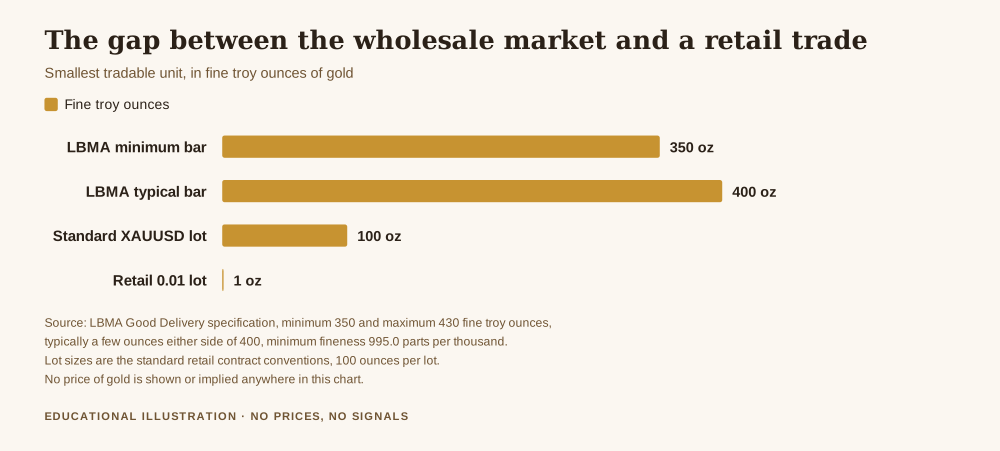
The London Bullion Market Association publishes the Good Delivery standard, the spec a bar must meet to be accepted in the London wholesale market. You can read it on lbma.org.uk. The weight section is short and worth reading twice:
- Minimum gold content: 350 fine troy ounces, approximately 10.9 kilograms
- Maximum gold content: 430 fine troy ounces, approximately 13.4 kilograms
- Bars typically weigh a few ounces either side of 400 troy ounces, roughly 12.5 kilos
- Minimum acceptable fineness: 995.0 parts per thousand fine gold
Now put that next to the smallest trade a retail account places. A standard contract in XAUUSD is 100 ounces, and the common minimum of 0.01 lots is one ounce. So the smallest unit the wholesale market will accept is 350 times the smallest trade you can place, and a typical bar is four standard contracts of metal in a single object you would have to store, insure and assay.
That is the access answer, and it is real. But notice what it does not explain. Plenty of markets are wholesale at the top and retail at the bottom without needing an intermediary who also holds your money. The reason a broker sits in the middle of this one is the second part.
The thing you are actually buying is not gold
This is the part that gets skipped, and skipping it is how people end up surprised by their own account.
When you trade XAUUSD in a retail account, in most cases you are not buying gold and no gold moves anywhere on your behalf. You are entering a contract with the broker whose value tracks the gold price. The broker is not your agent fetching metal from London. The broker is your counterparty, or is routing you to one.
That single fact reorganises the whole question. If the broker were a shop, the only things that would matter are price and service. Because the broker is a counterparty holding your funds, three other things matter at least as much:
- Whether your money is separated from theirs. Client money held in segregated accounts is not available to the firm’s creditors in the same way its own cash is.
- What happens if the firm fails. That depends on the compensation scheme in its jurisdiction, not on how good its platform was.
- Who is on the other side of your trade. A firm that nets your position internally has a different relationship to your losses than one that passes it to a liquidity provider.
I have written about that last point separately in what A book and B book mean in forex and what a dealing desk broker is, and about the failure case in what happens if your forex broker goes bust. The short version is that “which broker” is not a shopping question. It is a question about who holds your capital and under whose rules.
The protections arrive through the broker, not around it
Here is the argument for the middle layer that nobody makes, and it is the strongest one.
In 2018 the European Securities and Markets Authority adopted binding product intervention measures on contracts for difference sold to retail clients. The measures are listed in the ESMA announcement on esma.europa.eu, and three of them are numbers rather than sentiments:
- Leverage limits on opening a position, varying by underlying: 30:1 for major currency pairs, 20:1 for non-major currency pairs, gold and major indices, 10:1 for commodities other than gold, 5:1 for individual equities, 2:1 for cryptocurrencies.
- A margin close out rule on a per account basis, standardising the level at 50 per cent of minimum required margin.
- Negative balance protection on a per account basis, which ESMA describes as an overall guaranteed limit on retail client losses.
Read the third one again. Before that rule, a retail client could finish a bad day owing the broker money. The chair of ESMA at the time put the purpose plainly in the same announcement, saying the measures would “for the first time, ensure that investors cannot lose more money than they put in.”
None of those three protections exists in a direct relationship with a wholesale market. There is no negative balance protection on a 400 ounce bar. These are obligations placed on the intermediary, which means the intermediary is the mechanism by which they reach you. A broker inside that perimeter is handing you something a broker outside it is not. That is the clearest case for why the middle layer earns its keep, and it is also why “which jurisdiction is this firm in” is a more important question than the spread.
The number that should make you slow down
The leverage cap is usually presented as a restriction. Turn it round and it is a measurement of how thin the cushion is even at the regulated limit.
Take the gold cap of 20:1. Assume an account with no spare cash, where equity equals the required margin exactly, and ignore spread, commission and overnight financing so the arithmetic stays clean. All three assumptions flatter the result.
- Leverage of 20:1 means initial margin of 5.00 per cent of the position’s notional value.
- The close out rule triggers at 50 per cent of required margin, so an adverse move of 2.50 per cent of notional takes you there.
Two and a half per cent. That is the distance between a position opened at the maximum leverage a European regulator considers appropriate for gold and a position being closed for you. Gold can cover that range inside a single session without anything unusual happening, which is the subject of what leverage in gold trading actually does.
The point is not that 20:1 is dangerous and 10:1 is safe. The point is that the cap is a ceiling, not a recommendation, and the cushion at the ceiling is thinner than most people picture when they hear the word “limit”. If you want the position sizing that follows from this, it is in the pillar piece on risk management in gold trading.
What people actually ask me about this
Roughly 261 messages in my inbox touch on trust and choosing who to deal with. That is a keyword count across my own message history, not a survey, so treat it as a description of what lands in front of me rather than a measurement of traders generally. What strikes me is that almost nobody asks about the spread. They ask about getting their money back.
One reader wrote: “I haven’t withdrawn with it as yet, that is why I am asking you how reliable are they with withdrawals? The reviews are very disappointing.”
Another: “i was scammed drastically 3 years ago and since then my trustness was declined.”
And this one, which I think about often: “I hope this doesn’t offend you, I’m only asking for my own reassurance and trust.”
Nobody should have to apologise for asking whether their money is safe. That instinct is the correct one, and the first question in the list above is the one the whole industry is organised around avoiding. Withdrawals are where the relationship is tested, because that is the only moment the firm has to actually part with something.
The checks to run before you pick one
These are verification steps, not a recommendation of any firm. Each one is a thing you can confirm yourself rather than take on trust.
- Find the licence, then find it again on the regulator’s own register. A licence number printed in a website footer is a claim. The same number on the regulator’s public register is a fact. Check that the entity named on the register is the entity whose name is on your account.
- Identify which entity you are contracting with. Large groups operate several entities under one brand, in different jurisdictions, with different protections. The one you sign with decides which rules apply, and it is often not the one in the marketing.
- Read the client money language. Look for segregation of client funds, and for what happens to them if the firm fails. Then look up the compensation scheme that covers that jurisdiction, if there is one. I have set out what those schemes do in what an investor compensation scheme is.
- Check whether negative balance protection applies to you. It is a rule in some jurisdictions and a marketing line in others. If it is not in the contract, assume it is absent.
- Test the withdrawal before you need it. Fund a small amount, trade nothing, withdraw it. The cost of this test is a transfer fee and some patience. The cost of skipping it is the subject of most of the messages quoted above.
- Read the financing and swap terms if you hold overnight. This is a recurring cost that does not appear on the spread comparison tables, and it is covered in what swap in gold trading is.
If you are at the start of this and want the account mechanics rather than the selection logic, how to open a gold trading account walks through the paperwork, and choosing a broker for gold trading covers the comparison itself.
Get the free Gold Empire survival sheet, a one page guide to keeping an account alive inside exactly the kind of arrangement this article describes. One email, no spam, unsubscribe anytime.
Frequently asked questions
Why we need broker for trading, in one sentence?
Because the wholesale market’s smallest acceptable unit is 350 fine troy ounces of gold and its minimum fineness is 995.0 parts per thousand, neither of which a retail account can transact, and because the investor protections that apply to retail trading are legal obligations placed on an intermediary rather than features of the market itself.
Could I buy gold without a broker instead?
You can buy physical metal from a dealer, which is a different activity with different costs and no leverage, and it leaves you responsible for storage, insurance and verification. What you cannot do is participate in the wholesale market on its own terms at retail size. The choice is not broker or no broker, it is which market you are in.
Does the broker take the other side of my trade?
Sometimes, and it depends on the firm and the model. A firm running a B book nets client positions internally rather than passing each one to the market. This is legal and disclosed in the client agreement, and it changes the firm’s relationship to your outcomes, which is why it is worth knowing which model you are in before you fund the account.
Is a 20:1 leverage cap a safe level of leverage?
It is a regulatory ceiling, not a suggestion. At 20:1 the initial margin is 5 per cent of notional, and under the ESMA close out rule an adverse move of about 2.5 per cent of notional reaches the close out level if the account holds no cash beyond the required margin. Most of the accounts I see trouble in were sized at or near the ceiling.
What is the single most useful check on a broker?
Verifying the licence of the specific legal entity you are contracting with on the regulator’s own public register, then making one small withdrawal before you rely on the account. The first tells you which rules apply. The second tells you whether the firm honours them in practice.
Where this fits
Gold Empire is free to read and stays free. Most of my week goes on messages from people partway through a hard stretch, and the recurring pattern is not a bad trade, it is an arrangement whose terms were never read. The free gold survival sheet is a one page summary of how to keep an account alive, and there is an optional kit for anyone who wants the longer version. No profit promise is attached to either, because anybody promising you one is telling you something they cannot know.
The foundation under this piece is risk management in gold trading. Beside it sit how forex brokers make their profit, which explains where the firm’s revenue comes from, and what happens if your forex broker goes bust, which is the scenario this whole article is really about. If you are mid decision, how to open a gold trading account and what an investor compensation scheme is are the two to read next.
About the author
Matthew writes the Gold Empire blog and spends most of his week reading messages from people somewhere in the middle of a hard stretch. He is more interested in why accounts die than in why they win, on the grounds that the first question is answerable and the second mostly is not. The figures here are either quoted from the published sources linked above or computed from the stated assumptions, so you can repeat them with your own numbers. Reader quotes are real messages, lightly edited to remove anything identifying. You can read more about Gold Empire and Matthew here.
This article is educational and general in nature. It is not financial advice, and it does not account for your circumstances, your jurisdiction, or your risk tolerance. Nothing here is a recommendation to use or avoid any particular platform, firm or arrangement, and no entry, stop or target discussed should be treated as a signal. Trading leveraged products carries a substantial risk of loss.
One step first
Where should we send the Gold Survival Sheet?
Leave your email and we will send the free one page checklist, then take you straight to the Telegram channel.
No cost and no obligation. Educational only, not financial advice, and nothing here promises a return. Unsubscribe any time in one click.
Leave a Reply