

What is social trading, in the sense that matters to your account, is not a platform feature. It is a transfer of a decision. Somewhere a person you have never met decides to open a position, and because of a setting you agreed to, that decision becomes a position in your account, in your name, funded by your money. The feed, the leaderboard, the follower counts and the little green ticks are the packaging. The substance is that the choice of when you are exposed to the market has moved from you to somebody else, and the interesting question is not whether that person is any good. It is who is responsible when it goes wrong, and whether anyone has checked.
About 90 messages in my inbox touch on following or copying somebody else’s trades. That is a keyword count across my own inbox, not a survey, so treat it as a measure of how often this comes up rather than a statistic about traders anywhere. The thing that strikes me is how rarely the question is about responsibility. One reader wrote: “Your signals are good but I don’t think I am good enough to take them at the moment which is a shame but my account keeps going down for trying to take them so I will stop now.” Another put the same gap more bluntly: “Your signal is good but when I enter by myself I lose.” A third described how the arrangement started: “It was just another signal group in the list of telegram chats.” And a fourth described where it ended: “I have honestly lost a lot of money in my ignorance and mistrust to other channels who frauded me, and now back to 0.”
Read those four again and notice what is missing from all of them. Nobody is confused about whether the calls were good. They are confused about why the same calls produced a different result in their account, and about who they were actually dealing with. Both of those have answers, and the answers are more concrete than you would expect.
What is social trading, as the regulator describes it
The term covers at least four arrangements that behave very differently, and the fastest way to see the differences is to look at how a financial regulator carves them up, because a regulator has to decide who is liable rather than who is impressive.
In March 2023 the European Securities and Markets Authority published a supervisory briefing on copy trading, reference ESMA35-42-1428. It is addressed to supervisors rather than to the public, which is exactly why it is useful: it is a description of how these services are actually built, written by people whose job is to work out which rules attach to each version. The briefing sets out several business models, and they map onto what you will meet in the wild.
- Inside one firm. The person being copied and the person copying are both clients of the same broker, and the broker executes the orders. The briefing notes the copied trader may have a commercial contract with the firm and receive benefits from it, or may even be an employee on fixed remuneration.
- Signals gathered from outside. The broker lets you copy traders who publish on a third party platform. The firm runs the service in house but does not gather the signal itself, and may have no direct link with the copied trader at all.
- Two firms, split roles. One firm pools the signals and lets clients subscribe, a second firm executes the orders. The briefing points out it then has to be worked out, case by case, whose client you actually are.
- Pure social media. You read somebody’s post, you decide, you place the order yourself at your own broker. Here the order comes straight from you, and the briefing says no direct link exists between the executing firm and the person on social media.
The briefing also lists the shapes the relationship between the copied trader and the firm can take: outsourcing, employment, an agency relation where the copied trader promotes the firm, or another commercial contract. That list is worth keeping, because a leaderboard shows you none of it. The person at the top of the table might be an employee of the venue, might be paid per follower, or might be a stranger the venue has never spoken to, and the screen looks identical in all three cases.
Which of these is legally somebody managing your money
This is where the briefing becomes genuinely useful, because it draws a line that most marketing pages blur deliberately.
Under Article 4(1)(8) of MiFID II, portfolio management means managing portfolios under mandates given by clients on a discretionary, client by client basis. The defining feature is the discretion: investment decisions get implemented without any intervention by the client beyond the mandate itself. ESMA then points back to a question and answer it published in 2012, covering the case where a firm executes buy or sell orders resulting from signal providers the client chose, or passes them on for execution, with no further intervention from the client. The conclusion was that this arrangement requires authorisation for portfolio management.
Turn that around and you have a test you can apply to any product you are looking at. If trades land in your account without you doing anything each time, somebody is managing your portfolio, whatever the website calls it. If instead some action from you is required before every transaction, the briefing says it should not be qualified as portfolio management, though other services may still be in play, notably investment advice where a personal recommendation is involved, or simple reception, transmission and execution of orders where it is not.
One sentence in the briefing deserves to be quoted almost in full, because it cuts through a very common claim. Where a single firm provides the copy trading service and has a direct link to the copied traders, ESMA says it seems highly unlikely that this firm is only providing execution services. Venues like to present themselves as neutral pipes. The regulator’s own supervisors are being told that in that configuration, neutrality is improbable.
There is a mirror image worth noticing too. In the pure social media case, where you see a post and place the order yourself, the briefing observes that the trades being shared could still qualify as investment advice given by the person sharing them. The informality of the channel does not change what the activity is.
The qualification question nobody on the leaderboard has answered
Article 25(1) of MiFID II requires firms to ensure and demonstrate that the natural persons who give investment advice or information about financial instruments on the firm’s behalf possess the necessary knowledge and competence. ESMA’s briefing works through what that implies for copy trading. Since these services are likely to fall under either portfolio management or investment advice, copied traders would need the knowledge and competence required for whichever service is being provided, and firms should have procedures in place to make sure they comply. The briefing adds that firms should ensure copied traders meet requirements on minimum skill, trading experience or knowledge.
Now compare that against the screen. A leaderboard ranks people by past return, sometimes over a few months, usually with the losers quietly dropping off the list. It does not tell you whether anyone assessed that person’s competence, whether the firm has any procedure for doing so, or what happens to you if nobody did. A ranking is a record of outcomes. Competence is a process, and the two can look the same for a surprisingly long time.
This is the part I would want a straight answer on before putting money anywhere near one of these products, and it is a fair question to ask in writing: under which service is this offered, and what assessment has been done of the people being copied. A firm that is comfortable with its own answer will give it.
Why the same trade does different damage to different accounts
Set the legal question aside for a moment, because there is a purely arithmetical reason that copying a good trader can still empty an account, and it has nothing to do with the trader.
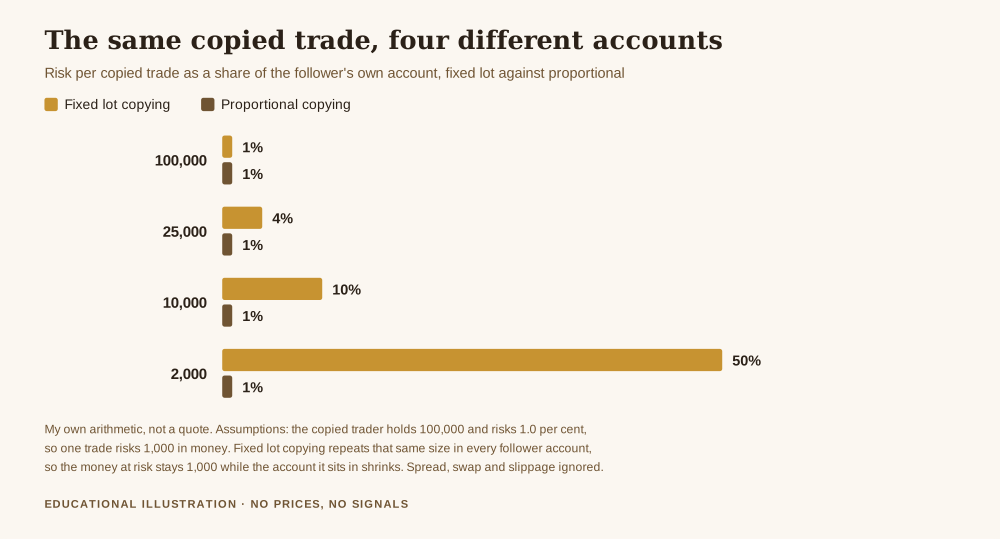
Take a copied trader with 100,000 in the account who risks 1.0 per cent on a position. That is 1,000 of money at risk. Now have that trade copied into follower accounts of different sizes, with the copy setting on a fixed lot, meaning the same position size is repeated regardless of who is receiving it. The money at risk stays at 1,000. The account it is sitting in does not.
- A 100,000 follower account. 1,000 of 100,000 is 1.0 per cent. Identical to the leader.
- A 25,000 follower account. 1,000 of 25,000 is 4.0 per cent.
- A 10,000 follower account. 1,000 of 10,000 is 10.0 per cent.
- A 2,000 follower account. 1,000 of 2,000 is 50.0 per cent. One trade.
Those are computed, not quoted, and the assumptions are stated so you can redo them with your own figures: the leader’s size and risk held constant, fixed lot copying rather than proportional, and spread, swap and slippage ignored, all of which make the small accounts slightly worse rather than better. The ratio between the first and the last is 50. The same decision, taken by the same person, on the same instrument, at the same moment, is a routine 1 per cent event for one follower and a halving for another.
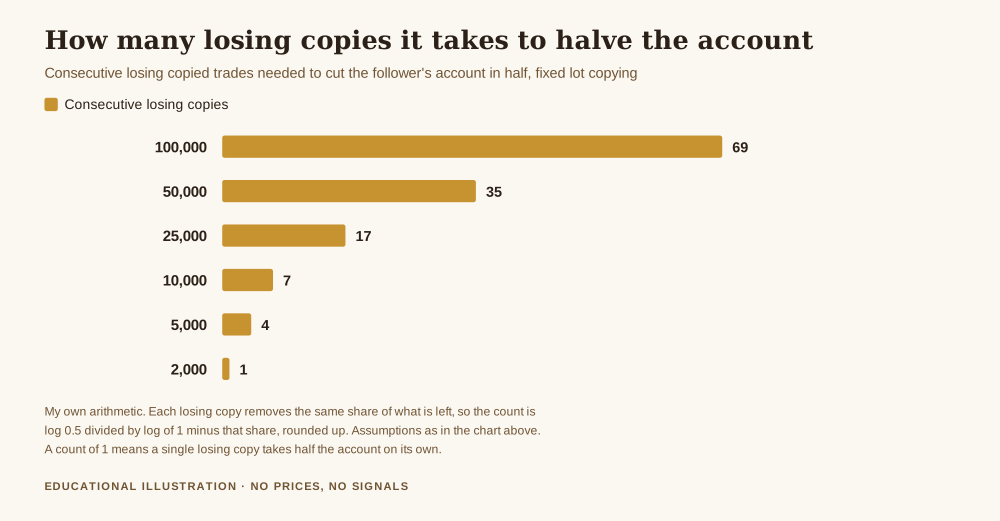
The second chart puts the same point in the unit that actually governs survival, which is how many of these in a row you can take. Each losing copy removes the same share of whatever is left, so the count needed to halve an account is log 0.5 divided by the log of 1 minus that share, rounded up. At 1.0 per cent it takes 69 consecutive losing copies to halve the account. At 4.0 per cent it takes 17. At 10.0 per cent it takes 7. At 50.0 per cent it takes one.
Set the copy mode to proportional and every one of those accounts carries the leader’s 1.0 per cent instead, which is the dark bar sitting flat across the first chart. That single setting, buried in a configuration screen, does more to determine your outcome than the identity of the person you chose to follow. It is also the part of the decision that is entirely yours, which makes it the part worth most of your attention.
It explains the reader I quoted at the start, too. When somebody says the signals are good but their account keeps going down, the usual assumption is that they executed badly. Often they executed fine. They were sized so that the leader’s ordinary week was their catastrophe.
Get the free Gold Empire survival sheet, a one-page guide to protecting your account through the kind of market this article describes. One email, no spam, unsubscribe anytime.
Frequently asked questions
What is social trading in plain language?
It is an arrangement where another person’s trading decisions reach your account, either automatically or after you approve each one. The umbrella covers a social feed you read and act on yourself, a signal service you subscribe to, copy trading that mirrors positions automatically, and managed account structures where somebody trades on your behalf. They look similar on a screen and they are different products with different rules attached, which is why the first useful step is working out which one you are actually in.
Is copy trading the same thing as having somebody manage my money?
Often yes, in substance. ESMA’s briefing points to its 2012 conclusion that where a firm executes orders from signal providers chosen by the client with no further intervention from the client, that requires authorisation for portfolio management. Where you have to act before each transaction, it is not portfolio management, though it may be investment advice or order execution. The practical test is whether trades appear in your account while you are asleep.
Does a long track record on a leaderboard mean the trader is qualified?
It is not the same question. Article 25(1) of MiFID II is about knowledge and competence being ensured and demonstrated, and ESMA’s briefing says copied traders would need the competence required for the service provided, with firms having procedures to check it. A leaderboard reports past outcomes and typically drops the people who did badly. You can have a good ranking without anyone ever having assessed you, so ask the firm what assessment it does.
Why did I lose money copying a profitable trader?
The most common mechanical reason is position sizing. Under fixed lot copying the money at risk per trade is the same in every follower account, so the percentage of your account at risk rises as your account gets smaller. On the assumptions set out above, a trade that risks 1.0 per cent of a 100,000 account risks 50 per cent of a 2,000 account. Spread, swap, slippage and a delay between the leader’s fill and yours all add to the gap. None of this requires the leader to have been wrong.
Which setting should I check first?
Whether copying is proportional to your equity or a fixed size, because that one choice decides whether you inherit the leader’s risk profile or a magnified version of it. After that, look at what the service does when you have less free margin than the copied position needs, and at whether you can close a copied position yourself without the system reopening it. None of that is a recommendation to use these products, it is the list of facts worth establishing before you do.
Where this leaves you
Gold Empire is free to follow and stays free. The daily work writes out the reasoning rather than a number to copy, there is a free survival sheet for anyone who wants the capital protection material in one place, and there is an optional kit for people who want the longer version. Nothing here promises a return, because nobody can promise you one, and nothing here recommends or warns against any particular platform, firm or person.
The foundation under this article is risk management in gold trading. Next to it, the mechanics of the copying itself are in how to use copy trading in forex, the managed account version of the same idea is in what PAMM accounts are, the question of whether the groups selling these calls are what they claim is in are forex signal groups legit, and the reason a leaderboard is weak evidence is in how to spot fake trading profit screenshots.
Outside sources used here: the business models, the four relationship types, the qualification of the service under Article 4(1)(8) of MiFID II, the 2012 conclusion on signal providers requiring portfolio management authorisation, the observation that a firm with a direct link to copied traders is highly unlikely to be providing execution only, and the competence expectations under Article 25(1), are all from the European Securities and Markets Authority supervisory briefing ESMA35-42-1428, published 30 March 2023, with ESMA’s own announcement of the guidance alongside it. Every percentage and count in the worked example is computed from the assumptions stated in the text, so you can reproduce it with your own figures.
About the author. Matthew writes Gold Empire and spends most of his time on the unglamorous half of this job, which is making sure an account is still there next year. He reads the service agreement before the leaderboard, on the theory that the ranking is marketing and the agreement is the thing you are actually signing. The regulatory material here is quoted from the ESMA briefing linked above and the arithmetic is computed from the assumptions stated in the text so you can repeat it with your own numbers, the account sizes are illustrative of a mechanic rather than figures from any particular venue, this article is educational and is not investment, legal or tax advice, nothing in it recommends or warns against any specific firm, platform, instrument or person, and no entry, stop or target discussed should be treated as a signal.
One step first
Where should we send the Gold Survival Sheet?
Leave your email and we will send the free one page checklist, then take you straight to the Telegram channel.
No cost and no obligation. Educational only, not financial advice, and nothing here promises a return. Unsubscribe any time in one click.
Leave a Reply