

If you have spent any time watching a gold chart, you have probably heard traders throw around the phrase “break of structure” as if everyone already knows what it means. They say it fast, they say it with confidence, and they rarely stop to explain it. That leaves a lot of newer traders nodding along while quietly wondering what actually just happened on the screen.
My name is Matthew, and at Gold Empire I spend most of my time helping people slow down and understand the mechanics before they ever think about clicking a button. Break of structure, often shortened to BOS, is one of those ideas that sounds complicated but is really just a way of describing how a market moves. Once you see it clearly, a gold chart starts to look less like random noise and more like a story with a rhythm you can follow.
In this article I want to walk you through what break of structure means, how it connects to the idea of market structure and change of character, and why disciplined traders treat it as context rather than a magic signal. This is an educational explainer, so we will keep the focus on understanding, not on chasing a specific trade.
First, what do we mean by market structure?
Before we can talk about a break, we need to agree on what is being broken. Market structure is simply the pattern of highs and lows that price leaves behind as it moves. Think of it like footprints in the sand. Each swing up creates a high, each pullback creates a low, and together they tell you the direction the market has been leaning.
When gold is trending up, it tends to make a series of higher highs and higher lows. Price pushes up, pulls back but not all the way down, then pushes up again to a new peak. When gold is trending down, you see the mirror image: lower highs and lower lows, like steps walking downstairs. When neither pattern is clean, the market is usually ranging, which is just a polite way of saying it is undecided.
Learning to read this rhythm is a foundational skill, and it pairs closely with knowing how to read a gold chart with a clear head. The structure is always there. Your job is to notice it without letting your hopes color what you see.
Higher highs and higher lows in plain language
Let me make this concrete. Imagine gold rallies to a peak, then eases back a little. That peak is a swing high. Then it dips to a low point before turning back up. That dip is a swing low. If the next rally climbs above the previous peak, you have a higher high. If the next dip stops above the previous dip, you have a higher low.
Stack a few of these together and you have the skeleton of an uptrend. The market is saying, in its own quiet way, that buyers keep showing up a little earlier and pushing a little further each time. Nothing about this guarantees the trend continues. It simply describes what has happened so far, which is all any chart can ever honestly tell you.
So what is a break of structure?
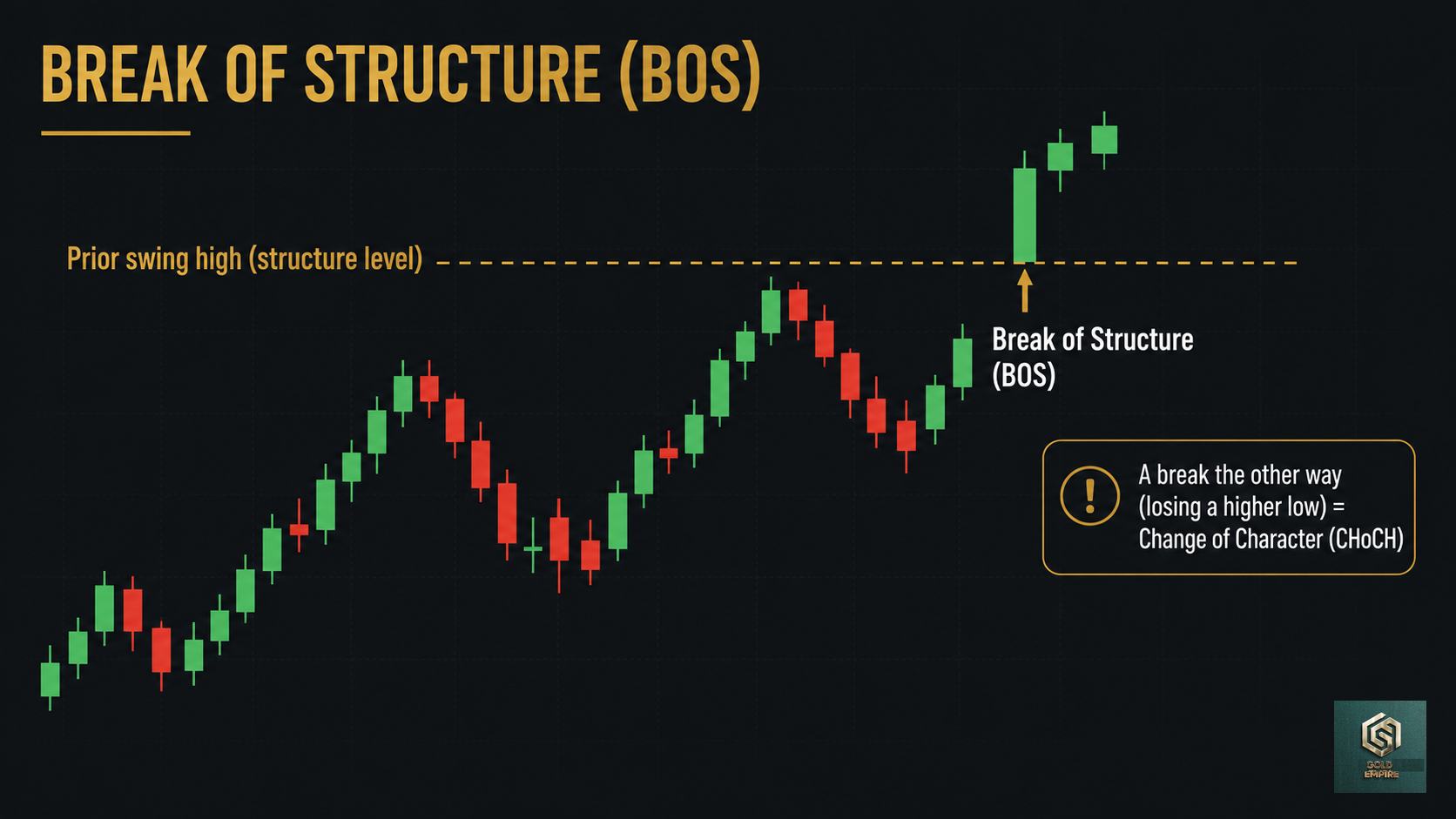
A break of structure happens when price moves through and closes beyond a meaningful prior swing point, confirming that the existing rhythm has continued or shifted. In an uptrend, a break of structure is usually when price closes above the most recent prior swing high. That break says the pattern of higher highs is still intact and the trend has stretched a little further.
The key word there is “closes.” A wick that pokes above a level and snaps back is not the same as a candle that closes cleanly beyond it. Many newer traders get caught watching price tap a level for a split second and assume the structure has broken, when really the market just brushed against it and retreated. Waiting for a close is one small discipline that filters out a lot of noise.
It helps to think of break of structure as confirmation of a story you were already reading, not as a surprise plot twist. If gold has been climbing with higher highs and higher lows, a fresh break above the last high is the market continuing its sentence. It is punctuation, not prophecy.
Break of structure versus change of character
This is where a lot of confusion lives, so let us separate the two carefully. A break of structure confirms the current trend is continuing. A change of character, often written as CHoCH, is the first hint that the trend might be shifting.
Here is the difference in practice. In an uptrend, price keeps making higher highs and higher lows. As long as it breaks above prior highs, that is break of structure in the direction of the trend. But the first time price fails to hold and instead breaks below a recent higher low, the character of the market has changed. Buyers who were reliably stepping in have gone quiet. That early warning is the change of character.
Think of it like a friend who is usually cheerful. Break of structure is them staying cheerful day after day. Change of character is the first morning they show up unusually quiet. It does not tell you the whole story, but it is worth noticing. Neither event is an instruction to act. Both are pieces of information you fold into a wider read of the market.
Why a broken level matters at all
You might reasonably ask why traders care so much about these levels. The honest answer is that these swing highs and lows are places where a lot of other market participants are watching, remembering, and making decisions. A prior swing high is not magic, but it is a spot where earlier buyers and sellers left orders, emotions, and expectations.
When price approaches such a level, activity often clusters there. That is also why levels connect so closely to the idea of liquidity. If you want to go deeper on how price sometimes runs past a level to trigger orders before reversing, our explainer on what is a liquidity sweep is a useful companion read. Structure and liquidity are two lenses on the same underlying human behavior.
If you find these breakdowns useful, you are welcome in the free Gold Empire community. We share calm, education-first notes on how gold moves over on our free Telegram channel, and you can grab our free starter Kit to keep these structure concepts handy while you practice. No pressure and no hype, just a place to keep learning at your own pace.
How disciplined traders actually use break of structure
Here is the part I most want you to remember. A break of structure is context, not a trigger. It is a piece of the puzzle that tells you which way the market has been leaning, so you can frame your thinking. It is not a green light that says “act now.”
A disciplined trader treats a break of structure the way a sailor treats the wind direction. Knowing the wind is blowing north does not mean you raise every sail and charge ahead. It just informs your plan. You still check your instruments, your risk, and your conditions before you commit to anything.
In practice, that means a break of structure might tell you that you would only consider ideas aligned with the trend, and that you would ignore setups fighting against it. It helps you say no more often, which is quietly one of the most valuable skills in trading. The best decisions a trader makes are often the trades they choose to skip, and structure gives you a principled reason to skip.
Common mistakes: false breaks, wicks, and liquidity traps
Break of structure is a clean idea in theory and a messy one in practice, so let us name the traps honestly. The most common is the false break, sometimes called a fakeout. Price pushes just past a prior high, pulls in a wave of eager traders, then reverses and leaves them stranded. This is not the market being cruel. It is simply how liquidity gets collected around obvious levels.
A second mistake is reacting to wicks instead of closes. As I mentioned earlier, a candle that closes beyond a level carries more weight than one that briefly stabs through and retreats. Patience here is not glamorous, but it protects you from a lot of avoidable frustration.
A third mistake is treating every tiny bump as a structural break. On a low timeframe, price makes countless little highs and lows, and if you label each one as a break of structure you will exhaust yourself and see signals everywhere. Zooming out to a higher timeframe usually reveals the structure that actually matters and quiets the noise below it.
The thread connecting all three mistakes is impatience. False breaks, wick reactions, and over-labeling all come from wanting the market to confirm our story faster than it is willing to. Slowing down is the cure for most of them.
Where break of structure fits inside risk management
Even a perfectly read break of structure means very little without a plan for what happens if you are wrong. This is the heart of the matter. Structure tells you about direction and context. Risk management tells you how much of your account you are willing to expose to any single idea, and it is the part that actually keeps you in the game over the long run.
No chart pattern removes uncertainty. A break of structure can look textbook and still fail, because markets are made of people and people are unpredictable. That is precisely why the professionals I respect spend far more energy on sizing, on defining their exit before they enter, and on protecting their capital than they do on hunting the perfect signal. If there is one topic to master before any of this, it is risk management for gold trading.
Part of that groundwork is also practical setup, like understanding choosing a broker for gold trading so that spreads and conditions do not quietly work against your process. These structural concepts only matter once the foundation beneath them is sound. Structure sits on top of risk management, never the other way around.
Get the free Gold Empire survival sheet, a one-page guide to protecting your account through the kind of market this article describes. One email, no spam, unsubscribe anytime.
Frequently Asked Questions
What is the difference between BOS and CHoCH?
A break of structure, or BOS, confirms that the current trend is continuing, for example price making a new higher high in an uptrend. A change of character, or CHoCH, is the first sign the trend might be shifting, such as price breaking below a recent higher low. BOS is continuation, CHoCH is a possible turning point. Neither is an instruction to trade.
What timeframe should I use to spot break of structure?
There is no single correct timeframe. Break of structure exists on every timeframe, from the one minute chart to the weekly. Newer traders often find that higher timeframes, like the four hour or daily, show cleaner and more meaningful structure with less noise. Many traders read the bigger picture on a higher timeframe first, then look at lower timeframes for detail. The point is consistency, not a magic setting.
Is a break of structure a buy or sell signal?
No. This is the most important thing to understand. A break of structure is context, not a signal. It tells you which way the market has been leaning so you can frame your thinking, but it does not tell you to act. Treating it as an automatic entry is one of the fastest ways to get caught in false breaks. Always fold it into a wider plan that puts risk first.
Does break of structure work on gold specifically?
Break of structure is a general concept about how any market moves, so it applies to gold the same way it applies to other instruments. Gold can be fast and news-sensitive, which sometimes produces sharp false breaks around obvious levels, so patience and confirmation matter even more. The concept is not unique to gold, but it is very readable on a gold chart once you practice.
Can beginners use break of structure right away?
You can start learning to spot it immediately, and studying charts to identify structure is a great, low-pressure exercise. What beginners should not do is rush to trade off it in isolation. Spend time simply marking highs and lows and watching how breaks play out before you ever risk real money. Understanding comes first, action comes much later, and only alongside solid risk habits.
About the Author
Matthew runs Gold Empire, where he writes plain-spoken guides to help newer gold traders build a calm, rules-first process. His focus is teaching the mechanics of how markets move and the discipline that keeps traders steady, rather than chasing quick outcomes. He believes the least dramatic parts of trading, patience, risk management, and honest self-assessment, are the parts that matter most, and he tries to write the way he would explain things to a friend across the table. If you are just getting started and want to open an account carefully, his walkthrough on how to open a gold trading account is a steady place to begin.
No entry, stop or target discussed should be treated as a signal.
This article is for educational purposes only and is not financial advice. Nothing here is a recommendation to buy or sell any instrument. Trading gold and CFDs carries a substantial risk of loss and is not suitable for everyone. You could lose some or all of your capital. Always do your own research and consider seeking guidance from a licensed professional before making any financial decision.
One step first
Where should we send the Gold Survival Sheet?
Leave your email and we will send the free one page checklist, then take you straight to the Telegram channel.
No cost and no obligation. Educational only, not financial advice, and nothing here promises a return. Unsubscribe any time in one click.
Leave a Reply