
If you spend enough time watching gold, you will notice something that looks almost like a scar on the chart. Price races in one direction, three candles fire off in quick succession, and then a little untraded pocket is left behind in the middle of the move. Traders call that pocket a Fair Value Gap, or FVG for short. Some also call it an imbalance. It is one of the most talked about ideas in modern price action, and also one of the most misunderstood.
Today was a good reminder of why this matters. Gold moved fast on news-driven, safe-haven flows, the kind of session where buyers and sellers are not calmly taking turns but stampeding through each other. When price travels that quickly, it leaves gaps in its wake. And the temptation, especially for newer traders, is to chase the move while it is still running hot. The calmer path is to understand what those gaps are, why price so often drifts back toward them, and how to wait for a healthy retracement instead of jumping on a candle that has already told most of its story.
So let us slow this down. In this guide I want to teach you the mechanics of a Fair Value Gap in plain language, show you a simple diagram, and, more importantly, show you how a disciplined trader treats an FVG as context rather than a magic button. No hype, no promises. Just the how and the why.
What an imbalance actually is
Under normal conditions, a market breathes. Buyers and sellers meet at nearly every price on the way up or down, and each level gets a fair amount of trading. We could say the auction is balanced, because both sides had a chance to do business.
An imbalance is what happens when that fairness breaks. One side becomes so aggressive that price skips through a range of levels almost instantly. Think of a crowded room where someone shouts fire. People do not calmly walk out in an orderly line. They surge, and a whole section of the room empties in a blink. In market terms, a band of prices gets very little two-sided trading because one side simply overwhelmed the other. That thin, skipped-over band is the Fair Value Gap.
The word fair is doing a lot of work here. The idea is that the market did not spend enough time in that zone to establish a fair, agreed-upon value. Many traders believe the market has a quiet tendency to revisit those zones later, as if to finish the business it rushed through the first time. Notice I said tendency, not law. We will come back to that, because it is the single most important nuance in this whole topic.
The three-candle pattern that creates the gap
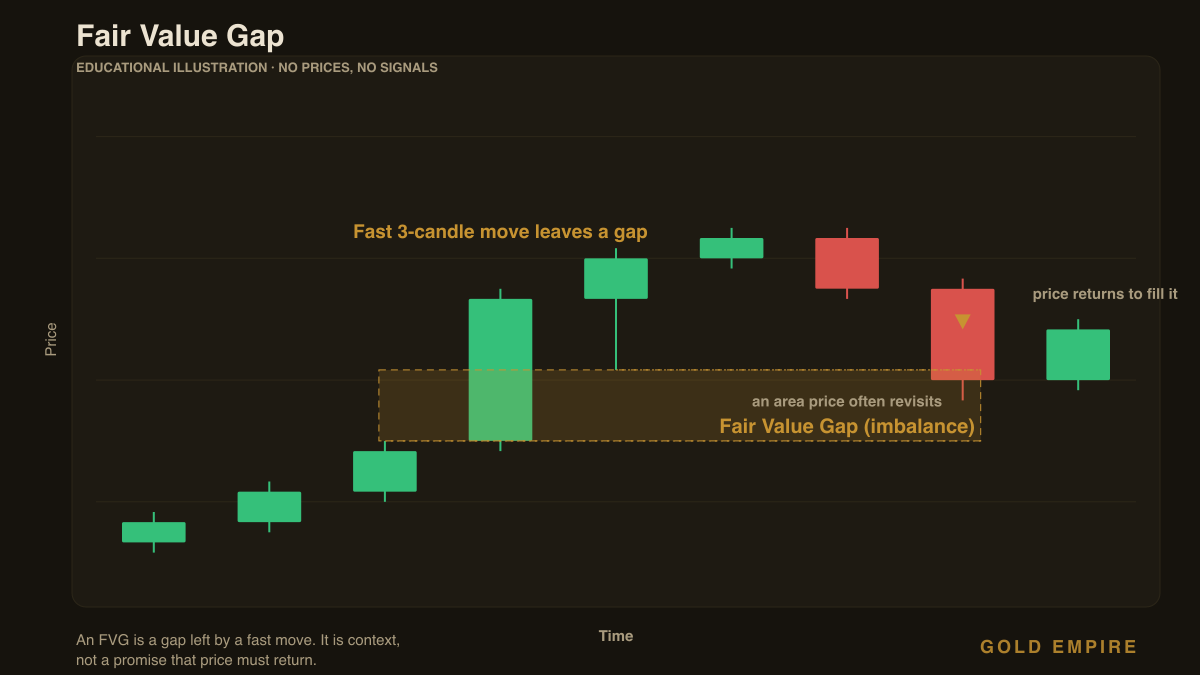
Here is the mechanical part, and it is simpler than it sounds. A Fair Value Gap is usually defined across three consecutive candles during a strong move.
- Candle 1 is the starting candle. We care about one edge of it. In a strong move up, we care about its high.
- Candle 2 is the big, fast candle. This is the surge, the one that does most of the traveling.
- Candle 3 is the candle that follows. In a strong move up, we care about its low.
The gap exists when the high of candle 1 and the low of candle 3 do not overlap. There is clean air between them. That untraded space, the band the market leapt over during candle 2, is the imbalance. In a strong move down, you flip it: you look at the low of candle 1 and the high of candle 3, and the gap sits in the space between them.
That is really all there is to spotting one. You are not measuring anything exotic. You are simply asking, did price move so fast that it left a pocket where the neighboring candles never traded. If the answer is yes, you have found a Fair Value Gap. The diagram above shows exactly this shape: three candles, a shaded pocket in the middle, and an arrow hinting at what often comes next.
Why price so often returns to fill it
This is the part that fascinates people, and it deserves an honest explanation rather than a mystical one.
When a market rips through a zone in a single aggressive candle, a lot of business is left unfinished. Some buyers wanted in but the move left without them. Some sellers got run over and would like a second chance to exit closer to where they were caught. There can also be resting orders in that skipped band that were never touched. All of that creates a kind of magnetic pull. When the initial burst of energy fades, price often drifts back toward the gap, giving both sides the chance they missed. Traders describe this as price returning to fill the gap or to rebalance.
There is also a plainer reason. Fast moves driven by a burst of news or emotion are, by nature, not fully considered. Once the headline is digested and the panic or excitement cools, the market frequently reconsiders and retraces part of the move. That retracement can carry price straight back through the imbalance. This is exactly the healthy retracement I mentioned at the start, the pullback a patient trader waits for instead of chasing the first violent candle.
But please hold this loosely. A gap filling is a tendency the market shows often, not a promise it keeps every time. In a genuinely strong trend, price can leave a gap unfilled for a long stretch, or never come back to it at all. Building your whole plan on the certainty of a fill is how disciplined thinking quietly turns into wishful thinking.
Fair Value Gap versus a normal price gap
People sometimes confuse an FVG with the classic weekend or session gap, so let us separate them cleanly.
A normal gap is a break in price between one candle closing and the next one opening, usually because the market was closed while news happened. Gold might close Friday at one area and open Sunday somewhere quite different, leaving a literal blank space on the chart. That is a gap in trading time.
A Fair Value Gap is different. It forms during live, continuous trading. Price never stopped. It simply moved so fast that the candles on either side of the surge do not overlap, leaving an untraded pocket inside an otherwise unbroken sequence. So a normal gap is about the market being closed, while an FVG is about the market being violently one-sided while fully open. Both leave a visible space, but they are born from different causes, and treating them as the same thing will muddle your reading.
How FVGs relate to liquidity and market structure
An imbalance never lives in a vacuum, and this is where beginners and more seasoned traders part ways. A gap on its own is just a shape. Its meaning comes from where it sits.
Start with structure. If the broader trend is clearly pushing higher and price pulls back into a Fair Value Gap that formed on the way up, that gap is sitting in a spot that agrees with the larger flow. If instead you find a tiny gap on a one-minute chart that points against a strong daily trend, it carries far less weight. Context is everything, which is why understanding a break of structure gives an FVG its real significance. The gap tells you where; structure tells you whether that where is worth caring about.
Then there is liquidity. Fast moves are often triggered when the market grabs a pool of orders resting above or below an obvious level, then reverses or accelerates. That grab and the surge behind it are frequently what create the imbalance in the first place. If you want to see how those two ideas connect, it is worth understanding what is a liquidity sweep, because a sweep and an FVG often appear in the same breath. One explains the fuel; the other marks the trail it left behind.
The lesson is that a Fair Value Gap is a piece of a larger sentence, not a complete thought. Read it alongside the higher timeframe, the direction of structure, and where liquidity likely sat. On its own it is a hint. In context it becomes information.
How disciplined traders use an FVG as context, not a trigger
Here is the heart of everything, and the part I care about most as a mentor. An FVG is a where, not a when, and it is certainly not a because.
A disciplined trader does not see a gap and immediately act. They use it to narrow their attention. The gap might mark a zone worth watching if price returns to it. But arriving at that zone is not a reason to do anything by itself. The trader still wants to see how price behaves when it gets there, still checks that the higher timeframe agrees, still respects a plan written in advance with defined risk. The gap sets the stage. It does not read the lines.
This is also where reading the chart with a steady mind matters more than any single pattern. It is easy to force gaps onto a chart when you are emotional, seeing an imbalance in every wiggle because you badly want a reason to click. Learning how to read a gold chart with a clear head will do more for you than memorizing ten more patterns. And none of this replaces the real foundation, which is risk management for gold trading. A Fair Value Gap can sharpen your attention, but only your risk plan protects your account when a tendency does not play out.
An imbalance shows you where the market rushed. It does not tell you what to do next. That decision still belongs to your plan, your patience, and your risk limits.
Common mistakes to avoid
Since I have watched a lot of newer traders meet this idea for the first time, let me flag the traps that catch most of them.
- Treating every gap as a guaranteed reversal. A gap is a zone of interest, not a stop sign. Price can push right through an imbalance, especially in a strong trend. Expecting a clean bounce every time is a fast way to fight the market.
- Ignoring the higher timeframe. A gap on a tiny timeframe can look convincing while pointing straight into a much larger trend. If you only zoom in, you will keep taking positions against the bigger flow and wondering why they get run over.
- Chasing the surge instead of waiting. The whole point of understanding gaps is patience. When gold sprints on news, the disciplined move is usually to wait for a healthy retracement, not to leap onto a candle that has already done most of its traveling.
- Seeing gaps everywhere. Once you learn the pattern, your brain wants to find it constantly. Not every three-candle sequence is a meaningful imbalance. Quality and location matter far more than quantity.
- Skipping risk entirely. No concept, gaps included, removes the need to define what you are willing to lose before you act. The pattern is never the safety net. Your risk plan is.
A calmer place to keep learning
If this way of thinking feels like a relief rather than a shortcut, you are in the right frame of mind. I run a free Gold Empire community where we talk about gold in exactly this tone: mechanics first, patience over hype, process over predictions. There is no pressure and nothing to prove.
You are welcome to join the free Gold Empire Telegram and simply read for a while. You can also grab our free starter Kit, a short, plain-spoken resource for newer gold traders who want to build a calm, rules-first routine. Take what is useful and leave the rest. The goal is not to make you trade more. It is to help you trade with a clearer head.
Get the free Gold Empire survival sheet, a one-page guide to protecting your account through the kind of market this article describes. One email, no spam, unsubscribe anytime.
Frequently Asked Questions
What is a Fair Value Gap in simple terms?
It is a small untraded pocket left on the chart when price moves so fast that three consecutive candles do not fully overlap. That skipped-over band is called an imbalance or Fair Value Gap, and many traders watch it as a zone the market may revisit later.
Does a Fair Value Gap always get filled?
No. Filling a gap is a tendency the market shows often, not a rule it always follows. In a strong trend, price can leave an imbalance untouched for a long time or never return to it. Treat a fill as something that frequently happens, never as something guaranteed.
What is the difference between a Fair Value Gap and an order block?
They are related but not identical. A Fair Value Gap is the untraded space left by a fast move. An order block usually refers to the specific candle or zone from which a strong move began. Traders often look at them together, but a gap describes the skipped range while an order block describes the origin of the push.
What timeframe should I look at for FVGs?
There is no single correct answer, but the higher timeframe almost always sets the context. A gap that agrees with the direction of the daily or four-hour trend carries more weight than a tiny gap on a one-minute chart that points against the larger flow. Always read the smaller gap in light of the bigger picture.
Is a Fair Value Gap a buy or sell signal?
No. An FVG is context, not a trigger. It can highlight a zone worth watching, but it does not tell you to buy or sell on its own. Any decision still depends on structure, the higher timeframe, how price actually behaves, and a plan with defined risk written in advance.
About the Author
Matthew runs Gold Empire, where he helps newer gold traders build a calm, rules-first process instead of chasing every fast move. His focus is on mechanics, patience, and risk discipline, explained in plain language for people who are still finding their footing. He makes no performance claims. His only aim is to help traders think more clearly about the charts in front of them.
No entry, stop or target discussed should be treated as a signal.
Disclaimer: This article is for educational purposes only and is not financial advice. Nothing here is a recommendation to buy or sell any instrument. Trading gold and CFDs carries a substantial risk of loss and is not suitable for everyone. Never risk money you cannot afford to lose, and consider seeking guidance from a licensed professional before making any trading decision.
One step first
Where should we send the Gold Survival Sheet?
Leave your email and we will send the free one page checklist, then take you straight to the Telegram channel.
No cost and no obligation. Educational only, not financial advice, and nothing here promises a return. Unsubscribe any time in one click.
Leave a Reply