
Most of the questions I get about how to trade gold with small account balances assume the problem is strategy. People believe that a $200 account needs a sharper method than a $20,000 account, some tighter, cleverer way of reading the chart that makes up for the missing money. It does not. The percentages behave identically at every account size. What actually changes on a small balance is something far more boring and far more binding, and almost nobody mentions it, because it is arithmetic rather than analysis.
The constraint is this: your broker will not let you trade a position small enough to obey your own risk rule. Below a certain balance, the smallest trade you are permitted to place already risks more of your account than you intended to risk. No amount of discipline fixes that, because the discipline is not the thing failing. The platform’s minimum order size is.
This article works through that floor with numbers you can recalculate, then covers what leverage does and does not do for you, and finishes with the four honest options available when the floor binds. To be clear from the start: no entry, stop or target discussed should be treated as a signal.
What a small balance actually changes
Start by clearing away the thing that does not change.
Percentage risk is scale free. Risking 1 percent of $500 and 1 percent of $50,000 are the same decision expressed in different currency amounts. A ten trade losing streak hurts an account by the same percentage either way. The recovery arithmetic is identical. In that sense a small account is not more dangerous, and anybody telling you that small accounts are inherently doomed is skipping a step.
What does change is granularity. Gold is quoted per troy ounce, a convention you can see in the LBMA precious metal price data, and the standard contract most brokers build on is 100 troy ounces. The common minimum most retail platforms allow is one hundredth of that, usually written as 0.01 lots, which is one troy ounce. At one ounce, a one dollar move in the gold price is one dollar of profit or loss. That is the smallest unit of exposure the platform will sell you.
So your risk per trade is not a dial you can turn continuously. It comes in steps, and on a small account the first step is already large relative to the balance.
How to trade gold with small account balances starts with the minimum lot
Here is the calculation that decides everything else, and it needs no forecast and no view on gold.
Your risk on a trade is the size of your position multiplied by the distance to your stop. At the minimum size of one ounce, your position multiplier is fixed at one. So your risk in dollars simply equals your stop distance in dollars per ounce. A $5 stop risks $5. An $8 stop risks $8. There is no way to risk less, because there is no smaller position to take.
Now express that as a percentage of different account balances.
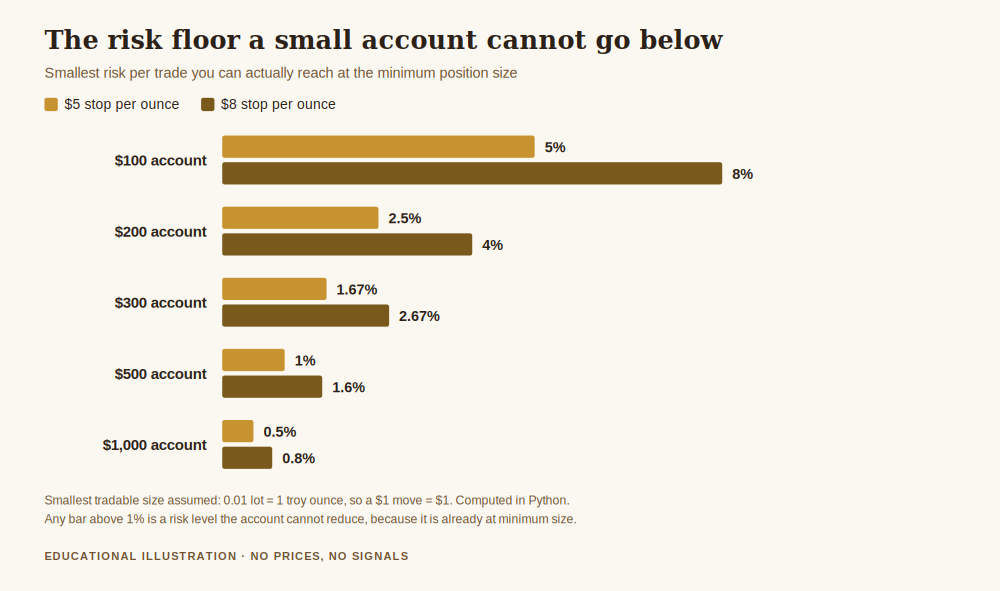
A $100 account taking a $5 stop is risking 5 percent of everything it has, on the smallest trade the platform allows. Widen the stop to $8, which is not an unusual distance on gold, and that becomes 8 percent. A $200 account is at 2.5 percent and 4 percent respectively. Only at $500 does the $5 stop finally land on 1 percent.
The general rule falls straight out of it. To keep risk at or under 1 percent per trade at minimum size, you need an account of at least one hundred times your stop distance in dollars per ounce:
- A $3 stop needs about $300.
- A $5 stop needs about $500.
- An $8 stop needs about $800.
- A $12 stop needs about $1,200.
I calculated these in Python and the assumptions are all on the table: minimum size of 0.01 lots equals one troy ounce, one dollar of price movement equals one dollar per ounce, and no commission included. Change the minimum size your broker offers and the whole table shifts. That is the point. These are not laws of nature, they are the consequences of a contract specification, and you can look yours up in ten minutes.
Notice what this does to the usual advice. “Risk one percent” is excellent guidance that quietly assumes you are able to. Under roughly $500, with a normal gold stop, you are not able to. The advice does not become wrong, it becomes unreachable, and the gap between the two is where a lot of small accounts quietly die while their owners believe they are following the rules.
Leverage is not the lever you think it is
The instinctive response to a small balance is to reach for more leverage, and this is worth being precise about, because the reasoning behind it is usually backwards.
Leverage determines how much margin the broker sets aside to hold your position. It does not determine how much you lose when price moves against you. Your loss is decided by position size and stop distance, both of which you chose before leverage entered the conversation. Two traders with identical positions and identical stops lose identical amounts whether one is at 20:1 and the other at 500:1. The higher leverage account simply had more of its balance left free while the trade was open. I have written about this at more length in what leverage in gold trading actually is, because it is the single most misunderstood number on the platform.
What leverage genuinely changes is how much rope you have to hang yourself with. It raises the ceiling on the size you are permitted to take, and on a small account the temptation to use that ceiling is strongest, because it is the only apparent route to a meaningful return.
Regulators reached the same conclusion from the other direction. When the European Securities and Markets Authority reviewed retail trading in leveraged products, it capped retail leverage on gold at 20:1 and paired it with two structural protections: a margin close out rule that forces positions shut when account equity falls to 50 percent of the minimum required margin, and negative balance protection so a retail client cannot end up owing the broker money.
Read that margin close out rule carefully if you hold a small account, because it is the mechanism that will actually end you. You do not get to ride a position all the way to zero and hope. The system intervenes at a threshold, and on a small balance with a large position, the distance to that threshold is short. The protection is real and I am glad it exists, but its existence tells you what regulators expected to happen often enough to legislate for.
The survival arithmetic under a forced risk level
Once you know the risk percentage the floor forces on you, you can work out how much room for error you have bought. I ran the same simple loop for three balances, all at a $5 stop and minimum size, counting how many consecutive full stop losses it takes to cut the account in half:
- A $200 account is forced to 2.5 percent per trade, and loses half its balance after 20 straight losses.
- A $500 account reaches 1 percent, and needs 50 straight losses.
- A $1,000 account reaches 0.5 percent, and needs 100.
Twenty consecutive losses sounds impossible until you remember that a beginner changing method every week is effectively taking random trades, and that a run of twenty is not remotely rare across a few hundred attempts. The $500 account is not twice as safe as the $200 one. In terms of how many mistakes it can absorb while you are still learning, it is two and a half times as safe, and that ratio compounds with every extra dollar of funding until the minimum lot stops binding at all.
This is also why I keep pointing people at position sizing for gold before anything else, and why risk management sits underneath every other article on this site. Size is the only input in the whole chain that you control completely and that the market cannot argue with.
The four honest options when the floor binds
If the arithmetic above says your balance cannot support a sane risk level, you have four real choices. I am going to be blunt about the trade-offs in each, because the usual answer is to pretend the problem does not exist.
One: fund the account to where the rule becomes reachable. Multiply your realistic stop distance by 100 and that is your target balance. This is the cleanest fix and often the least popular, because it means waiting. If the difference is a few hundred dollars, waiting two months is a genuinely better trade than any setup you will take this week. It is worth reading how much money you actually need to start trading gold alongside this, since the two questions are the same question asked from opposite ends.
Two: find a broker that offers a smaller minimum. Some platforms allow 0.001 lots, a tenth of an ounce, which drops the floor by a factor of ten and makes a $100 account workable on paper. Check this before you deposit rather than after, and check it against the same broker’s other terms, because a tiny minimum size attached to a wide spread or an unregulated entity is not a bargain. The process for vetting that is in how to open a gold trading account.
Three: trade a shorter stop distance, with your eyes open. Halving your stop halves your dollar risk at fixed size, which does move the floor. But a stop is not a free parameter. It should sit where your idea is proven wrong, and moving it closer to entry for accounting reasons means you will be stopped out of trades that were working. You are trading one problem for another, and the second one is harder to see because it shows up as a series of small losses rather than one large one.
Four: accept a higher risk percentage deliberately, and cap the damage elsewhere. If you decide a $200 account will risk 2.5 percent per trade because that is the floor, then the compensating control has to be frequency and a hard stop on the month. Deciding in advance that four losses in a row ends your week is a real constraint, and it is the only one available once size is maxed out at the minimum. What makes this option survivable is that you set it while calm, in writing, before the first trade.
What I would not do is the fifth option nobody lists, which is to take the forced 5 percent risk and simply not think about it. That is how a small account becomes a story about how trading does not work.
The costs that do hit a small account harder
One correction to a common belief, since I want this to be accurate rather than just reassuring.
Dealing costs scale with position size, so the spread you pay is the same percentage of your account whether you trade one ounce or one hundred. Frequency multiplies it identically at every balance. On that dimension, small accounts are not penalised.
Fixed fees are the exception, and they are brutal on small balances precisely because they do not scale. An inactivity fee, a withdrawal charge, or a fixed minimum commission per ticket is a rounding error on $20,000 and a serious tax on $200. A $10 monthly inactivity fee is 5 percent of a $200 account per month, which is more than most traders make in a good month. Read the fee schedule, and look specifically for the charges quoted in currency rather than percentages. Those are the ones aimed at you.
Get the free Gold Empire survival sheet, a one-page guide to protecting your account through the kind of market this article describes. One email, no spam, unsubscribe anytime.
Frequently asked questions
What is the minimum realistic balance for trading gold?
It depends entirely on your stop distance and your broker’s minimum position size, not on a round number somebody quotes. With a standard 0.01 lot minimum and a $5 stop, roughly $500 is where a 1 percent risk rule becomes reachable. With a broker offering 0.001 lots the same rule works from about $50. Work out your own figure by multiplying your typical stop distance in dollars by 100.
Can I just use higher leverage to trade gold with a small account?
Higher leverage does not reduce your loss on a losing trade, it only frees up margin while the position is open. Your loss is position size multiplied by stop distance, and leverage appears nowhere in that calculation. What higher leverage does is permit larger positions, which on a small account is the fastest available route to a serious loss.
Does a small account need a different strategy?
No. The percentage arithmetic is identical at every balance. What a small account needs is an honest check that its risk rule is actually achievable at the minimum position size, and a deliberate decision about what to do if it is not.
Is it better to demo trade until I can fund properly?
Demo is genuinely useful for learning the platform mechanics, order types and your own process, and it costs nothing. What it cannot teach is how you behave when the money is real, which is a substantial part of the skill. A reasonable compromise is to demo the mechanics while funding the account properly, then start live at the size the arithmetic supports.
What happens if my small account runs out of margin?
Under the European rules, positions are closed automatically once account equity reaches 50 percent of the minimum required margin, and negative balance protection means a retail client cannot be left owing the broker. Rules differ by jurisdiction, so check what applies to the entity you actually signed with rather than assuming.
Do these numbers change if gold is expensive or cheap?
The risk arithmetic in this article does not depend on the gold price at all, because it works from the stop distance in dollars per ounce rather than from a price level. What the gold price does affect is the margin required to hold a position, since margin is a percentage of notional value. That changes how many positions you can hold at once, not how much you lose on any one of them.
Where this leaves you, and what we do about it
The honest summary is that a small account is not a strategy problem, it is a resolution problem. Your risk rule is continuous and your position sizes are not, and below a certain balance those two facts collide in a way no amount of chart reading resolves. Once you can see the floor, the decision in front of you is a funding and broker decision made while calm, not a trading decision made at the screen.
Gold Empire is a free Telegram channel where we work through market context in public, including the days the read does not work out. There is no promise of profit, because there honestly cannot be one. What there is, is a group of people trying to stay in the game long enough for competence to start paying.
If this was useful, the free Gold Survival Sheet is the natural next step. It is a one page checklist that puts the size, the cost and the ceiling in front of you before you enter, and it is free to download with nothing to join.
About the author. Matthew writes the Gold Empire market notes. He spends most of his time on the unglamorous half of trading, position size, dealing costs and the arithmetic of recovery, on the view that surviving the first two years is what makes the rest of it possible.
Disclaimer: This article is general educational content about how leveraged markets work. It is not financial advice and it is not a recommendation to buy or sell anything. Trading leveraged products carries a high risk of losing money rapidly. No entry, stop or target discussed should be treated as a signal. Figures attributed to external sources are linked so you can check them, and figures I have calculated are shown with the assumptions they rest on so you can change them.
One step first
Where should we send the Gold Survival Sheet?
Leave your email and we will send the free one page checklist, then take you straight to the Telegram channel.
No cost and no obligation. Educational only, not financial advice, and nothing here promises a return. Unsubscribe any time in one click.
Leave a Reply