
Almost every trader who asks me how to avoid stop loss hunting forex style has just watched the same thing happen. Price dipped a little below the obvious low, took them out, then turned around and went exactly where they thought it would. It feels personal. It feels like somebody looked at their order and reached for it.
I want to give you the honest version, because the popular explanation is wrong in a way that leads people to do the one thing that makes the problem worse. Your broker is almost certainly not hunting your individual stop. But your stop was very probably sitting in the same obvious place as thousands of other stops, and that cluster is a real thing that real money moves toward. Those two statements are not in conflict, and the difference between them decides what you should actually do about it.
So this is a mechanism first, then arithmetic. To be clear from the start: no entry, stop or target discussed should be treated as a signal.
What a stop order actually is
Start with the definition, because most of the confusion lives here.
The US Commodity Futures Trading Commission defines it plainly in its official glossary: a stop order “becomes a market order when a particular price level is reached”, and “a sell stop is placed below the market, a buy stop is placed above the market”.
Read that once more, slowly. Your stop is not a polite request to exit at your price. It is an instruction that converts into a market order the instant a level trades. It takes whatever price is available at that moment.
Now think about what happens when several thousand traders have all placed sell stops just below the same visible low. That level is not a line on a chart any more. It is a pile of dormant market sell orders, all of which will fire at once the moment price touches it.
This is the whole mechanism, and there is nothing shadowy in it. Price reaches an obvious level, a cluster of stops converts to market orders simultaneously, that burst of selling pushes price further and faster than the original move justified, and then, with the stops cleared out, price is free to go back to whatever it was doing. What you experienced as being hunted was your order being part of a crowd that moved the market by exiting together.
Why the conspiracy version leads you astray
The reason I labour this is not pedantry. The two explanations point at opposite solutions.
If you believe a broker is picking off your specific order, the natural response is to hide it: use a mental stop, or set it much tighter so there is less to take. Both of those are seriously bad ideas, and I will show you why with numbers in a moment.
If instead you understand that the problem is where your stop sits relative to everyone else’s, the response is completely different and much more useful. You stop placing stops in the obvious place, and you accept that the obvious place is obvious to everyone precisely because it is easy to see.
There is a further point worth making for fairness. Genuine misconduct by regulated brokers does exist and regulators pursue it. But the everyday experience of “my stop got hit then price reversed” is almost always the crowd mechanism above, and treating ordinary market structure as a personal attack tends to produce angry trading rather than better trading.
How to avoid stop loss hunting forex traders fall into: the arithmetic of stop width
Here is the part that settles the argument, and it needs no view on gold and no assumption that anyone has an edge.
Model the market as a driftless random walk. That is deliberately the fairest possible assumption: nobody is predicting anything, there is no trend, no manipulation, no skill on either side. For a position with a stop distance S and a target distance T, the probability that price touches the stop before the target is simply T divided by (S plus T).
Fix the target at 10 dollars per ounce and vary the stop:
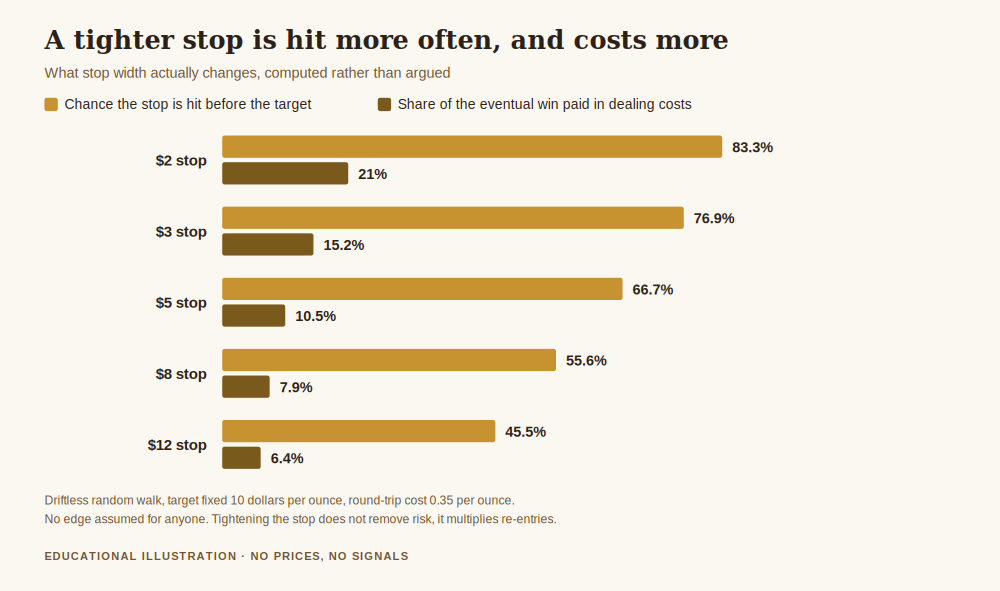
- A $2 stop is hit first 83.3 percent of the time.
- A $3 stop, 76.9 percent.
- A $5 stop, 66.7 percent.
- An $8 stop, 55.6 percent.
- A $12 stop, 45.5 percent.
Look at the top line again. Four times out of five, a tight stop is taken out before the target is reached, in a market where by construction nobody is hunting anyone. If your response to feeling hunted is to tighten up, you have just volunteered for that number.
And it gets worse once dealing costs enter, because being stopped out means going again. At a round-trip cost of 35 cents per ounce, the number of entries needed before one target is reached, and the share of that eventual win consumed by costs, run like this:
- $2 stop: 6.00 entries per win, costing 21.0 percent of the win.
- $5 stop: 3.00 entries, costing 10.5 percent.
- $8 stop: 2.25 entries, costing 7.9 percent.
Tightening from an $8 stop to a $2 stop makes you enter 2.7 times as often for the same result. I computed all of this in Python from the assumptions stated above, and you can change the target, the cost or the model and watch the table move.
The conclusion is uncomfortable but clean. In a fair market, no stop width is smarter than another in terms of expectancy before costs. What stop width genuinely changes is how frequently noise ends your trade, and therefore how much you pay in friction. Tight stops do not protect you from being hunted. They guarantee you are stopped more, and they hand more of your account to the spread.
What actually reduces the problem
Four things, in the order I would fix them.
One: place the stop where your idea dies, not where your wallet is comfortable. A stop has one job, to tell you the reason for the trade is gone. If the level that would prove you wrong is 8 dollars away, then the trade risks 8 dollars, and the only remaining variable is how many ounces you buy. Deciding the stop from how much you want to lose is backwards, and it is the single most common cause of stops sitting in silly places. This is why position sizing is the lever, not stop distance.
Two: stop using the most obvious level available. If you can see the swing low at a glance, so can everyone. Placing your stop a little beyond the level, rather than immediately against it, moves you out of the densest part of the cluster. It costs you a slightly wider stop, which the arithmetic above says is a good trade, and it means the burst of market orders can clear without taking you with it.
Three: understand the level before you trade near it. The sweep you keep getting caught in has a name and a shape, and I have written about the mechanism separately in what a liquidity sweep in gold trading is and in why price moves toward where the crowd is losing. Neither of those will let you predict the sweep. Both will stop you being surprised by it.
Four: never remove the stop. The mental stop is the worst answer to this problem. It replaces a defined, automatic loss with a decision you have to make while losing money, which is the moment you are least able to make it well. An account can survive being stopped out badly for years. It rarely survives one position held without a stop through a genuine move. The rules on where to place a stop loss on XAUUSD are worth settling while calm, in writing.
One thing a stop cannot do for you
Since we started with the CFTC definition, it is worth closing the loop on it.
Because a stop becomes a market order, it does not guarantee your price. In a fast market, or across a weekend gap, the next available price can be well beyond your level, and you will be filled there. That is not your broker cheating. It is what a market order does when there is nothing to trade against at your price.
The practical consequence is that your real worst case is wider than the number on your ticket. Any risk plan that treats the stop as a hard floor is slightly optimistic, which is another argument for sizing so that being wrong, and being wrong by more than expected, are both survivable. That is the entire logic of the risk management approach underneath everything else on this site.
Get the free Gold Empire survival sheet, a one-page guide to protecting your account through the kind of market this article describes. One email, no spam, unsubscribe anytime.
Frequently asked questions
Do brokers really hunt stop losses?
Regulated brokers are not generally sitting there picking off individual retail orders, and the everyday version of this experience is explained by order clustering rather than misconduct. Stops gather at visible levels, they all convert to market orders at the same instant, and that burst moves price further than the original flow justified. Genuine misconduct exists and regulators pursue it, but it is a poor explanation for the ordinary case.
Will a tighter stop protect me from stop hunting?
It does the opposite. On a driftless random walk with a fixed 10 dollar target, a 2 dollar stop is hit first 83.3 percent of the time against 55.6 percent for an 8 dollar stop, and it requires 2.7 times as many entries per eventual win, paying 21 percent of that win in dealing costs rather than 7.9 percent.
Should I use a mental stop instead so nobody can see it?
No. A stop resting at the broker is not visible to the wider market in any useful sense, and replacing it with a decision you must make under pressure removes the one protection that works when you are least rational. The failure mode of a mental stop is the position you never closed.
Where should I put my stop so it does not get swept?
There is no placement that cannot be reached, and anybody promising one is selling something. What helps is choosing the level from where your reasoning is proven wrong rather than from your comfort, then sitting a little beyond the most obvious price rather than right against it, and adjusting the number of ounces so the wider stop still risks the percentage you intended.
Does a stop loss guarantee I lose only that amount?
No. A stop becomes a market order when the level trades, so in fast conditions or across a gap you can be filled materially worse than your level. Treat the stop as your intended loss rather than your maximum one, and size with that gap in mind.
Where did these numbers come from?
I calculated them in Python from a driftless random walk, where the probability of touching the stop before the target is the target distance divided by the sum of both distances. The assumptions are a 10 dollar target and a 35 cent round-trip cost per ounce, both stated so you can change them. The stop order definition is quoted from the CFTC glossary, linked above.
Where this leaves you, and what we do about it
The honest summary is that stop hunting is mostly a description of crowding, not of villainy, and the fix is to stop standing where the crowd stands. That is a placement and sizing decision made calmly before the trade, not a grievance to be processed after it. Once the arithmetic of stop width is in front of you, the instinct to tighten up after a bad exit stops looking like discipline and starts looking like what it is, which is paying more to be stopped more.
Gold Empire is a free Telegram channel where we work through market context in public, including the days the read does not work out. There is no promise of profit, because there honestly cannot be one. What there is, is a group of people trying to stay in the game long enough for competence to start paying.
If this was useful, the free Gold Survival Sheet is the natural next step. It is a one page checklist that puts the size, the cost and the ceiling in front of you before you enter, and it is free to download with nothing to join.
About the author. Matthew writes the Gold Empire market notes. He spends most of his time on the unglamorous half of trading, position size, dealing costs and the arithmetic of recovery, on the view that surviving the first two years is what makes the rest of it possible.
Disclaimer: This article is general educational content about how leveraged markets work. It is not financial advice and it is not a recommendation to buy or sell anything. Trading leveraged products carries a high risk of losing money rapidly. No entry, stop or target discussed should be treated as a signal. Figures attributed to external sources are linked so you can check them, and figures I have calculated are shown with the assumptions they rest on so you can change them.
One step first
Where should we send the Gold Survival Sheet?
Leave your email and we will send the free one page checklist, then take you straight to the Telegram channel.
No cost and no obligation. Educational only, not financial advice, and nothing here promises a return. Unsubscribe any time in one click.
Leave a Reply