
Search for the best broker for gold trading in UAE and you will get lists. Ranked tables, star ratings, a column for spreads and a column for maximum leverage, and somewhere near the bottom a line about regulation that says something like regulated and trusted. That last line is doing almost all of the work and being given almost none of the space.
I want to spend this article on the part the lists skip, because in the UAE it is genuinely more complicated than in most countries, and because getting it wrong is the kind of mistake that is not recoverable by trading well afterwards. No entry, stop or target discussed should be treated as a signal.
The Question the Ranking Lists Never Ask
In most countries there is one financial regulator and the question regulated by whom has one answer. The UAE is not built that way, and this is the single most useful thing to understand before you fund anything.
There are parallel regimes operating in the same country at the same time. Onshore, the Securities and Commodities Authority is the federal regulator for securities and commodities activity. Alongside it sit two financial free zones, each with its own independent regulator and its own rulebook: the Dubai International Financial Centre, supervised by the Dubai Financial Services Authority, and Abu Dhabi Global Market, supervised by its Financial Services Regulatory Authority. The Central Bank of the UAE covers banking and payments.
These are not branches of one another. A firm authorised in one is not thereby authorised in the others, and the protections, the complaint routes and the rules that apply to your account depend on which one your broker actually holds a licence from.
So regulated in the UAE, on its own, is not information. It is the shape of information. The useful version has three parts: which authority, what category of licence, and what reference number. Anything short of that is a claim you cannot check, and a claim you cannot check should be treated as a claim that has not been made.
Best Broker for Gold Trading in UAE Starts With the Register, Not the Spread
Here is the check, and it takes about five minutes.
Find the licence claim on the broker’s own site, usually in the footer or on a legal page. Note the authority named, the entity name, and the number. Then go to that authority’s public register yourself and look the entity up. Not the link from the broker’s website. Navigate to the regulator independently, because a link on a site you are trying to verify is not evidence about that site.
The two registers you can reach directly are the Securities and Commodities Authority for onshore firms and Abu Dhabi Global Market for firms in that free zone. The DIFC regulator maintains an equivalent public register for firms licensed there. Each of them exists precisely so that you do not have to take a firm’s word for its own status.
Four things to confirm once you find the entry, and each of them catches a different real problem.
- The entity name matches exactly. Not similar, exactly. A group may hold a licence in one subsidiary while your account is opened with a different one registered somewhere else entirely. The name on the register and the name on your client agreement should be the same legal person.
- The licence permits what you are about to do. Authorisation is granted by category. A firm may be licensed for an activity that has nothing to do with holding retail client money for leveraged trading.
- The status is current. Registers show withdrawn and lapsed permissions too, and marketing material does not update itself when a licence does.
- Client money is addressed in writing. Segregation of client funds from the firm’s own funds is the arrangement that matters most if the firm fails, and it should be stated in your agreement rather than implied by a badge.
Why offshore keeps appearing in the results
You will meet plenty of firms marketing to residents of the UAE while licensed somewhere with a much lighter regime. That is not automatically fraud, and I am not going to pretend it is. It is a trade, and it should be priced honestly.
What you typically get is higher leverage and a faster sign up. What you typically give up is the register you can check, the complaints process with teeth, and any realistic route to recovering money if the firm stops answering. Traders tend to weigh the first two because they are visible on day one, and discover the value of the last three on the only day they matter.
What the Numbers Say About Skipping This Step
I would rather show you a measured figure than lean on the word careful.
The FBI’s Internet Crime Complaint Center publishes an annual report of fraud reported to it. In its 2024 annual report, reported losses in the investment fraud category were 6.57 billion dollars. The two preceding years were 4.57 billion and 3.31 billion. Reported losses in that category roughly doubled in two years.
Within that, fraud involving cryptocurrency investment accounted for 41,557 complaints and about 5.8 billion dollars, with losses up 47 percent on the prior year.
Two caveats I will state rather than bury. This is United States data and it does not measure the UAE. And it counts what was reported, which is a floor rather than a total, since most people who lose money this way do not file a report.
I use it anyway because the shape is the lesson. The category that grows like that is not one where victims made exotic mistakes. The standard pattern is an unverifiable platform, an account that displays profits, and withdrawals that stop working. Every part of that is prevented by the five minute check above, which is the cheapest risk control available anywhere in this business.
The Leverage Number Is a Marketing Number
The other column that dominates broker comparisons is maximum leverage, and it is the one most consistently misread. Higher is presented as better, or at least as more. Here is what it actually changes.
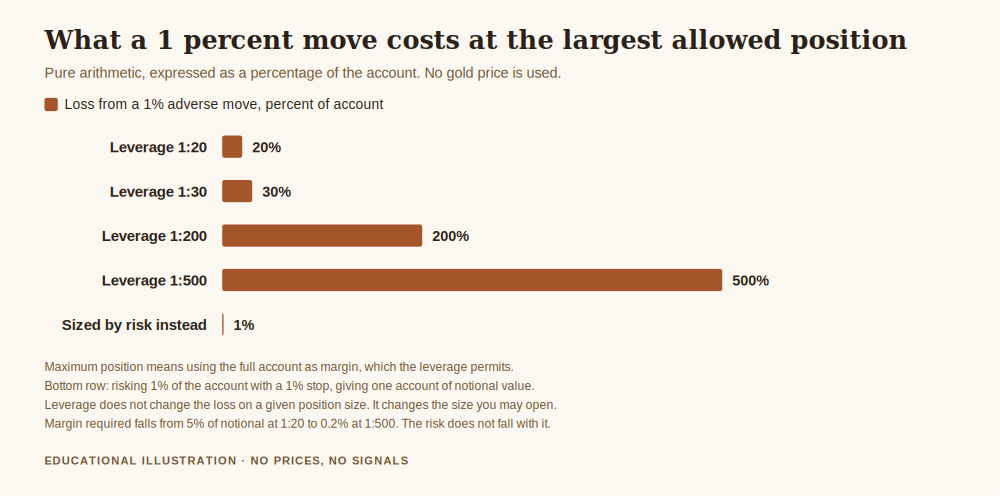
Take an account and call its value A, and a position whose full contract value is V. Margin required is simply V divided by the leverage. At 1:20 you post 5 percent of V. At 1:500 you post 0.2 percent of V, twenty five times less cash for exactly the same position.
Now the part the marketing omits. A 1 percent adverse move costs you 1 percent of V. That is true at every leverage level, because the loss is a property of the position, not of the financing. Leverage did not make the trade safer or riskier. It changed how much of your cash was tied up while the trade was open.
What it did change is the size you are permitted to open. At 1:20 an account can support a position of about 20A. At 1:500 it can support 500A. Run the 1 percent move against those maximum positions and the arithmetic is brutal: 20 percent of the account at 1:20, and 500 percent of it at 1:500. The second number is larger than the account, which is a formal way of saying the account is gone and a debt may remain.
Contrast that with sizing from risk instead of from permission. Decide to risk 1 percent of the account with a stop 1 percent away, and the position works out at about one account of contract value. That is roughly one five hundredth of what the leverage would have allowed. The leverage cap was never the constraint that was protecting you, because your own sizing rule binds hundreds of times earlier, and that arithmetic is set out in how much to risk per trade.
Which reframes the whole column. High leverage is not dangerous because of what it forces you to do. It is dangerous because of what it permits on the day your judgement is poor, and everyone has those days.
Then, and Only Then, Compare the Features
Once two or three brokers have survived the register check, the remaining comparison is ordinary and worth doing properly.
The total cost of a round turn on gold. Spread plus commission plus any overnight financing, quoted on the instrument you will actually trade, at the hours you will actually trade it. A tight spread advertised during the quietest hour of the day is a number about their marketing, not about your costs.
Behaviour when it is busy. Everything works at 3pm on a Wednesday. What matters is the minute around a scheduled release, and the only way to learn it is a small live account and a few weeks of paying attention.
Withdrawals before deposits. Test the exit path early with a small amount, while the stakes are low and while you are calm. A deposit is designed to be effortless. The withdrawal is the process that tells you what kind of firm you are dealing with.
Whether local presence means local licence. An office in Dubai, an Arabic website and a UAE phone number are marketing facts, not regulatory ones. The register is the regulatory fact, and the two are frequently not the same.
Get the free Gold Empire survival sheet, a one page guide to sizing a gold position so the leverage your broker offers never becomes the size you actually carry. One email, no spam, unsubscribe anytime.
Frequently asked questions
Which regulator covers gold trading brokers in the UAE?
It depends on where the broker is licensed, and that is the whole point. Onshore firms fall under the Securities and Commodities Authority. Firms in the Dubai International Financial Centre fall under the Dubai Financial Services Authority, and firms in Abu Dhabi Global Market fall under that free zone’s Financial Services Regulatory Authority. They are separate regimes with separate registers, so the useful question is never is it regulated but which authority, which licence and which number.
Is an offshore broker with higher leverage a reasonable choice?
It can be a considered choice, but it should be a priced one. You are trading away a register you can check and a complaints process that works in exchange for larger permitted positions and an easier sign up. Given that your own sizing rule should bind long before any leverage cap does, you are usually paying a real price for a permission you should never use.
How do I actually verify a broker’s licence?
Take the entity name and licence number from the broker’s legal page, then navigate to the regulator’s website independently and search its public register. Confirm the exact entity name, that the licence category covers holding retail client money for leveraged trading, and that the status is current. If any part of that does not line up, you have your answer without needing to resolve why.
Does a Dubai office mean the broker is regulated in the UAE?
No. A physical office, a local number and a local website are commercial facts. Plenty of firms maintain a presence in one country while holding their licence in another, and the licence is what determines your protections. Check the register rather than the address.
How much leverage do I actually need for gold?
Far less than is offered, and the arithmetic settles it rather than opinion. If you size from a risk rule, a 1 percent risk with a 1 percent stop produces a position of roughly one account of contract value, which even 1:20 accommodates comfortably. Everything above that is headroom you have no plan to use.
Is my money protected if the broker fails?
Do not assume it is, and do not assume any jurisdiction works like another you have read about. What matters in practice is whether client funds are held segregated from the firm’s own money and what your written agreement says about it. Ask directly, get the answer in writing, and treat a vague reply as an answer in itself.
What is the single most common mistake here?
Choosing on spread and leverage first and treating regulation as a tie breaker. That inverts the order of importance. Costs affect your returns. The licence affects whether you can get your money back, and no amount of skill later compensates for getting that one wrong at the start.
A Short Checklist Before You Fund Anything
- Identify the specific authority, licence category and reference number, from the broker’s own legal page.
- Verify it on that regulator’s public register, reached independently rather than by following the broker’s link.
- Confirm the exact legal entity you will contract with is the one on the register.
- Get the client money arrangement in writing.
- Fund a small amount, then test a withdrawal before the account matters.
- Compare total round turn cost on gold at the hours you actually trade.
- Ignore the maximum leverage figure, and size from your own risk rule instead.
Where This Leaves You
The honest answer to the question in the title is that there is no single best broker for gold trading in UAE, and anyone publishing that ranking is selling placement rather than judgement. What exists is a short list of firms whose licence you have personally verified with the right authority, from which you pick on cost and on how they behave when the market is busy.
That is a duller answer than a ranked table and it is worth considerably more, because it is the one part of this decision that cannot be undone by trading well afterwards. Every other mistake in this business is recoverable given time and a surviving account. Handing your capital to a firm you could not verify is the one that removes the account itself, and with it every future decision you were planning to make better.
Check the register. Then argue about spreads.
Where Gold Empire Fits
Gold Empire is a free Telegram channel where I post gold analysis with the reasoning stated before the move rather than after it, losing days included. There is nothing to buy in order to follow along, and an optional Kit if you want more structure later. I publish no profit claims, and I do not rank brokers for payment.
The free survival sheet is the one page version of the sizing discipline that makes the leverage column irrelevant. If you are still at the account opening stage, how to open a gold trading account covers the mechanics, and the wider framework sits in risk management in gold trading.
About the author. Matthew writes Gold Empire. He is interested in the unglamorous half of this business, cost, size, frequency and the arithmetic of staying solvent, on the view that most accounts are lost to ordinary errors repeated patiently rather than to any single dramatic trade.
Disclaimer: This article is general educational content about how to verify a broker’s regulatory status and how leverage relates to position size. It is not financial advice, it is not a recommendation of any broker, and no firm is named or endorsed anywhere in it. Trading gold, CFDs and leveraged products carries a high risk of losing money rapidly. No entry, stop or target discussed should be treated as a signal. The regulatory descriptions are a general orientation and not legal advice; regimes change, and you should confirm current requirements with the relevant authority directly. The fraud figures are taken from the FBI Internet Crime Complaint Center 2024 annual report, which covers losses reported in the United States and therefore understates totals and does not measure the UAE; the report is linked so you can check it. The margin and leverage figures are pure arithmetic from the stated assumptions, offered as worked examples rather than as settings to copy. No gold price is quoted anywhere in this article.
One step first
Where should we send the Gold Survival Sheet?
Leave your email and we will send the free one page checklist, then take you straight to the Telegram channel.
No cost and no obligation. Educational only, not financial advice, and nothing here promises a return. Unsubscribe any time in one click.
Leave a Reply