
A trader wrote to me in July with a question he was slightly embarrassed to ask. He had placed an order for a size he had worked out carefully, the platform showed him in the trade, and the position tab said something smaller than what he had asked for. He wanted to know whether he had made a mistake typing the number in.
He had not. He had been partially filled, and the reason the question is worth a full article is that almost nobody explains the consequence. What happens if an order is partially filled is not really a question about order mechanics. It is a question about whether the risk you calculated before the trade is still the risk you are carrying after it, and for most people the honest answer is no.
The mechanics take one paragraph. The consequence takes the rest of this article, because the consequence is where accounts get hurt, quietly, in a way that never shows up as a single bad day.
What Happens if an Order Is Partially Filled, in Plain Terms
An order is an instruction to trade a certain size at a certain price or better. It is not a promise that the size exists. When you send an order for a size larger than what is available at your price, the part that can be filled is filled, and the rest either waits, expires, or is cancelled, depending on the order type and the venue.
So you asked for a full position and you got a fraction of one. The platform is not broken. Your broker is not cheating you. There simply was not enough on the other side at the price you were willing to accept, and the part that existed came to you.
This is a normal feature of markets rather than a fault in them. It shows up more often in three situations, and they are worth knowing because they are the situations in which people also tend to be trading larger than usual: around a scheduled release, in the minutes after one, and in the thin hours when the desks that normally quote size have gone home.
The rule that governs how a firm has to treat your order in the United States is worth reading once, because it tells you what the firm owes you and what it does not. FINRA Rule 5310 requires that a member firm “use reasonable diligence to ascertain the best market for the subject security and buy or sell in such market so that the resultant price to the customer is as favorable as possible under prevailing market conditions.” Read that last clause again. The obligation is to the prevailing conditions, not to your intended size. And among the factors the rule lists for judging whether a firm exercised reasonable diligence is, in its own words, “the size and type of transaction.”
Your size is a factor in the rule. It is not a guarantee in the rule. That distinction is the whole article.
The First Consequence, Your Risk Shrinks
Start with the harmless version, because it helps to see the arithmetic somewhere safe.
Say the plan was to risk one percent of a ten thousand unit account, which is one hundred units, on a position of a given size with the stop a fixed distance away. That distance is the thing that turns size into risk. Size multiplied by stop distance is the money at stake.
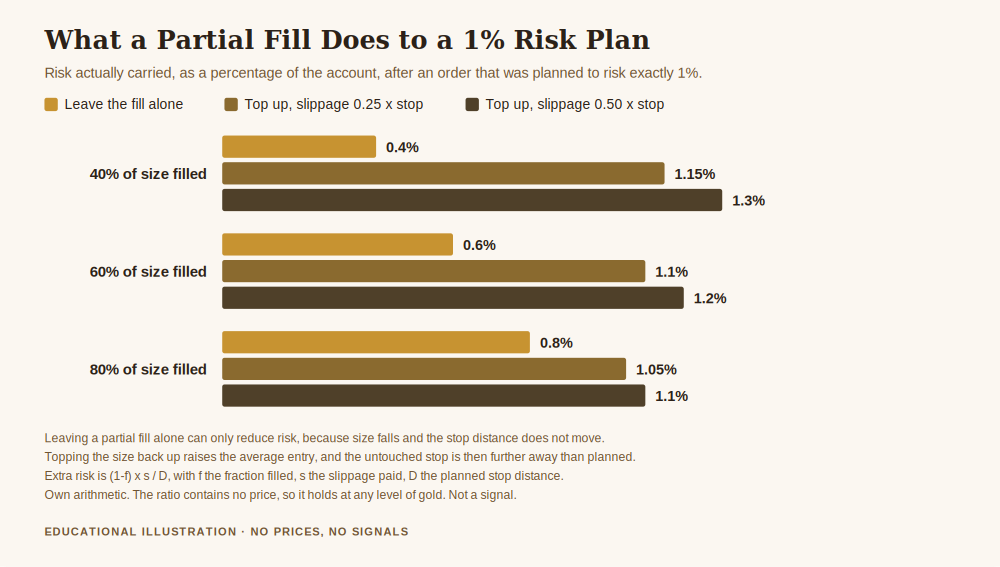
If only forty percent of the size fills, and the stop stays exactly where the plan put it, then the money at stake is forty percent of what it was. The risk becomes zero point four zero percent of the account instead of one percent. Sixty percent filled gives zero point six zero percent. Eighty percent filled gives zero point eight zero percent.
Nothing has gone wrong here. You are risking less than you planned. The trade can also only return a proportionally smaller amount if it works, which matters over a long series but does not threaten anything.
The problem is that almost nobody leaves it there.
The Second Consequence, and This Is the Expensive One
Here is what actually happens in the room. The trader sees a position smaller than intended. It looks wrong. The instinct, and it is a strong one, is to fix it, so they buy the missing portion at whatever the market is now showing, which by definition is worse than the price they originally wanted. That is why they were only partially filled in the first place.
Now walk through what that does, without needing a single gold price.
Call the fraction already filled f, the extra slippage paid on the remainder s, and the planned stop distance D. Your average entry moves against you by (1 minus f) multiplied by s. Your stop, meanwhile, is still sitting where the plan put it, because moving the stop felt like breaking the rules, and the trader was busy fixing the size.
So the distance from your new average entry to your unchanged stop is now D plus (1 minus f) times s. Your risk has grown by the ratio (1 minus f) times s, divided by D.
That expression contains no price at all. It is pure proportion, which means it is true at any level of gold, in any year, on any account size. Here is what it produces:
- Forty percent filled, then completed at slippage equal to a quarter of your stop distance: risk is fifteen percent above plan. A one percent trade is now a one point one five percent trade.
- Forty percent filled, completed at slippage equal to half the stop distance: risk is thirty percent above plan. The one percent trade is now one point three zero percent.
- Sixty percent filled, completed at a quarter of the stop distance: risk is ten percent above plan.
- Sixty percent filled, completed at half the stop distance: twenty percent above plan.
Notice that the trader in every one of those rows believes they are risking one percent. They sized the position correctly. They placed the stop correctly. They fixed what looked like an error. And they are carrying between ten and thirty percent more risk than the plan they are so carefully following.
How Often This Actually Happens
A single instance of fifteen percent extra risk is not going to hurt anybody. The reason this is worth your attention is frequency, so let us put a number on that too.
Assume that eight percent of your orders come back partially filled, and treat the orders as independent of each other. Those are assumptions, stated plainly so you can substitute your own. Under them:
- Across five orders, the chance of at least one partial fill is thirty four point one percent. So it is roughly a one in three week.
- Across twenty orders, the chance is eighty one point one percent. So it is most months.
- Across two hundred orders, which is a plausible year for an active trader, you expect sixteen of them.
Now combine that with the arithmetic above. Sixteen partial fills a year, each one topped up from a forty percent fill at slippage equal to a quarter of the stop distance, each one carrying zero point one five extra percentage points of risk, gives two point four zero percentage points of additional risk taken across the year.
Two point four percent of the account, exposed on purpose by nobody. Not sized, not decided, not written in any plan. It is the residue of sixteen small moments of tidying up.
I want to be careful about what that figure is and is not. It is not a loss. It is additional risk carried, and whether it costs anything depends on which of those trades went against you. But that is precisely the point of position sizing: you control the risk, and you do not get to control the outcome. Risk that arrives without a decision is the kind that eventually meets the wrong week.
What to Do Instead
None of this argues for never completing a position. It argues for deciding in advance, once, so that you are not deciding at the worst possible moment with a number on the screen that looks wrong.
There are three coherent answers, and the trouble in practice is that people use a fourth, which is to react.
Take the fill and leave it. Your risk is smaller than planned, your stop is where it belongs, and the arithmetic of the trade is intact. This is the simplest answer and it is defensible every single time. The cost is that the position is smaller than intended, which over a long enough series does affect your results.
Complete the size and move the stop to keep the risk constant. If you want the full position, then the stop has to move so that size multiplied by distance returns to the planned number. This keeps the risk right and changes the trade, because a stop at a different distance is a different trade with different odds. That is an honest trade off, as long as you know you are making it.
Cancel the remainder and treat the position as complete. Functionally similar to the first answer, but done deliberately, which for many people is the difference between a rule and a shrug.
The fourth answer, which is to buy the rest at market because the position tab looked wrong, is the one that produces the two point four percentage points. It feels like discipline. It is the opposite of discipline, because the plan specified a risk and the fix silently changed it.
One practical note that costs nothing: know what your order types actually do when they cannot be filled completely. Order handling differs between platforms and between venues, and the behaviour of a resting remainder is not the same everywhere. Finding this out on a quiet afternoon is considerably cheaper than finding it out two minutes after a release.
Why This Belongs in the Survival File
Most of what gets written about orders is about getting in at a better price. This is not that. A partial fill is a risk control problem wearing an execution costume, and it belongs next to position sizing rather than next to entries.
The general shape of the thing is familiar to anyone who has been doing this a while. The account is rarely destroyed by the loss you were expecting. It is worn down by the exposures you never counted, because each one individually was too small to argue about. Fifteen percent extra on one trade is nothing. Sixteen of them, unnoticed, across a year in which you believed your risk was fixed at one percent, is a different animal.
If you keep a record of your trades, add one column: intended size, filled size. That is the entire intervention. You cannot manage a number you never wrote down, and after a month you will know your own partial fill rate instead of using my assumed eight percent.
Get the free Gold Empire survival sheet, a one-page guide to protecting your account through the kind of market this article describes. One email, no spam, unsubscribe anytime.
Frequently asked questions
Is a partial fill a sign of a bad broker?
Not by itself. It is usually a sign that the size you wanted was not available at the price you were willing to pay, which is a market condition rather than a firm behaviour. It becomes a question about the firm if it happens constantly on ordinary size in ordinary conditions, or if the remainder is handled in a way the firm never disclosed to you.
Does a partial fill mean I paid a worse price?
No. The part that filled, filled at your price or better. The worse price only appears if you go and buy the remainder at whatever is showing now, which is the decision this article is about.
Should I always just accept the smaller position?
It is the simplest and safest default, and it is never wrong on risk grounds. Whether it is right for your results depends on your strategy, and that is a decision to make once in advance rather than in the moment.
Does this affect my stop loss automatically?
That depends entirely on your platform, and it is worth checking rather than assuming. Some setups attach protective orders to the filled quantity, some to the requested quantity. A stop for a size you do not hold, or no stop on a size you do hold, are both worth discovering before it matters.
Where did the numbers in this article come from?
The wording of the best execution obligation and the list of factors including “the size and type of transaction” are quoted from FINRA Rule 5310, linked above. Every other figure was calculated for this article from assumptions written into the text: a ten thousand unit account, one percent planned risk, fill fractions of forty and sixty percent, slippage of a quarter and a half of the stop distance, a partial fill rate of eight percent, and two hundred orders a year. There are no gold prices in any of the arithmetic, because the ratios do not require one, and no entry, stop or target discussed should be treated as a signal.
Where Gold Empire fits
Gold Empire is free to follow. Daily XAU/USD analysis on Telegram with the level and the risk written down before the trade, losing days included. There is a free survival sheet for anyone who wants the capital protection side on one page, and an optional kit for people who want the full process. No profit is promised anywhere, because nobody can promise one.
If you want the rest of the sizing picture, risk management in gold trading is the pillar this sits under, how to calculate lot size for gold covers the arithmetic a partial fill disturbs, how much to risk per trade covers the number that is supposed to stay fixed, and the author page explains who writes this and why. The external rule quoted above is FINRA Rule 5310.
About the author. Matthew writes Gold Empire. He spends most of his time on the survival end of this job, the part where an account is still there in twelve months, and he has a particular interest in the small mechanical details that quietly undo a plan somebody worked hard on. Nothing here is a recommendation, and no entry, stop or target discussed should be treated as a signal.
Disclaimer: This article is general educational content about order execution and position sizing. It is not financial advice, not legal advice, not tax advice and not a recommendation to buy, sell or use any product, venue or firm. It is a summary written for general readers and is not a statement of the law; order handling rules vary by venue, by product and by the jurisdiction and legal entity holding your account, and only a licensed professional can tell you what applies to you. The regulatory wording is quoted from the FINRA source linked in the text, which was checked and reachable at the time of writing. All other figures were calculated for this article from the assumptions stated in the text and are illustrations of proportion, not observed market data or a description of any particular firm’s fill rates. Leveraged trading in gold carries a high risk of losing money rapidly, and a majority of retail accounts lose money. Past behaviour of any market does not indicate future behaviour. No entry, stop or target discussed should be treated as a signal.
One step first
Where should we send the Gold Survival Sheet?
Leave your email and we will send the free one page checklist, then take you straight to the Telegram channel.
No cost and no obligation. Educational only, not financial advice, and nothing here promises a return. Unsubscribe any time in one click.
Leave a Reply