

The blown trading account meaning that most people carry around is a feeling rather than a definition. It means the money is gone, it happened fast, and there was a moment near the end where nothing could be done. That is roughly right as a description of the experience, and it is almost useless as an explanation, because it leaves out the only part you can actually control.
There is a precise mechanical meaning underneath the feeling. An account is blown when the broker closes your positions for you, because your equity has fallen to a level the rules say is the floor. You do not choose the moment. It is defined in advance, in writing, by a rule you agreed to and probably never read. And once you know where that floor sits, you can calculate exactly how far price has to move against you before you meet it.
That calculation is the whole of this article. Everything numerical below is my own arithmetic, derived from two published rules, with the assumptions written out as I go. There are no gold prices here, nothing is a forecast, and nothing tells you what to do with a position.
The blown trading account meaning, stated mechanically
Two rules do the work, and both come from the same place: the product intervention measures the European Securities and Markets Authority agreed on 23 March 2018 under Article 40 of MiFIR, which you can read in ESMA’s own announcement.
The first rule is a leverage cap. ESMA set retail leverage limits that vary by instrument, and gold sits in the 20:1 band, alongside non major currency pairs and major indices. Twenty to one means the margin you must post to open a position is one twentieth of its contract value, which is 5 per cent.
The second rule is the one nobody talks about, and it is the actual definition of a blown account. ESMA requires “a margin close out rule on a per account basis”, which, in their words, standardises “the percentage of margin (at 50% of minimum required margin) at which providers are required to close out one or more retail client’s open CFDs”.
Read that slowly. The broker is required to close you when your equity falls to half of the margin your open positions require. Not when your money runs out. Not when you decide. At half of required margin, by rule.
There is a third rule worth knowing because it is the one that works in your favour: negative balance protection, also on a per account basis, which means your loss stops at the money you deposited and you do not end up owing the broker. That is a genuine protection and it is why the modern version of this story ends badly rather than catastrophically.
How far price has to move, derived in four lines
Let N be the contract value of your position, D the money you deposited, and f the fraction price moves against you.
Minimum required margin is M = N divided by 20, which is 0.05N. Define margin use u as M divided by D, so a u of 100 per cent means you have opened the largest position your deposit allows at the cap. Rearranging, D = 0.05N divided by u.
The broker must close you when equity reaches half of required margin, which is when D minus f times N equals 0.5 times 0.05N, or 0.025N.
Solve for f and you get f = 0.05 divided by u, minus 0.025. That is the entire model. One line, two published rules, no opinions in it.
Two and a half per cent
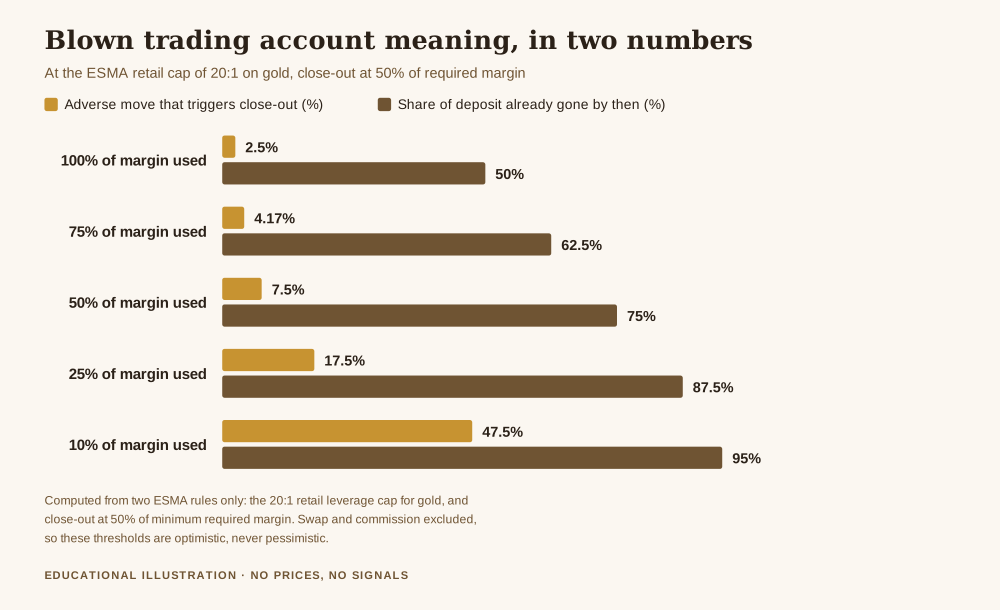
Put u at 100 per cent, the case where a trader opens the biggest position the deposit permits, and f comes out at 2.5 per cent.
Two and a half per cent. That is the distance between a fully committed account at the regulatory leverage cap and a forced liquidation. Not a crash, not a black swan, not a gap. An ordinary adverse session.
I have excluded swap charges and commission from the arithmetic, which makes 2.5 per cent the optimistic figure. Financing costs push the threshold nearer, never further away. Whatever your real number is, it is worse than the one I just gave you.
Back the position off and the threshold widens, exactly as you would expect. At 75 per cent margin use it is 4.17 per cent, at 50 per cent it is 7.5 per cent, at 25 per cent it is 17.5 per cent, and at 10 per cent margin use price has to travel 47.5 per cent against you before the rule fires.
The part that is genuinely counterintuitive
Now look at the second bar in each pair on that chart, because it reverses the lesson most people take from the first.
At the moment the close out fires, how much of your deposit is left? The algebra gives a clean answer: remaining equity as a share of deposit is 0.5 times u. So at 100 per cent margin use you still have 50 per cent of your deposit when the broker closes you. At 50 per cent margin use you have 25 per cent left, meaning you lost 75 per cent. At 10 per cent margin use you have 5 per cent left, having lost 95 per cent of everything you put in.
That is worth sitting with. The maximally leveraged account is closed sooner and keeps more of its deposit. The conservatively leveraged account survives a far larger move, and if it does eventually reach the floor, it arrives there having lost almost everything.
This is not an argument for using more leverage, and I want to be very clear about that. It is a correction to a belief I hear constantly, which is that the close out rule is a safety net for the trader. It is not. It is a safety net for the broker, protecting the firm from an account going negative. Where it happens to protect you, that is a by product of protecting them. The number it defends is the firm’s exposure, not your capital.
Get the free Gold Empire survival sheet, a one-page guide to protecting your account through the kind of market this article describes. One email, no spam, unsubscribe anytime.
Twice is enough
One more piece of arithmetic, and it is the one that explains why this tends to happen to the same person more than once.
Suppose an account is closed out at full margin use, keeping 50 per cent of its deposit, and the trader does what people do, which is open the same size position again with what is left. The second close out leaves 50 per cent of that, which is 25 per cent of the original deposit.
Two forced liquidations. Three quarters of the money gone. Not through a disaster, through a rule working precisely as written, twice, on a position sized to the maximum the regulator permits. Nobody needs to be unlucky for this to happen, and nobody needs to be stupid either.
What the numbers say about how common this is
ESMA did not write these rules in the abstract. In the same announcement they recorded what the national regulators found: analyses of CFD trading across different EU jurisdictions showed that “74-89% of retail accounts typically lose money on their investments, with average losses per client ranging from €1,600 to €29,000”.
Three quarters to nine tenths. That is the context the 2.5 per cent sits in, and it is why I write about survival first and growth second on this site rather than the other way around.
What this article does not say
It does not say that 2.5 per cent is a likely move or an unlikely one. I have not told you how often gold travels that far in a session, because that is a separate measurement and I am not going to assert it without doing the work properly.
It does not say that your broker uses exactly these numbers. ESMA’s rules apply to retail clients of firms in scope. Your leverage cap, your close out percentage and your negative balance protection are in your own account documentation, and the only correct source for them is the firm you trade with.
And it does not tell you what size to trade. It gives you the formula so that you can work out your own threshold instead of discovering it.
How I would actually use this
Three things, and the first takes two minutes.
Find your broker’s actual close out level and your actual leverage on gold. They are in the client agreement. If the close out is at 50 per cent of required margin and gold is capped at 20:1, every figure in this article applies to you unchanged. If the numbers differ, put them into f = initial margin rate divided by u, minus close out fraction times initial margin rate, and you have your own threshold.
Second, write that threshold down next to your position size. Not the stop you intend to use, the distance at which the decision stops being yours. Most traders have never calculated it, which means they are operating with an invisible boundary somewhere in front of them.
Third, treat margin use as the dial that matters, because it is the one that sets everything else. If you want to understand why that dial behaves the way it does, what leverage is in gold trading is the mechanical companion to this piece, and how much to risk per trade is where the decision actually gets made.
Frequently asked questions
What is the blown trading account meaning, in one sentence?
It means the broker has force closed your positions because your equity fell to the margin close out level, which under ESMA’s rules is 50 per cent of the minimum margin your positions required.
How far does gold have to move to blow an account?
It depends entirely on margin use. At the ESMA retail cap of 20:1 with every available unit of margin committed, the arithmetic gives 2.5 per cent, before swap and commission, which bring it closer.
Can I lose more than I deposited?
Under ESMA’s negative balance protection, which applies on a per account basis, your loss is limited to the funds in the account, so you should not end up owing the broker. Confirm it applies to your account rather than assuming it.
Does the margin close out rule protect me?
Not primarily. It caps the broker’s exposure to a client account going negative. At low margin use it fires only after roughly 95 per cent of the deposit has already gone, which is not what most people picture when they hear the word protection.
Why does a smaller position lose a larger share of the deposit?
Because the floor is set at half of required margin, and a smaller position requires less margin, so the floor sits lower in absolute terms. The remaining equity at close out works out as 0.5 times margin use, which is why 10 per cent margin use leaves 5 per cent of the deposit.
Is a margin call the same as being blown?
No. A margin call is a warning that your equity is approaching the required level. The close out is the automatic action that follows if it keeps falling, and that is the event this article defines.
What Gold Empire actually does
Gold Empire is a free channel about surviving in gold rather than getting rich in it. There is no signal service here and nothing is sold on the promise of a return. The free Gold Survival Sheet is a single page on protecting an account through exactly the kind of week this article describes, and the only thing it asks for is an email address you can unsubscribe from. The risk management guide that sits underneath all of this is simply published, alongside why you keep blowing your trading account, which covers the behaviour that walks a trader to the threshold this article measures, and position sizing in gold.
The model is deliberate. Follow along for free, read the arithmetic, and decide for yourself. If a piece of writing ever makes you feel you must act immediately, that is a reason to be suspicious of the writing, including mine.
About the author
Matthew writes Gold Empire. He traded for two years without knowing where his own close out level sat, which is the sort of thing you can look up in four minutes and most people never do, and he now writes the number next to the position size before the position exists. He has no interest in telling anyone where price is going. You can read more about the approach on the about page.
This article is educational and is not financial advice. Trading gold carries a high risk of losing money rapidly, and no entry, stop or target discussed should be treated as a signal. The leverage cap, the margin close out level and the negative balance protection described above are quoted from the European Securities and Markets Authority’s product intervention measures agreed on 23 March 2018, and the loss statistics are ESMA’s own, as cited. All thresholds are computed from those published rules with the assumptions stated, exclude swap and commission, and were accurate at the time of writing. Your own broker’s terms govern your account. Decide your own risk, and never trade money you cannot afford to lose.
One step first
Where should we send the Gold Survival Sheet?
Leave your email and we will send the free one page checklist, then take you straight to the Telegram channel.
No cost and no obligation. Educational only, not financial advice, and nothing here promises a return. Unsubscribe any time in one click.
Leave a Reply