
Almost nobody asks whats the difference between a stop and a stop limit before they need to know. The question arrives afterwards, in the hour after a protective order did something unexpected, either filling somewhere the trader did not expect or not filling at all. About 48 messages in my inbox touch fills and spreads, counted by keyword rather than by any survey, and the pattern repeats. One person wrote: “I think my spread is too big. It just closed the two other order.” Another: “the spread is not fixed and it hit my stop with that spread.” A third, after the dust settled: “Yes, it took me out. No profit because of the spread but no loses as well.”
Those three people are describing two different failure modes, and they belong to two different order types. The difference is small to read and large to live through. One order type guarantees you get out but not at what price. The other guarantees the price but not that you get out. Everything else in this article follows from that single trade off, including the arithmetic that decides how much it can cost you.
Whats the difference between a stop and a stop limit, in the rulebook’s own words
This is one of the rare cases where a regulator has written the answer down in a single sentence each, so we can skip the folklore. FINRA Rule 5350 defines both:
A “stop order” is an order to buy (or sell) that becomes a market order to buy (or sell) when a transaction occurs at or above (below) the stop price.
A “stop limit order” is an order to buy (or sell) that becomes a limit order to buy (or sell) at the limit price when a transaction occurs at or above (below) the stop price.
Read those twice and the whole thing falls out. Both orders sit dormant. Both wake up at the same moment, when trade happens at your stop price. What differs is what they turn into. A stop turns into a market order, which means it will be filled, and the market decides where. A stop limit turns into a limit order, which means it will only be filled at your limit price or better, and if the market never offers that price, nothing happens at all.
Notice what neither definition promises. Neither one promises you the stop price. The stop price is a trigger, not a fill. A great many accounts have been damaged by people who believed otherwise, including people who had been trading for years.
One important caveat before you lean on that rule
FINRA Rule 5350 governs US securities. It does not govern spot gold, and it does not govern a contract for difference on gold written by an offshore broker. The definitions are still the right mental model, because the mechanics are the same everywhere and most platforms use the same two words, but the protections around them are not.
That distinction matters more than it sounds, and I will come back to it, because the gap between a market where somebody has written the rules down and a market where nobody has is exactly the gap most readers of this blog are standing in.
What a stop order actually costs when it misbehaves
A stop order will get you out. That is its job and it does it reliably. The cost is that the fill price is whatever is available when the order reaches the book, which in a fast or thin market is not the trigger price.
Let us put arithmetic on it, because the feeling of a bad fill and the size of a bad fill are different things, and only one of them appears in your account. Assume you risk 1.00 per cent of equity on a trade and your stop distance D is the planned adverse move. The useful question is not where the price was, it is what fraction of D the slippage added.
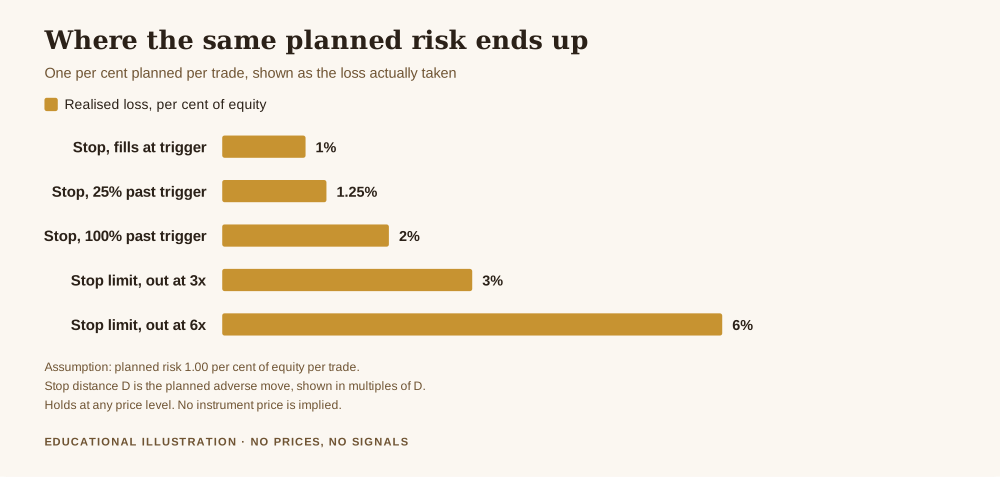
Fill at the trigger and you lose the 1.00 per cent you planned. Fill a quarter of D past the trigger and you lose 1.25 per cent. Fill a full D past the trigger, which is a rough day but not a remarkable one, and you lose 2.00 per cent, double the plan. Fill two D past it and you lose 3.00 per cent.
That is the honest downside of a stop order, and notice how contained it is. Even the bad case is a multiple of your plan, not a different order of magnitude. The position is closed. The bleeding stopped. Whatever happened next in the market happened without you in it.
What a stop limit costs when it misbehaves
Now the other side. A stop limit protects you from the bad fill above. It will never fill you two D past your trigger, because you told it not to. What it will do instead, in exactly the conditions where you most wanted out, is nothing.
The conditions that cause a bad fill and the conditions that cause a missed fill are the same conditions. Price moving fast, a gap, a thin book. The stop limit triggers, becomes a limit order, and the market has already traded through your limit. Your order sits there, unfilled, while you are still in the position.
The arithmetic is less forgiving. If the limit never fills and you eventually get out at three times your planned stop distance, that planned 1.00 per cent becomes 3.00 per cent. At six times, it becomes 6.00 per cent. Six per cent of equity is six consecutive planned losses taken in one trade, and it needs 6.38 per cent of gain to get back to where you started. At ten times it is 10.00 per cent, which needs 11.11 per cent to recover.
Every one of those outcomes came from an order placed specifically to prevent them. That is the part worth sitting with. The stop limit did not fail. It did precisely what it was defined to do, and what it is defined to do includes leaving you in the trade.
How far is too far, and who decides
There is a reasonable objection here. Surely if a fill is absurd, somebody cancels it. In US equities, sometimes. FINRA Rule 11892 sets out the numerical guidelines for when a transaction is reviewed as clearly erroneous, and the thresholds are worth knowing because they tell you how far from fair a print must be before anyone treats it as a mistake rather than a price.
During normal market hours, for a reference price above 50 dollars, the subject transaction must differ from the reference price by at least 3 per cent. For a reference price above 25 dollars it is 5 per cent, and at or below 25 dollars it is 10 per cent. Outside normal hours every one of those doubles. When an event hits twenty or more securities within five minutes, the rule nullifies transactions 30 per cent or more away from the reference price.
Turn that into your own units. If your stop distance D is half a per cent of price, a print 3 per cent away is six times D, which on a 1 per cent planned risk is 6 per cent of equity. If your D is a quarter of a per cent, a 3 per cent print is twelve times D, which is 12 per cent of equity. In other words, a fill can be bad enough to take six to twelve times your intended risk and still sit comfortably inside what the rulebook treats as a normal price rather than an error.
And that is the regulated venue. On spot gold through a CFD broker there is no Rule 11892, no reference price committee, and no nullification process. Whatever you got filled at is what you got.
Get the free Gold Empire survival sheet, a one page guide to protecting your account through the kind of market this article describes. One email, no spam, unsubscribe anytime.
Choosing between them without pretending there is a free option
I am not going to tell you which order to use, partly because it depends on things I cannot see from here, and partly because anyone who tells you one of them is simply better has not understood the trade off. What I can give you is the question that decides it.
Ask yourself which failure you can survive twice in a row. If an exit two D worse than planned would hurt but leave you trading, and being stuck in a position that keeps running would not, then the certainty of exit is what you are buying and a stop order buys it. If you are trading something where you genuinely can wait, where you are not leveraged into a corner, and a bad print is the thing that would end you, then the price certainty of a stop limit is what you are buying, and you should know you are buying it with the risk of still being in the trade.
What you cannot do is place a stop limit and then think about it as though it were a stop. That is the single most expensive mistake in this whole topic, and it is a mistake of belief rather than of mechanics. One reader described it exactly: “Yes, but the spread difference can’t take the position at the right time.” The order did not take the position. He still had it.
Two practical habits follow. First, after any volatile session, open your platform and look at what your protective orders actually did, rather than assuming. Second, size the position so that the bad version of whichever order you chose is survivable, because sizing is the only part of this you control completely. The order type decides which failure you are exposed to. Position size decides whether that failure matters.
Frequently asked questions
Whats the difference between a stop and a stop limit in one sentence?
A stop becomes a market order when triggered, so it fills but not necessarily at a good price, and a stop limit becomes a limit order, so it fills at your price or better or it does not fill at all. Both wake up at the same trigger. Only one of them guarantees you are out.
Does a stop loss guarantee my maximum loss?
No, and this is the most common misunderstanding in the topic. A stop guarantees a trigger, not a fill price. In a gap or a fast market the fill can be well past the trigger, which is why the loss table above shows 2 and 3 per cent outcomes on a 1 per cent plan.
Why did my stop limit not fill?
Because price traded through your limit before your order could be filled at it. The order triggered correctly and then waited for a price that never came back. This is not a platform fault, it is the definition of a limit order doing its job.
Which is better for gold?
Neither is better in the abstract, and anyone selling you one as the safe choice is skipping the trade off. Gold moves quickly around scheduled news and over weekends, which raises both the chance of a bad fill and the chance of a missed one. The practical answer for most people is to decide which failure they can survive and then size so that the answer is both.
Do these definitions apply to my CFD broker?
The mechanics do, the protections do not. FINRA Rule 5350 and Rule 11892 govern US securities. Your broker may use the same two words and the same triggering logic while offering no erroneous trade review at all, so read their order execution policy rather than assuming the rulebook travels with the vocabulary.
Where this fits
Gold Empire is free to read and stays free. I spend most of my week reading messages from people in the middle of a hard stretch, and a surprising share of those stretches began with a protective order that behaved differently from how the person believed it would. The free gold survival sheet is a one page summary of how to keep an account alive through conditions like these, and there is an optional kit for people who want the longer version. No profit promise is attached to any of it, because anyone promising you one is telling you something they cannot know.
If this was useful, the pillar piece on risk management in gold trading is the natural next step. Two pieces sit directly beside this one: what buy limit, sell limit, buy stop and sell stop actually mean, which covers the entry side of the same family, and what happens if a limit order is not filled, which goes deeper into the failure mode described above. If you want the mechanism that closes a position when nobody chooses to, what a stop out level means covers it.
About the author
Matthew writes the Gold Empire blog and spends most of his week reading messages from people somewhere in the middle of a hard stretch. He is more interested in why accounts die than in why they win, on the grounds that the first question is answerable and the second mostly is not. The figures here are either quoted from the rules linked above or computed as ratios with their assumptions stated, so you can repeat them with your own numbers. You can read more about Gold Empire and Matthew here.
This article is educational and general in nature. It is not financial advice, and it does not account for your circumstances, your jurisdiction, or your risk tolerance. Nothing here is a recommendation to use or avoid any particular order type, instrument or firm, and no entry, stop or target discussed should be treated as a signal. Trading leveraged products carries a substantial risk of loss.
One step first
Where should we send the Gold Survival Sheet?
Leave your email and we will send the free one page checklist, then take you straight to the Telegram channel.
No cost and no obligation. Educational only, not financial advice, and nothing here promises a return. Unsubscribe any time in one click.
Leave a Reply