

Four names, two ideas, and one of the four can cost you more than you agreed to lose. Most people learn them in the wrong order, which is to say they learn the two buy orders when they are opening a position and never think about the two sell orders until one of them fills somewhere they did not expect. If you have searched what is buy limit sell limit buy stop sell stop, you are probably staring at a platform dropdown with four options and no explanation of why they are not interchangeable.
They are not interchangeable. Two of them promise you a price and may never fill. Two of them promise you a fill and make no promise at all about the price. That single distinction is the whole subject, and the reason it matters is that your protective stop on a gold position belongs to the second group.
Everything numerical below is either quoted from the European regulator I link, or arithmetic I work out in front of you from assumptions I state. There are no gold prices here, nothing is a forecast, and nothing is a suggestion about what you should place or where.
What is buy limit sell limit buy stop sell stop, in one sentence each
Strip the jargon and every pending order is the same instruction with two variables: which side you want to end up on, and whether you want the market to come to your price or to prove something first.
A limit order sits on the side of the market that is better for you than the current price. You are waiting for a move in your favour before you transact. A stop order sits on the side that is worse for you than the current price. You are waiting for the market to move against your current position, or to break out in a direction you want to join, before you transact.
- Buy limit. Placed below the current price. You will buy, but only if price falls to your level. You are asking for a discount.
- Sell limit. Placed above the current price. You will sell, but only if price rises to your level. You are asking for a premium.
- Buy stop. Placed above the current price. You will buy once price trades up through your level. You are asking for confirmation and paying for it.
- Sell stop. Placed below the current price. You will sell once price trades down through your level. This is where almost every protective stop on a long position lives.
I wrote at length about the two buy orders and what each one costs in a fast market in buy stop and buy limit explained. This article is the complete set, and the half that gets skipped is the sell side, because that is the half holding your risk.
The promise each order actually makes
Here is the part that platform documentation states in a footnote and that costs people real money.
A limit order has a price guarantee and no fill guarantee. If your buy limit sits below the market and price never reaches it, nothing happens. If price reaches it but there is not enough size at your level, you may get part of your order or none of it. What cannot happen is a fill at a worse price than you specified. The limit is a floor under the quality of your execution. I set out what the unfilled case actually looks like in what happens if a limit order is not filled.
A stop order is the mirror image, and the mirror is unkind. A stop has a fill guarantee and no price guarantee. Once price trades through your stop level, the order converts into a market order and takes whatever the book offers next. In a quiet hour that is a few cents away from your level. In the first second after a scheduled release, or at the Sunday open after a weekend of news, the next available price can be a long way from where you asked.
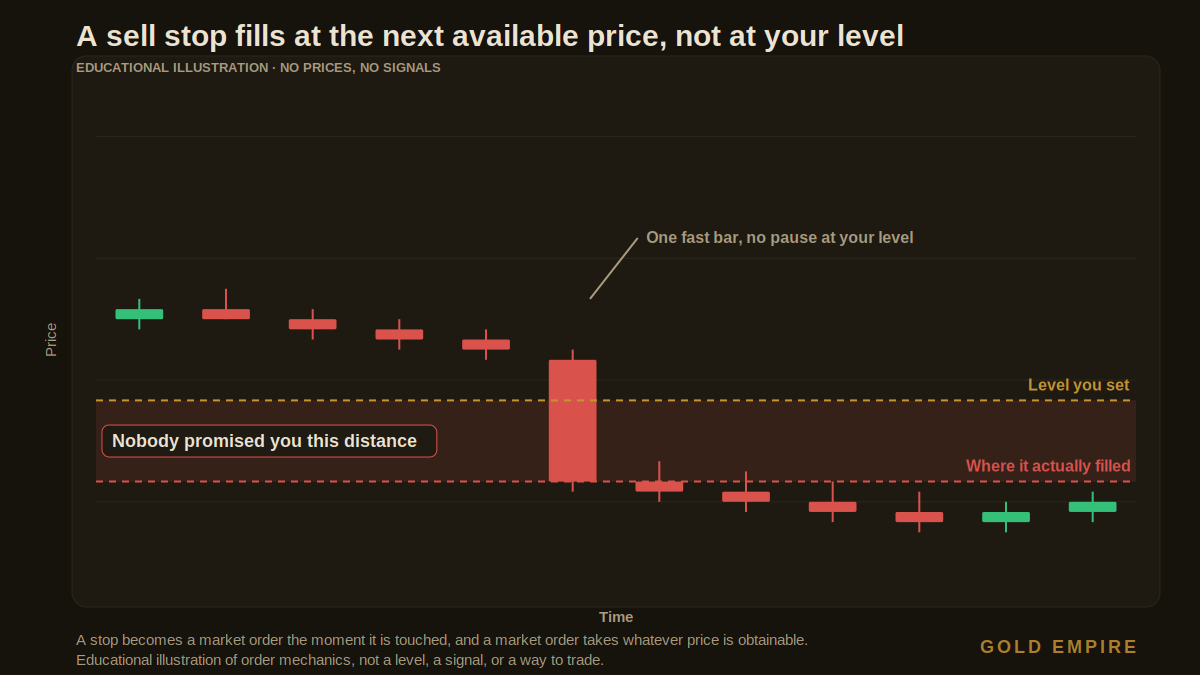
That is not a platform defect and it is not your broker being difficult. It is the definition of the order. A stop that refused to fill at a worse price would not be a stop, it would be a stop limit, and a stop limit that goes unfilled during a fast move leaves you in the position you were trying to exit. There is no version of this where you get both guarantees.
What the overshoot costs, in units you can plan with
Dollars per ounce are useless for this because they depend on your size. So measure the damage the way a risk plan measures everything, in multiples of the amount you decided to risk on the trade. Call that amount one R.
Set up the arithmetic. You are long. Your protective sell stop sits a distance below your entry, and that distance is what defines one R. If the market gaps past your stop, your fill lands further away, and your realised loss is the full distance divided by the planned distance. If the gap carries price a quarter of the stop distance past your level, you lose 1.25R. Half the stop distance past, 1.50R. A full stop distance past, 2.00R. Twice the stop distance past, 3.00R.
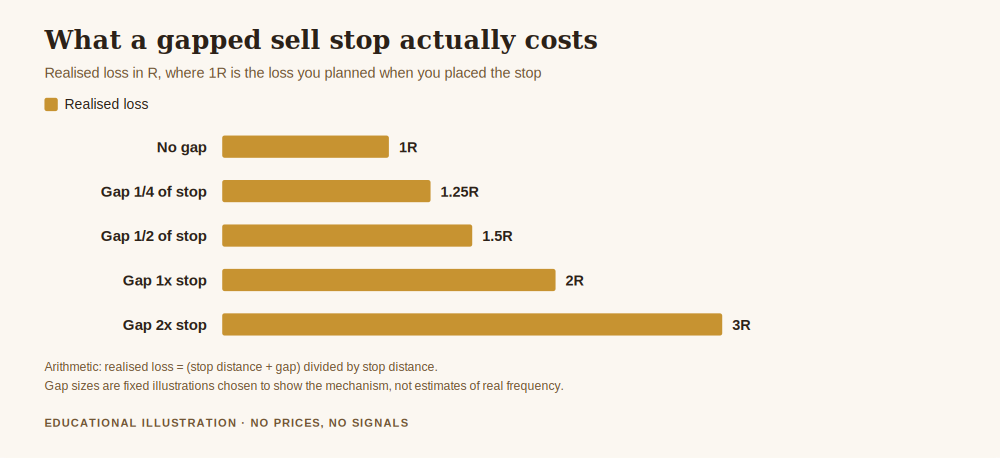
Read that table once more and notice what it is telling you. A tighter stop does not protect you from a gap, it makes the gap more expensive in R terms, because the same overshoot in dollars is a larger multiple of a smaller planned distance. The size of the gap is set by the market. The size of the denominator is set by you, before you enter. That is the only lever in the equation that belongs to you, and it is the argument underneath everything in the risk management guide.
Where the regulator draws the line, and what that tells you about the tail
Gaps are not hypothetical, and the European Securities and Markets Authority built an entire set of rules around the fact that retail accounts were being carried past zero by them. When ESMA announced its product intervention measures on contracts for difference, it set a leverage cap of 20:1 for gold, alongside 30:1 for major currency pairs and 10:1 for other commodities. It also imposed a margin close out rule standardised at 50 per cent of the minimum required margin, and negative balance protection on a per account basis.
Turn the leverage cap into the number that matters. A 20:1 cap means the minimum required margin on a gold position is 5.00 per cent of its notional value. The close out rule bites when account equity falls to half of that, which is 2.50 per cent of notional. So an account funded with exactly the minimum margin has a total adverse move of 2.50 per cent of position value between fully funded and forced liquidation. Not 5 per cent. Half of it.
Two things follow. The first is that a sell stop placed further than 2.50 per cent of notional away from entry, on an account at minimum margin, will never be the thing that closes your position, because the broker’s close out arrives first. The second, and more important, is why negative balance protection had to be written into law at all. Regulators do not legislate against risks that stay inside the agreed loss. They legislate against the ones that run past it, and a stop order filling past its level is exactly that shape of risk.
Those rules apply to retail accounts under European rules. If your account sits elsewhere, the arithmetic above still holds, but the floor underneath it may not, and that is worth knowing before you need it.
Where each of the four belongs in a survival plan
Now the practical part, written as mechanics rather than instruction.
Buy limit and sell limit are entry tools for patient positions. They are the orders you use when your thesis is that price is currently wrong and will come to you. Their failure mode is the quiet one: you do not get filled, you watch the move go without you, and you feel the itch to chase. Nothing is lost except the opportunity, and a missed entry has never emptied an account.
Buy stop is an entry tool for breakout positions. You are deliberately paying a worse price in exchange for the market demonstrating something first. Its failure mode is slippage on entry plus the risk that the breakout was the high of the move. The cost is real but it is bounded by the stop you attach to it.
Sell stop does two completely different jobs and this is the confusion worth clearing. As an entry, it opens a short on a breakdown. As an exit, it is the protective stop on every long you hold. The order type is identical. The consequence of a bad fill is not. A slipped entry costs you a worse starting price on a trade you chose to take. A slipped exit costs you more than the loss you signed up for on a trade that is already going wrong.
Which is why the planning question is not which order type is best. It is: given that my protective order can fill past its level, is my position size small enough that a 2R or 3R outcome is survivable rather than structural? If the honest answer is no, the position is too large, and no choice of order type fixes that. Gaps around the weekend are the most predictable version of this, and I went through the mechanics in what is a weekend gap in gold trading.
Four checks before you place any of the four
These take under a minute and they are the difference between an order you understand and one you are hoping about.
- Say the guarantee out loud. Limit means my price or nothing. Stop means a fill at whatever is next. If you cannot say which one you just placed, you do not yet know what you placed.
- Check the side. Buy limit below, sell limit above, buy stop above, sell stop below. Platforms reject an order placed on the wrong side of price, and traders routinely misread that rejection as a broker problem rather than a sign they wanted the other order.
- Price the bad fill before you need it. Ask what a 2R outcome on this position does to your account. If the answer is uncomfortable, reduce size now, not after.
- Look at the calendar. A pending order left running into a scheduled release or over a weekend is a different order than it was when you placed it, because the distribution of next available prices has changed.
What this article is not saying
I want the limits stated plainly. The R multiples above are arithmetic on assumptions I chose to make the mechanism visible. They are not an estimate of how often gold gaps, by how much, or in which direction, and I have deliberately not offered one, because a credible figure would need a dataset and a method, not a confident sentence.
Nothing here tells you which order to use, where to place it, or when. The regulatory figures are quoted from ESMA and apply to retail accounts under European rules at the time the measures were announced. Rules change, brokers differ, and your account may sit under a completely different regime.
Get the free Gold Empire survival sheet, a one page guide to protecting your account through the kind of fast market where a stop order fills a long way from the level you asked for. One email, no spam, unsubscribe anytime.
Frequently asked questions
What is buy limit sell limit buy stop sell stop, in the shortest possible answer?
Limits sit on the favourable side of price and guarantee your price but not a fill. Stops sit on the unfavourable side and guarantee a fill but not your price. Buy limit is below, sell limit is above, buy stop is above, sell stop is below.
Which of the four can lose me more than I planned?
The two stop orders, because they become market orders when triggered. A sell stop used as a protective exit is the one that matters most, since a fill past the level turns a planned 1R loss into 1.25R, 1.50R, 2.00R or more depending on how far price travels before the fill.
Is a sell limit the same as a take profit?
On a long position, mechanically yes. A take profit above the market on a long is a sell limit, and it inherits the limit guarantee: you get your price or you do not transact. That is why a take profit never slips in your favour and never slips against you.
Why did my platform reject my pending order?
Usually because the level is on the wrong side of the current price for the type you chose, or because it is inside the minimum distance your broker enforces around the market. Both are rules of the order type and the venue rather than faults.
Does a stop limit solve the slippage problem?
It replaces one problem with another. A stop limit will not fill worse than your limit price, but if the market moves straight past that limit during a fast move, it does not fill at all, and you keep the position you were trying to exit. You are choosing which failure you would rather have.
How much margin does a gold position need?
Under the ESMA measures the retail cap for gold is 20:1, which puts minimum required margin at 5.00 per cent of notional, with the close out rule triggering at half that, 2.50 per cent. Outside that regime the numbers are set by your broker and can differ substantially.
What Gold Empire actually does
Gold Empire is a free channel about surviving in gold rather than getting rich in it. There is no signal service here and nothing is sold on the promise of a return. The free Gold Survival Sheet is a single page on protecting an account through exactly the kind of fast market this article describes, and the only thing it asks for is an email address you can unsubscribe from. Everything else, including the risk management guide underneath all of it, is simply published.
The model is deliberate. Follow along for free, read the arithmetic, and decide for yourself. If a piece of writing ever makes you feel you must act immediately, that is a reason to be suspicious of the writing, including mine.
About the author
Matthew writes Gold Empire. He learned the difference between the price guarantee and the fill guarantee the expensive way, on a Sunday open, and has written the arithmetic down ever since rather than relearning it. He has no interest in telling anyone where price is going. You can read more about the approach on the about page.
This article is educational and is not financial advice. Trading gold carries a high risk of losing money rapidly, and no entry, stop or target discussed should be treated as a signal. The regulatory figures are quoted from the European Securities and Markets Authority announcement linked above; the R multiples are arithmetic from stated assumptions, not estimates of real world frequency. Decide your own risk, and never trade money you cannot afford to lose.
One step first
Where should we send the Gold Survival Sheet?
Leave your email and we will send the free one page checklist, then take you straight to the Telegram channel.
No cost and no obligation. Educational only, not financial advice, and nothing here promises a return. Unsubscribe any time in one click.
Leave a Reply