
A weekend gap in gold trading is what you see when Monday’s first price is nowhere near Friday’s last one. No candle connects them. Nothing traded in between. You go to bed on Friday with the chart in one state and you come back to a market that has already moved without you, and without giving anybody a chance to buy or sell inside that space.
This past weekend was a clean example of why the subject matters. Headlines moved over a Saturday and a Sunday while every gold desk in the world was shut. By the time the market reopened, the first tradeable price already reflected the new information. Traders who were flat spent Monday morning reading a chart. Traders who were holding size spent Monday morning finding out what they had been holding.
This article explains what a gap actually is, why gold in particular produces them, what a gap does to a stop loss and to margin, and what a sensible person does about it on a Friday afternoon. It contains no prices, no entries and no targets. It is about the mechanics.
What a weekend gap in gold trading actually is
Every price on your chart is a record of a transaction. Somebody was willing to sell, somebody was willing to buy, and the number where they agreed became a print. A chart is a list of those agreements in time order.
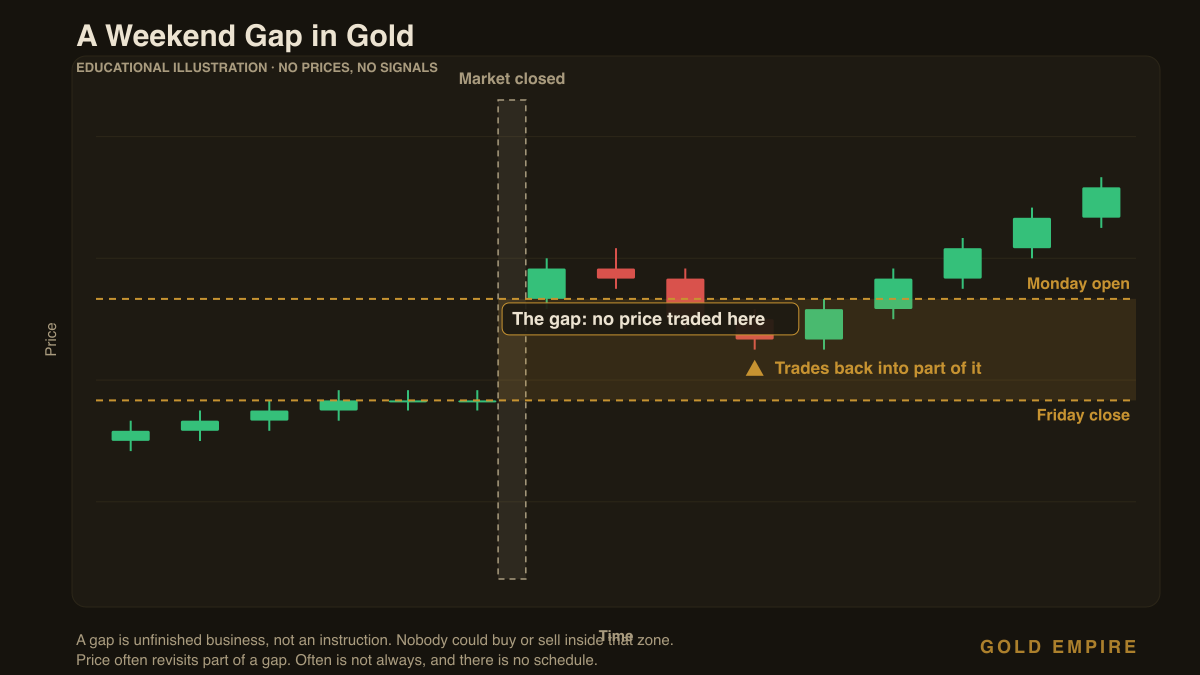
A gap is the absence of one. When the market shuts on Friday, the last agreement of the week is recorded. When it opens again, a new agreement is recorded. If the two numbers are far apart, the space between them contains no agreements at all, because there was no market in which to make them.
That is the whole idea. A gap is not a special kind of move. It is an ordinary move that happened while the door was locked, so the chart has no way to draw it.
Three consequences follow from that, and they are the reason gaps matter more than they look:
- Nobody has a position taken inside the gap, because nobody could trade there.
- Nobody’s stop loss could be filled inside the gap, for the same reason.
- The first tradeable price after the gap is the market’s new opinion, formed in the dark, with no argument along the way.
Why the gold market shuts at all
Gold has a reputation for trading around the clock, and that reputation is broadly earned. The London Bullion Market Association describes the over the counter market plainly: “Internationally, precious metals are traded on a 24-hour basis,” and it puts the scale of it at “approximately 25 billion dollars worth of gold is settled each day in the global OTC market, with London at its centre” (LBMA, About Loco London).
Notice the words “each day”. Twenty four hours a day is not the same as seven days a week. The benchmark makes the point even more sharply. The LBMA Gold Price, the reference number the industry settles against, is set by auction twice a day, at 10:30 and 15:00 London time, and it runs on business days only (ICE Benchmark Administration). On a Saturday there is no auction, because there is no market to auction into.
Put a number on the hole that leaves. If you treat the week as continuous trading from Sunday evening to Friday evening, the shutdown runs roughly 48 hours out of the 168 hours in a calendar week. That is about 29 percent of every week with no tradeable gold price anywhere on earth. The assumption there is a standard week with no holidays, and your own broker’s hours may differ by an hour or two at each end, but the order of magnitude is the point: for two days out of seven, the world keeps generating news about gold and the market has no way to answer.
Gold is unusually exposed to this because of what moves it. Interest rate expectations, the dollar, inflation prints and geopolitical risk are the main drivers, and none of them respect a trading calendar. A central banker gives a speech on a Saturday. A conflict escalates or de-escalates on a Sunday. If you have never worked through the full list of drivers, our piece on what moves the price of gold lays them out.
What a gap does to your stop loss
This is the part that costs people real money, and it is the part almost nobody thinks about until the first time it happens to them.
A stop loss is an instruction, not a guarantee. What you are telling your broker is: when the market reaches this price, get me out at the best available price. In a liquid, continuously trading market, “the best available price” is usually very close to the level you named, and the distinction feels academic.
A gap removes the distinction. If your stop sits inside the gap, the market never traded there. Your instruction is triggered at the reopen and filled at the first available price, which can be well beyond the level you chose. The loss you sized for is not the loss you take.
People discover this and conclude that stops are useless. That is the wrong lesson. The right lesson is that a stop protects you from the ordinary case and does not protect you from the extraordinary one, so the extraordinary case has to be handled somewhere else, which is in your position size. Our guide on where to place a stop loss on XAU/USD covers the mechanics of placement, and position sizing for gold covers the part that actually caps the damage.
Margin arrives before you are awake
There is a second-order effect that beginners rarely anticipate. A leveraged position that gaps against you does not just book a bigger loss than planned. It also consumes margin instantly, at the open, before you have looked at a screen. If the account was already carrying several positions, the reopen can produce a margin call in the first minutes of the week, on a chart you have not even read yet.
This is not an argument for panic. It is an argument for arithmetic. If you would not be comfortable with a position that moved several times its usual distance against you before you could react, then the position is too large to hold through a closed market. That is a sizing decision made on Friday, not a reaction made on Monday.
Execution quality is a broker question too
How a gap is handled in practice depends partly on who is filling your orders: the reopen spread, whether stop orders are treated as market orders, and how slippage is applied. This is one of the few moments where the choice of counterparty shows up directly in your P&L, which is why it belongs in the same conversation as choosing a broker for gold trading rather than being treated as a chart topic.
Working through this with us. We publish gold market context daily in the free Gold Empire Telegram channel, and the free Gold Survival Sheet is the one page checklist we use before holding anything through a closed market. Both are free, and neither asks you to trade.
Four things a gap can do next, not one
There is a piece of folklore that says gaps always fill. It gets repeated because it is memorable and because it is often enough true to feel like a rule. It is not a rule. It is a tendency with no timetable attached, and a tendency with no timetable is not something you can plan around.
Here is the honest version. After a gap, price can do four different things, and none of them is announced in advance:
- Fill quickly. The move was an overreaction to a headline, participants who could not trade over the weekend take the other side, and the gap closes within hours.
- Fill slowly. The market drifts back over days or weeks, long after anyone who traded the reopen has been shaken out.
- Fill partially, then continue. Price dips back into part of the untraded zone, finds sellers or buyers there, and carries on in the direction of the gap. This is the case drawn in the chart above.
- Never fill in any timeframe that matters to you. The repricing was real, the market accepted it, and the empty space stays empty.
If four outcomes are possible and you cannot tell which one you are in, then “the gap will fill” is not analysis. It is a hope with a chart attached. The useful question is not what the gap will do. It is what you will do in each of the four cases, decided before the market opens.
Reading the Monday open without guessing
The reopen is one of the lowest quality information environments of the week. Spreads are typically wider than normal, volume is thin until the Asian session properly gets going, and the first prints often move more than they should because there is very little on the book to absorb them. If you want the wider context on why different hours behave differently, we covered it in the best time to trade gold.
A few practical points that hold up regardless of your method:
- The first price is not a verdict. It is the first offer in a negotiation that has not started yet. Treating the opening print as the market’s settled opinion is how people end up buying the extreme of the week.
- Wait for the market to trade, not just to open. A gap becomes readable once there is enough activity to see whether the new level attracts business or repels it. That usually takes hours, not minutes.
- The gap edges become reference points. Friday’s close and Monday’s open are levels the whole market can see, which makes them worth marking on the chart. That is exactly the same logic as any other structural level, and our piece on support and resistance in gold trading applies to them without modification.
- Standing aside is a decision. If the reopen is unreadable, not trading it is a position with a defined cost of zero.
A gap driven by a scheduled event is a different animal from a gap driven by a surprise, and if the weekend contained something that was on the calendar, the approach we set out in trading gold through high impact news is closer to what you want.
You cannot control whether the market gaps. You can control how much of your account is exposed to it when it does.
Three Friday habits that cost nothing
None of what follows requires a view on direction. All of it is available to a complete beginner.
1. Decide your weekend exposure deliberately, not by default. The question is not “should I hold over the weekend”, because sometimes the answer is genuinely yes. The question is whether the size you are holding is a size you chose for a two-day blind spot, or just the size you happened to have on at 4pm on Friday. Those are different numbers for most people.
2. Assume the stop can be jumped, and size for that. Work out what the position costs if it opens well past your stop. If that number changes how you feel, reduce until it does not. This single exercise removes most of the horror from Monday mornings, and it is the same discipline described in our guide to risk management in gold trading.
3. Write down what you will do in each of the four cases. Two sentences is enough. If it gaps in my favour, I will do this. If it gaps against me, I will do that. The value is not in the prediction, it is in having a plan that was written by a calm person rather than by a person looking at a red number.
Get the free Gold Empire survival sheet, a one-page guide to protecting your account through the kind of market this article describes. One email, no spam, unsubscribe anytime.
Frequently asked questions
Do all weekend gaps get filled?
No. Many do, which is why the myth persists, but plenty do not, and among those that do, some take months. There is no timetable, so a gap fill cannot be treated as an expected outcome you can build a plan on.
Can I avoid gap risk completely?
Only by being flat when the market closes. That is a legitimate choice with a real cost, since you also give up any move that happens in your favour. Most of the difference between traders who survive gaps and traders who do not is size, not timing.
Why does gold gap when it trades 24 hours a day?
Because 24 hours a day applies to business days. The benchmark auction runs twice a business day and there is no weekend session, so roughly two days a week the market is closed while the news that drives gold carries on.
Does a bigger gap mean a bigger move is coming?
Not reliably. Gap size tells you how much the consensus changed while the market was shut. It says nothing about what happens next, and large gaps are followed by continuation and by full reversal often enough that neither can be assumed.
Should a beginner trade the reopen?
There is nothing magic about it, and it has wider spreads and thinner liquidity than almost any other part of the week. If you are still building consistency, there are better hours to be learning in.
Where this leaves you, and what we do about it
Gaps are one of the clearest illustrations of the idea this whole channel is built around. You cannot control the market. You can control the size of the bet you have on the table when the market does something you did not authorise. Everything else is commentary.
Gold Empire is a free Telegram channel where we publish gold market context and work through this kind of mechanic in public. There is no promise of profit here, and there never will be, because nobody can honestly make one. What we can do is make sure you understand the machinery you are dealing with before it teaches you the expensive way.
If this article was useful, the free Gold Survival Sheet is the natural next step. It is a one page checklist covering position size, stop placement and the questions worth asking before you hold anything through a closed market. It costs nothing and it does not require you to trade anything.
About the author. Matthew writes the Gold Empire market notes and has spent his time in this market mostly learning what not to do. He is not a licensed adviser and does not want to be one. His interest is in the part of trading nobody posts screenshots of: staying in the game long enough for a method to matter.
Disclaimer: This article is general educational content about market mechanics. It is not financial advice, not a recommendation, and not a solicitation to trade. Trading leveraged products carries a high risk of losing money rapidly. No entry, stop or target discussed should be treated as a signal. Past market behaviour does not predict future behaviour. Consider your own circumstances and seek independent regulated advice if you need it.
One step first
Where should we send the Gold Survival Sheet?
Leave your email and we will send the free one page checklist, then take you straight to the Telegram channel.
No cost and no obligation. Educational only, not financial advice, and nothing here promises a return. Unsubscribe any time in one click.
Leave a Reply