
Every few weeks a single American statistic empties the order book, widens the spread and moves gold further in ninety seconds than it moved in the previous nine hours. That statistic is nonfarm payrolls, and if you have been trading gold for more than a month or two you have already been on the wrong side of one, probably without understanding what actually happened.
This week is a heavy one for exactly that reason. The American calendar is stacked with labour market releases, and the payrolls report lands at the end of it. So this is a good moment to explain the machinery properly, because most of what gets said about this release in trading groups is wrong in a way that costs money.
I am not going to tell you how to trade it. I am going to tell you what the number is, where it comes from, how precise it actually is, and why the honest answer to “what will gold do on payrolls day” is that nobody knows, including the people who sound most certain.
What nonfarm payrolls actually measures
The Employment Situation report is published by the US Bureau of Labor Statistics. The headline everyone quotes, the payrolls number, is the estimated change in the number of people on American payrolls over the past month, excluding farm workers, the self employed, private household staff and a few other categories. That is where the slightly odd word “nonfarm” comes from. It is a leftover from an era when agricultural employment swung so violently with the seasons that leaving it in made the rest of the picture unreadable.
The number is an estimate from a survey, not a count. The Bureau surveys roughly 119,000 businesses and government agencies each month, covering about 622,000 individual worksites, which together represent around 26 percent of all nonfarm payroll jobs. A second and completely separate survey of about 60,000 households produces the unemployment rate.
Two surveys, two methods, two sets of numbers, released in the same document at the same minute. That alone should tell you the report is not the single clean fact it gets treated as.
Why a metal cares about an American jobs number
Gold does not care about employment. Gold cares about what employment does to interest rate expectations, and there the link is direct and official rather than a matter of opinion.
The Federal Reserve has what is known as a dual mandate. In its own words, Congress has assigned it to conduct monetary policy “to support the goals of maximum employment and stable prices“. Employment is not one input among many. It is one of the two things the central bank is legally pointed at.
So the chain runs like this. A jobs report changes the market’s view of how strong the labour market is. That changes expectations of what the Fed will do with rates. Rate expectations move the dollar and real yields. And gold, which pays no interest to anyone who holds it, becomes relatively more or less attractive as the return available on cash moves. That is the whole transmission, and it is the same chain I walked through in the piece on the FOMC and why gold reacts to it. Payrolls is not a competing story. It is one of the main pieces of evidence the committee is reading.
This is why a strong jobs number often pressures gold and a weak one often supports it. Note the word “often”. It is not a rule, and later in this article you will see why treating it as one is how people get hurt.
The number everyone quotes is one of four
Open the report and you will find that the headline payrolls figure sits alongside several other numbers that regularly matter more.
- The payrolls change itself. The number that flashes on every screen.
- Revisions to the previous two months. The Bureau states plainly that “the prior 2 months are routinely revised to incorporate additional sample reports and recalculated seasonal adjustment factors.”
- The unemployment rate, which comes from the household survey, not the business survey, and can move in a direction that appears to contradict the headline.
- Average hourly earnings. Wage growth feeds directly into the inflation half of the Fed’s mandate, and in some months this is the line the market actually trades.
A trader who has decided in advance that “strong number equals gold down” is reading one line of a four line document. It is entirely normal for payrolls to beat expectations while the prior two months are revised down by more than the beat, which means the level of employment is now lower than the market believed five minutes ago. The headline was green. The information was red.
What the margin of error does to the headline
This is the part almost nobody mentions, and it is the single most useful thing in this article.
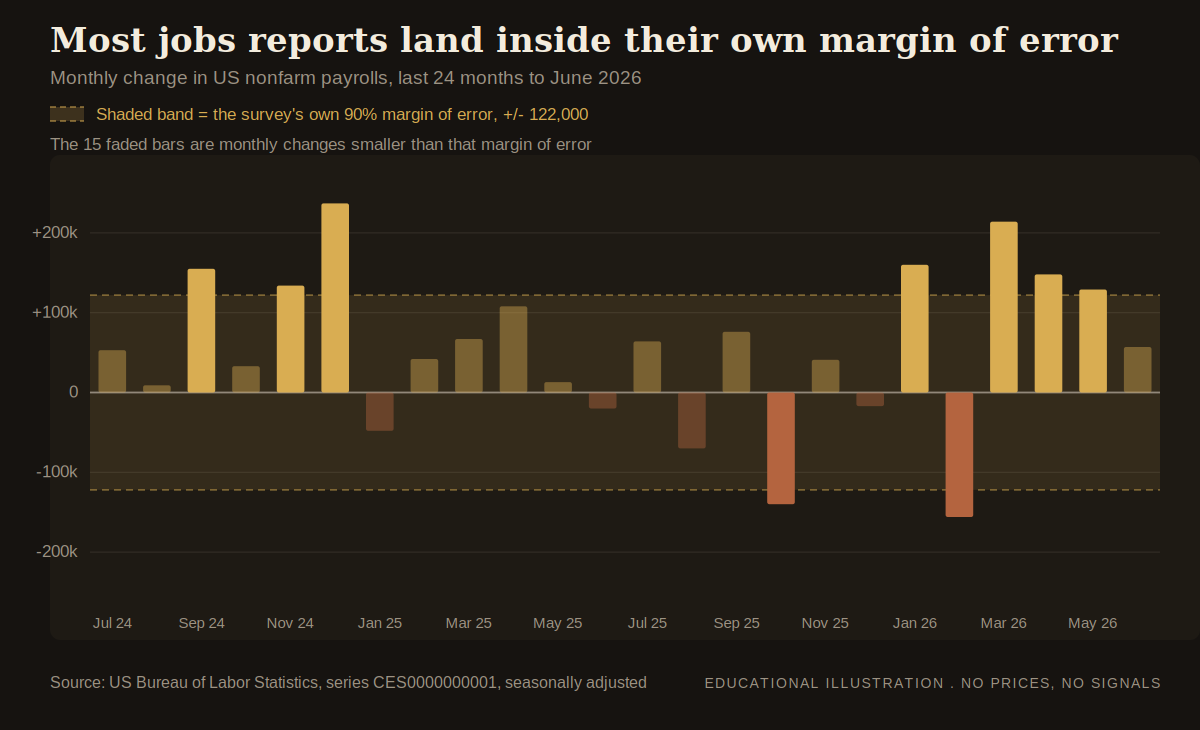
Because payrolls is a survey estimate, it carries sampling error, and the Bureau publishes how much. In its technical note it states that “the confidence interval for the monthly change in total nonfarm employment from the establishment survey is on the order of plus or minus 122,000” at 90 percent confidence.
Sit with that number for a second. It means that when the report says employment rose by 90,000, the survey itself cannot distinguish that from zero with 90 percent confidence. It also cannot distinguish it from 200,000.
I pulled the official series from the Bureau’s public data service and checked how often that matters. Over the 24 months to June 2026, the average absolute monthly change was about 91,000. Fifteen of those 24 months, that is 62 percent of them, reported a change smaller than the survey’s own margin of error. Those are the faded bars in the chart above.
To put the scale in perspective: total nonfarm employment is running near 159 million. A typical monthly change of 91,000 is under six hundredths of one percent of that level. We are watching a small difference between two very large estimated numbers, and then trading it in the first second.
Now, I want to be careful and fair here, because the wrong conclusion is easy to draw. This does not mean the data is worthless. The direction over several months carries real information, the level is meaningful, and the Fed is genuinely reading it. What it means is narrower and more practical: a single month’s headline is a noisy estimate, and a “miss” of 40,000 against forecast is statistical noise being reported as news. The market will still react to it. That reaction is real and it will move your position. But the confidence some people project about what the number means is not supported by the number itself.
Why the revisions matter more than the release
Follow the logic of that margin of error one step further and the revisions stop being a footnote.
The first print of any month is the estimate with the least data behind it. More responses arrive over the following two months, and the Bureau updates the figure accordingly. So the number the market violently repriced on the first Friday is, by design, the least reliable version of that month’s employment picture, and the more accurate version arrives quietly weeks later when nobody is watching.
There is a lesson in that which goes well beyond this one release. The market’s biggest reaction happens at the moment of maximum uncertainty, not the moment of maximum information. That is not a flaw you can exploit. It is simply the shape of the thing, and knowing it should make you humbler about the first ninety seconds rather than more excited about them.
What the release window does to your account
Whatever you believe about the number, the mechanical conditions during the release are hostile, and this part is not a matter of interpretation.
Liquidity thins out before the print as market makers pull back. Spreads widen, sometimes dramatically, which I covered in more detail in the article on the spread in gold trading. Price can move through a range in a single tick with nothing traded in between. And that last point is the one that hurts people, because a stop loss is an instruction to exit at the market once your level is touched, not a promise of the price you will get. In a fast market it can fill materially worse than where you placed it.
This is worth being blunt about. If your risk plan assumes your stop fills exactly where you put it, your actual risk on a payrolls Friday is larger than the number in your head. That is not a reason to trade without a stop, which would be far worse. It is a reason to size as though the stop might slip, and it is one of the reasons execution quality and who you trade through matters more on these days than on any other.
None of this is exotic. It is the same set of conditions I described in the general guide to trading gold through high impact news, and payrolls is simply the clearest monthly example of it.
How careful traders treat a payrolls Friday
I am not going to give you an entry, and I would be suspicious of anyone who does. What I can describe is how people who are still trading after several years tend to behave around this release. There are broadly three approaches, and all three are legitimate.
The first is to be flat. Close what you have before the release, sit it out, and come back when spreads normalise. This is not cowardice and it is not missing out. Choosing not to have an opinion during the least predictable minutes of the month is a decision with a real edge behind it, and plenty of consistently profitable traders do exactly this every month.
The second is to already be positioned, with size chosen specifically so that a violent move against you is survivable rather than terminal. The key word is “already”. The position was taken for reasons that existed before the release, and the release is a risk to be endured rather than the reason for the trade.
The third is to wait. Let the print land, let the first reaction happen, let the fake move in the wrong direction burn itself out, and only then consider whether the market has told you something. The cost of this approach is that you never get the best price. The benefit is that you are reacting to what happened rather than betting on what might.
What all three share is that the decision was made in advance, calmly, and the position size was set so that being wrong is affordable. That is the whole discipline, and it is the same one described in the risk management guide that underpins everything else on this site.
What none of them involve is deciding at 13:29 to take a large position because you have a feeling about the number.
A quick word before the questions
If this is the kind of explanation you find useful, the Gold Empire Telegram channel is where I post market context through the week, free and with no upsell attached. And the free Gold Survival Sheet is a one page checklist for exactly these situations: how to size, where risk actually sits, and what to check before a scheduled event lands.
Get the free Gold Empire survival sheet, a one-page guide to protecting your account through the kind of market this article describes. One email, no spam, unsubscribe anytime.
Frequently asked questions
When is nonfarm payrolls released?
It is usually released on the first Friday of the month at 8:30 in the morning New York time, covering the previous month. The Bureau of Labor Statistics publishes its schedule in advance, so the date is never a surprise. There is no excuse for being caught unaware by a scheduled release.
Does a strong jobs number always push gold down?
No, and this is the most common mistake. The market trades the difference between the outcome and what was already expected, not the raw number. A strong figure that is weaker than the market had positioned for can send gold up. Add in revisions, wage growth and the unemployment rate pulling in different directions, and single line rules break down quickly.
Why does gold sometimes move in both directions within a minute?
Because the report contains several numbers that can conflict, because liquidity is thin enough that a modest amount of buying or selling moves price a long way, and because a lot of automatic orders trigger at once. The first move is frequently not the move that lasts. That is a description of what commonly happens, not a prediction you can rely on.
Is the payrolls number accurate?
It is a carefully constructed estimate, produced honestly, with its uncertainty published openly. It is not a precise count, and the Bureau has never claimed it is. The 90 percent confidence interval on the monthly change is around plus or minus 122,000, and that is a fact about survey mathematics rather than a criticism of the statisticians.
Should a beginner trade the payrolls release?
In my honest opinion, no. Spreads are at their worst, slippage risk is at its highest, and the informational content of the first move is at its lowest. If you are still building consistency, this is a poor place to learn, and there are twenty other trading days in the month with better conditions.
What about the other labour releases in the same week?
Reports such as job openings, private payroll estimates and jobless claims all feed the same picture, and they can move gold too, usually less. They are worth knowing about mainly so that you are not surprised by volatility on a day you assumed was quiet. Knowing what is on the calendar is basic operational hygiene.
Where this leaves you, and what we do about it
Nonfarm payrolls is a good teacher because it strips away the comfortable illusion that there is a knowable answer if you just read enough analysis. Here is a number produced by a rigorous public agency, published with its own error bars, revised twice as more evidence arrives, and interpreted through four separate lines that regularly disagree. If certainty were available anywhere, it would be available here, and it is not.
So the honest position is the one this channel keeps arriving at from every direction. You cannot control what the number says or how the market reads it. You can control whether the size of your position makes a bad ninety seconds survivable. That is not a consolation prize. Over a career it is very nearly the whole game.
Gold Empire is a free Telegram channel where we work through this kind of market mechanic in public. There is no promise of profit here and there never will be, because nobody can honestly make one. What we can do is make sure you understand the machinery before it teaches you the expensive way.
If this was useful, the free Gold Survival Sheet is the natural next step. It is a one page checklist covering position size, stop placement and the questions worth asking before a scheduled event lands. It costs nothing and it does not require you to trade anything.
About the author. Matthew writes the Gold Empire market notes and has spent his time in this market mostly learning what not to do. He is not a licensed adviser and does not want to be one. His interest is in the part of trading nobody posts screenshots of: staying in the game long enough for a method to matter.
Disclaimer: This article is general educational content about market mechanics and public economic data. It is not financial advice, not a recommendation, and not a solicitation to trade. Trading leveraged products carries a high risk of losing money rapidly. No entry, stop or target discussed should be treated as a signal. Past market behaviour does not predict future behaviour. Consider your own circumstances and seek independent regulated advice if you need it.
One step first
Where should we send the Gold Survival Sheet?
Leave your email and we will send the free one page checklist, then take you straight to the Telegram channel.
No cost and no obligation. Educational only, not financial advice, and nothing here promises a return. Unsubscribe any time in one click.
Leave a Reply