

When a trade moves your way, there is a moment where the sensible thing seems obvious: pull the stop up to your entry price so the trade can no longer lose. That move has a name. It is a break-even stop, and you will see it announced in every trading room on earth, usually with a phrase like “capital is now protected”.
We say something close to that ourselves when a position earns it. I want to spend this article being precise about what that phrase means, because it is roughly true, it is not exactly true, and the difference between roughly and exactly is where people quietly lose expectancy for years without noticing.
This is not an argument against moving your stop. It is an argument against believing the move is free.
What a break-even stop actually is
You enter a trade with a stop below your entry, risking some fixed amount. Price moves in your favour. You then move the stop up to the price you entered at. From that point, if price comes back to where you started, you exit with nothing gained and nothing lost, minus costs.
The appeal is emotional and immediate. The trade can no longer hurt you. You stop watching it with your stomach. For a lot of people this is the single most calming action available in trading, and I am not going to pretend that has no value, because managing your own state is part of the job.
But notice what has actually happened. You have not removed risk from the trade. You have exchanged one risk for another. The risk of losing 1R has been swapped for the risk of being taken out of a trade that was going to work.
Why “zero risk” is not quite right
Two things stop a break-even stop from being the guarantee it sounds like.
The first is mechanical. A stop is an instruction to leave at the market once your price is touched. It is not a promise about the price you will get. In a thin or fast market, price can pass through your level and fill you somewhere worse. That is not a rare edge case, it is normal behaviour around scheduled news and at the edges of the trading day.
The second is the weekend and the gap. If the market closes and reopens somewhere else entirely, your stop was not sitting there defending anything, because there was no market for it to act in. I went through this in detail in the piece on weekend gaps in gold trading, and it is the cleanest proof that a stop level is an instruction rather than a shield.
Regulators have effectively conceded this point. When European authorities intervened in leveraged retail products in 2018, one of the measures they introduced was to ensure that investors cannot lose more money than they put in. That protection had to be legislated. If stop orders reliably capped losses at the level people set them, there would have been nothing to legislate.
So “capital is now protected” is a fair shorthand for “most of the downside on this position has been removed”. It is not the same as “zero downside risk”, and the honest version is worth saying out loud.
The part almost nobody calculates
Now the more interesting question, and the reason I wanted to write this. Set aside slippage and gaps entirely. Assume the break-even stop works perfectly and takes you out at exactly your entry. Is it still a good idea?
The answer is that it depends, and it depends on something you can measure rather than something you can feel. Here is the arithmetic, with every assumption stated so you can disagree with it.
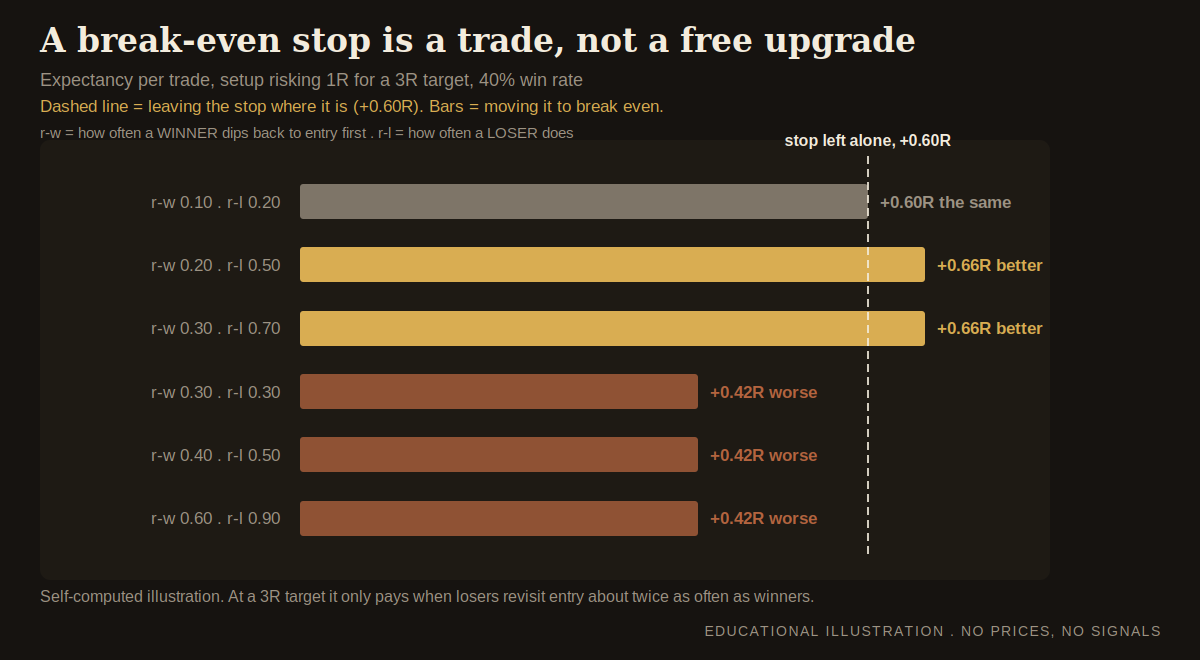
Take a setup that risks 1R and targets 3R, and assume it reaches that target 40 percent of the time. Left alone, the expectancy is 0.40 times 3, minus 0.60 times 1, which is plus 0.60R per trade.
Now introduce the break-even stop. Two numbers decide everything:
- How often a trade that would have won dips back to your entry first, and gets scratched at zero. Call it the winner pull-back rate.
- How often a trade that would have lost comes back to your entry before hitting its original stop, and gets scratched at zero instead of costing you 1R. Call it the loser pull-back rate.
The first number costs you 3R every time it happens. The second saves you 1R every time it happens. That asymmetry is the whole story, and it is why the answer is not obvious.
Run the numbers and a clean condition falls out. On this setup, a break-even stop only improves your expectancy if your losers come back to entry at least twice as often as your winners do. If losers revisit entry 50 percent of the time and winners only 20 percent, expectancy improves from 0.60R to 0.66R. If both revisit entry 30 percent of the time, expectancy falls from 0.60R to 0.42R, a drop of about a third, for a change that felt like pure prudence.
The general form is worth keeping. The ratio you need is your reward multiple times your win rate, divided by your loss multiple times your loss rate. The bigger your target, the more the break-even stop has to earn its place, because every winner it scratches costs you more.
What that means in practice
The useful conclusion is not “never move your stop” and it is not “always move it”. It is that the right answer is a property of your setup, not a rule you can borrow.
Nobody can tell you from the outside whether your losers revisit entry more often than your winners. It depends on how you choose entries, how much room you give them, and what kind of market you trade in. It is knowable, but only from your own records.
Which means the honest instruction is boring: go and look. If you keep a journal, you already have the raw material. For your last several dozen trades, mark whether price came back to your entry after moving in your favour, and whether that trade eventually worked or not. Two columns. If losers come back far more often than winners, the break-even stop is earning its keep. If both come back at similar rates, you are paying for comfort.
This is the same principle behind everything in the risk management guide. Rules that sound universal are usually rules somebody derived from their own data and then presented as law.
The reason people move to break even anyway
I want to be fair to the practice, because there is a real argument for it even when the arithmetic is unfavourable.
A trader who moves to break even and then sits calmly is a different trader from one who watches an open position with real money at stake and interferes with it. If the break-even stop costs you 0.18R of expectancy but prevents one panicked exit a month, it may still be the better choice for you as an operator. Expectancy on paper assumes you execute perfectly. You do not, and neither do I.
That is a legitimate reason. Notice it is a completely different reason from “this removes risk”. One is an honest trade of expectancy for consistency. The other is a misunderstanding. Make the trade knowingly, and you are managing yourself well. Make it because you think it is free, and you are slowly paying for something you were never told the price of.
There is also a middle path a lot of experienced traders end up on: move the stop to reduce risk rather than eliminate it, so a pull-back costs you a fraction of the original amount instead of scratching you at exactly zero. It keeps some of the protection without sitting your stop at the single most likely place for price to touch on its way up. I am describing what people do, not telling you to do it.
Where this sits with the rest of trade management
Moving a stop is one decision inside the larger job of running a position after you are in it, which I covered more broadly in how to manage a gold trade after you enter. And where you put the stop in the first place, before any of this comes up, matters more than any adjustment you make later. That is the subject of where to place a stop loss on XAUUSD.
If your original stop is in a bad place, moving it to break even does not fix that. It just gives you a different way to be taken out.
A quick word before the questions
If this is the kind of thinking you find useful, the Gold Empire Telegram channel is where I post market context through the week, free, with no upsell. And the free Gold Survival Sheet is a one page checklist covering sizing and stop placement, which is the layer underneath everything in this article.
Get the free Gold Empire survival sheet, a one-page guide to protecting your account through the kind of market this article describes. One email, no spam, unsubscribe anytime.
Frequently asked questions
When should I move my stop to break even?
There is no honest universal answer, and that is the point of this article. It depends on whether your losing trades return to your entry more often than your winning ones do, which is measurable in your own journal and different for every method. Anyone who gives you a confident number for this without seeing your records is guessing.
Does a break-even stop really mean zero risk?
No. It removes most of the downside on that position, which is worth having, but a stop is an instruction to exit at the market rather than a guaranteed price, and a closed market can reopen past your level. “Most of the risk is gone” is accurate. “No risk” is not.
Why would moving to break even ever hurt me?
Because your entry price is a level price often revisits on its way to your target. Every time it does, you are taken out of a trade that would have paid. If your target is three times your risk, each of those costs three times what a saved loser gains you.
Is it better to move the stop partway instead?
Some traders do exactly that, reducing risk without sitting at the most crowded price. It keeps part of the protection and scratches fewer good trades. Whether it suits you depends on your setup and on how you behave with an open position, so treat it as an option to test rather than an upgrade to adopt.
Does this apply to trailing stops as well?
The same logic applies with more force. A trail is a repeated version of the same decision, so it exits more winners early in exchange for locking in more of the moves that keep running. Whether that is a good exchange depends on how your particular market moves, which again comes back to your own records.
What about the emotional benefit, does that count?
Yes, genuinely. If moving to break even stops you interfering with trades, that is worth real expectancy, because a plan you actually follow beats a better plan you abandon. Just be clear with yourself that you are buying calm with expectancy, rather than getting something for nothing.
Where this leaves you, and what we do about it
The break-even stop is a good example of how trading advice goes wrong. Nobody is lying when they say capital is protected. It is a reasonable shorthand, said in good faith, and mostly accurate. But it hardens into a belief that the move is free, and once something feels free, nobody measures it.
Almost everything that costs traders money over a career looks like this. Not a dramatic mistake, just a small unexamined assumption applied several hundred times.
Gold Empire is a free Telegram channel where we work through market mechanics in public. There is no promise of profit here and there never will be, because nobody can honestly make one. What we can do is take the phrases everyone repeats and check whether they survive arithmetic.
If this was useful, the free Gold Survival Sheet is the natural next step. It is a one page checklist covering position size, stop placement and the questions worth asking before you touch a live position. It costs nothing and it does not require you to trade anything.
About the author. Matthew writes the Gold Empire market notes and has spent his time in this market mostly learning what not to do. He is not a licensed adviser and does not want to be one. His interest is in the part of trading nobody posts screenshots of: staying in the game long enough for a method to matter.
Disclaimer: This article is general educational content about trade management mechanics. It is not financial advice, not a recommendation, and not a solicitation to trade. The expectancy figures are illustrations computed from stated assumptions, not measurements of any real strategy or account. Trading leveraged products carries a high risk of losing money rapidly. No entry, stop or target discussed should be treated as a signal. Past market behaviour does not predict future behaviour. Consider your own circumstances and seek independent regulated advice if you need it.
One step first
Where should we send the Gold Survival Sheet?
Leave your email and we will send the free one page checklist, then take you straight to the Telegram channel.
No cost and no obligation. Educational only, not financial advice, and nothing here promises a return. Unsubscribe any time in one click.
Leave a Reply