
If you are searching for how to get signals for forex trading, I can answer the literal question in about thirty seconds, and then I want to spend the rest of this article on the part that actually decides what happens to your account. Because the getting is easy. Almost everyone gets that part right. It is the ninety seconds after the signal lands on your phone that separates the traders who are still here next year from the ones who are not.
I run a gold signal channel. I am aware of how it sounds for me to tell you that signals are the least important input in this business. I am telling you anyway, because I blew up accounts of my own while holding a list of perfectly reasonable trade ideas, and the ideas were never the problem.
How to Get Signals for Forex Trading, the Easy Part
There are only a handful of routes, and none of them are hard to find.
Free public channels
Telegram, Discord and X are full of them. You join, and setups appear. This is the cheapest option and the most crowded one. The trade-off is that you usually cannot see a full history, the person posting has no obligation to you, and the incentive is to post frequently rather than to post well.
Paid subscription services
You pay monthly for a smaller room, and usually you get more explanation attached to each idea. The money changes the incentive slightly for the better, because now they have to keep you. It also changes it for the worse in one specific way: a service with nothing to show you this week is still charging you this week, which quietly pressures them to manufacture activity.
Copy trading and signal marketplaces
Platforms that connect your account to somebody else’s and mirror their trades automatically. The appeal is obvious. The catch is that the position size is decided by an algorithm reading your balance, not by anyone who knows what else you have going on in your life this month.
Broker-provided research and autochartists
Many brokers bundle in a signal tool. It is free, it is convenient, and it is generated by software scanning for patterns. Treat it as one more opinion rather than a decision.
That is the complete map. You can be receiving forex signals within five minutes of finishing this paragraph, at no cost. Which is exactly why the ability to get signals has never been what separates a surviving account from a dead one.
The Same List, Three Different Accounts
Here is a piece of arithmetic that took me far too long to take seriously.
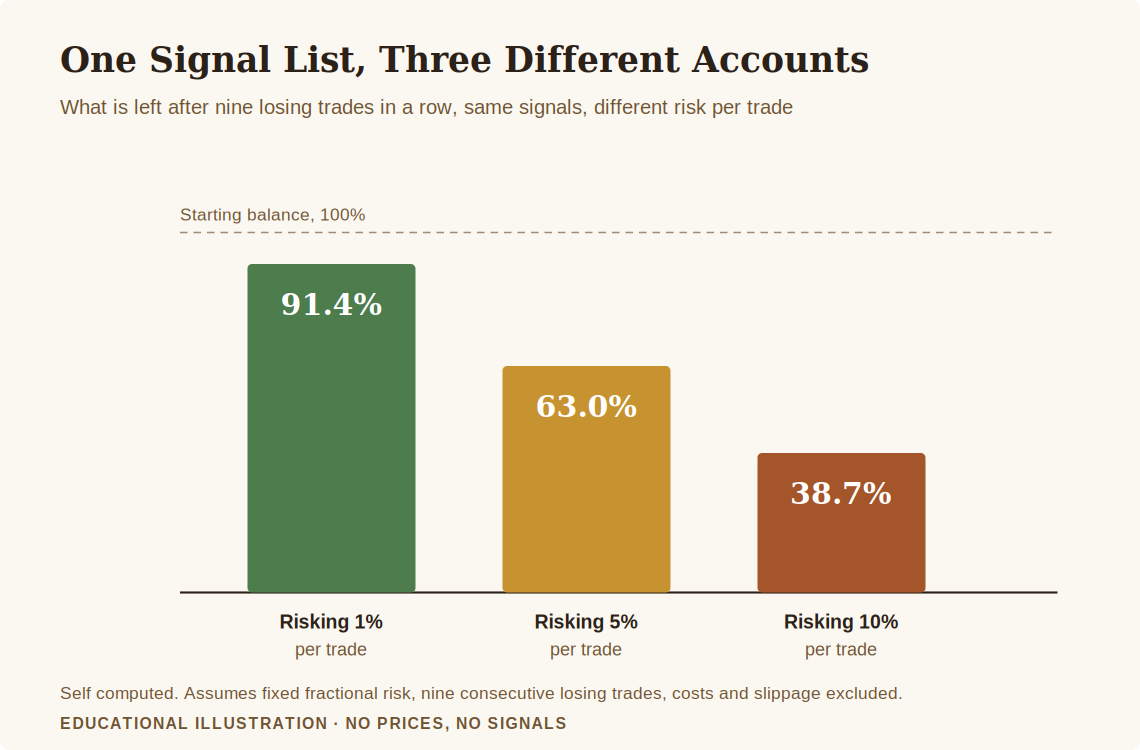
Imagine three traders in the same room, reading the same channel, taking every single call at exactly the same moment. Identical entries. Identical exits. The only difference between them is how much of the account each one puts at risk on a trade.
Now hand all three of them the same losing run, nine trades that do not work. This happens. It happens to good processes.
- The trader risking 1 percent per trade finishes that run with 91.4 percent of the account intact.
- The trader risking 5 percent finishes with 63.0 percent.
- The trader risking 10 percent finishes with 38.7 percent.
I calculated those figures directly, assuming fixed fractional risk, nine consecutive losses and no trading costs. You can reproduce them in a spreadsheet in a minute. The assumptions are simple on purpose, because the point does not need complexity to hold.
Three traders. One signal provider. One set of trades. The first one has had an annoying fortnight. The third one now needs to more than double what is left simply to get back to where they started, and they will be trying to do that while frightened, which is the worst possible condition for decision making.
The signal was identical in all three cases. The signal was not the variable. It never was.
This is why I keep pointing people back to the one rule that keeps you in the game before they ask me anything about entries, and why how much to risk per trade matters more than any setup I could hand you. If you want the mechanics of turning a percentage into an actual lot size, position sizing for gold covers it.
How Many Trades Before a Win Rate Means Anything
Somebody advertises a 60 percent win rate. You want to know whether that is real or whether it is a coin flip with good marketing. This is a question statistics can answer precisely.
Suppose the honest baseline is 50 percent, and you want to be reasonably confident that a claimed 60 percent is genuinely better than that, rather than an ordinary run of luck. Running the exact binomial test, at a 5 percent significance level and 80 percent power, you need roughly 158 trades before the difference can be distinguished from noise. If you want to be more confident than that, the number climbs past 200.
Sit with that for a second. One hundred and fifty-eight trades. Most signal services have not shown you anything like that many verified results, and most subscribers make up their mind after about a dozen.
Twelve trades is nothing. Twenty trades is nothing. A screenshot of a good week is worse than nothing, because it was selected precisely for being good. The honest position, after a month of following anyone, is that you still do not know very much, and any confidence you feel is manufactured.
I would rather tell you that than sell you certainty I cannot back up.
A Losing Run Is Not Proof of a Bad Signal
The reverse error is just as expensive, and I see it constantly.
Take a process that genuinely wins 55 percent of the time. Good, not spectacular, better than most. Over 100 trades, the probability of hitting a run of at least six losses in a row somewhere along the way is about 36 percent. Roughly a one in three chance. A run of eight straight losses still shows up about 8 percent of the time.
Again, calculated directly, assuming independent trades and a fixed win rate. Real trading is messier, but messier tends to make streaks more likely, not less.
So a six-loss streak is not evidence that something broke. It is an ordinary feature of a working process. Yet this is the exact moment when most people cancel the subscription, double their size to catch up, or go looking for a different channel. They quit a functioning process during a statistically unremarkable bad patch, and then repeat the cycle somewhere else.
If you have lived through this, trading after a losing streak deals with the psychology of it, and the quiet loop that drains accounts maps how the cycle actually runs.
If you want the setups, they are free. I post gold ideas daily on the Gold Empire Telegram channel, with the reasoning attached rather than just a level.
And if you would rather fix the part that actually decides your outcome, take the free Survival Sheet instead. It is one page, it costs nothing, and it is the thing I wish someone had put in front of me first.
How to Check Who You Are Actually Following
If you are going to pay someone, or hand them influence over your money, spend twenty minutes on this. It is the least glamorous part of the job and the highest return on time you will find.
Check the registration before you check the results
In the United States, the CFTC maintains a public tool for exactly this purpose, and it takes a couple of minutes to use. You can look up whether a firm or an individual is registered, and whether there is a disciplinary history attached to them, through the CFTC’s check tool. Other jurisdictions run their own equivalents. Someone who is legitimately in this business will not mind you looking. Someone who minds has told you something useful.
Understand the modern version of the con
The old warning signs were bad grammar and obviously fake screenshots. Those are gone. The CFTC has published an advisory on how criminals now use generative AI, warning that they create “false images, voices, videos, live-streaming video chats, social media profiles, and malicious websites designed to look like financial trading platforms”, and that AI now cleans up the language errors that “may have raised suspicions in the past”. The advisory specifically flags fake profiles aimed at people looking for “friendship, trading information, or advice”. You can read it in full on the CFTC advisory page.
Which means the surface has stopped being evidence. A polished website, a confident voice on a call, a track record chart, a room full of people agreeing with each other: all of that can now be produced cheaply by someone who has never traded anything.
The questions worth asking
- Are results published before the outcome is known, or only afterwards?
- Are losing trades posted with the same visibility as winning ones?
- Is anyone telling you what to risk, or only what to buy?
- Does anyone guarantee a return, or describe an outcome as certain? Nobody honest does this.
- Are you being rushed? Urgency is a sales technique, not a market condition.
One more, and it is the one people skip: where is your money actually held? A signal provider should never be holding your funds. If the person giving you ideas is also the person you deposit with, you have a problem that no win rate can fix. Choosing a broker for gold trading covers what to look for, and opening an account properly walks through doing it in your own name.
What a Signal Cannot Tell You
A signal is a sentence about the market. It is not a sentence about you, and the gap between those two things is where accounts die.
It does not know your account balance. It does not know that you are already holding two other positions in the same direction, so that what looks like three trades is really one large bet wearing three costumes. It does not know that your rent is due, that you lost money yesterday and are trying to get it back, or that you are reading this at work and will not be able to manage the position for the next four hours.
It also cannot tell you what to do when the trade goes sideways, which is most of the time. A level is a starting point, not a plan. What happens after you are in is a separate skill, and managing a gold trade after you enter is the part almost nobody teaches, because it is far less exciting than the entry.
Two more that matter for gold specifically. First, cost: a trade that looks flat can still be losing money overnight, and a stop moved to break even is often not actually break even once financing is counted. Second, timing: a signal that arrives ten minutes before a major economic release is a different proposition to the same signal on a quiet Tuesday, and what nonfarm payrolls does to gold explains why that gap matters.
How I Would Use a Signal Channel If I Started Again
Not as instructions. As a reading list.
When a setup appears, the useful question is not “should I take this”. It is “why does this person think that”. If the reasoning is given, you get to compare your read of the chart against someone else’s, and disagree sometimes, and find out later who was closer. That is how you build judgement rather than dependency. If the reasoning is never given, you are not learning anything. You are just outsourcing, and the day the channel goes quiet you will be exactly where you started.
The practical version looks like this. Decide your risk per trade before you look at anything. Take fewer of the ideas rather than all of them. Write down why you took the ones you took. Review that record monthly against your own notes, not against the provider’s marketing. And size every position as though the next nine are going to lose, because sometimes they are.
To be completely clear, and this applies to my channel as much as anyone else’s: no entry, stop or target discussed should be treated as a signal.
Get the free Gold Empire survival sheet, a one-page guide to protecting your account through the kind of market this article describes. One email, no spam, unsubscribe anytime.
Frequently Asked Questions
Are free forex signals worse than paid ones?
Not automatically. Price tells you about a business model, not about quality. Some free channels are run by people who trade their own ideas and post them as a byproduct. Some expensive ones are marketing operations. What matters is whether losses are shown, whether reasoning is attached, and whether anyone is talking to you about risk.
How long should I follow a signal provider before deciding?
Longer than feels necessary. As shown above, distinguishing a genuine 60 percent win rate from a coin flip takes around 158 trades. You will probably not wait that long, and that is understandable, but you should at least stop pretending that twenty trades told you something.
Can I just copy the trades automatically?
You can, and the position sizing is then decided by software that knows nothing about your circumstances. If you use copy trading, the risk settings are the part to obsess over. Everything else is somebody else’s decision applied to your money.
What is the single biggest mistake people make with signals?
Changing size based on confidence. Feeling sure about a trade because it came with a detailed explanation, and quietly doubling up. Confidence is not information, and the market has no idea how sure you were.
Does a signal service need to be regulated?
Rules vary by country, and pure education sits in a grey area in many of them. The check is still worth doing. Look up the name, look for a disciplinary history, and be far more careful with anyone who also wants to hold your deposit.
Where This Leaves You
Gold Empire is a free channel. I post gold setups with the reasoning attached, most days, and you can follow along on Telegram without paying for anything. There is a Survival Kit for people who want the structured version of the risk work, and it is entirely optional. The free channel is not a trial of it, and I am not going to pretend that people who pay get better market conditions.
If you take one thing from this article, take the free Survival Sheet. One page, no cost, no promises about returns. It is about the only part of this business you can actually control.
About the Author
I am Matthew. I traded gold badly for a long time before I traded it acceptably, and the turning point had nothing to do with finding better setups. I had good setups for years while my account went in one direction. What changed was that I finally accepted that the size of the bet was the whole game, and that my job was to still be here in twelve months rather than to be right this afternoon. I run the Gold Empire channel now, which means I spend a lot of my week talking people out of the exact mistakes I made. More about how I work.
Risk disclaimer: This article is educational and is not financial advice, not a recommendation, and not an offer to trade. Trading gold, CFDs and leveraged products carries a substantial risk of loss and is not suitable for everyone. Most retail accounts lose money. The figures in this article are either self-calculated illustrations with their assumptions stated, or are taken from the cited public sources, and none of them are a forecast. No entry, stop or target discussed should be treated as a signal. Never risk money you cannot afford to lose.
One step first
Where should we send the Gold Survival Sheet?
Leave your email and we will send the free one page checklist, then take you straight to the Telegram channel.
No cost and no obligation. Educational only, not financial advice, and nothing here promises a return. Unsubscribe any time in one click.
Leave a Reply