
If you are looking for the best broker for gold trading in canada, you have probably already found a dozen lists ranking them by spread, platform and bonus. I want to give you a different starting point, because those lists all skip the question that decides whether the other answers matter at all: if the firm holding your money fails tomorrow, what actually comes back to you?
That question has a published answer in Canada, with numbers attached, and almost nobody reads it before funding an account. It is not a thrilling read. It is the single most consequential thing on this page. Before we go further, the standing line: no entry, stop or target discussed should be treated as a signal.
So this article is about protection first and features second. What Canadian investor protection actually covers, what it explicitly does not, and the short list of checks worth doing before you send money anywhere.
The Question Ranking Lists Never Ask
A broker is not a strategy. It is a counterparty. When you fund an account, you are handing your capital to a company and trusting two separate things at once: that the company will still be there next year, and that if it is not, your property comes back.
Those are different risks from the risk of being wrong about gold, and they are the ones a comparison table cannot help you with. A firm can have the tightest spread in the market and still be the wrong place to keep your money. The order of operations matters here. Survive the counterparty first, then optimise the costs.
What Protection Actually Covers in Canada
Canada has an investor protection fund that covers clients of member firms. The Canadian Investor Protection Fund publishes its coverage limits openly, and the wording is worth quoting rather than paraphrasing.
For an individual holding accounts with a member firm, CIPF states the limits are generally: “$1 million for all general accounts combined (such as cash accounts, margin accounts, TFSAs and FHSAs), plus $1 million for all registered retirement accounts combined (such as RRSPs, RRIFs and LIFs), plus $1 million for all registered education savings plans (RESPs) combined where the client is the subscriber of the plan.”
You can read the full policy summary on the CIPF coverage page.
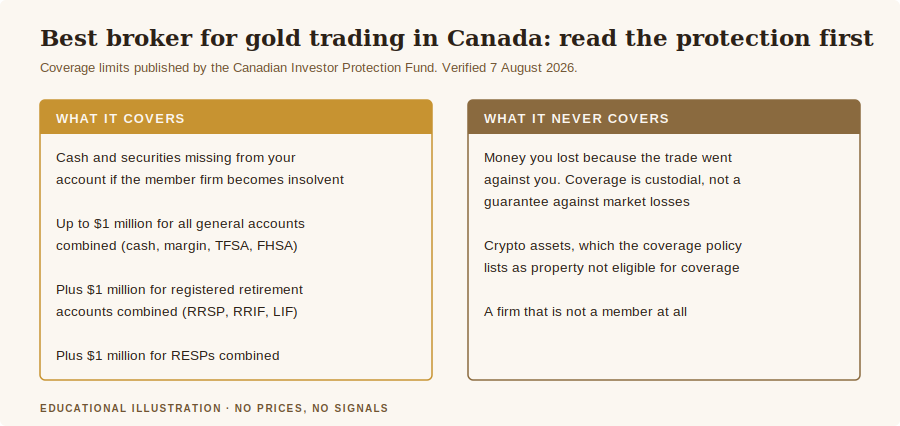
Three separate million dollar buckets, at one member firm, for one individual. For the overwhelming majority of retail gold traders, that ceiling is not the binding constraint. Almost nobody reading this has a million dollars in a margin account. Which means the number to worry about is not the limit. It is whether the firm is a member at all, a point I will come back to.
What It Never Covers, and Why That Matters More
Here is the part that gets misread constantly. CIPF describes its coverage as custodial in nature, and states directly that it does not provide protection against market losses.
Read the mechanism rather than the phrase. What the fund does is compensate you for property that is missing from your account at the date the member firm becomes insolvent. If a hundred shares should be in your account and they are not, you are compensated based on their value on the day of the insolvency. It restores what should have been there.
What it does not do is make you whole for a trade that went against you. If gold moves the wrong way and your account halves, nothing about that is a coverage event. It is simply the business you chose to be in.
The coverage policy also lists property that is not eligible, crypto assets among them.
I labour this because I have seen the confusion cause real damage. A trader hears “protected up to a million dollars”, relaxes, and sizes accordingly. The protection they are relying on has nothing to do with the risk they are actually running. Coverage protects you from the firm. It does not protect you from yourself, and it is your own position sizing that does that job, which is the whole argument in risk management for gold trading.
Membership Is the Check That Actually Matters
Since the dollar ceiling is irrelevant for most retail accounts and market losses are excluded, the entire practical value of Canadian investor protection collapses into one binary question. Is this specific firm a member?
Not the group. Not the brand on the website. The legal entity your account will actually be opened with. Firms routinely operate several entities across different jurisdictions, and a name you recognise in Toronto may be a different company entirely on the account agreement you are about to sign. The protections attached to those entities are not the same, and the one that matters is the one named in your documents.
So the check is: find the entity name in the account agreement, then confirm that exact entity on the regulator’s own register and on the protection fund’s member list. Not on the firm’s website. Regulator badges in a website footer are graphics, and graphics can say anything.
The Offshore Trade-Off, Priced Honestly
The pull toward an offshore firm is almost always leverage. Somewhere offering 500:1 looks generous next to a domestic account offering a fraction of that, and it feels like being handed more room to work.
Here is why that reasoning usually fails. Leverage does not set your risk. Your position size and your stop distance set your risk. If you size from your stop, which is the correct order, then the leverage ceiling is a limit you rarely approach. Trading a risk-sized position with a sensible stop, most retail gold traders use a modest share of their available margin at ordinary leverage levels. The extra headroom offshore buys them nothing at all.
What it costs, though, is concrete: weaker recourse, a protection fund that may not exist, and a legal entity in a jurisdiction where enforcing anything is impractical. You are trading away real protection for theoretical room you were never going to use. If the mechanics of leverage are still fuzzy, what leverage actually is in gold trading covers it properly.
There is a second reason to be careful. The US Commodity Futures Trading Commission’s fraud advisory on foreign currency trading opens with a warning worth reading twice: “The forex market is volatile and carries substantial risks. It is not the place to put any money that you cannot afford to lose, such as retirement funds, as you can lose most or all it very quickly.” The advisory notes the regulator has seen a sharp rise in forex trading scams, and it is published on the CFTC’s fraud advisory page. Different country, identical lesson: the further from a real regulator you go, the more of that risk you carry alone.
Then, and Only Then, Compare the Features
Once a firm has passed the protection test, the ordinary comparison becomes worth doing. In rough order of how much they affect a gold account:
- Total dealing cost on gold, spread plus any commission, measured at the hours you actually trade rather than the headline number.
- Overnight financing, which quietly dominates the cost of anything held for days.
- Execution behaviour around news, meaning how far fills drift when it matters.
- Withdrawal record, which is the one thing you cannot test until you need it, so look for a long unremarkable history rather than promises.
- Platform and instrument, whether gold is offered in a form you understand and at a contract size your account can size sensibly.
Notice that spread is on the list but not at the top. A slightly wider spread at a firm that will still exist in five years is a better deal than a tight one at a firm you cannot verify. The general framework is in what actually matters when choosing a gold broker, and the account-opening mechanics are in how to open a gold trading account.
A Short Checklist Before You Fund Anything
- Find the legal entity name on the account agreement, not the brand on the homepage.
- Confirm that entity on the regulator’s own register.
- Confirm that entity on the investor protection fund’s member list.
- Read what the coverage excludes, and accept that market losses are yours alone.
- Decide how much capital genuinely needs to sit at the firm, and leave the rest at your bank.
- Only then compare spreads, financing and platforms.
The whole exercise takes about twenty minutes once. It is the cheapest twenty minutes in this business.
Get the free Gold Empire survival sheet, a one-page guide to protecting your account through the kind of market this article describes. One email, no spam, unsubscribe anytime.
Frequently Asked Questions
Is my gold trading account protected in Canada?
Only if the firm holding it is a member of the Canadian Investor Protection Fund. Membership is per legal entity, so check the specific entity named in your account agreement rather than the brand. If it is a member, coverage applies to property missing from your account if the firm becomes insolvent, up to the published limits.
How much does CIPF cover?
For an individual, generally $1 million for all general accounts combined, plus $1 million for registered retirement accounts combined, plus $1 million for RESPs combined where the client is the subscriber. Exceptions exist and the coverage policy governs any actual claim, so read it rather than relying on a summary.
Does investor protection cover my trading losses?
No. Coverage is custodial. It addresses property missing from your account when a member firm fails. Money lost because a trade went against you is not covered by any investor protection scheme anywhere, and no broker feature changes that.
Should I use an offshore broker for higher leverage on gold?
For most risk-sized traders the leverage ceiling at a regulated firm is never the binding constraint, so the extra headroom buys nothing while the loss of protection and recourse is real. Work out the margin your normal position actually requires first. If you are nowhere near the ceiling, higher leverage is not a benefit you can use.
How do I check whether a broker is really regulated?
Look the entity up on the regulator’s own public register and match the exact legal name, registration number and address against your account documents. Never rely on logos or claims on the broker’s own site. If the entity you are signing with does not appear, treat that as the answer.
How much money should I keep in my trading account?
Enough to meet the margin your planned positions require, plus a sensible buffer, and not much more. Capital sitting idle at a broker is exposed to the firm for no return. This is a separate decision from position sizing and worth making deliberately.
Choosing the Best Broker for Gold Trading in Canada
The best broker for gold trading in canada is not the one with the tightest spread on a comparison table. It is the one that is still there in five years, that is a verified member of the protection scheme under the exact entity on your paperwork, and whose costs you have measured yourself at the hours you actually trade.
Gold Empire is a free Telegram channel where we work through market context in public, including the days the read does not work out. There is no promise of profit here, because there honestly cannot be one. What there is, is a group of people trying to stay in the game long enough for competence to start paying.
If this was useful, the free Gold Survival Sheet is the natural next step. It is a one page checklist that puts the size, the cost and the ceiling in front of you before you enter, and it is free to download with nothing to join.
About the author. Matthew writes the Gold Empire market notes. He spends most of his time on the unglamorous half of trading, position size, dealing costs and the arithmetic of recovery, on the view that surviving the first two years is what makes the rest of it possible.
Disclaimer: This article is general educational content about how leveraged markets and investor protection schemes work. It is not financial, legal or tax advice, and it is not a recommendation of any firm. Coverage rules change and the published coverage policy governs any actual claim, so verify current terms directly with the fund and your regulator. Trading leveraged products carries a high risk of losing money rapidly. No entry, stop or target discussed should be treated as a signal. Figures attributed to external sources are linked so you can check them.
One step first
Where should we send the Gold Survival Sheet?
Leave your email and we will send the free one page checklist, then take you straight to the Telegram channel.
No cost and no obligation. Educational only, not financial advice, and nothing here promises a return. Unsubscribe any time in one click.
Leave a Reply