
Every few weeks someone in the Gold Empire group asks a version of the same question, and it is a good question: if I want exposure to gold, should I buy a fund or should I buy the metal? Usually it arrives phrased as a search, gold ETF vs physical gold returns, as though one of the two quietly pays more than the other. It does not. Both hold the same metal. What differs is the toll booth you drive through on the way in, the one you drive through on the way out, and the small fee that is taken from you every year you stay parked. That is the whole story, and once you can see it as an arithmetic problem instead of a loyalty question, the answer for your own situation falls out in about two minutes.
I want to be careful about the word returns here, because it is the word that gets people into trouble. Nobody, including me, knows what gold will do next year. This article is not about that. It is about the part you can actually control and actually calculate, which is how much of your metal survives the wrapper you chose to hold it in.
The part nobody actually argues about
A physically backed gold ETF is a fund that owns bullion sitting in a vault and issues shares against it. The World Gold Council, which tracks this market, describes a data set covering “more than 100 physically-backed gold ETFs and similar products worldwide”, so this is not a niche corner of the market, it is a mature one. When you buy a share, you own a claim on a slice of that bullion. When you buy a coin from a dealer, you own the coin.
The metal does not know which one you picked. An ounce in a vault in London and an ounce in a safe in your house track the same reference price. If gold rises twenty percent, both rise twenty percent before costs. Anyone who tells you that one wrapper “performs better” than the other in some structural way is either selling you something or has confused a cost difference with a price difference.
So the honest question is not which one returns more. It is which one leaks less, given how long you plan to hold and how much you are putting in.
Gold ETF vs physical gold returns: the difference is a cost difference
Here is the structure, stripped down. An ETF charges an annual expense ratio, which is taken out of the fund’s metal continuously. It is small, it is invisible, and it never stops. Physical gold charges you a spread, which is the gap between what a dealer sells at and what a dealer buys back at. It is large, it is very visible, and you pay it essentially twice in one round trip. Then, if you do not keep the metal at home, you add storage and insurance on top.
One is a small recurring fee. The other is a large one time fee. That is the entire trade off, and it means the answer depends almost completely on your holding period.
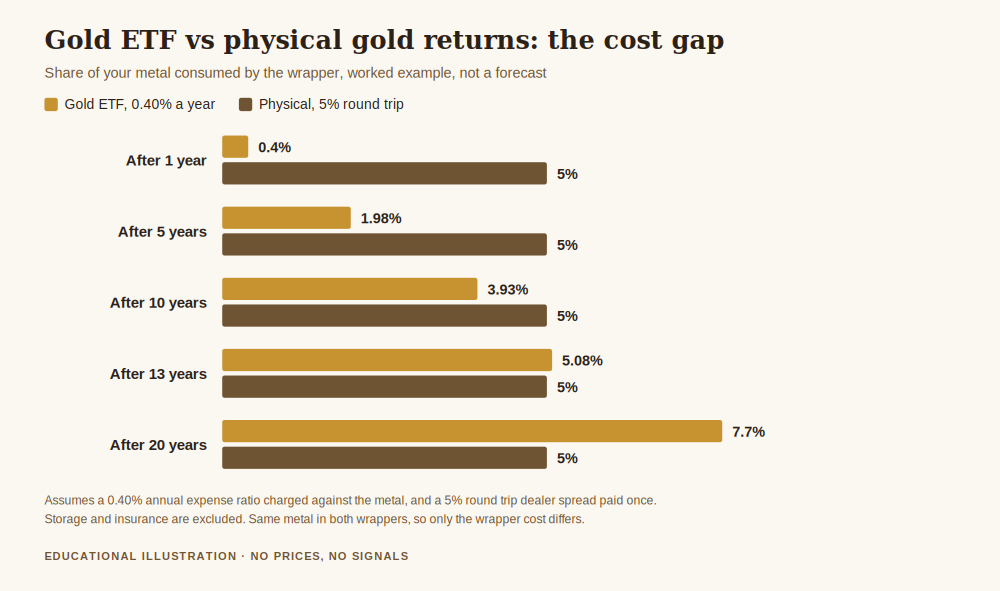
Let me put numbers on it, and let me be explicit that these are worked assumptions rather than quoted prices, because dealer spreads and fund fees vary a great deal and I am not going to pretend otherwise. Assume a fund charging 0.40 percent a year, and assume a physical round trip that costs you 5 percent all in. Run both forward:
- After 1 year, the fund has consumed 0.40 percent of your metal. The physical round trip has consumed 5.00 percent.
- After 5 years, the fund has consumed 1.98 percent. Physical is still at 5.00 percent, because you paid it once.
- After 10 years, the fund has consumed 3.93 percent. Physical is still at 5.00 percent.
- After 13 years, the fund has consumed 5.08 percent, and physical, still sitting at 5.00 percent, has quietly become the cheaper wrapper.
- After 20 years, the fund has consumed 7.70 percent against physical’s 5.00 percent.
That crossover point is the whole answer, and it moves around depending on your inputs. Cut the dealer spread to 3 percent and the fund loses its advantage after roughly 8 years. Find a fund at 0.25 percent and hold against a 5 percent spread, and the fund stays ahead for about 20 years. Add 0.5 percent a year of vaulting and insurance to the physical side, and physical never catches up at all, because now it is also paying a recurring fee, just a different one.
None of this requires you to have a view on the gold price. It is arithmetic, and you can redo it with your own numbers in the time it takes to finish a coffee.
What the fund actually charges you
The expense ratio is deducted from the fund’s holdings rather than billed to you, which is why most people never feel it. The share count stays the same, but the amount of metal behind each share drifts down a fraction every year. Over a year you will not notice. Over two decades, at 0.40 percent, you have handed over roughly seven and a half percent of your metal without a single line item ever appearing on a statement.
On top of that sits the brokerage cost of buying and selling the shares, and the bid ask spread on the exchange, which for large funds is usually small but is not zero. If you are the sort of person who buys a little every month, those small trading costs add up faster than the expense ratio does, and it is worth checking whether your broker charges per trade.
The counterpart benefit is the one people forget to price: you can sell it on a Tuesday afternoon in about four seconds, at a price you can see on a screen, without meeting anyone. Liquidity is a real feature, and in the specific situation where you need money quickly, it is worth considerably more than the fee difference we have been discussing.
What physical actually charges you
The spread you pay on the way in and on the way out
Retail physical gold does not trade at the reference price. It trades at a premium over it when you buy and at a discount under it when you sell, and the width of that gap is the dealer’s business model. Smaller units carry proportionally bigger premiums, because the cost of minting, shipping, and authenticating a one gram bar is not one four hundredth of the cost of doing the same for a large one.
This is where the wholesale market becomes relevant to a retail decision. The LBMA Good Delivery standard, which defines the bars that clear between banks and vaults, is built around bars of approximately 400 troy ounces. That is the unit the professional market is designed around. Everything smaller than that, which is to say everything a retail buyer would realistically own, is a retail product with a retail markup attached. The further you get from the wholesale unit, the more you pay for the privilege.
Storage, insurance, and the problem of the lumpy unit
Keeping metal at home costs nothing in fees and quite a lot in risk, and most household insurance policies have a limit on bullion that is lower than people assume. Vaulted storage solves the risk and reintroduces the annual fee, which puts physical back into the same category as the fund, only usually at a higher rate.
There is a second, subtler cost. Physical gold does not divide well. If you hold four coins and you need the value of half a coin, you sell a whole coin and pay the spread on the whole coin. A fund holding lets you sell exactly the amount you need. For anyone whose gold is part of an emergency reserve rather than a museum piece, that granularity matters more than a few basis points of annual fee.
The four questions that settle it
Rather than argue the general case, answer these four about your own situation and the choice usually makes itself.
How long is this staying put? Under five years, the recurring fee barely registers and the one time spread dominates, which favours the fund. Over fifteen, the recurring fee compounds against you and the one time spread starts to look cheap, which favours the metal.
How much are you putting in? Small and regular contributions suit a fund, because you are not paying a fresh retail premium every month. A single large allocation you intend to forget about suits physical, because you pay the spread once on a large unit with a proportionally smaller markup.
What is it for? If the answer is “so I can sell it quickly if something goes wrong”, a fund does that job better. If the answer is “so I own something that exists outside the financial system”, then a fund does not do that job at all, whatever its fee is, and the fee comparison is beside the point. That is a legitimate reason to accept a higher cost, as long as you know you are accepting it.
Where do you actually live, tax wise? Fund shares and physical metal are frequently taxed differently, and the size of that difference will usually dwarf the fee difference we have spent this article measuring. I am not qualified to advise you on this and neither is anyone in a forum. It is the one part of this decision genuinely worth paying a professional to answer for your jurisdiction.
If you are trading gold rather than holding it, this is a different question
Most people who read Gold Empire are not deciding where to park a decade of savings. They are trading XAUUSD, which is a third thing entirely, and it does not belong in the comparison above. A leveraged position is not ownership. You are not accumulating metal, you have no wrapper cost to compound, and your dominant cost is spread and overnight financing, not an annual expense ratio.
It also comes with a risk profile that regulators have looked at directly. When ESMA introduced its restrictions on contracts for difference in March 2018, it recorded that “74-89% of retail accounts typically lose money on their investments”, and it capped leverage on gold at 20:1 for retail clients specifically because of that. Read that number next to the ones earlier in this article. We spent several hundred words on whether a wrapper costs you 4 percent or 5 percent over a decade. The trading decision is operating on a completely different scale of risk, and it deserves proportionally more of your attention.
Which is the actual point I want to leave you with. The fund versus metal question is worth getting right, and it is worth about half an hour. If you are also trading, your position size is worth considerably more than that, because it is the thing that decides whether you are still here in three years. If you have not read our piece on risk management in gold trading, that is the one to read after this one. It is the article on this site I would keep if I could only keep one.
Get the free Gold Empire survival sheet, a one-page guide to protecting your account through the kind of market this article describes. One email, no spam, unsubscribe anytime.
Frequently asked questions
Does a gold ETF actually hold real gold?
A physically backed one does, in allocated form in a vault, and publishes its bar list. There are also synthetic products that track the gold price using derivatives rather than owning metal, and those are a different instrument with different counterparty risk. If this matters to you, and it should, check the fund’s own documentation for the words physically backed and allocated before you buy.
Which one gives higher returns over ten years?
Neither, structurally. They hold the same metal, so the gross move is the same and the difference is the wrapper cost. On the worked assumptions in this article, a fund at 0.40 percent a year costs about 3.93 percent over ten years against a 5.00 percent physical round trip, so the fund is slightly ahead at that horizon and behind it by year thirteen. Change the assumptions and the crossover moves.
Is physical gold safer than a fund?
It removes the fund and custodian from the chain, which is exactly why some people want it, and it adds theft, storage, and authentication risk, which is exactly why others do not. Safer is not one axis. Decide which of those two risks you would rather be exposed to, because you cannot avoid both.
Can I convert a gold ETF holding into physical metal?
For a retail holder, usually not in any practical sense. Redemption in metal is generally reserved for authorised participants dealing in wholesale bar quantities, which is to say the 400 ounce scale described above. If the ability to take delivery is the reason you are buying, buy the metal.
Does the same comparison apply to trading XAUUSD?
No, and it is worth being clear about it. Trading a leveraged gold contract is not an ownership decision, and the costs that matter there are spread, swap, and above all position size. See our article on gold CFDs compared with physical gold for that side of it.
What Gold Empire actually does
Gold Empire is a free education channel for people trading gold, and the priority order is deliberate: survive first, then grow. We publish the mechanics of the market, the ways accounts get destroyed, and the habits that keep people in the game long enough to get good at it. The free gold survival sheet is the one page summary of that, and it costs nothing.
Everything on the site is free to read. There is an optional kit for people who want the material organised into a working system, and following along without ever buying it is a completely normal way to use this channel. We share our own results openly, and signals are part of what the channel offers, but we do not promise profits, because no honest channel can. If you want the next steps in order, start with risk management in gold trading, then how much to risk per trade, and if you are still choosing where to trade, how to pick a broker for gold trading covers what to look for.
About the author
Matthew writes the Gold Empire material. He spent his first years in this market learning the expensive way that the size of a position matters more than the direction of it, and most of what he publishes now is the article he wishes had existed then. He reads every message in the group and answers the ones about risk first. You can read more about the Gold Empire approach here.
This article is educational content, not financial advice. It does not account for your personal circumstances, your tax position, or your risk tolerance, and nothing in it is a recommendation to buy or sell any instrument. Trading leveraged products carries a high risk of losing money rapidly, and no entry, stop or target discussed should be treated as a signal. Consider speaking to a licensed professional in your jurisdiction before making decisions about your money.
One step first
Where should we send the Gold Survival Sheet?
Leave your email and we will send the free one page checklist, then take you straight to the Telegram channel.
No cost and no obligation. Educational only, not financial advice, and nothing here promises a return. Unsubscribe any time in one click.
Leave a Reply