
There is a question that turns up in the Gold Empire group every single week, usually from someone who has already been trading gold for a month or two and has quietly realised they never actually checked. It arrives as a search, what is spot gold meaning, and it is a much better question than it looks. Most people trading XAUUSD have never been told what the word spot refers to, which market it belongs to, or what is physically happening behind the number on their screen. They know the price moves. They do not know what the price is a price of.
That gap matters more than it sounds, because almost every confusing thing about gold trading comes from it. Why your broker’s quote differs slightly from the one on a news site. Why the futures price is not the same number. Why the phrase owning gold means something very different to a London bank than it does to someone with a coin in a drawer. All of it resolves once you know what spot actually is, so let us do that properly, with the source documents open.
What is spot gold meaning, in one sentence
Spot gold is the price of gold for immediate delivery, as opposed to delivery on some agreed date in the future. That is the whole definition. The United States regulator puts it in almost exactly those words. The CFTC glossary defines a spot price as “the price at which a physical commodity for immediate delivery is selling at a given time and place.”
Read that last part again, because it is the part people skip: at a given time and place. A spot price is not a universal constant floating above the world. It is the price in a particular market, with particular rules about how metal changes hands. For gold, that place has a name, and once you know the name, a great deal of the confusion clears up.
The market the word spot actually points at
The reference market for spot gold is London, and the trade is known as loco London, meaning the metal is located in London. This is not a small technicality. It is the plumbing that the number on your screen ultimately traces back to. The London Bullion Market Association sets out how that market is built, and it rests on a few things worth knowing.
Trades between the clearing members are cleared and settled electronically on a net basis, through a body called London Precious Metals Clearing Limited. Storage is not scattered: six LBMA members plus the Bank of England provide the secure vaulting and act as gatekeepers to the market. Only bullion from refiners who meet the LBMA Good Delivery standards can be traded there at all. And the gold, silver, platinum and palladium prices set in London are treated as global benchmarks, which is why they end up feeding, directly or indirectly, into what your platform shows you.
So when you buy XAUUSD, you are not transacting in some abstract global gold. You are trading an instrument whose price is anchored to a specific, rule bound wholesale market in one city, run by a defined set of institutions.
Nine thousand tonnes, and why the average bar weighs 12.5 kilos
Here is where it becomes concrete. The LBMA publishes what is actually sitting in those London vaults. As at the end of July 2026, the published vault data shows 9,534 tonnes of gold held in London, a 0.74 percent increase on the previous month, held in approximately 762,723 bars. There were also 28,213 tonnes of silver.
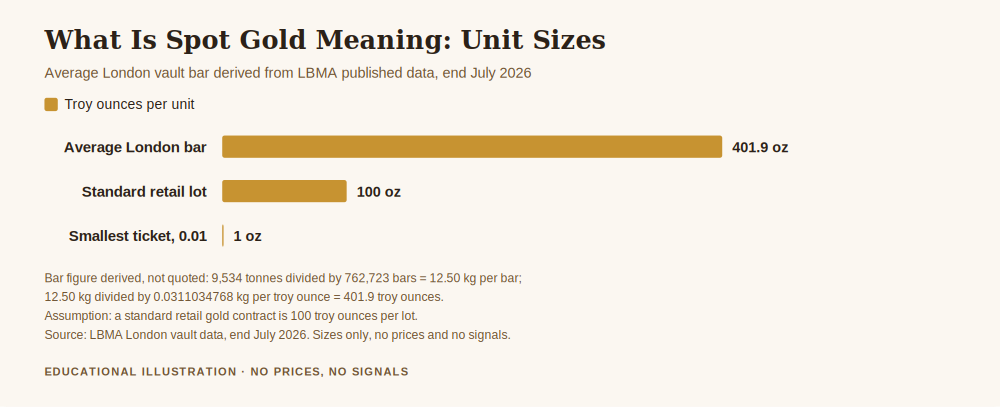
Those two numbers, the tonnage and the bar count, let you work something out for yourself, and I would rather show you the arithmetic than ask you to trust me. A tonne is 1,000 kilograms, so 9,534 tonnes is 9,534,000 kilograms. Divide that by 762,723 bars and the average bar in a London vault weighs 12.50 kilograms. A troy ounce is 0.0311034768 kilograms by definition, so 12.50 divided by that is 401.9 troy ounces.
The market settles, on average, in units of roughly 400 troy ounces. Nobody had to tell us that. It falls straight out of two published aggregates and a calculator. And it is the single most useful fact in this article, because now compare it with what you trade. On a standard retail gold contract, one lot is 100 troy ounces, so the smallest ticket most platforms accept, 0.01 lots, is one troy ounce. The unit the wholesale market physically moves is about four hundred times the size of the smallest unit you can click.
That is not a criticism of retail trading. It is the reason retail gold trading exists in the form it does. You are not being handed a share of a bar. You are being given a contract whose price tracks a market that deals in bars you could not practically take delivery of anyway.
Allocated and unallocated, the distinction that actually matters
Now the part that most articles about spot gold leave out entirely, and the part I would want a new trader to understand before anything else.
In the London market there are two ways to hold metal. An allocated account means specific, identified bars belong to you. An unallocated account means you have a general entitlement to an amount of metal, without owning any particular bar. The LBMA is direct about which one dominates: most bullion trading and settlement in London uses unallocated accounts, where customers do not own specific bars but have a general entitlement to an amount of metal.
Sit with that for a second. The reference market for the gold price, the one your XAUUSD quote descends from, runs mostly on claims rather than on bars moving around. Gold at the wholesale level is, for the most part, a book entry backed by metal, transferred between accounts, with physical movement being the exception rather than the rule.
This is not a scandal and it is not a conspiracy. It is how a market clears enormous volume without forklifts. But it does mean that the word owning is doing a lot of quiet work in gold conversations, and it means very different things at different points in the chain. If you want the retail version of that same question, we went through it in gold CFDs compared with physical gold, which is the closest thing to this article on the site.
Spot is not futures, and it is not exactly your platform’s price either
Why the futures number is different
A futures contract is an agreement to deliver at a specified time in the future, so its price carries the cost of waiting: financing, storage, the time value of holding metal until the delivery month. Spot carries none of that, because spot means now. Two different prices for the same metal, both correct, describing two different questions. If you have ever pulled up a gold chart on one site and a different number on another, this is very often why. We took that comparison apart in the difference between gold and gold futures.
Why your broker’s quote is not the London price
Your platform does not show you the London benchmark. It shows you your broker’s own bid and ask, derived from its liquidity providers, with a spread applied. It will track the underlying market closely, and it will not match it to the last decimal, and it should not surprise you when it does not. The practical consequence is that the spread and the swap are real costs you pay for the convenience of trading a wholesale market in one ounce clips, and they deserve the same attention you give the chart. Ours on that is what the spread in gold trading really costs you.
What this actually changes for you
You could argue none of this changes a single decision, and I would push back on that. Three things follow from it directly.
First, you stop treating the gold price as a fact of nature and start treating it as a quote from a specific market with specific mechanics. That alone kills a category of bad reasoning, the kind that leads people to believe a price is wrong rather than that they misunderstood which price they were looking at.
Second, you get honest about what you are holding. A leveraged contract on spot gold is not a hedge against the world falling apart in the way a bar in a safe might be. It is a trading instrument. Those are both legitimate things to want, and they are not the same thing, and confusing them is how people end up holding a leveraged position through a weekend for reasons they cannot articulate.
Third, and this is the one that actually keeps accounts alive, understanding that you trade in one ounce increments of a four hundred ounce market should make you more careful about size, not less. The instrument is frictionless. The losses are not. If you have not read it yet, risk management in gold trading is the article on this site I would keep if I could only keep one, and how much to risk per trade is the arithmetic that sits underneath it.
Get the free Gold Empire survival sheet, a one-page guide to protecting your account while you are still learning how this market is put together. One email, no spam, unsubscribe anytime.
Frequently asked questions
What is spot gold meaning in the simplest possible terms?
It is the price of gold for delivery now, rather than on a future date. The regulator’s own wording is the price at which a physical commodity for immediate delivery is selling at a given time and place. Everything else in this article is detail hanging off that sentence.
Is spot gold the same as XAUUSD?
Closely related, not identical. XAUUSD on a retail platform is your broker’s quoted price for a contract that tracks spot gold, with the broker’s own spread applied. It follows the underlying market, and it is the broker’s price rather than the London benchmark itself.
Do I own any actual gold when I trade spot gold?
On a leveraged retail contract, no. You hold a contract whose value moves with the gold price. It is worth knowing that even at the wholesale level most London trading uses unallocated accounts, where the holder has a general entitlement to metal rather than title to specific bars, so the question of who owns which bar is more layered than most people assume.
Why is the futures price different from the spot price?
Because a futures contract delivers later, so its price includes the cost of waiting, mainly financing and storage. Spot excludes that by definition. Two prices, same metal, different questions.
Does knowing this help me trade better?
Indirectly, and honestly that is the most I would claim. It will not tell you which way gold goes next, and anyone who says otherwise is selling something. What it does is stop you making decisions based on a wrong mental picture of the instrument, which is a quieter benefit and a real one.
What Gold Empire actually does
Gold Empire is a free education channel for people trading gold, and the order is deliberate: survive first, then grow. We publish the mechanics of this market, the ways accounts get destroyed, and the habits that keep people around long enough to get good. The free gold survival sheet is the one page version of that, and it costs nothing.
Everything here is free to read. There is an optional kit for people who want the material organised into a working system, and following along without ever buying it is a completely normal way to use this channel. We share our own results openly, and signals are part of what the channel offers, but we do not promise profits, because no honest channel can. If you want the next steps in order, start with risk management in gold trading, then how much to risk per trade, and if you are still choosing where to trade, how to pick a broker for gold trading covers what to look for.
About the author
Matthew writes the Gold Empire material. He spent his first years in this market learning the expensive way that the size of a position matters more than the direction of it, and most of what he publishes now is the article he wishes had existed then. He reads every message in the group and answers the ones about risk first. You can read more about the Gold Empire approach here.
This article is educational content, not financial advice. It does not account for your personal circumstances, your tax position, or your risk tolerance, and nothing in it is a recommendation to buy or sell any instrument. Trading leveraged products carries a high risk of losing money rapidly, and no entry, stop or target discussed should be treated as a signal. Consider speaking to a licensed professional in your jurisdiction before making decisions about your money.
One step first
Where should we send the Gold Survival Sheet?
Leave your email and we will send the free one page checklist, then take you straight to the Telegram channel.
No cost and no obligation. Educational only, not financial advice, and nothing here promises a return. Unsubscribe any time in one click.
Leave a Reply